
Trees that Love Wet "Feet"
“Who Will Stop the Rain?” — I think a lot of us have been wondering this lately. After seeing problem after problem at almost every property I have visited recently, I decided to write about trees that like wet feet.
“Who Will Stop the Rain?” — I think a lot of us have been wondering this lately. After seeing problem after problem at almost every property I have visited recently, I decided to write about trees that like wet “feet.”
I myself have a very wet back yard. After visiting Louisiana several years ago I came to know one of my favorite trees for wet locations. We took several boat rides into the swamps and bayous where we were introduced to the Bald cypress (Taxodium distichun). My wife’s uncle Roland had some favorite spots where the knees growing from the root systems were unbelievable, some reaching up to 2’ high.

Bald cypress “knees” growing out of the ground from the root system
© Russell Tree Experts
It is thought that the knees produced by the Bald cypress are actually a function of the root system to acquire oxygen. The tree is often mistaken for an evergreen. It is actually a deciduous evergreen. Each fall when they acquire their amazing fall color, I am often asked if they are dead. They become a beautiful orange to rust color each fall.
Here is another photo that I took on the San Antonio river walk which shows just how adaptable this tree can be. It is growing in a 5’ tree lawn where it grew to be over 4’ in diameter and well over 70’ tall. It does have an unlimited water supply in this situation.

© Russell Tree Experts
My favorite ornamental for wet locations happens to be a Red Buckeye (Aesculus pavia). I have one in my backyard that puts on a tremendous show each spring with its red blooms. The buckeyes that it produces seem to be a lighter shade than traditional buckeyes and actually show a little bit of wood grain in the nut.
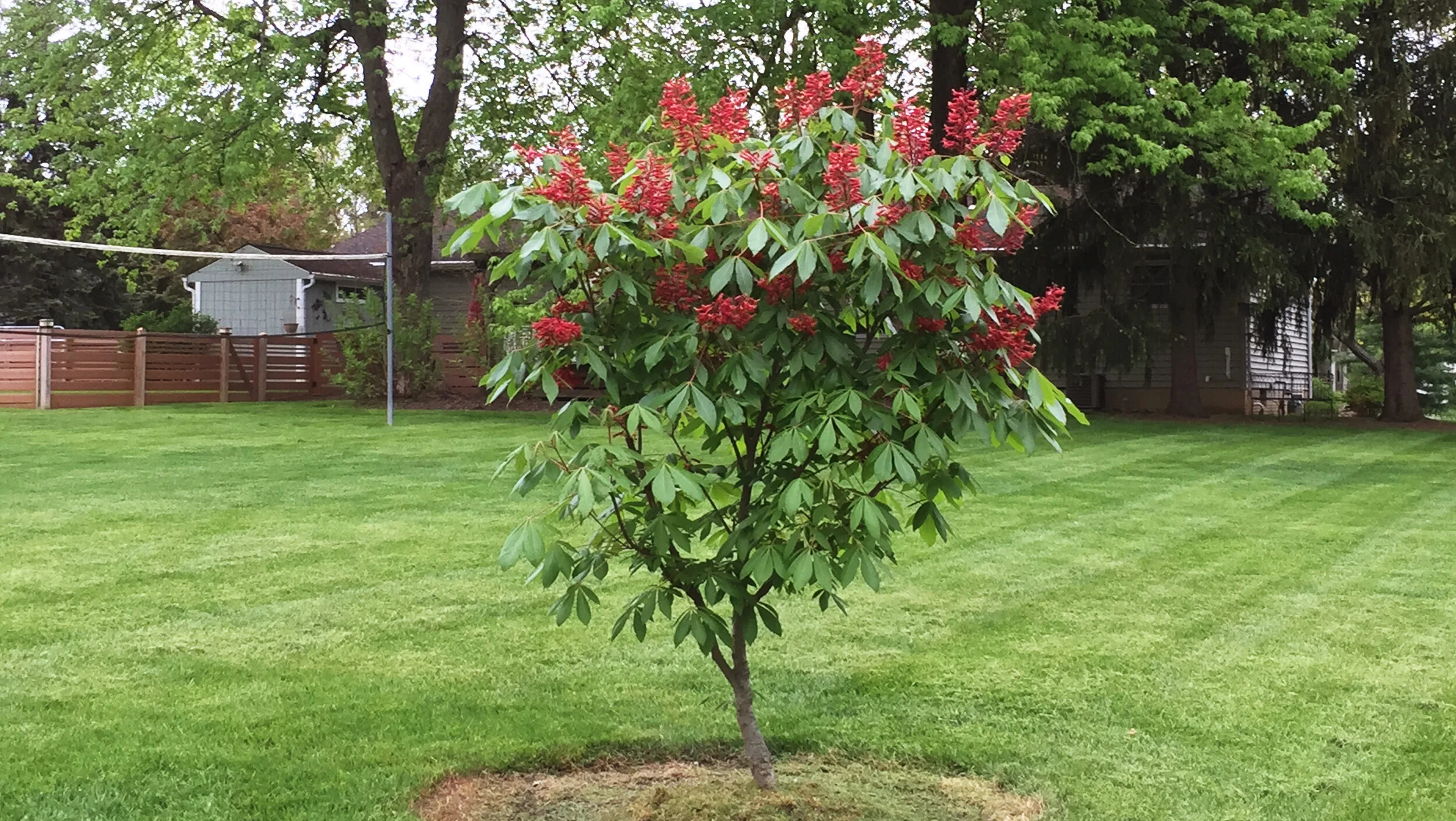
Red Buckeye (Aesculus pavia)
© Russell Tree Experts
A couple of other small ornamentals that can handle wet areas would be the Sweetbay Magnolia (Magnolia virginiana) and the Pawpaw (Asimina triloba). The Sweetbay which blooms later in the spring than other varieties, is not quite as showy, but makes up for it with their scent. The Pawpaw is known for the fruit that it produces. See a previous article written by Jose Fernandez to learn more about the Pawpaw.
A couple of trees that you can find growing naturally along our river banks and streams would be the River birch (Betula nigra) and the American Sycamore (Platanus occidentalis). Both are loved for the year round appeal of their bark. The Sycamore can become quite large and should be properly sited. We often find River birch planted in the wrong location as well. Their root systems can become quite aggressive in search of water.
If you have a pond or small stream and plenty of room there is always the Weeping willow (Salix babylonica). People have always loved its graceful habit, but like other trees on this list it must be properly sited. Another favorite seems to be the Red Maple (Acer rubrum) but as we learned from TJ Nagel in a previous article, you need to be careful where you plant Red Maple due to incompatible soils in much of central Ohio. They do have amazing fall color though and tolerate wet conditions if properly sited.
A couple of native trees that also produce amazing fall color are the Black gum (Nyssa sylvatica) and the Sweet gum (Liquidambar styraciflua).
And last there are a couple of trees in the oak family as well that tolerate wet conditions. There is the Willow Oak (Quercus phellos) and the Swamp White Oak (Quercus bicolor) which are both beautiful and long lived trees if planted in the right location.
Although many of these trees can be considered nuisance trees if not properly sited, they all can be beautiful if planted where they are meant to be.
If you have lost trees recently due to fungal issues or site conditions in the last few years, please take the time to speak with an arborist about the right tree for the right location.
Sincerely,

Mike McKee | Regional Manager, Russell Tree Experts
Mike graduated from Hocking College in 1983 with a degree in Natural Resources specializing in urban tree care. He has been a certified arborist since 1991. Mike started his career in the private industry in 1985 before becoming a municipal arborist in1989. He retired after serving thirty years before joining us at Russell Tree Experts in Sept. of 2018. His love of trees has never waned since trying to climb up the ridges of the massive Cottonwood tree in front of his childhood home.
"Stop and Notice Me" said the Pawpaw Tree
Last weekend I was in southern Ohio, working on a personal building project that needs to reach a certain stage of completion while the dry summer weather persists. Usually a time of relaxation, my weekend visits to this site have become slightly stressful due to time constraints. As I moved about the building frame, I kept dodging low branches from several Pawpaw trees growing about the place.
Last weekend I was in southern Ohio, working on a personal building project that needs to reach a certain stage of completion while the dry summer weather persists. Usually a time of relaxation, my weekend visits to this site have become slightly stressful due to time constraints. As I moved about the building frame, I kept dodging low branches from several Pawpaw trees growing about the place.
The plan is to remove the trees eventually, but my father and I are partial to the fruit, so we are waiting until after the harvest before we cut them down. We are also a bit attached to these trees since they are the last remnant of a group of volunteer seedlings we left in place 10 years ago, and we have enjoyed lots of fruit and shade from them in the last two years.
My head down, I moved about the building: Fetch the hammer; back around for the level; measure from here...
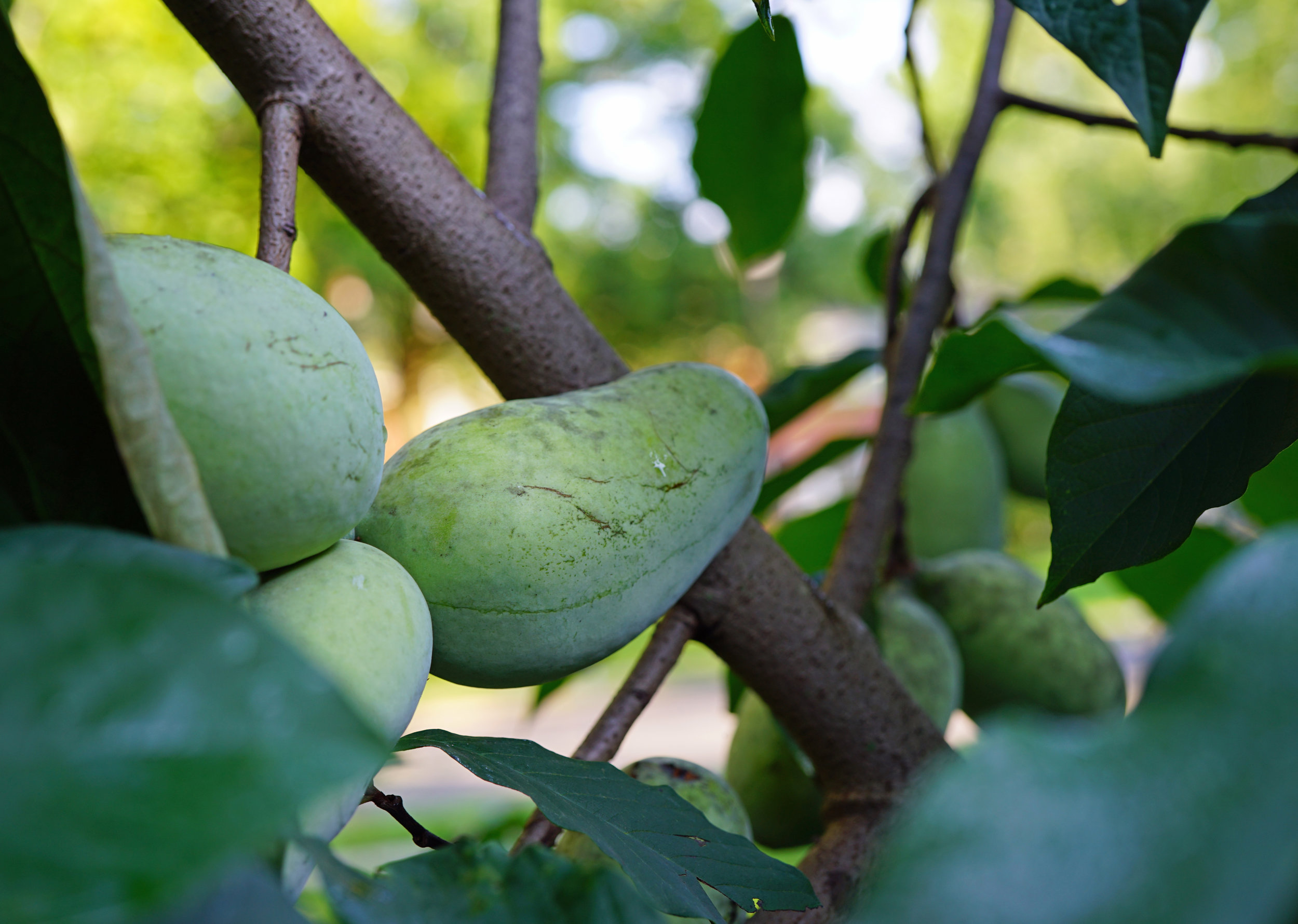
BUMP. Just ran into a green pawpaw, but kept my head down, busy with the task at hand.
30 seconds later…
BUMP. Ran into the same fruit again. Continued doing what I was doing, when about a minute later…
BUMP. The exact same fruit, exact same spot on my head. I’m feeling so pressed for time that I am distracted and not really connecting with the moment.
After arriving back home the next day, that pawpaw kept bumping into my thoughts, so I took some time to pay attention to it.
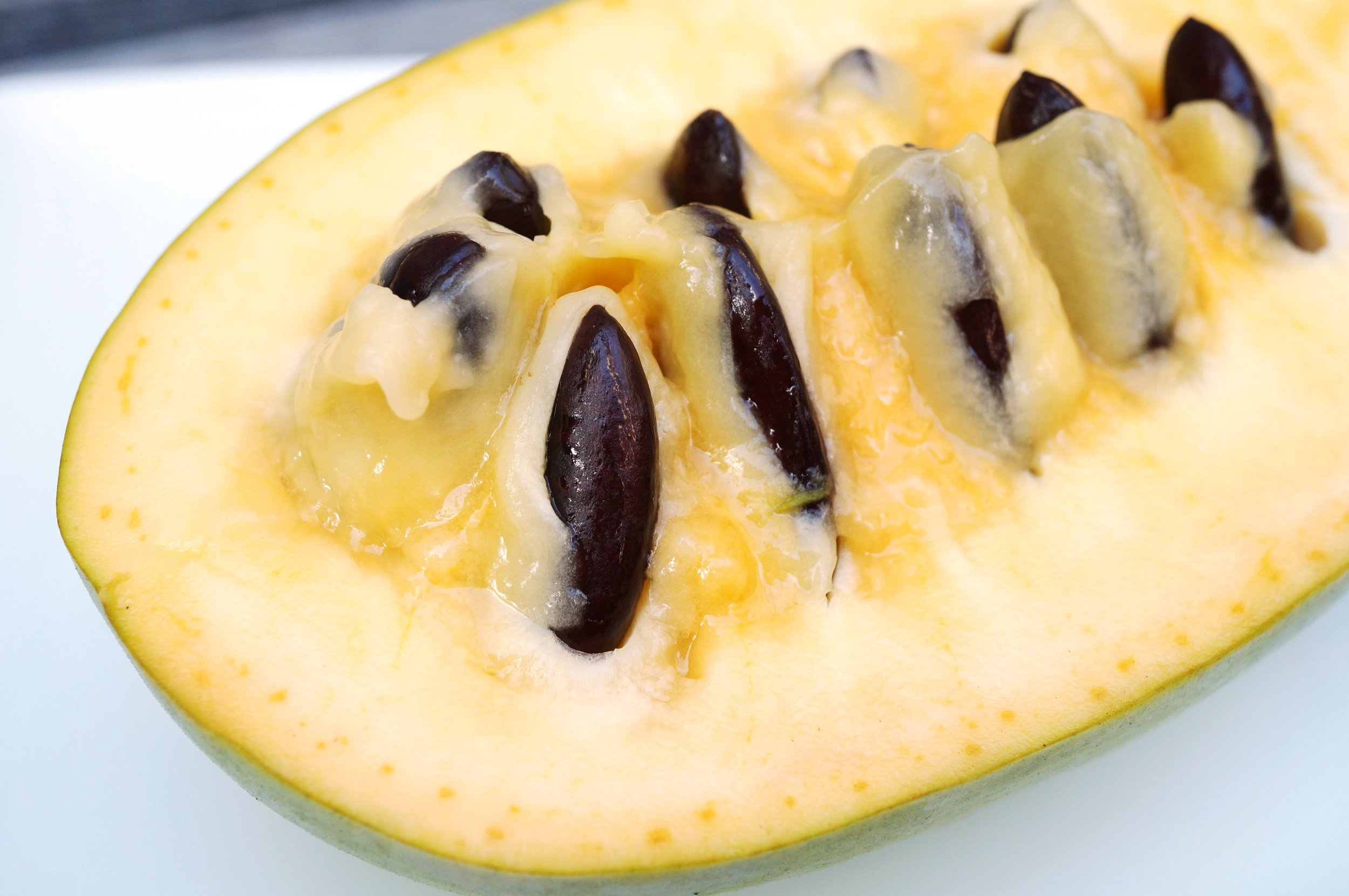
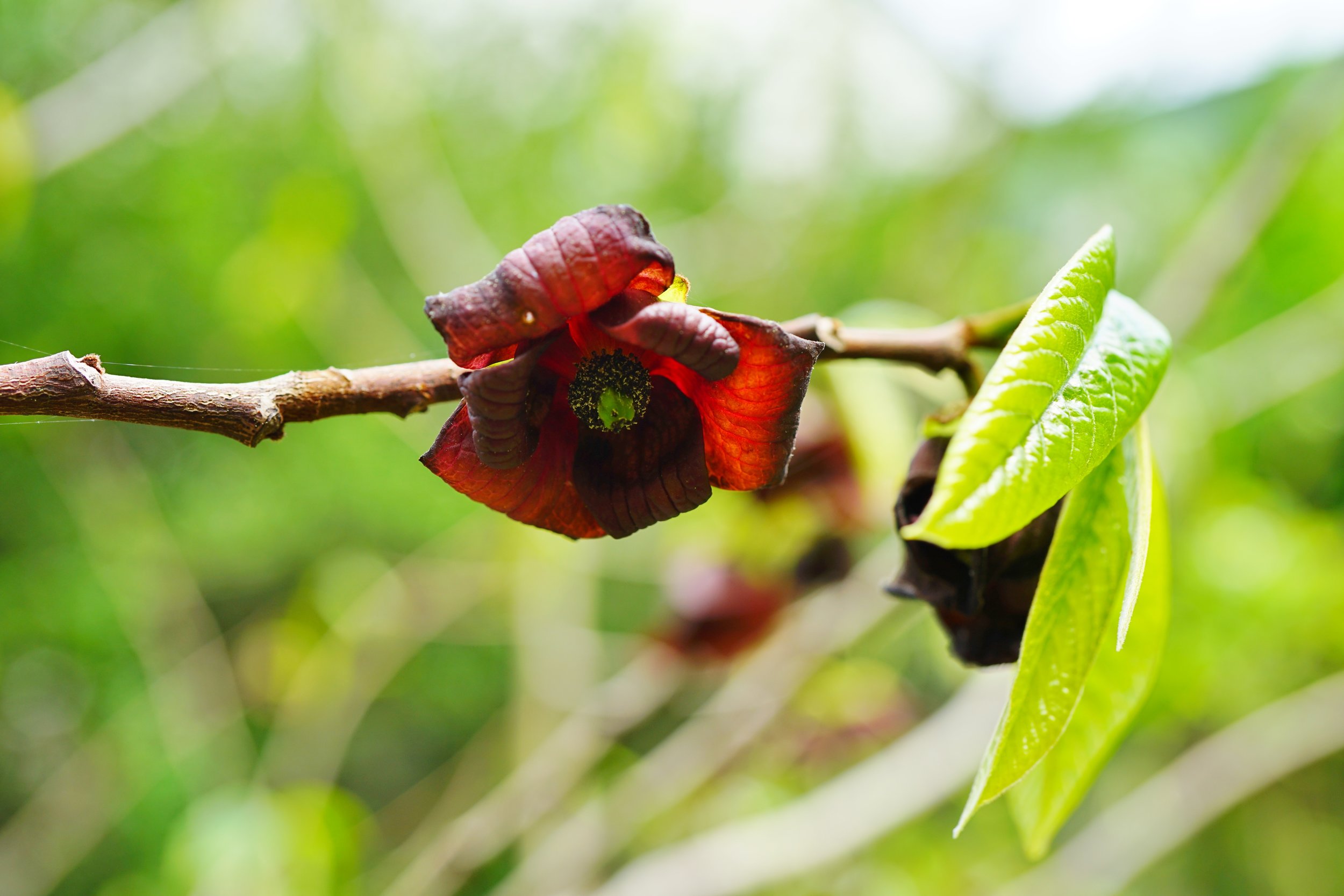
Asimina triloba, Common Pawpaw or Custard Apple (see Michael Dirr, Manual of Woody Landscape Plants). I have been told this tree produces the largest native fruit in North America. My father and I like the tree because it has a tropical look to it – large leaves somewhat irregularly attached in clusters. The flowers appear early in spring, before other trees and plants have started leafing out. They are easy to miss because they are not very large, maybe an inch in diameter, and they are a purplish brown color.
Usually found as an understory tree, it also does well in full sunlight. I have seen it growing in well-drained uplands, but have also seen entire stands of large trees (30-40 feet is large for this species) growing in bottomlands along streams and rivers.
The fruit is a large, curious thing that also makes one think of tropical fruits when trying to describe it. There is some variation in taste and color depending on what part of Ohio the trees are growing in, based on my experience.
There is much more I can say about this tree, such as mentioning the unique caterpillars that feed on the foliage, festivals that are held to celebrate the fruit, and the time TJ Nagel (of Russell Tree Experts) brought me in a prize fruit which mysteriously went missing before I got my hands on it. But since trees serve to ground me in the moment, as well as raising me above the moment, I can’t help but feel that this fruit was bumping me in the head, repeatedly, to let me know it was time to stop for a minute.
Things have been unusually hectic this season, and the last several months have blown by in a blur of work, travel, projects – each pulling in a different direction. One can only be pulled so far before something starts to give. With me, that something is peace, sister to joy. And last weekend, one tree bent down to tap me on the head. Three times. To tell me to hit the pause button.
Work is still as busy as ever. I have unfinished landscaping and building projects at home. My new trees need to be watered every few days to get them through this drought. The new semester starts today. I would like to spend some more time with my wife and family. I would like to get some use out of my mountain bike. I have a stack of books I keep falling asleep under.
When will it stop? Well, it won’t, really. But I am thankful for a pawpaw giving me a gentle knock on the head. “Notice me”, it said. “Stop and notice me”.
So here I am.
Get out this September and sample a pawpaw or two. You might not like it, but it’s worth trying. While you are there under the tree, take a look and a listen; think about something you love, or someone you miss. Don’t wait for a bump on the head to bring you back to what matters.
Wishing you all the best,

José Fernández | Regional Manager, Russell Tree Experts
José became an ISA Certified Arborist® in 2004, and a Board-Certified Master Arborist® in 2015. Currently he is enrolled at The Ohio State University pursuing a Master’s Degree in Plant Health Management. José likes working around trees because he is still filled with wonder every time he walks in the woods. José has worked at Russell Tree Experts since 2012.
Join Me!

On Friday, September 13th, at 9AM join us for a 90-minute tree tour through Indian Run Falls with José Fernández of Russell Tree Experts. José (ISA Board Certified Master Arborist®) will take you into the woods and introduce you to the many trees of Central Ohio. You'll learn a TON about each tree (root systems, bark, growth speeds, fruits, and more!) and in the end, you'll have an even greater appreciation for nature and the trees around you!