
The Double Tree of Casorzo
Between Casorzo and Grana in Piemonte, a region in northwest Italy, there is a cherry tree growing healthily on top of a mulberry tree with branches spreading over 5 meters long. This tree, or should I say, these trees, are known as the Double Tree of Casorzo (Bialbero de Casorzo in Italian) or the Grana Double Tree.

By Enrique Arayata
ISA Certified Arborist® OH-7252A
May 11, 2022
Today I want to talk about a rare and interesting sight: the Double Tree of Casorzo. Before anyone asks, no I am not referring to a DoubleTree hotel in Casorzo. Between Casorzo and Grana in Piemonte, a region in northwest Italy, there is a cherry tree growing healthily on top of a mulberry tree with branches spreading over 5 meters long. This tree, or should I say, these trees, are known as the Double Tree of Casorzo (Bialbero de Casorzo in Italian) or the Grana Double Tree.
As you may already know, it is not common by any means to see a tree on top of another tree, but somehow, someway, this cherry tree managed to find its home on top of this mulberry tree. It is unclear how exactly this double tree grew to be, but one popular theory is that a bird dropped off a cherry tree seed on top of the mulberry tree. The cherry tree seed then spread its roots down through the hollow trunk of the mulberry tree and found a connection to the soil where it can absorb nutrients. The relationship between the two trees does not appear to be parasitic or harmful to one another. It is fascinating to see that the mulberry and cherry trees are able to share water, sunlight, soil nutrients, and most importantly space without outcompeting one another and growing just fine.
Plants growing non-parasitically on top of other plants are not uncommon and are known as epiphytes. Common examples of epiphytes include some species of ferns, orchids, and bromeliads, which can attach themselves to trees or other plants and absorb some nutrients from rain and air along with any other nearby debris or soil they can access; all while not harming its host. What makes the Double Tree of Casorzo unique is that most epiphytes either are small in size or have a short lifespan due to lack of space and humus. However, as you can see in the photo within this article, this cherry tree is quite tall and healthy!

I talked to ISA Certified Arborist Andy Bartram (Crew Production Manager, Russell Tree Experts) about these trees to get his thoughts and opinions. Without seeing the tree in person, he believes the bird seed theory is plausible and he’s interested to know what the cherry tree’s root system looks like. As mentioned earlier, the cherry tree’s roots could be spreading down through the hollow trunk of the mulberry tree to get its nutrients, but there is also a chance that some grafting between the cherry tree and the mulberry tree’s root system could be occurring. The cherry tree could also be receiving nutrients from any available rain and mulberry leaves. I asked Andy about the tree’s health and longevity. In terms of treatment, if the trees have been growing healthily without any human interference, then they should be left untouched. If needed, watering during dry periods or seasonal fertilization could also aid in their health and growth. On a final note, Andy was curious about the structural rigidity of the Double Tree of Casorzo. With the cherry tree’s root system being higher off the ground (or potentially grafted to the mulberry tree), it may pose a hazard during windy days for visitor safety. If so, the fence surrounding the trees is definitely necessary and may even need to be extended as the trees continue to grow.
So if you ever take a trip to Piemonte, Italy, visit this tree and feel free to share any photos or videos you take! This Double Tree of Casorzo is definitely something you do not see every day!


Enrique Arayata I Media Production Manager, Russell Tree Experts
Enrique is an ISA Certified Arborist® and FAA Certified Remote Pilot. In his free time, he enjoys working out, hanging out with his family and girlfriend, video production, photography, cars, technology, and cooking. Enrique has a BA in moving image production with a double minor in film studies and studio art specializing in photography from The Ohio State University, and an AA in web graphic design from DeVry University. His favorite tree is the Kwanzan cherry tree.
Lecanium Scale (Part One)
If “Lecanium” is a new word for you, consider yourself lucky, or at worst, blissfully ignorant. If you have experienced species of this genus in your landscape you may know how devastating, unsightly, and generally… uncomfortable this insect can be. If you have ever stood under a tree covered in a scale population which is actively feeding and digesting you will know why the word “uncomfortable” came to mind. In this installment I will briefly describe Lecanium scale and its life cycle. In the next installment, I will share an unusual finding from last season, and stand out on a limb to make a forecast for this season.

A Brief Description of a Common Pest:
If “Lecanium” is a new word for you, consider yourself lucky, or at worst, blissfully ignorant. If you have experienced species of this genus in your landscape you may know how devastating, unsightly, and generally… uncomfortable this insect can be. If you have ever stood under a tree covered in a scale population which is actively feeding and digesting you will know why the word “uncomfortable” came to mind. In this installment I will briefly describe Lecanium scale and its life cycle. In the next installment, I will share an unusual finding from last season, and stand out on a limb to make a forecast for this season.
Lecanium is a genus in the family Coccidae. Within this genus there are many different species of scale insects, but fortunately they are very similar in their appearance, feeding habits, and life cycle. This helps arborists identify the insect when populations reach a threatening level on a plant. Because the life cycle is similar from one species to another (with very few exceptions), treatment intervention is relatively straightforward. For the purpose of this article, and for discussion among arborists, we lump these scale species into a generic type we call lecanium scale.

Lecanium scale starts life as an egg. In central Ohio egg hatch usually takes place in June, when Washington hawthorn is blooming. (This event is a phenological indicator for lecanium scale hatch. For more on that topic, read my article here). The first nymphal form (called an instar) is the most mobile state within the lifecycle of the insect. Because of this we call this form a crawler. Crawlers will move out onto the leaf of a plant or tree and affix themselves adjacent to the veins of the leaf where they will feed through the summer. Sometime in late summer these crawlers turn into the second-instar form, and they move back onto the twigs to overwinter. Here one must pause for a moment of silence and ponder the question: How do these nymphs know that their host’s leaves are going to fall off for the winter? Do they really “know” at all? Why do they do what they do?
Moving on, we find these second-instar nymphs waking up with the rest of the plant and insect world the following spring. They begin to feed on the twigs now, and are no longer mobile. A waxy covering begins to form over their bodies as they grow. Most of the lecanium scales will have a domed appearance, some flatter than others, some with different colors, but easily recognizable as lecanium scales once you know what to look for. When the adult female matures, she lays her clutch of eggs underneath her “shell” and dies soon after. The eggs hatch soon and the cycle continues.
Now some comments to finish up the picture:
Many plant hosts are targeted by this insect, including oak, hickory, honeylocust, crabapple, cherry, pear.
There is only one generation per year, which greatly simplifies the treatment process.
The crawler stage is the most vulnerable to treatment and is the one we try to target for control.
The most damaging stage is the second-instar nymph which feeds voraciously on plant sap in order to grow into an adult and lay eggs.
During this stage, digested sap is excreted as honeydew, a sweet substance that coats leaves, sidewalks, cars, and yes, people if you stand under the tree for too long. This honeydew is fed upon by sooty mold, turning the surfaces black.
Large populations can weaken a plant, causing dieback, stress, and even plant death due to the amount of sap extracted during feeding. Sooty mold interferes with photosynthesis, further stressing plants.
How new scale populations arrive onto formerly uninfested trees seems to be a bit of a mystery.
Lecanium scales are grouped with sucking insects (as opposed to chewing insects). They insert a proboscis into plant tissue to feed on sugars and other nutrients in the sap.
So much for the entomology lesson. Congratulations to you stalwart readers who have made it this far! You now have a good base of knowledge that will help you understand how I came to certain conclusions about the 2020 population of this pest, and what this might mean for 2021. I hope you can meet me here once more next week for the final installment!
>> (2/15/21 Update: Read Part 2!) <<
Your friendly neighborhood arborist,

José Fernández | Regional Manager, Russell Tree Experts
José became an ISA Certified Arborist® in 2004, and a Board-Certified Master Arborist® in 2015. Currently he is enrolled at The Ohio State University pursuing a Master’s Degree in Plant Health Management. José likes working around trees because he is still filled with wonder every time he walks in the woods. José has worked at Russell Tree Experts since 2012.
[Some technical notes retrieved, and some fact-checking facilitated by W. T. Johnson and H. H. Lyon, Insects That Feed On Trees and Shrubs, Second Edition, Cornell University, 1991.]
Where’s the Fruit?
As an arborist, I often feel like I need to double as a detective. Trees, obviously, cannot tell us verbally how they are "feeling" or why they are behaving in a certain way. We have to look for clues as to what is possibly going on with them. When I am asked why a tree is performing poorly, oftentimes I need to swap out my helmet for a Sherlock Holmes cap and start digging around, asking questions of the tree's caretaker and standing back to observe the environment in which the tree exists.

As an arborist, I often feel like I need to double as a detective. Trees, obviously, cannot tell us verbally how they are "feeling" or why they are behaving in a certain way. We have to look for clues as to what is possibly going on with them. When I am asked why a tree is performing poorly, oftentimes I need to swap out my helmet for a Sherlock Holmes cap and start digging around, asking questions of the tree's caretaker and standing back to observe the environment in which the tree exists.
One of the questions I am asked often, especially this past year, is "why didn't (or doesn't) my fruit tree produce fruit?" The answer to this can be complicated and can have many explanations. The fruit trees we typically grow here in Ohio are apples, pears, peaches, nectarines, cherries, and plums. These trees are all in the same rather challenging plant family, the rose family or Rosaceae. This family of trees (and shrubs) is susceptible to many pests, diseases, and seasonal issues. The biggest culprit last year was a late spring freeze near Mother's day [See Fig. 1]. This polar vortex sent Ohio orchard owners scrambling to save their precious buds, flowers, and very young fruit. There was also a freeze in mid-April that killed a lot of the very early blooming flowers of peaches especially.
![[Fig. 1] Temperatures dipped below and to freezing on May 9th and 12th in 2020.](https://images.squarespace-cdn.com/content/v1/59dfb3df46c3c41919eac60a/1612277614052-4CG70N1EYV41EC77KFXP/temp-graph.gif)
[Fig. 1] Temperatures dipped below and to freezing on May 9th and 12th in 2020.
Cold is a component that is very important to fruit production. Fruit trees need a certain amount of "chill hours" below a given temperature to recognize that winter has occurred and that it is time to wake up and flower. Typically, here in Ohio, we get plenty of chill hours. Our issue is either extreme and prolonged cold or a very cold dip in temperature after a warm, late winter spell. Very cold winters can kill dormant flower buds and even entire trees. This may be the case if your tree does not flower as expected in the spring. In the case of warm periods before a freeze, the tree may flower beautifully, but the flowers are damaged and cannot create that yummy crop you had been dreaming of.
Apples and pears are the most cold-hardy of the rose family fruit trees and produce fruit most reliably in our climate.
Windy, rainy, and chilly weather in spring also presents an obstacle for some of our tiniest workers, the pollinators. Native bees, honey bees, and bumblebees need to be present if any fruit is to develop on your tree at all. However, these gals are reluctant to venture out in search of pollen if the weather is wet and gusty and the temperature is below 55 degrees Fahrenheit. Thank goodness each flower is viable for 3-4 days and flowers do not open all at once. If the sun comes out for even one nice afternoon, you should have some pollination even in the worst weathered spring. Attracting bees to your yard with bee-friendly perennials and reducing the use of insecticides while bees are active should also help your future yields.
Along with pollinators, many fruit trees need a pollinizer as well. Peaches, tart cherries, nectarines, and some plums are self-fertile and will produce a crop without the help of another tree. However, apples, pears, and sweet cherries need a second tree of the same species, but a different variety, to cross-pollinate with. The trees should have overlapping bloom times and be within 300 feet of each other to be the most successful. It is interesting to note that crabapples are the exact same species as apples and will pollinate apple trees as long as they flower at the same time (and the crabapple is not a sterile variety). It is also interesting to note that cross-pollination between different varieties does not change the nature of the fruit. A Red Delicious apple tree will always produce Red Delicious apples even when pollinated by a Snowdrift crabapple [See Fig. 2], but if the seeds from the cross-pollination are planted, an entirely different and surprising fruit may be produced.
![[Fig. 2] A Red Delicious tree pollinated by a Snowdrift Crabapple will still produce a Red Delicious apple.](https://images.squarespace-cdn.com/content/v1/59dfb3df46c3c41919eac60a/1612213753269-LHLE5MF4TGKN6AIG9Q79/pollination-red-delicious-v2.gif)
[Fig. 2] A Red Delicious tree pollinated by a Snowdrift Crabapple will still produce a Red Delicious apple.
So, if you had good fruit-producing weather during winter and spring, saw many bees working your full bloom flowers, and are sure you have a pollinizer nearby, we will have to look for more clues.
![[Fig. 3] The dripline of a tree](https://images.squarespace-cdn.com/content/v1/59dfb3df46c3c41919eac60a/1612214024166-UE172M6OUJBIAMCKVDIF/200901-drip-line.png)
[Fig. 3] The dripline of a tree
Is your tree getting enough sun?
Fruit trees have the best yields with at least 8 hours of sun a day.How old is your tree?
Most fruit trees need to be between 3-5 years old before they flower and set fruit.Is your tree starved for nutrients or has it been fertilized too much?
Producing flowers and fruit takes a lot out of a tree. Fruit trees definitely benefit from a spring application of slow-release organic fertilizer to give them a boost of energy. You can also spread cow manure or compost within the dripline [See Fig. 3] to improve the soil and nourish your tree. On the other hand, over-fertilization with quick-release synthetic fertilizers high in nitrogen will cause your tree to grow too much. This vigorous green growth is at the expense of flower and fruit production and will make your tree more susceptible to fungal and bacterial attack and look delectable to deer and insects.Has your tree been pruned lately?
Pruning fruit trees during the dormant season each year can improve fruit production. It is recommended to remove 25% of the tree’s canopy (depending on age), concentrating on limbs that are broken, dead, crossing, growing into the tree, or growing vertically (water sprouts). Pruning to maintain good air circulation and sun penetration within the tree by making the correct thinning cuts will assist in keeping leaves dry and less susceptible to disease. It is important to note that fruit production is better on more horizontal limbs than limbs that grow more vertically.Is your tree getting enough water during our very hot, dry summers?
Without the proper hydration, fruit will suffer so that the tree itself can survive. Removing turf and weeds within the dripline of your tree and applying a thin 2” layer of organic mulch can help retain moisture and reduce competition. Apply supplemental water slowly and deeply during times of drought.Do you suspect your tree may be infested with insects or infected with a disease?
There are many insects, mites, fungi, and bacteria that love to feast on and infect fruit trees. Dormant oil sprays in late winter and fruit-friendly fungicide sprays during the spring may be needed to produce edible fruit.
If you have a fruit tree that needs pruned, fertilized, or inspected and treated for disease and insects, call Russell Tree Experts and entrust their proper care to our team of certified arborists. We would love to care for your trees and help you get to the bottom of “the mystery of the missing fruit”.
May you have a fruitful year ahead!

Krista Harris | Regional Manager, Russell Tree Experts
Krista grew up in the central Ohio area and became an ISA certified arborist in 2017. She graduated from The Ohio State University with a Bachelor of Science in Crop Science and a minor in Plant Pathology in 2000 and has been in the green industry ever since. Her favorite trees are the American sycamore, American beech, and giant sequoia.
BS in Horticulture Crop Science, The Ohio State University
ISA Certified Arborist® OH-6699A
ODA Comm. Pesticide Lic. #148078
CPR & First Aid
Fall Webworm In Full Effect
We’ve received a high volume of calls over the last couple of weeks about “bagworms” in client’s trees. In central Ohio, true bagworm feeds predominantly on evergreens - arborvitae, spruce, and junipers although some deciduous trees can be hosts as well. Generally, this

Fall Webworm vs. Bagworm
We’ve received a high volume of calls over the last couple of weeks about “bagworms” in client’s trees. In central Ohio, true bagworm feeds predominantly on evergreens - arborvitae, spruce, and junipers although some deciduous trees can be hosts as well. Generally, this feeding occurs late Spring through mid-Summer and by mid-August they have stopped feeding to go pupate and become a moth. So I initially was confused about this late population of “bagworm” that had taken central Ohio by surprise and was making my appointment schedule grow faster than kudzu.
After visiting with a few customers, I realized the real culprit of concern was actually, Fall Webworm - not Bagworm. It’s easy to understand why a lot of folks call this pest (which resembles a bunch of worms in a bag) bagworm. This article should clear this up. (For information on true bagworm see the postscript at the end of this post). For those of you reading this article, I hope you can help me to rise up and start a movement to correct this awful error in nomenclature. 😉
The Facts about Fall Webworm

Fall webworm on Bald cypress
Fall webworm is a native pest of shade trees and ornamentals and can appear early summer through early fall. It feeds on over 100 different species of trees commonly attacking hickory, walnut, elm, birch, cherry, and willow. In urban landscapes, I’ve observed it daily on oak, sweetgum, redbud, linden, mulberry, and crabapple.
Fall webworm gets most folks attention by the large unattractive webbed nests it makes at the ends of branches. In most cases, Fall webworm is most damaging to plants aesthetically, diminishing the beauty of its host plant. A large nest can contain dozens to hundreds of caterpillars and can measure up to 3 feet across. Even after caterpillars have left to pupate, empty webbed nests can persist for months containing dried up leaf fragments and lots of caterpillar feces.
A fall webworm feed generally lasts for 5 - 6 weeks before the caterpillar leaves its host plant to pupate in the soil. Fall webworm generally has 2 generations per year.
Fall Webworm Management
Because Fall webworm generally causes little to no harm to the overall health of established healthy trees, I generally do not recommend management for this pest. Ohio has dozens of natural predators that make a living on Fall webworm including several species of birds, parasitic wasps, and other beneficial insects and they can generally keep populations of Fall webworm in check without the help of human intervention.
Newly planted trees could be at risk of significant defoliation and heavy feeding could impact fruit or nut yield for crop trees. If management of Fall webworm does become necessary, nests can be pruned out and destroyed or insecticides can be sprayed to kill the caterpillars while they are feeding. The beneficial bacteria "Bt" (Bacillus thurngiensis) can also be used on young caterpillars. This is available at most high-end garden centers labeled as Dipel or Thuricide.
If spraying is your control method of choice, please note that product only needs to be applied directly to the nests (rather than the entire tree) to avoid damage to beneficial insects and other non-target organisms.
If you need assistance managing Fall webworm - we’re here to help.
And Now, Bagworms

Bagworm is a small caterpillar that uses silk and bits of foliage and bark from its host plant to make a small bag around its body to protect itself. Each bagworm has its own individual bag (which often resembles a small pine cone), rather than large webbed nests that protect entire communities of caterpillars like in the case of Fall webworm. Bagworms feed aggressively from late May through July and can quickly defoliate entire portions of trees and shrubs if left unchecked.
Bagworms can be removed from plants by hand and disposed of easily on small trees and shrubs. On larger plants, insecticide applications can be made effectively through June before bagworms have covered their bodies with their bag.
Thanks for reading!
TJ Nagel
ISA CERTFIED ARBORIST® OH-6298A
Black Knot Disease In Plum & Cherry Trees
Black Knot is a relatively common disease that mainly effects Plum and Cherry trees, but can impact other trees in the prunus species as well. These types of trees can frequently be seen growing in and around Columbus area neighborhoods. Black knot is actually a type of…

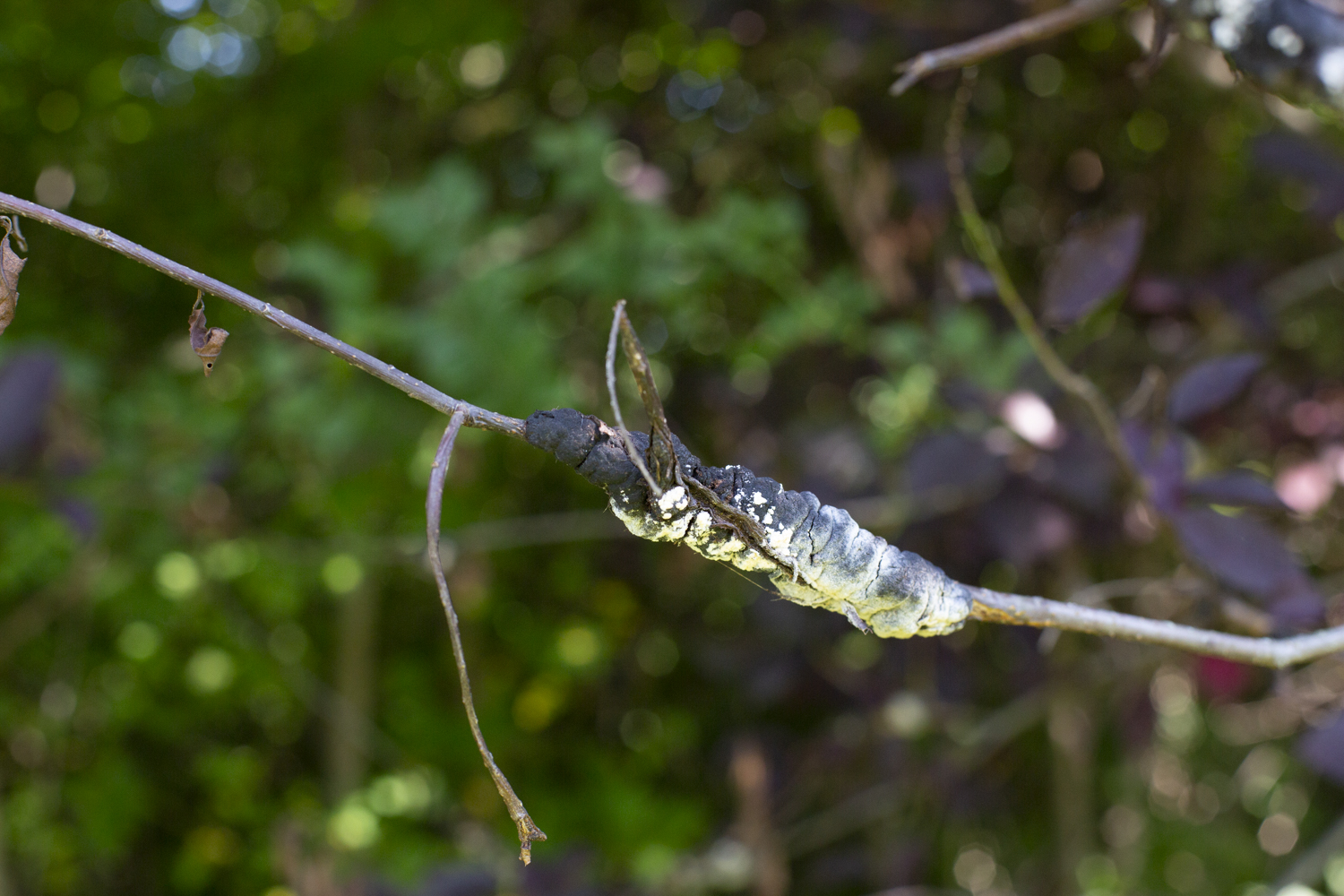
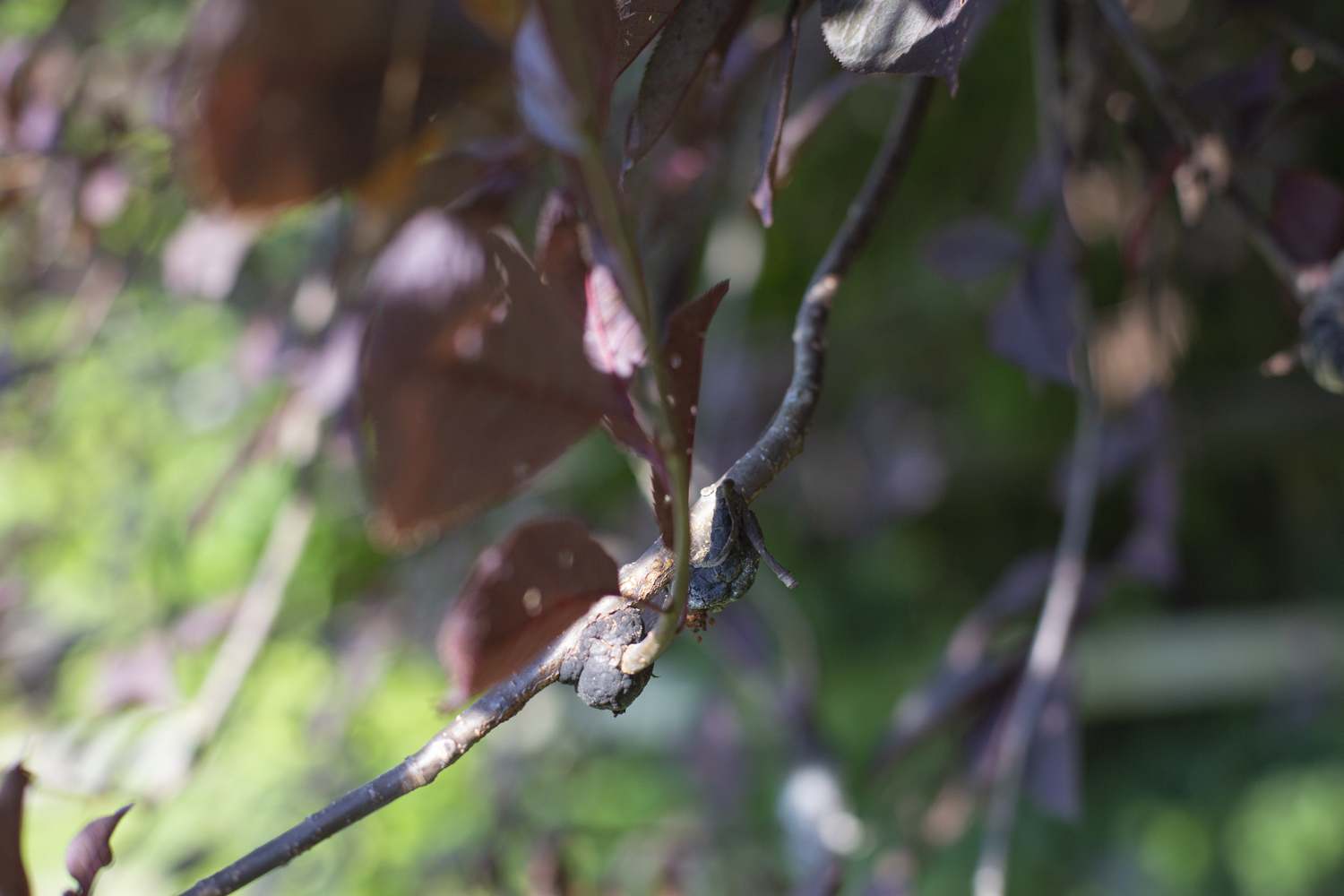
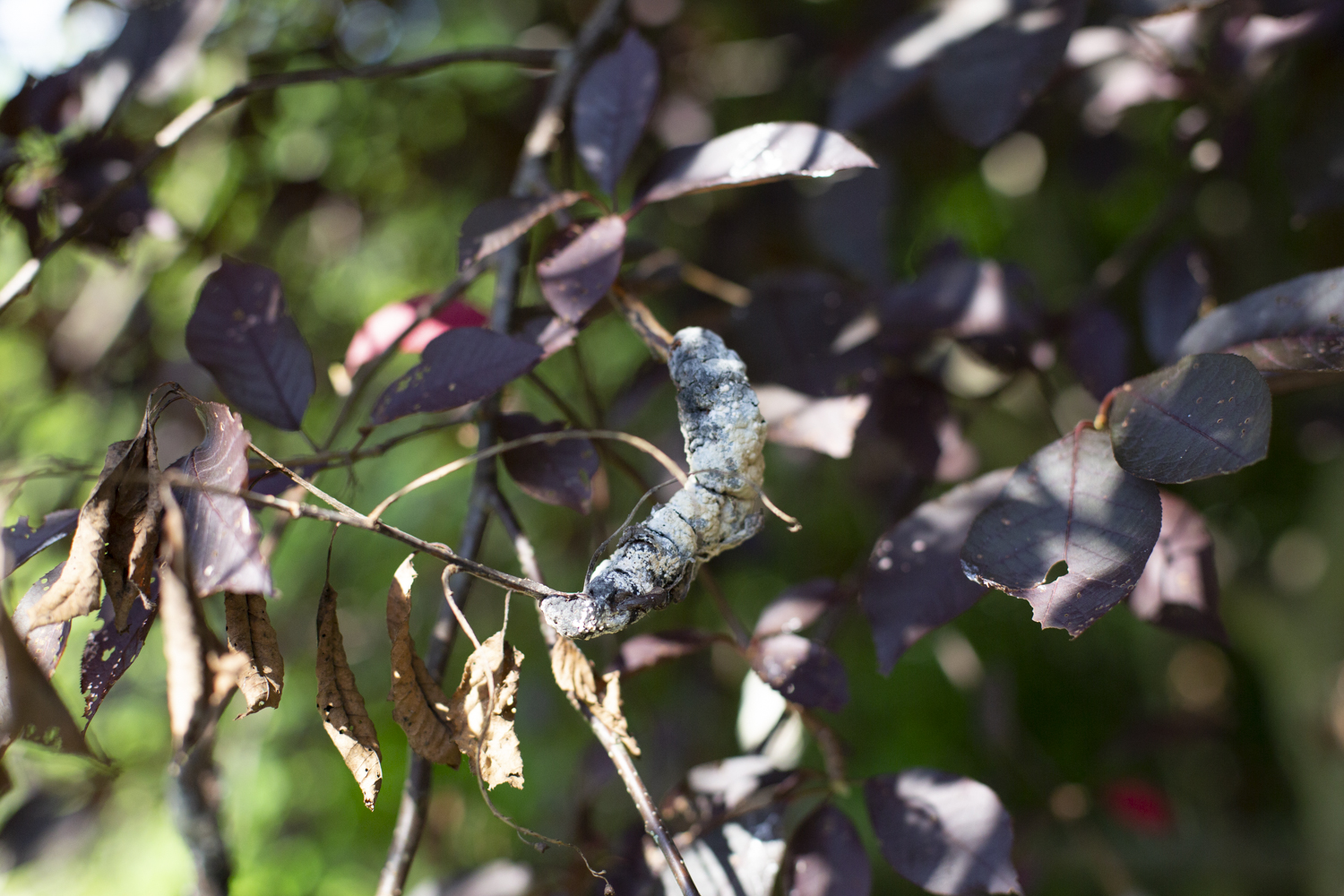

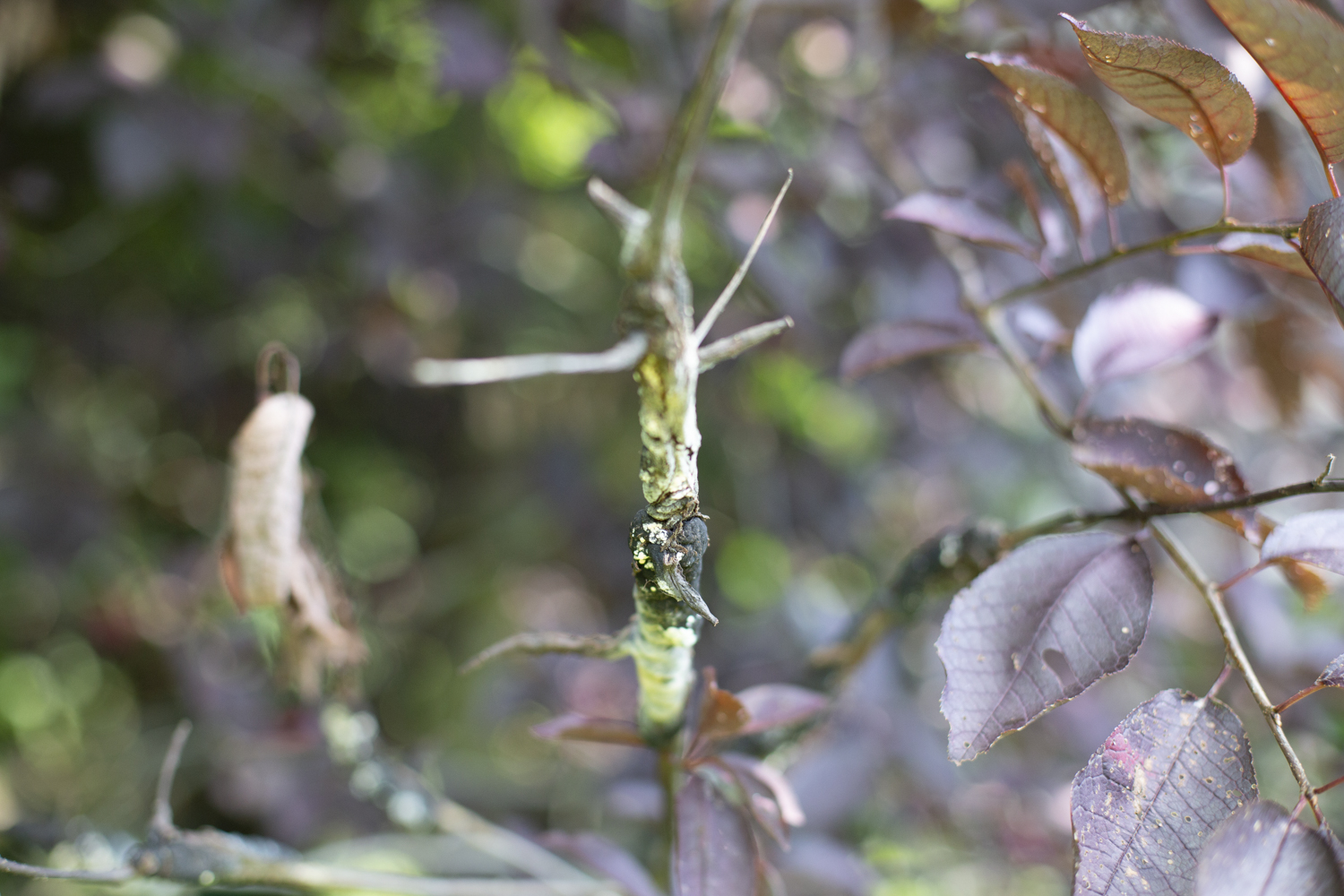
Black Knot is a relatively common disease that mainly effects Plum and Cherry trees, but can impact other trees in the prunus species as well. These types of trees can frequently be seen growing in and around Columbus area neighborhoods. Black knot is actually a type of fungus (Apiosporina morbosa). Its characteristic look consists of irregularly shaped black outgrowths arising from tree branches. It often spreads in the springtime but is not noticed by homeowners until winter after the tree leaves have fallen. If left untreated, the black knot growths eventually expand and encase the limbs and twigs of trees and can lead to dead branches, even death of the tree itself. Unfortunately, by the time many homeowners identify this as an issue, the fungus has already critically damaged the tree.
Early Stages of Black Knot in a Purple Plum Tree in Blacklick, Ohio. ©Russell Tree Experts
It’s best to catch this disease early as this is when it is most easily treated. An early warning sign that black knot may be affecting your tree is the presence of small green swellings/growths on a tree's branches. The first step in treatment is the identification of the presence of the disease. Once identified, selective sanitary pruning of the tree in combination with a fungicide can be instituted. Unfortunately, if the tree is in the advanced stages of the disease, these treatments may not be enough and the tree may need to be removed. In summary, Black Knot is an important disease that is relatively common, especially in trees types found throughout the Columbus area and is best treated when caught early.
Chris Gill
ISA CERTIFIED ARBORIST® OH-6416A
- - - -
If you suspect that your tree(s) may be infected with Black Knot, feel free to give us a call 614-895-7000 or request a free quote!
Fire Blight is No Delight
This year has been a particularly bad one for fire blight on Pear and Apple trees. Fire blight is a bacterial disease that affects plants in the Rosaceae family, causing a characteristic blackened wilting of leaves and twigs. This family of plants is also popular for its landscape value, both for flowers and fruit production. Pear, Cherry, Rose, Apple, Serviceberry, Cotoneaster, Hawthorn are just a few trees and shrubs that are very familiar to us. Have you noticed a profusion of dead, blackened leaves in your neighborhood? In your trees?
As an arborist, I can spot spring coming in February when a faint reddish tinge starts to color the woods. This tells me trees are starting to stir, and warmth will soon be on its way. Despite the early clues that I am looking for, I am always amazed by the vibrancy of life once trees have fully emerged. Yes, I love the stage when trees are flowering, but somehow once trees are fully leafed out they look so alive, so perfect, so unblemished. No bugs, no drought stress, no fungal diseases – just full, green leaves.
And then… pests and pathogens let us know that they have been waiting for spring as well. What can we say? Life the way we know it is varied and expressed by many different forms, each trying to survive in its own way.
This year has been a particularly bad one for fire blight on Pear and Apple trees. Fire blight is a bacterial disease that affects plants in the Rosaceae family, causing a characteristic blackened wilting of leaves and twigs. This family of plants is also popular for its landscape value, both for flowers and fruit production. Pear, Cherry, Rose, Apple, Serviceberry, Cotoneaster, Hawthorn are just a few trees and shrubs that are very familiar to us. Have you noticed a profusion of dead, blackened leaves in your neighborhood? In your trees?
There are ways to stave off the progression of the disease, even now. Ideally, the trees would be treated earlier in the season for better control, but a combination of steps are recommended for trees that are highly susceptible to the disease. Treatment steps vary depending on how affected your tree is.
Thanks for being our client, and for loving your trees! I’ll see you out there.
Your friendly neighborhood arborist,
José Fernández
ISA BCMA® OH-5129B
3 Tips to Check for Fire Blight
Check if your tree's leaves are browning only at the tips of the limbs
Check if limbs have the "Shepherd's Crook" (FYI - The Shepherd's Crooks doesn't always occur in trees infected with fire blight but it an obvious sign of the Fire Blight inspection.)
If you suspect your tree has fire blight, please click here or call 614-895-7000 and we'll send a Certified Arborist to review the tree and give you a quote to treat the issue