
Roots are Dry. Water your Trees!
Don’t let the extremely wet spring and recent rains fool you. It is already drying out more than you may think. With the recent hot temperatures and quick thunderstorms most of the water tends to run off. Most recommendations for watering trees and plants call for the equivalent of 1 inch of rain per week. I have already witnessed plant material struggling due to lack of moisture.

Image via Adobe Stock
[click to enlarge]
Don’t let the extremely wet spring and recent rains fool you. It is already drying out more than you may think. With the recent hot temperatures and quick thunderstorms most of the water tends to run off. Most recommendations for watering trees and plants call for the equivalent of 1 inch of rain per week. I have already witnessed plant material struggling due to lack of moisture. The first thing I check on a struggling plant is the planting depth, the amount of mulch or soil on top of the root ball and the amount of moisture in the root zone. Proper planting and watering are the best defense for most problems we see in the landscape. Whenever possible, identify the root zone on your plant material and only apply 1 to 2 inches of mulch over the root zone. Thoroughly soak at least once a week.
If history repeats itself like last year, we had a pretty severe drought towards the end of the summer of 2019. We lost a lot of plant material due to the extremely dry conditions. One plant that we saw having a lot of problems last year during the drought was the Emerald Green Arborvitae, this variety seemed to have the most casualties during last year’s drought. Recently planted trees and shrubs are also very vulnerable during hot, dry periods.
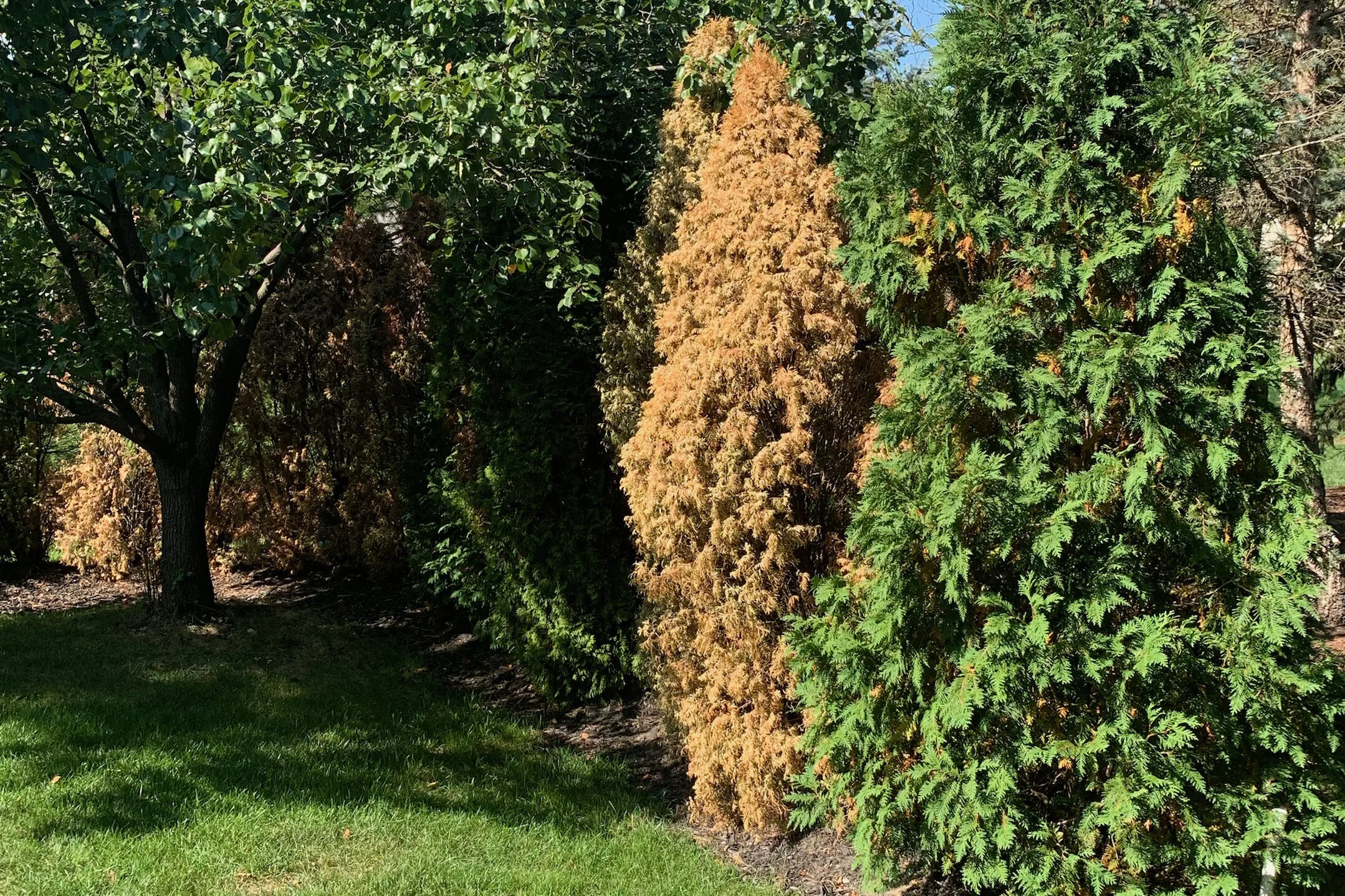
Pictured here is a dead Emerald Green Arborvitae due to extremely dry conditions in the fall of 2019.
© Russell Tree Experts
Another thing to check on struggling plant material would be to check for girdling roots which unfortunately has become a major problem in today’s landscape. On small plant material this can be accomplished with careful digging and washing soil away from the root system to check for roots that are circling the tree and possibly strangling itself. The most damaging of these roots should be removed to help improve the root structure moving forward. For larger trees this can be accomplished with an instrument called an Air Spade. This procedure is usually completed in the fall or early spring to remove damaging roots when it has the least amount of impact on the tree itself. The air spade quickly removes soil from the roots using air pressure making it easy to identify girdling roots. In extreme cases the offending roots may need to be removed in stages over a couple of years to avoid over stressing the plant.
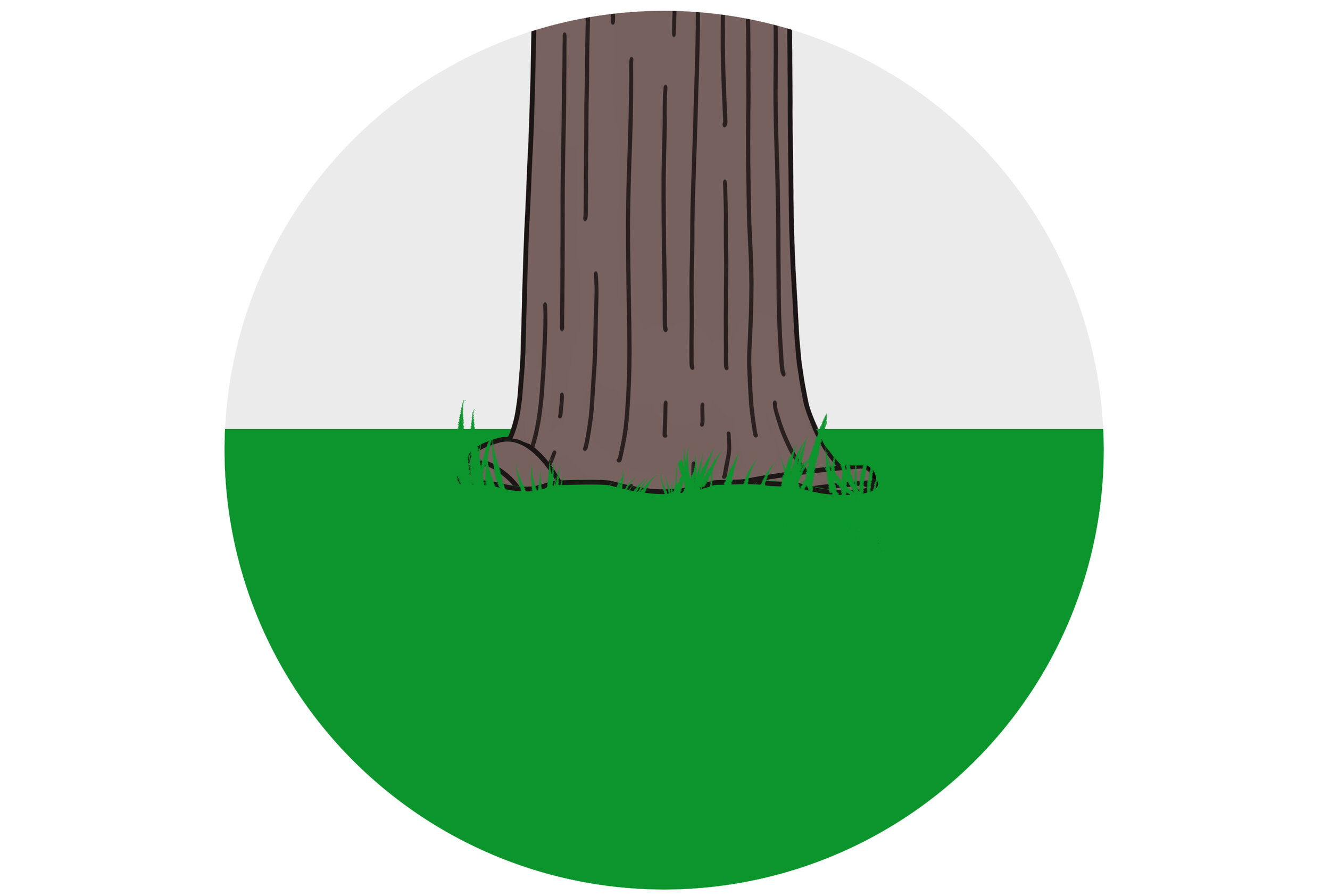
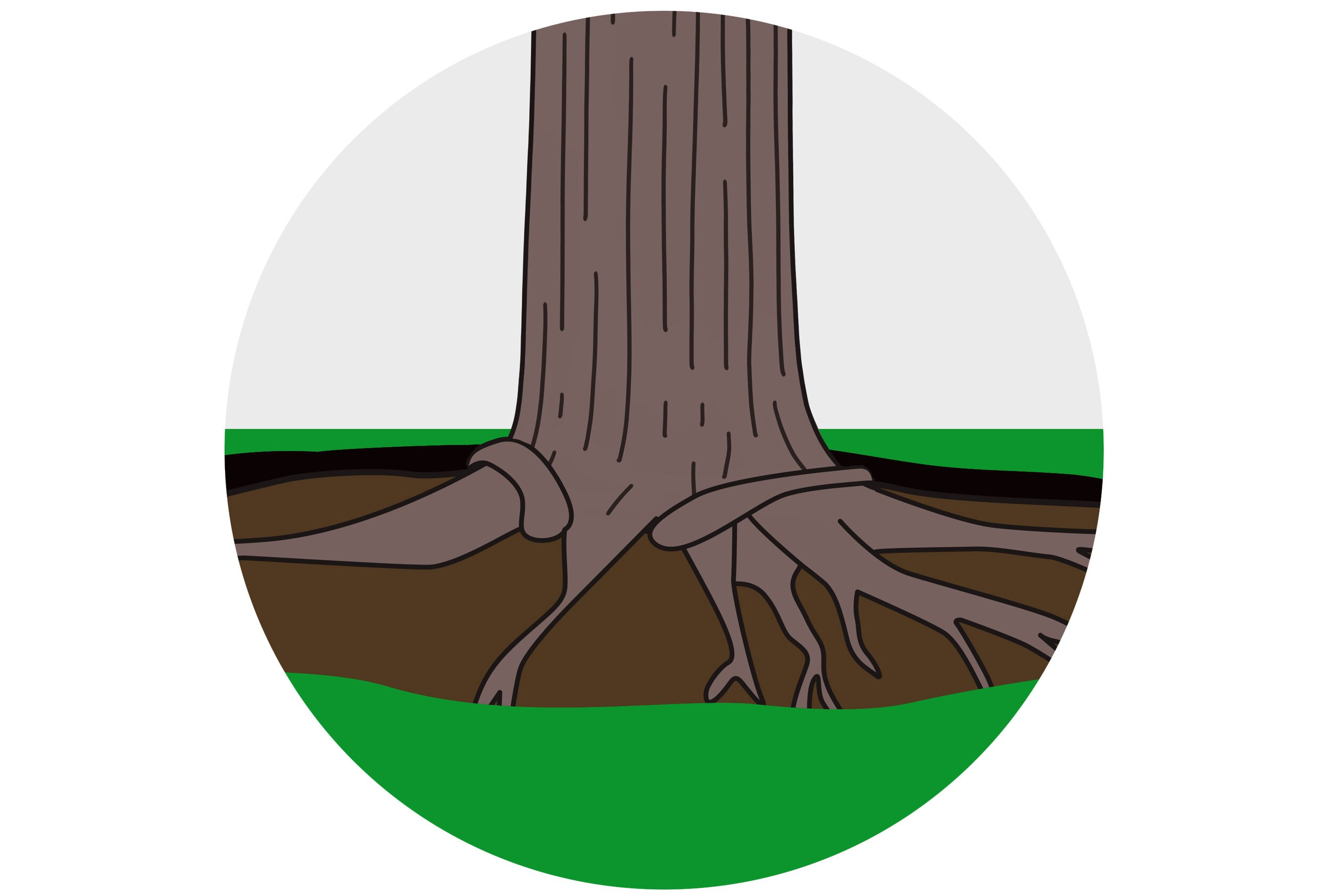
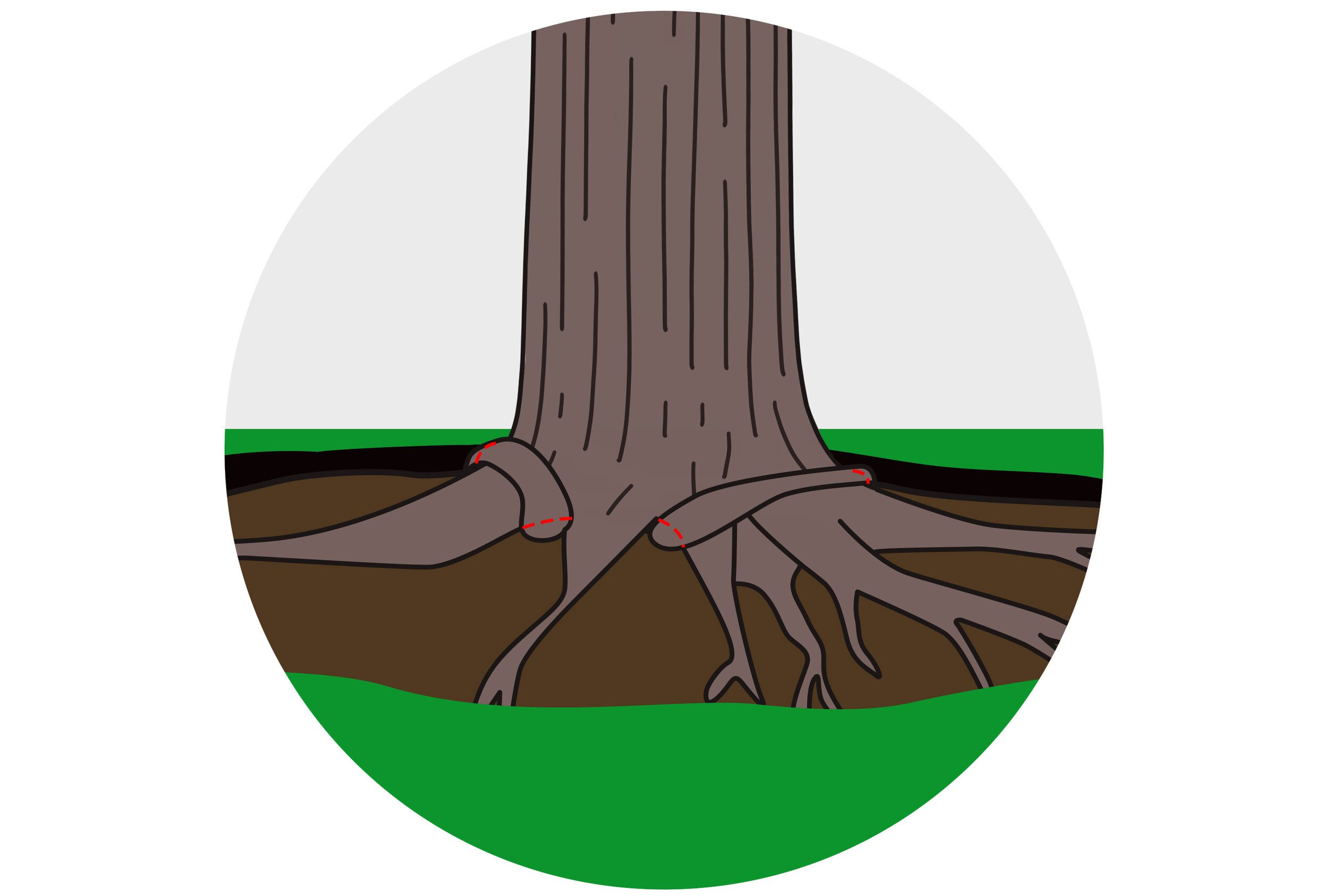
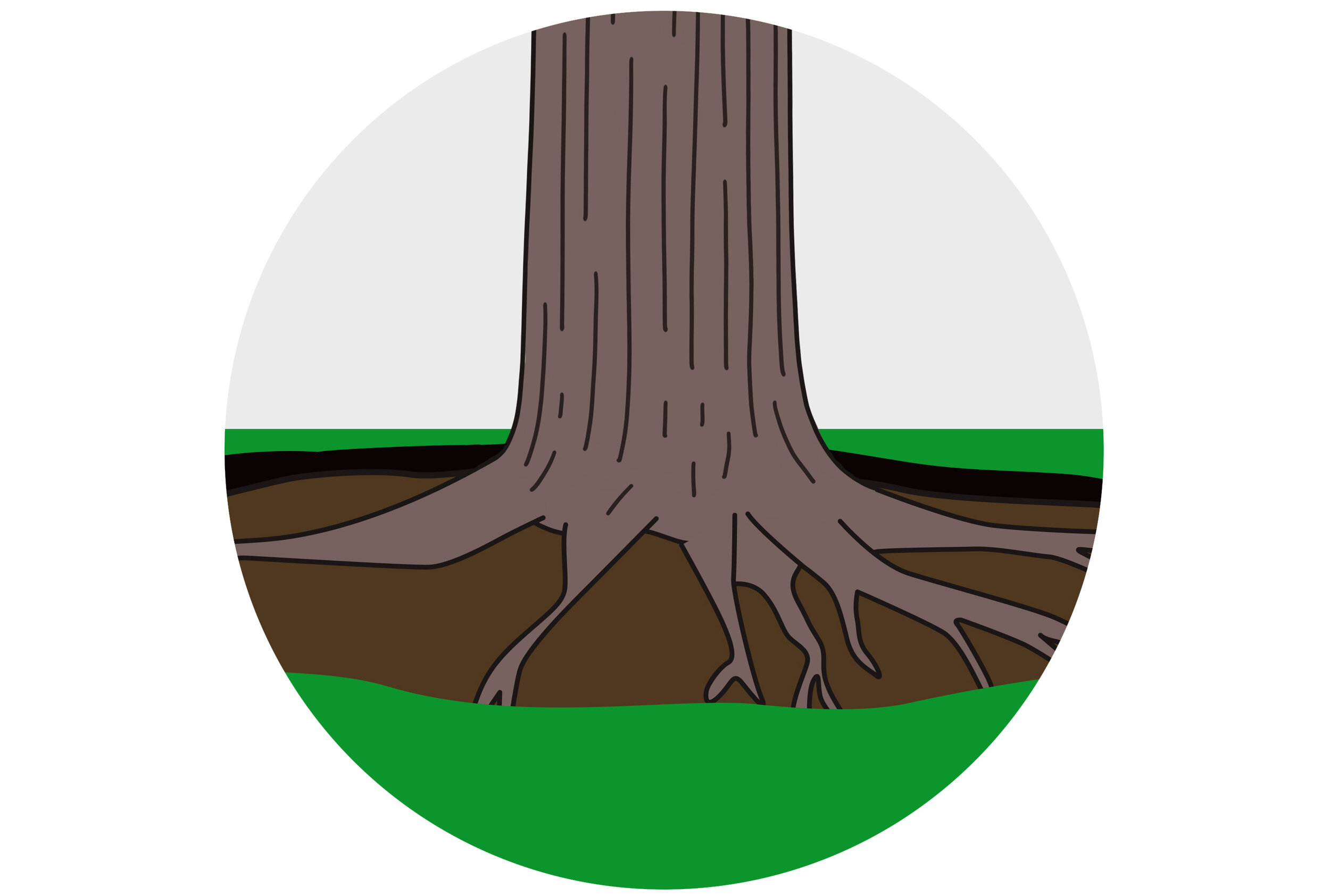
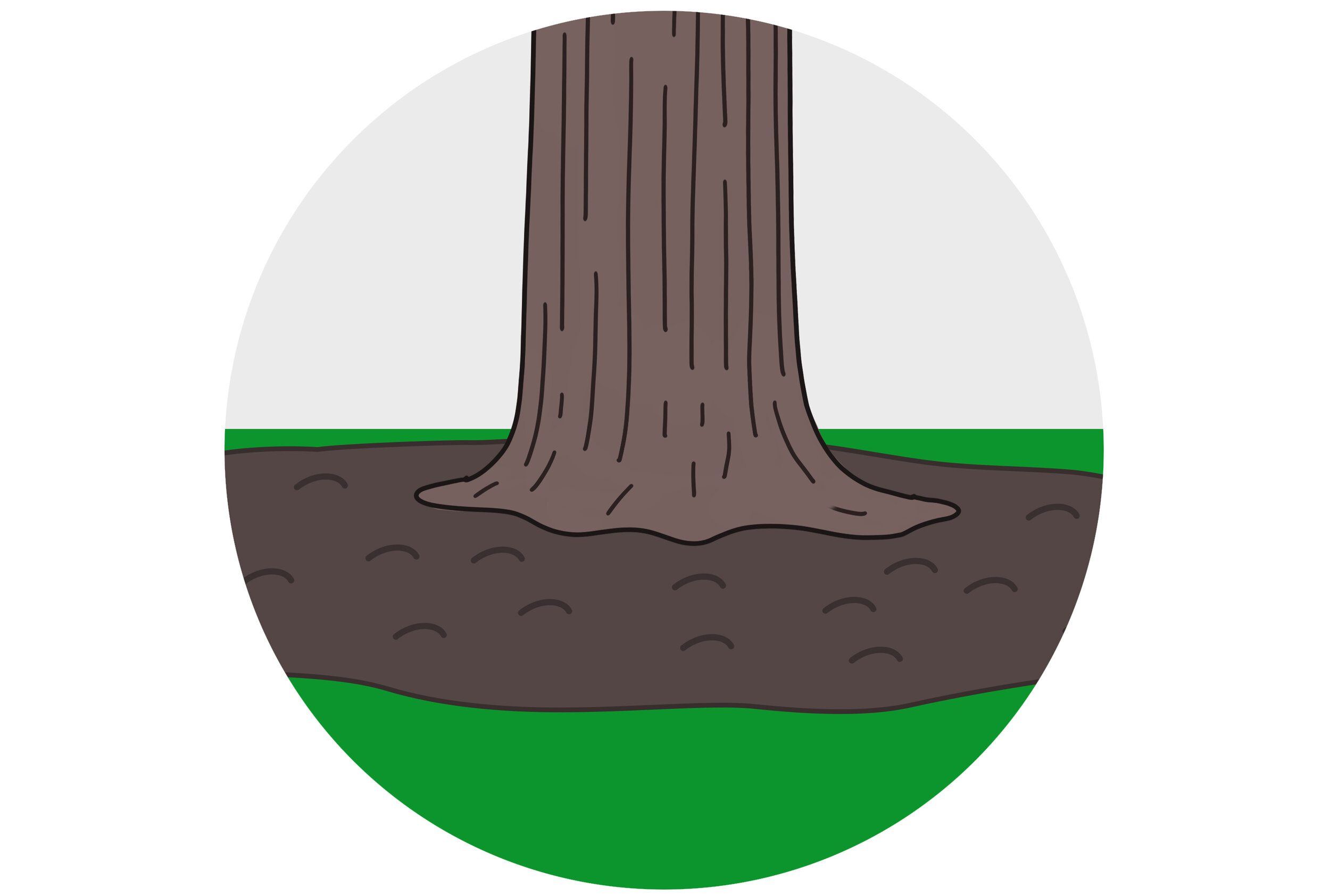
In summary it is very important to remember that what you see above ground often mimics what is happening underground. Take the time to make sure your trees are planted properly and keep them watered.

Mike McKee | Regional Manager, Russell Tree Experts
Mike graduated from Hocking College in 1983 with a degree in Natural Resources specializing in urban tree care. He has been a certified arborist since 1991. Mike started his career in the private industry in 1985 before becoming a municipal arborist in1989. He retired after serving thirty years before joining us at Russell Tree Experts in Sept. of 2018. His love of trees has never waned since trying to climb up the ridges of the massive Cottonwood tree in front of his childhood home.
Worms by the Bagful
Worms by the bagful. Bagworms, that is. This interesting insect is not really what we would usually call a worm, but is considered a caterpillar instead. While most caterpillars pupate into a flying adult (moth or butterfly), the female of this species never emerges from her mobile home. The male does, and he flies to the female so they can engage in activities that ensure the species does not die out.

© Russell Tree Experts
Bagworms, that is.
This interesting insect is not really what we would usually call a worm, but is considered a caterpillar instead. While most caterpillars pupate into a flying adult (moth or butterfly), the female of this species never emerges from her mobile home. The male does, and he flies to the female so they can engage in activities that ensure the species does not die out.

© Russell Tree Experts
After mating, both male and female eventually die, leaving many eggs within the female bag. These eggs hatch the following spring to cause more foliar damage as they feed on many kinds of plants, sometimes causing irreversible damage and death if left unchecked.
I focus on this pest for this article because I have been watching for its emergence this season wondering when it would finally show up. Early June is usually when we start seeing the new generation of this pest (630 growing degree days, according to the OSU OARDC calendar available here). Last season I recall bagworms emerging later than usual, and I was curious what would happen this year given the very unusual spring we have had. Yesterday I spotted my first bagworms in a client’s back yard – the smallest I have ever seen yet. The plant had been damaged in the past season by bagworm feeding, and the old adult bags were clearly visible. When I looked closely, I could just make out the very tiny, brand new bagworms moving about as they fed on the plant.
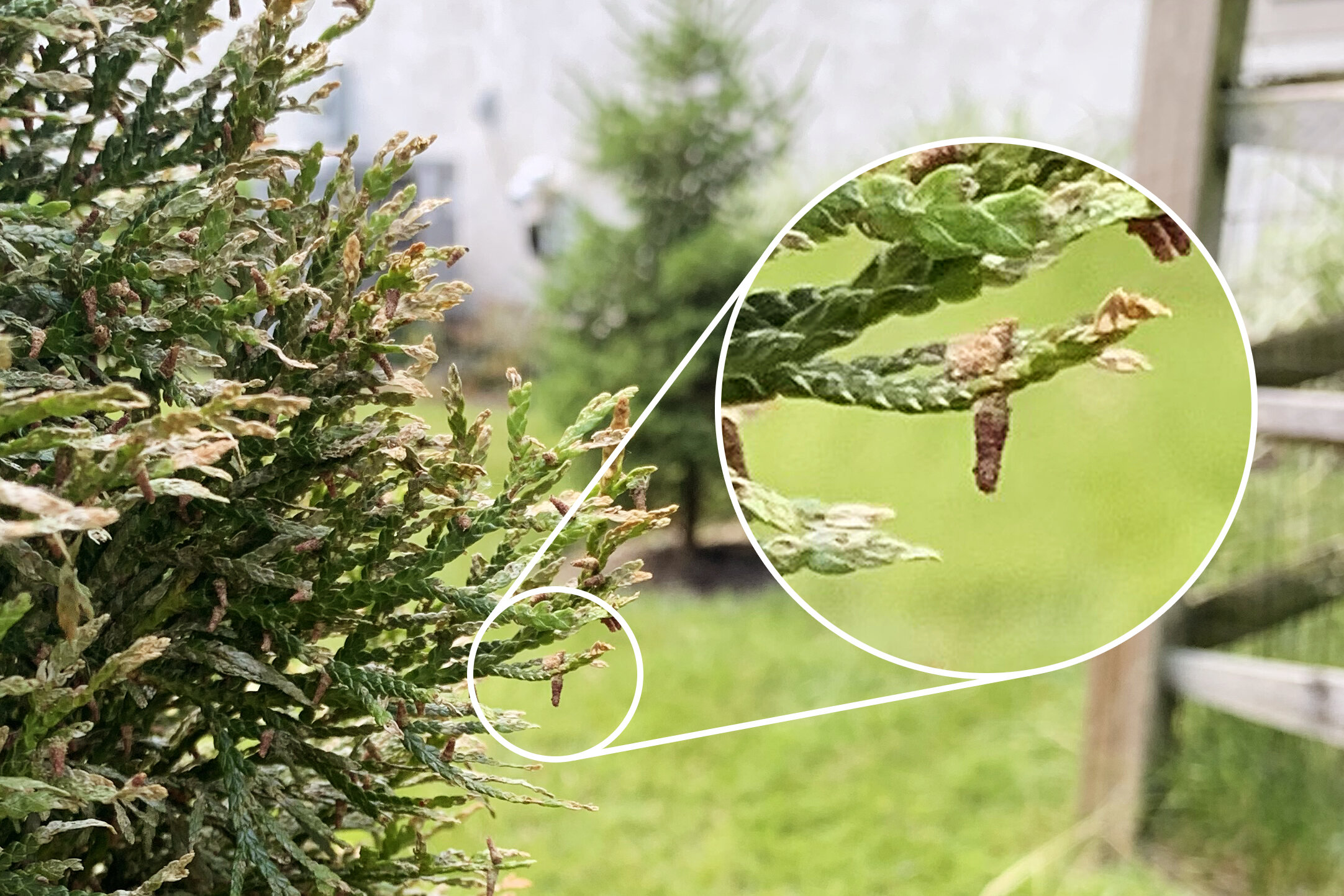
Very tiny, brand new bagworms
© Russell Tree Experts
They had also established on the neighboring, more healthy, plant.

© Russell Tree Experts
I checked the current growing degree days, and we are at 959 today for the area I was in. I can’t say when these baby bagworms were hatched, but it has not been long. I also do not know if there is a period between the hatching of the eggs and the emergence of the caterpillars from the old cocoon. As with everything in nature, there is always variation from season to season, and from place to place within the same season, so scouting is always the best way to determine when pests are present or not.

© Russell Tree Experts
Bagworms feed on a number of species, but evergreen species are the most at risk of permanent damage or death. If an evergreen is defoliated rapidly by large quantities of these mobile marauders, it will likely not have the ability to rapidly regenerate foliage to make up for that which was lost. I commonly drive past juniper, spruce, and arborvitae that have been sheared of green foliage by bagworms.
Thankfully, if caught early, this insect pest is relatively easy to control. Two treatments are sometimes recommended to make sure any late starters are caught during the second round. I routinely show clients what a bagworm looks like because they are very easy to miss within a plant. As they feed and grow they use foliage from the plant they are feeding on to build the bag that gives them their name. This means they look like part of the plant. Once identified though, they are easy to spot. If treatment is no longer an option (when the pest is settled for the winter or no longer actively feeding), removal of the bags by hand is a very good way to control this pest. This method works best on smaller plants since it is essential that every single bagworm is removed from the plant.
Thank you all for taking the time to read this article. If it is shorter and less philosophical than usual, it is because we are striving to keep up with the all the requests for service that keep coming in. I look forward to being able to take a slow breath later in the season and make some time for reflection. In the meantime, thank you very much for trusting us with your trees.
Your friendly neighborhood arborist,

José Fernández | Regional Manager, Russell Tree Experts
José became an ISA Certified Arborist® in 2004, and a Board-Certified Master Arborist® in 2015. Currently he is enrolled at The Ohio State University pursuing a Master’s Degree in Plant Health Management. José likes working around trees because he is still filled with wonder every time he walks in the woods. José has worked at Russell Tree Experts since 2012.
[Quick fact checks from https://bygl.osu.edu/node/1048 and https://www.mortonarb.org/trees-plants/tree-and-plant-advice/help-pests/bagworms.]
What’s Wrong with My Oak?
Each year around this time, as yards come alive at an unstoppable pace, we receive calls from customers and concerned tree owners all around town with questions about trees. As arborists receiving all of those calls, we’re fortunate to see patterns that help us quickly determine if an issue is an isolated occurrence or if it’s happening on numerous trees. When we receive multiple calls that describe the same concerns, we immediately consider weather patterns and how they may play into it.

© Russell Tree Experts
Each year around this time, as yards come alive at an unstoppable pace, we receive calls from customers and concerned tree owners all around town with questions about trees. As arborists receiving all of those calls, we’re fortunate to see patterns that help us quickly determine if an issue is an isolated occurrence or if it’s happening on numerous trees. When we receive multiple calls that describe the same concerns, we immediately consider weather patterns and how they may play into it.
This year we had a very cool and wet start to our spring, not unlike last year. One of those patterns we’ve received numerous calls about is the brown blotches and holes that many homeowners are seeing on their oaks. One half of this relates to the spring weather, the other may simply be more noticeable because of the increased overall unsightly appearance of the leaves.
There are likely two culprits at work here, an insect and a fungal pathogen. The holes you may be seeing in your oak leaves are caused by the Oak Shothole Leafminer. This feeding activity happens as the leaves are still in the bud or as they’re unfurling. Depending on when it occurs, it can even create symmetrical patterns on the right and left sides of the leaf. If we see these strange patterns, we naturally suspect one of two things: aliens, or those darn kids down the street. Alas, it’s just an insect. And a harmless one at that. The holes, while they may look alarming, will not affect the long-term health of the tree and no treatment is needed.

© Russell Tree Experts
The brown and diseased looking portions of the leaves, usually at the tips or edges, is Oak Anthracnose. This fungal disease is active during the cooler and wet weeks of spring. By the time we see the damage to the leaves, there isn’t anything that can be done. Fortunately, just like with the insect mentioned above, there really isn’t anything that needs to be done. Leaves that are affected significantly enough may fall off prematurely, but most will persist in the tree throughout the season. While the name of this disease sounds alarming, it’s overall effect on the health of an oak is typically a non-issue.

© Russell Tree Experts
There’s a fabulous online article that covers both of these issues and can be found on the Buckeye Yard and Garden Online website. It goes into much greater detail if you’re itching to understand the science behind what’s at work on your oak tree. Follow the link below for more information: https://bygl.osu.edu/node/1296
The Ohio State University Extension does a fabulous job with updating and maintaining this site. It is a wonderful resource for homeowners and industry professionals alike. I encourage you to explore its wealth of information and see what else you can learn about the trees in your yard and beyond.

Walter Reins | Regional Manager, Russell Tree Experts
Walter has been an ISA Certified Arborist since 2003. He graduated from Montgomery College in Maryland with a degree in Landscape Horticulture, and has called Columbus, OH his home for nearly 20 years. Walter appreciates trees for their majesty and the critical role they play in our world.
A Virtual Tour: Chadwick Arboretum
© Russell Tree Experts
By Enrique Arayata
ISA Certified Arborist® OH-7252A
May 6, 2020
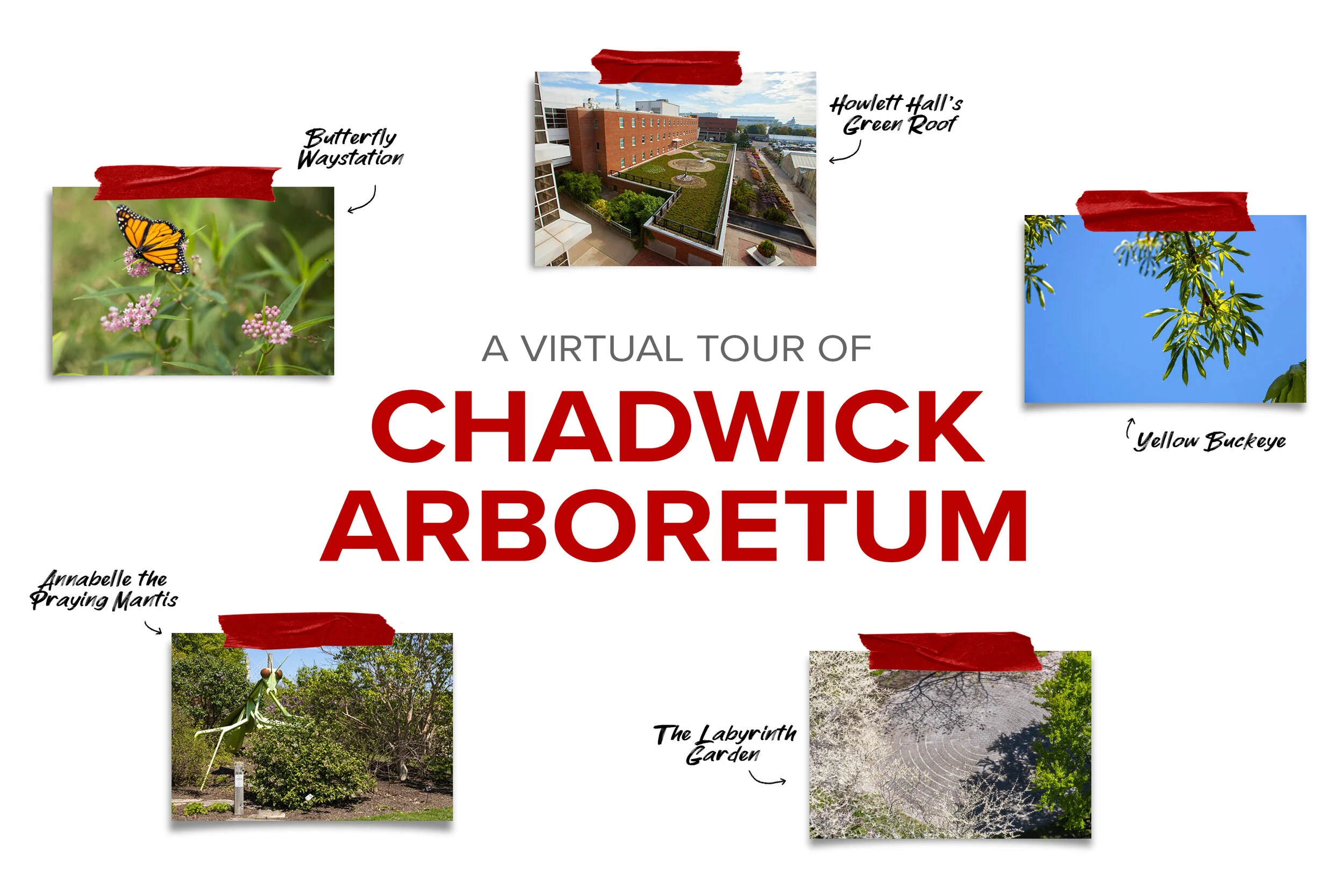
As a current student at The Ohio State University who was enrolled in HCS 2200: The World of Plants last Spring 2020 semester, I was disappointed to hear that the tour to Chadwick Arboretum and Learning Gardens was canceled, understandably so, due to the COVID-19 pandemic. In its place, my professor assigned a virtual tour of the area. Today, I would like to share some of the interesting aspects of Chadwick Arboretum and Learning Gardens to encourage you to go on a socially distanced walk to explore the area and take your mind off of everything currently going on in the world. We will be visiting Howlett Hall and its green roof, the Phenology Research Garden, the Lois B. Small and Gladys B. Hamilton Labyrinth Garden, the Monarch Butterfly Waystation, and the Andy Geiger Buckeye Collection at Buckeye Grove.
“Gather around! The tour is starting!”


Howlett Hall’s green roof
© Russell Tree Experts
Within Chadwick Arboretum and Learning Gardens is the green roof housed on top of Howlett Hall, a retrofitted roof containing living, breathing vegetation over a bed of sedum spanning across 12,000 square feet. The benefits of this green roof, apart from taking advantage of what would otherwise be a vacant and empty roof, is that it will prevent over 200,000 gallons of polluted water from entering the Olentangy River and will save over $10,000 annually through reduced energy costs and roof maintenance. (1) The green roof adds insulation to Howlett Hall, thus reducing summer air conditioning costs, and with the collected rainwater, it will also reduce, delay, and filter stormwater runoff. Overall, this green roof increases green space, biodiversity, urban food production, and food security, all while efficiently using urban space that will actually lengthen the lifespan of the roof.
“Let’s visit our next location!”


Annabelle the Praying Mantis at Phenology Research Garden
© Russell Tree Experts
Also within Chadwick Arboretum and Learning Gardens is the Phenology Research Garden. Phenology involves the study of the seasonal cycle of natural phenomena in relation to animal, climate, and plant life. Located outside of the Agricultural Engineering Building, the Phenology Research Garden contains 17 woody plant species and 15 perennial species that are closely observed during bloom time to more accurately predict regional insect emergence, allowing for better pest control. Our Board Certified Master Arborist José Fernández actually wrote an article about growing degree days which further explains how this concept works; I will link it down below for your reading pleasures! One of the most useful indicator plants in the Phenology Research Garden is the Chinese lilac (Syringa x Chinensis ‘Red Rothomagensis’) which aids in observing changes in plant and animal behavior and predicting the risk of biological invasions, the spread of disease, and drought. On top of that, it is a beautiful perennial, deciduous shrub that features tiny, reddish-purple flowers that can grow up to 12 to 16 feet tall! The biggest elephant in the room when talking about the Phenology Research Garden, or should I say the biggest praying mantis in the room, is Annabelle, a 15 by 11-foot tall steel praying mantis sculpture that is housed in the Phenology Research Garden. Since praying mantises are a seasonally appearing insect, Anabelle’s presence is very fitting and appropriate.
“now to our next stop on the tour!”


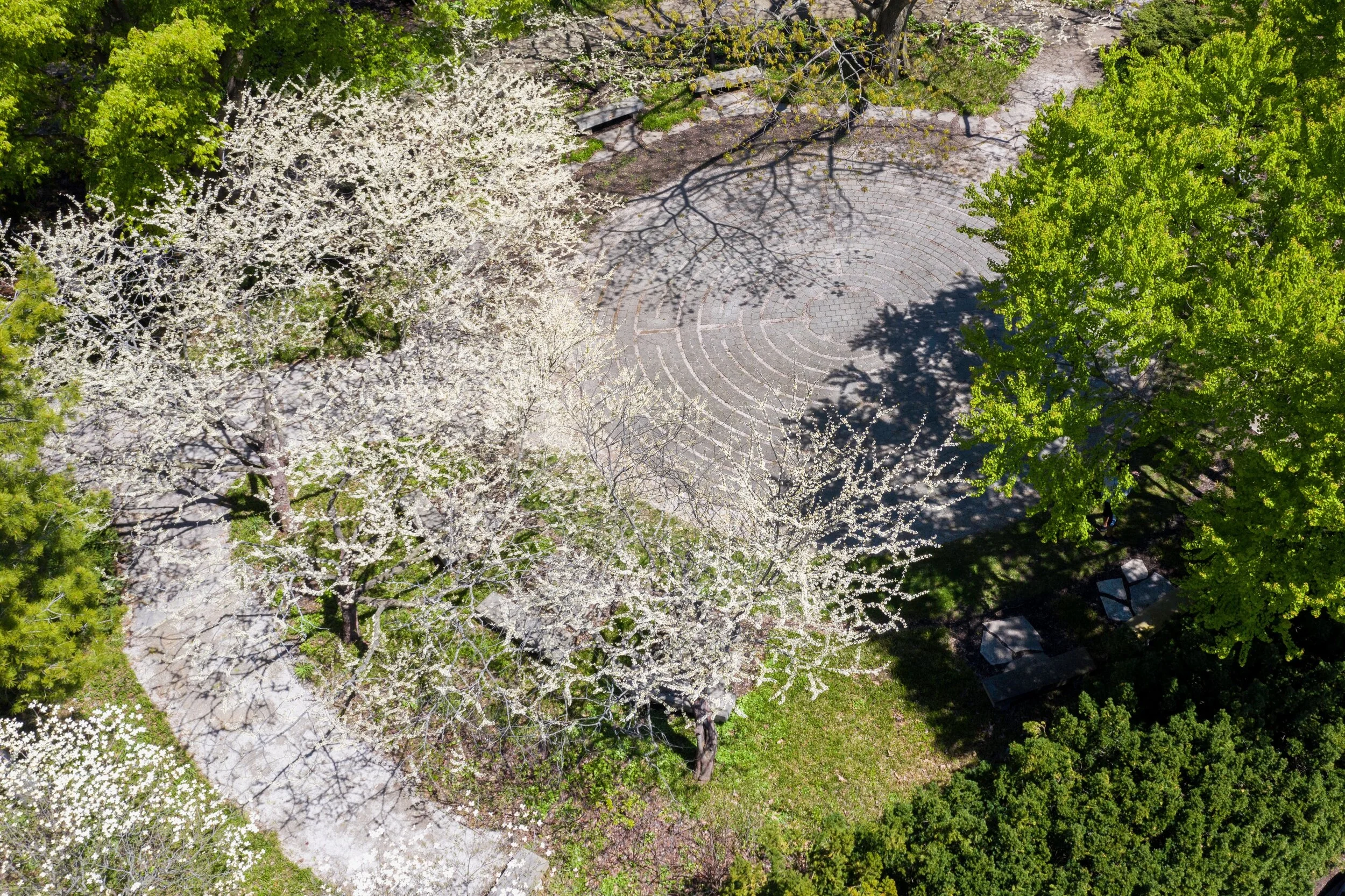
Lois B. Small and Gladys B. Hamilton Labyrinth Garden
© Russell Tree Experts
Another must-see area of Chadwick Arboretum and Learning Gardens is the Lois B. Small and Gladys B. Hamilton Labyrinth Garden located on the corner of Lane Avenue and Fyffe Road. This labyrinth takes approximately 20 minutes to walk through, but you may spend even more time as this is a common place to practice meditation or prayer on campus. The labyrinth can also be used as a tool of discernment during difficult decision-making times. It is said that following the path within the labyrinth can bring increased balance and well being to one’s self. Encircling the labyrinth is the White Blooming Garden filled primarily with white redbud trees (Cercis canadensis ‘Alba’). These trees provide a calming and quiet atmosphere as the color white is said to be restful and restorative. The use of a single color helps to minimize distractions and enhance meditation.
“Let’s flap our wings to our next location!”


Monarch Butterfly Waystation
© Russell Tree Experts
Next on the list of areas to visit in Chadwick Arboretum is the Monarch Butterfly Waystation located in Chadwick Arboretum North between Ohio State Route 315 and Chadwick Lake. The garden contains many necessary resources for monarchs to reproduce and sustain their migration such as coneflowers, asters, prairie dock, and most importantly, milkweed. Milkweed is important for the breeding process during the spring and summer for monarchs. Without the nectar from these flowers, monarch butterflies would be unable to travel to Mexico during fall migration. This beautiful area in and around the prairie plant research site in Chadwick Arboretum is one of many monarch butterfly waystations that help millions of monarch butterflies migrate from Canada and the United States to California and Mexico during the winter.
“…And now to our final stop!”


Buckeye Grove
© Russell Tree Experts
Lastly, the Andy Geiger Buckeye Collection, dedicated to Andy Geiger, the former Director of Athletics at Ohio State who retired in 2005, features numerous native buckeye trees such as the Ohio buckeye (Aesculus glabra), yellow buckeye (Aesculus flava), red buckeye (Aesculus pavia), bottlebrush buckeye (Aesculus parviflora), and Autumn Splendor buckeye (Aesculus x arnoldiana). This collection of buckeye trees is planted in Buckeye Grove, located on west campus between the football stadium and Morrill Tower. Fun fact, the Aesculus genus includes both buckeye trees and horse chestnut trees. While there are many native Buckeye trees in Ohio, there are no native horse chestnut trees in Ohio. If you would like to show your Ohio State pride, Buckeye Grove is a must-see!
“THANK YOU FOR JOINING ME!”
Thank you for taking your time in reading this article, hopefully I was able to inform you about this wonderful place and even persuade you to take a visit sometime in the future. These five stations are just five of many different areas to explore within Chadwick Arboretum and Learning Gardens. I hope you all are staying safe and healthy. Times are in no doubt difficult and my goal for this article was to inform you about a place where you may hopefully meditate and find peace. We will all make it through this together.
—
Visit in Person!
Address: 152 Howlett Hall 2021, Fyffe Rd, Columbus, OH 43210

Map Courtesy of Chadwick Arboretum
References
Howlett Hall: https://chadwickarboretum.osu.edu/our-gardens/learning-gardens/green-roof-howlett-hall-0
Phenology Research Garden: https://chadwickarboretum.osu.edu/our-gardens/lane-avenue-gardens/phenology-research-garden
Lois B. Small and Gladys B. Hamilton Labyrinth Garden: https://chadwickarboretum.osu.edu/our-gardens/lane-avenue-gardens/labyrinth-garden
Monarch Butterfly Waystation: https://chadwickarboretum.osu.edu/our-gardens/arboretum-north/prairie-plants-monarch-waystation
Buckeye Grove: https://chadwickarboretum.osu.edu/our-gardens/arboretum-north/geiger-buckeye-collection
Growing Degree Day by José Fernández: https://www.russelltreeexperts.com/arbor-ed/2020/2/4/growing-degree-days
Footnotes
(1) From “Green Roof on Howlett Hall,” by Chadwick Arboretum & Learning Gardens, 2020, para. 5. Copyright 2020 by The Ohio State University. Retrieved from https://chadwickarboretum.osu.edu/our-gardens/learning-gardens/green-roof-howlett-hall-0
Sincerely,

Enrique Arayata I Media Production Manager, Russell Tree Experts
Enrique is an ISA Certified Arborist® and FAA Certified Remote Pilot. In his free time, he enjoys working out, hanging out with his family and girlfriend, video production, photography, cars, technology, and cooking. Enrique has a BA in moving image production with a double minor in film studies and studio art specializing in photography from The Ohio State University, and an AA in web graphic design from DeVry University. His favorite tree is the Kwanzan cherry tree.
A Word of Caution
Earlier this year I attended a talk on plant disease diagnostics as part of my continuing education as an ISA Certified Arborist. The talk was given by a highly respected individual whom I have had the pleasure of learning from since my early days as an arborist in central Ohio. This time, one of the first statements spoken caught my attention immediately. I paraphrase it into something like this:

© Russell Tree Experts
Earlier this year I attended a talk on plant disease diagnostics as part of my continuing education as an ISA Certified Arborist. The talk was given by a highly respected individual whom I have had the pleasure of learning from since my early days as an arborist in central Ohio. This time, one of the first statements spoken caught my attention immediately. I paraphrase it into something like this:
When it comes to health, humans have spent most of their time and effort studying diseases of one single organism – humans. And when we go to a doctor and he or she does not have an immediate answer for what might ail us, we don’t shake our head in wonder and ask “Why? Why don’t you know what is wrong with me?” The doctor may prescribe certain tests to start to gather information on what is wrong with us, and we consider that to be a normal process.
In contrast, arborists and horticulturalists are faced with hundreds of species of plants, each with their own specific array of pests and diseases, and when faced with a problem we can’t immediately identify, saying “I don’t know” may not be considered an acceptable answer by the person whose plant we have been called to save.
This is a difficult subject for me to write about, but maybe sharing a bit of what goes through my mind when trying to figure out what went wrong with a sick or dead plant will help you as a plant owner see how things sometimes go, from an arborist’s perspective.
When I walk up to a plant that is declining, dying, or dead several things go through my mind. They are all based on the scientific concept of the disease triangle (Kenny put together a great summary here), but here are the steps I am following in my mind:

What is the species of plant? Does it look normal for its type?
What are the common issues this plant typically faces? Do the symptoms I am seeing match any of these issues?
What is the immediate environment of the plant? Is it what this type of plant needs to thrive?
Are there signs of pest predation? If no, is the problem root related? If yes, why are the pests here?
My thoughts will go back and forth among these general areas because so much is interconnected. For example, I may see borer activity near the base of the plant, but is that really the causal issue? Perhaps the plant is waterlogged, and has begun to produce alcohol because of that. The alcohol has attracted boring beetles. In this case treating the plant for borers will not make a difference to plant health – they are secondary to the fact that the plant is stressed by environmental conditions.
My main goal as an arborist is to give tree managers (current landscape owners) the best information I can so they can make the best decisions for their situation. For example, some pests and diseases can be treated with high success rates, others not so much. Some treatments, such as fungicide applications, are mostly preventive, and need to be applied frequently through each season for the best chance at being effective. All of this is communicated to the tree manager so the best decision can be made.
There is one thing I can assure each of you of, with confidence: If I know what is wrong with your tree, I will try to walk you through whether treatment is a good option or not. I may say, “X is a known prescribed treatment for this problem. Experience has shown me that sometimes trees respond well to this, and sometimes they do not. Here is the cost of X – it may or may not be the best approach for you or your tree”. You weigh your options and decide what makes the best sense to you. The tree may be an essential part of your landscape, or have great emotional value, meriting a “let’s do everything we can to save it” approach. On the other hand, it may be a tree you really don’t mind phasing out of your landscape, to make room for a tree that is better suited to that particular environment.
Things can get tricky though…
What about fertilization? Well, in most urban landscapes soil quality has proven to be very substandard compared to what trees and shrubs need to thrive. So we commonly recommend a general fertilization to help maintain good health for trees and shrubs. The product we use in particular is very good for this purpose: a low nitrogen formulation blended with organic products that help condition the soil as well as provide nutrients. (Why this is a good formula for trees is a topic that really needs to be discussed, but far larger than space in this installment will allow). Before I get to my word of caution, let me ask two questions:
We know that having good nutrition as people is essential for good health. But will eating the right foods guarantee good health for the rest of your life?
We take our pets to the veterinarian for their regular shots and checkups. Does this guarantee that our pets will never fall ill?
Both scenarios are true for trees, but sometimes I face tough questions from clients whose trees I have been caring for. “You fertilized my trees and shrubs, and now my shrubs are dead.” “I was told by another arborist that my oak had an iron deficiency, and you said to give it manganese instead. It has still not improved.”
I understand where questions like these come from, and I do not want to take them lightly. But I suppose my goal is for people to understand something crucial: I will prescribe what I believe to be the best approach for the health of a given plant, but trees and shrubs can still die. Sometimes I don’t know why. When that happens, there are only a few reasons that hold true:
I prescribed an incorrect treatment. If I did so knowingly, I am a charlatan, and not to be trusted. If unknowingly, perhaps I need more training, or it was a simple mistake.
I prescribed the right treatment, but conditions were such that the tree was too far in decline to begin with.
Something else besides what was being treated for caused the tree to die.
For the first reason, reputation serves to keep me in the clear. Reputation is based on how many people have experienced my service over time. As for learning, hopefully that never stops.
For the second reason, this happens more than I would like, but is only reasonable since by the time a tree is noticeably sick it has usually suffered for several years already. When I recognize this in a tree I try to steer people away from treatments that may not be successful even though they are the proper treatments to prescribe.
The third reason happens quite often as well, especially when environmental conditions change from one season to another.
So where does that leave us? The meaning of a treatment being prescribed and applied by an arborist of good reputation is that he or she believes it is the best next step needed to address a problem. Conversation and questions are always welcome, but we all know that sometimes the answers are not easy. Sometimes the answer requires humility and truth, and it may simply be “I don’t know. Let’s figure out what the next step is.” I have been with Russell Tree Experts for 8 years now, and there have been some difficult moments. But I am happy to say those are in the minority by far! There are many trees I can think of that have responded well to treatment, and are still alive because of it. And there are many tree owners who have lost their trees after attempting treatment who are still able to trust that we did what we could and for whatever reason it just did not work. Both of these scenarios are triumphs in my mind, because both scenarios represent the same good faith effort undertaken by arborist and tree manager working together.
Thank you for taking the time to read this lengthy article. I hope to visit with you in your landscape soon! I would also like to thank Shari Russell, TJ Nagel, and Annette Durbin for taking the time to read and comment on the first draft of this article.
Your friendly neighborhood arborist,

José Fernández | Regional Manager, Russell Tree Experts
José became an ISA Certified Arborist® in 2004, and a Board-Certified Master Arborist® in 2015. Currently he is enrolled at The Ohio State University pursuing a Master’s Degree in Plant Health Management. José likes working around trees because he is still filled with wonder every time he walks in the woods. José has worked at Russell Tree Experts since 2012.
COVID-19 Update
Russell Tree Experts continues to remain open during the “Stay Safe Ohio” order, providing services necessary to maintaining the safety and essential operation of residences and public infrastructure.
Please note that we will be prioritizing essential services such as the assessment and mitigation of hazardous or potentially hazardous limbs and trees, cabling or bracing of hazardous trees, utility and road clearance, emergency response readiness, public works contracts and other services deemed essential by the State of Ohio and Homeland Security.
In order to ensure the safety of our employees, we will be following enhanced guidelines to ensure a safe and hygienic workplace:
We will continue to measure the body temperature of each onsite staff member as they report to work.
Each staff member will complete a self-assessment of their health each morning, ensuring their fit-for-duty status.
All staff members will be required to wear facial coverings when safe and appropriate, per the RTE facial covering policy.
We will continue to require staff who believe they are sick to remain home.
We will continue to have staff work remotely when possible.
We will continue to stagger crew start times.
We will continue to stock disinfectant and other cleaning materials for use by all staff.
We will continue to sanitize our facilities each day.
We will continue to sanitize the cab and shared areas of each truck, every day.
We will continue to observe social distancing guidelines by only scheduling one person per vehicle.
In addition, for your safety and ours, our crews will maintain safe social distancing (6 feet) and will wear facial coverings when interacting with you on your property. If you would prefer, our crews are also happy to answer any questions or concerns you might have by telephone.
We are thankful for your business and know that we will come through these difficult times together.
Sincerely,
Russell Tree Experts
Trees that Love Wet "Feet"
“Who Will Stop the Rain?” — I think a lot of us have been wondering this lately. After seeing problem after problem at almost every property I have visited recently, I decided to write about trees that like wet feet.
“Who Will Stop the Rain?” — I think a lot of us have been wondering this lately. After seeing problem after problem at almost every property I have visited recently, I decided to write about trees that like wet “feet.”
I myself have a very wet back yard. After visiting Louisiana several years ago I came to know one of my favorite trees for wet locations. We took several boat rides into the swamps and bayous where we were introduced to the Bald cypress (Taxodium distichun). My wife’s uncle Roland had some favorite spots where the knees growing from the root systems were unbelievable, some reaching up to 2’ high.

Bald cypress “knees” growing out of the ground from the root system
© Russell Tree Experts
It is thought that the knees produced by the Bald cypress are actually a function of the root system to acquire oxygen. The tree is often mistaken for an evergreen. It is actually a deciduous evergreen. Each fall when they acquire their amazing fall color, I am often asked if they are dead. They become a beautiful orange to rust color each fall.
Here is another photo that I took on the San Antonio river walk which shows just how adaptable this tree can be. It is growing in a 5’ tree lawn where it grew to be over 4’ in diameter and well over 70’ tall. It does have an unlimited water supply in this situation.

© Russell Tree Experts
My favorite ornamental for wet locations happens to be a Red Buckeye (Aesculus pavia). I have one in my backyard that puts on a tremendous show each spring with its red blooms. The buckeyes that it produces seem to be a lighter shade than traditional buckeyes and actually show a little bit of wood grain in the nut.
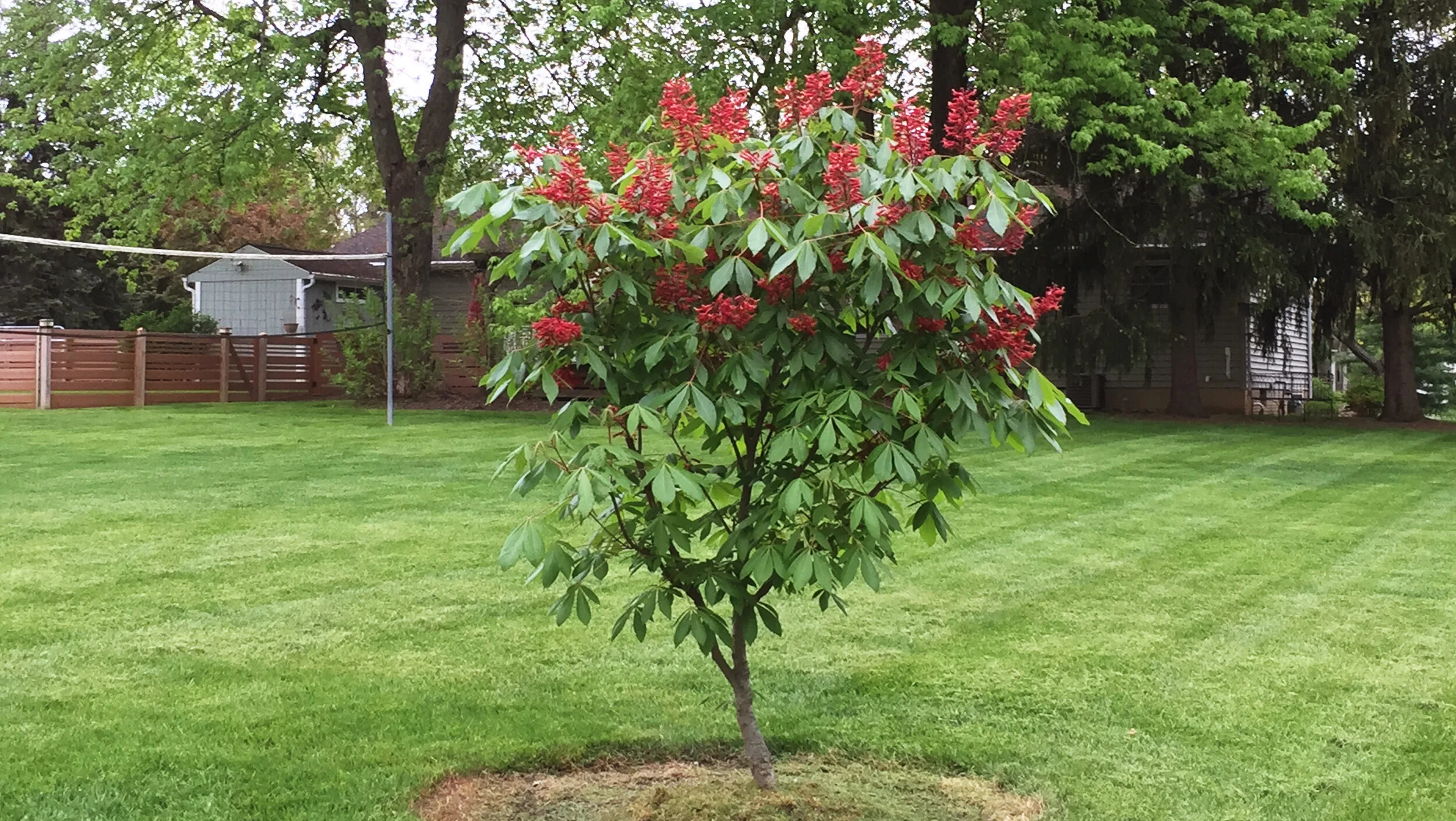
Red Buckeye (Aesculus pavia)
© Russell Tree Experts
A couple of other small ornamentals that can handle wet areas would be the Sweetbay Magnolia (Magnolia virginiana) and the Pawpaw (Asimina triloba). The Sweetbay which blooms later in the spring than other varieties, is not quite as showy, but makes up for it with their scent. The Pawpaw is known for the fruit that it produces. See a previous article written by Jose Fernandez to learn more about the Pawpaw.
A couple of trees that you can find growing naturally along our river banks and streams would be the River birch (Betula nigra) and the American Sycamore (Platanus occidentalis). Both are loved for the year round appeal of their bark. The Sycamore can become quite large and should be properly sited. We often find River birch planted in the wrong location as well. Their root systems can become quite aggressive in search of water.
If you have a pond or small stream and plenty of room there is always the Weeping willow (Salix babylonica). People have always loved its graceful habit, but like other trees on this list it must be properly sited. Another favorite seems to be the Red Maple (Acer rubrum) but as we learned from TJ Nagel in a previous article, you need to be careful where you plant Red Maple due to incompatible soils in much of central Ohio. They do have amazing fall color though and tolerate wet conditions if properly sited.
A couple of native trees that also produce amazing fall color are the Black gum (Nyssa sylvatica) and the Sweet gum (Liquidambar styraciflua).
And last there are a couple of trees in the oak family as well that tolerate wet conditions. There is the Willow Oak (Quercus phellos) and the Swamp White Oak (Quercus bicolor) which are both beautiful and long lived trees if planted in the right location.
Although many of these trees can be considered nuisance trees if not properly sited, they all can be beautiful if planted where they are meant to be.
If you have lost trees recently due to fungal issues or site conditions in the last few years, please take the time to speak with an arborist about the right tree for the right location.
Sincerely,

Mike McKee | Regional Manager, Russell Tree Experts
Mike graduated from Hocking College in 1983 with a degree in Natural Resources specializing in urban tree care. He has been a certified arborist since 1991. Mike started his career in the private industry in 1985 before becoming a municipal arborist in1989. He retired after serving thirty years before joining us at Russell Tree Experts in Sept. of 2018. His love of trees has never waned since trying to climb up the ridges of the massive Cottonwood tree in front of his childhood home.
Happy Arbor Day!
Today (April 24th, 2020) is Arbor Day so let’s celebrate by learning about the history of this wonderful day and watch a video of the beautiful trees of Central Ohio!
Today (April 24th, 2020) is Arbor Day so let’s celebrate by learning about the history of this wonderful day and watch a video of the beautiful trees of Central Ohio!Iron and Manganese Deficiency

© Russell Tree Experts
By Enrique Arayata
ISA Certified Arborist® OH-7252A
April 13, 2020
Nutrient deficiency such as with iron or manganese, is no joke for trees. It can lead to reduced growth, wilted leaves, and with enough time, death of the tree. One common symptom of iron or manganese deficiency is chlorotic leaves: the pale yellowish green discoloration of leaves. Today, I would like to talk about the who, what, when, where, and whys of nutrient deficiencies along with how to resolve this issue.

Iron or manganese deficiency in trees occurs when a tree’s roots are unable to take up these minerals from the soil. Some may believe that this is due to a lack of said nutrients in the soil, but in most cases, it is due to the high pH of the soil. pH is used to measure how basic or acidic a solution is. 0 is highly acidic, 14 is highly basic, and 7 is considered neutral. When the soil is too alkaline (basic) for the plant, the mineral nutrients are in a difficult form for roots to take up.
Many parts of Ohio contain highly alkaline pH soil. This is due to the parent material deep below the surface. Starting from the surface of the ground to the bottom, there are four horizon layers: O, A, B, and C. Each horizon is deeper than the next and there are less and less organic materials and clay. Below horizon C is the parent material that makes up the content of the soil above it. The parent material around much of Ohio, mostly in northwestern Ohio, contains limestone, which has a high pH. Marble, a high pH metamorphic rock, along with limestone, is heavily present in the parent material around Columbus and central Ohio. Would it come as a surprise that Marble Cliffs, Ohio has a lot of marble (and limestone) or that the soil in central Ohio has a high pH? Some studies have also shown that soils near freshly poured concrete have a high pH due to leaching of limestone from the concrete to the soil.

Trees with iron or manganese deficiency may have chlorotic leaves due to chlorosis. Chlorosis is a condition where leaves produce insufficient chlorophyll which leads to a yellow, white, or pale discoloration. If you look at the images below, one may argue that chlorotic leaves look visually appealing, but what cannot be argued is that it is a sign of poor tree health. Without treatment, a tree’s growth will be stunted and its leaves will begin to wilt or develop spots. With enough time, the tree will eventually die. Although chlorosis is a result of iron or manganese deficiency, it may also be a result of insect problems, disease, drought, soil compaction, or poor drainage. Before treating your tree for nutrient deficiency, it is important to identify that it is indeed your tree’s issue. If unclear, the best solution would be to send a soil sample to a lab to determine the issue. In central Ohio, trees to watch out for include pin oak, red oak, shingle oak, sawtooth oak, maple, sweetgum, river birch, holly, and sweetbay magnolia. I have also been told in my World of Plants class at The Ohio State University that people in central Ohio should avoid planting rhododendrons because they too do not survive well in highly alkaline soils.

Chlorosis in a pin oak tree
© Russell Tree Experts

Chlorosis in a river birch tree
© Russell Tree Experts
So let’s talk about how to resolve iron or manganese deficiency. The best solution is to avoid plants that favor acidic soils, such as the trees mentioned earlier. When selecting trees and plants, favor locally sourced when possible since they will be adapted to local soils. If a tree is chlorotic due to high soil pH, seasonal fertilization with iron and/or manganese supplements will be necessary. There are various ways that this can be done. Remember that the parent soil will continue to raise pH over time, so treating the soil with aluminum sulfate or elemental sulfur seasonally will help lower soil pH, making existing iron and manganese more available to plants.
Hopefully you enjoyed reading this article and learned a fact or two as I did in my World of Plants class at The Ohio State University and while researching more on this topic. Thank you for reading! For more information about soil, leaves, and fertilization, I will share two links to similar articles written by TJ Nagel and José Fernández.
The Importance of Green Leaves by TJ Nagel: https://www.russelltreeexperts.com/arbor-ed/2018/7/17/d686ziqwja9frp132ba4btg8owmtsk?rq=Chlorosis
Test Before Treatment: Soil & Tissue Testing by José Fernández: https://www.russelltreeexperts.com/arbor-ed/2018/11/5/tree-science-soil-amp-tissue-sampling?rq=Chlorosis
Sincerely,

Enrique Arayata I Media Production Manager, Russell Tree Experts
Enrique is an ISA Certified Arborist® and FAA Certified Remote Pilot. In his free time, he enjoys working out, hanging out with his family and girlfriend, video production, photography, cars, technology, and cooking. Enrique has a BA in moving image production with a double minor in film studies and studio art specializing in photography from The Ohio State University, and an AA in web graphic design from DeVry University. His favorite tree is the Kwanzan cherry tree.
When and How to Prune Lilacs
Common lilacs (Syringa vulgaris) are a favorite landscape shrub here in Ohio and beyond, with flowers that provide beauty and an unmistakable fragrance every spring. Other cultivars of lilacs offer different habits and uses in the landscape, but provide the same display of flowers that we all love. In order to ensure you get the most flowers on your lilac year after year, it’s important to know when and how to prune them.
By Walter Reins
ISA Certified Arborist® OH-5113A
March 6, 2025
Common lilacs (Syringa vulgaris) are a favorite landscape shrub here in Ohio and beyond, with flowers that provide beauty and an unmistakable fragrance every spring. Other cultivars of lilacs offer different habits and uses in the landscape, but provide the same display of flowers that we all love. In order to ensure you get the most flowers on your lilac year after year, it’s important to know when and how to prune them.
When To Prune
As a general rule for all lilacs, they should be pruned immediately after they’re done flowering in the spring. Since lilacs set next year’s flower buds right after the current year’s flowers have faded, pruning later in the summer or fall will result in cutting off many or all of next year’s flowers. This rule of timing applies to the larger common lilacs as well as the cultivars that are shorter or more “shrub” like. While the “when” of pruning lilacs is fairly straightforward, the “how” gets a little trickier. To keep things simple for now, we’ll think of lilac pruning as either maintenance pruning or rejuvenation pruning.
How To: Maintenance Pruning
For any lilac shrubs that have not outgrown their space or are still producing vibrant flowers each year, regular pruning can simply consist of any shaping that you choose to do along with removal of dead, diseased, or broken stems. You can also remove spent flowers from your lilacs to help encourage a cleaner growth habit and appearance. It’s always better to do this type of pruning by hand, rather than shearing. When making cuts, try to cut back to an outward facing bud. A good pair of hand pruners is the perfect tool for this and makes for much better pruning cuts than hedge shears.
How To: Rejuvenation Pruning
If you’ve ever had an older common lilac in your landscape that went unpruned for many years, you’re probably familiar with their overgrown, unruly habit when left alone. Many people mistakenly believe that these shrubs have stopped flowering at this point. Oftentimes what’s actually happening is the flowers are being produced on just the upper portions of the shrub where the plant has reached a taller height and is exposed to sunlight. Once they’ve reached this stage, we’re often left to stare at bare, woody branches at eye level and below. For these overgrown shrubs, we can remove entire older canes or stems that are 2” in diameter or larger to encourage a rejuvenation of the shrub. We want to apply the rule of thirds when doing this type of pruning - Remove approximately one third of the older canes or stems each year for 3 years. This gives the shrub a chance to slowly transition back to a fuller, shorter shrub with more new growth filling in from the bottom. If you decide to drastically prune the entire shrub this way all at once rather than just a third of it, a little extra care like fertilization and watering will be important to encourage new growth. Note that this “all at once” approach is generally not recommended for the health of the shrub.
Your lilac flowers can be influenced by many things, including the temperature, soil conditions, even disease and insect problems, but proper pruning goes a long way to ensuring they put on a great show every spring. And remember, if you have specific questions about pruning or anything tree and shrub related, your dedicated Russell Tree Experts arborist is only an email or phone call away.
*New* Video!
To accompany the above article, Walter Reins demos how to prune lilac trees in this new video! Click below!
Please note: This article was originally published on 4/6/2020 and was republished on 3/6/2025.
ADDITIONAL ARBOR ED ARTICLES!


Walter Reins | Regional Manager, Russell Tree Experts
Walter became an ISA Certified Arborist® in 2003 and has a degree in landscape horticulture. He has 25 years of experience in the tree and landscape industries and originally began working at Russell Tree Experts in 2011. Walter is also the owner/operator of Iwakura Japanese Gardens, a small design/build/maintenance firm specializing in Japanese-style gardens, and also offers responsible tree planting for all landscapes.
At home on the Blue Ridge Parkway
If you asked any of my colleagues why they like working at Russell Tree Experts, you might expect to hear answers about our great equipment, our camaraderie, or the training we provide and knowledge, etc. These things are all true. It may surprise you though that one of the most interesting and exciting things we offer as a tree care company is the unique opportunity for our employees to travel and work on out of town projects. Over the last year our crews have mobilized to…

© Russell Tree Experts
If you asked any of my colleagues why they like working at Russell Tree Experts, you might expect to hear answers about our great equipment, our camaraderie, or the training we provide and knowledge, etc. These things are all true. It may surprise you though that one of the most interesting and exciting things we offer as a tree care company is the unique opportunity for our employees to travel and work on out of town projects.
Over the last year our crews have mobilized to the far SE corners of Ohio, West Virginia, Niagara Falls, South Carolina, Tennessee, Valley Forge Historic Park, Pennsylvania and the Blue Ridge Parkway in North Carolina and Virginia - all in the name of arboriculture. These projects give us opportunities to observe a wide range of tree species and environments. They also provide an opportunity for us to see new places and experience new things.

I had the privilege of working several weeks on the Blue Ridge Parkway this past fall and winter with our crews that have been steadily working there over the last six months. Our mission is to clear 317 vistas between Ashville, NC and Roanoke, VA and we’re about a week away from the finish line.
If you aren’t familiar with the Blue Ridge Parkway, it is 469 miles of breathtaking, long-range vistas as well as close-up views of the rugged mountains and amazing flora. It runs from Cherokee, North Carolina to Waynesboro, Virginia mostly along the spine of the Blue Ridge, a mountain chain that is part of the Appalachian mountains.
Throughout the parkway the National Park Service has created over 900 vistas by removing large swaths of trees and vegetation so that hikers and motorists can easily enjoy the long range views of the valleys and surrounding landscapes. The work that we are performing is to maintain these views by re-removing trees that have been cut down previously and also removing invasive species that are quick to attempt to colonize these sunny locations.
While working on this project I have crossed paths with the some of most spectacular specimen of sourwood, hemlock, American holly, Carolina silverbell, mountain ash, rhododendron, American chestnut, witch-hazel, frasier fir, red spruce, pitch pine, striped maple, magnolia, chestnut oak and many others. Many of these trees are growing at home in my garden; Some better than others.
I’d like to share some of my favorite parts of my Blue Ridge Parkway experience with you:
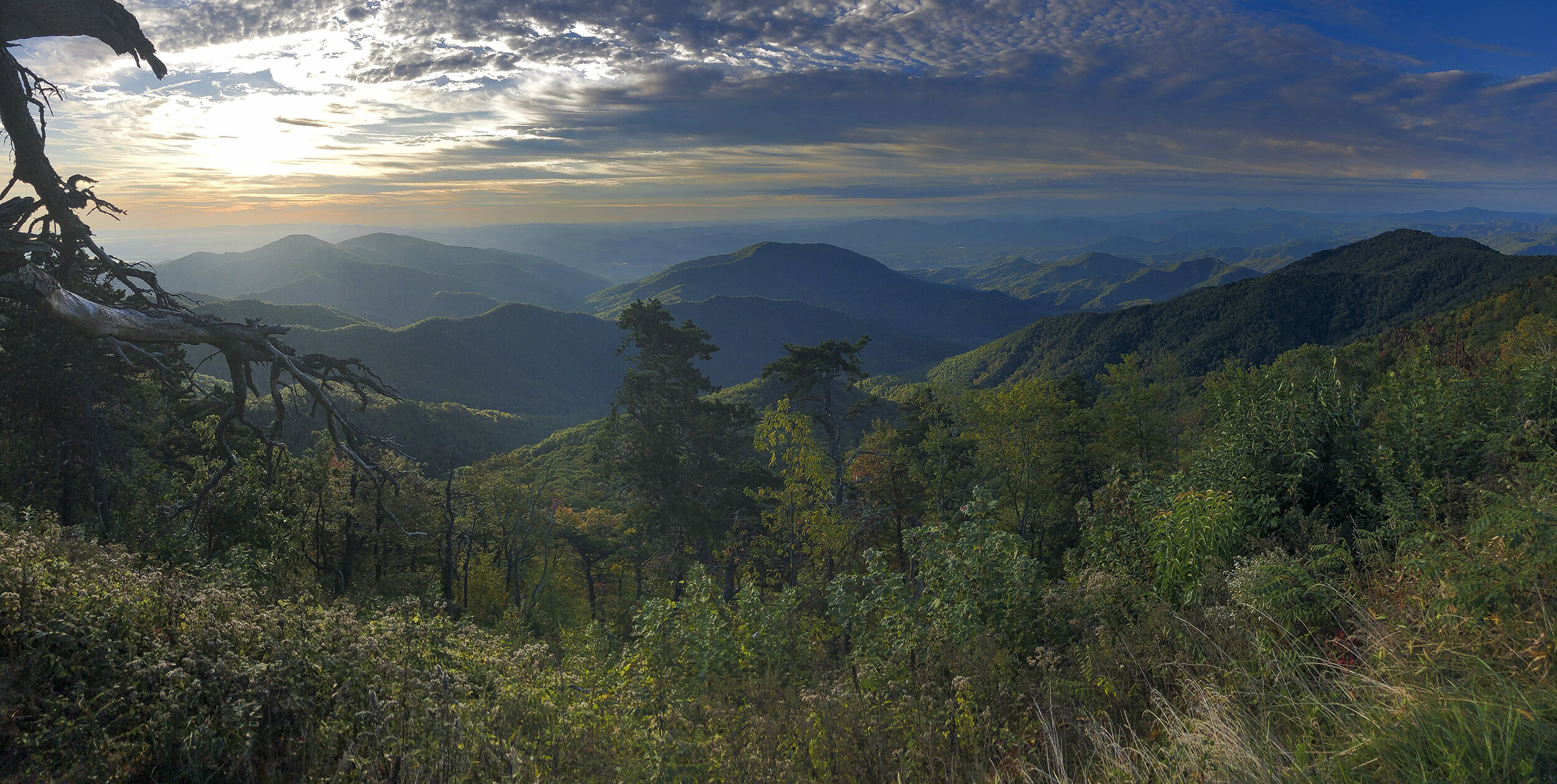
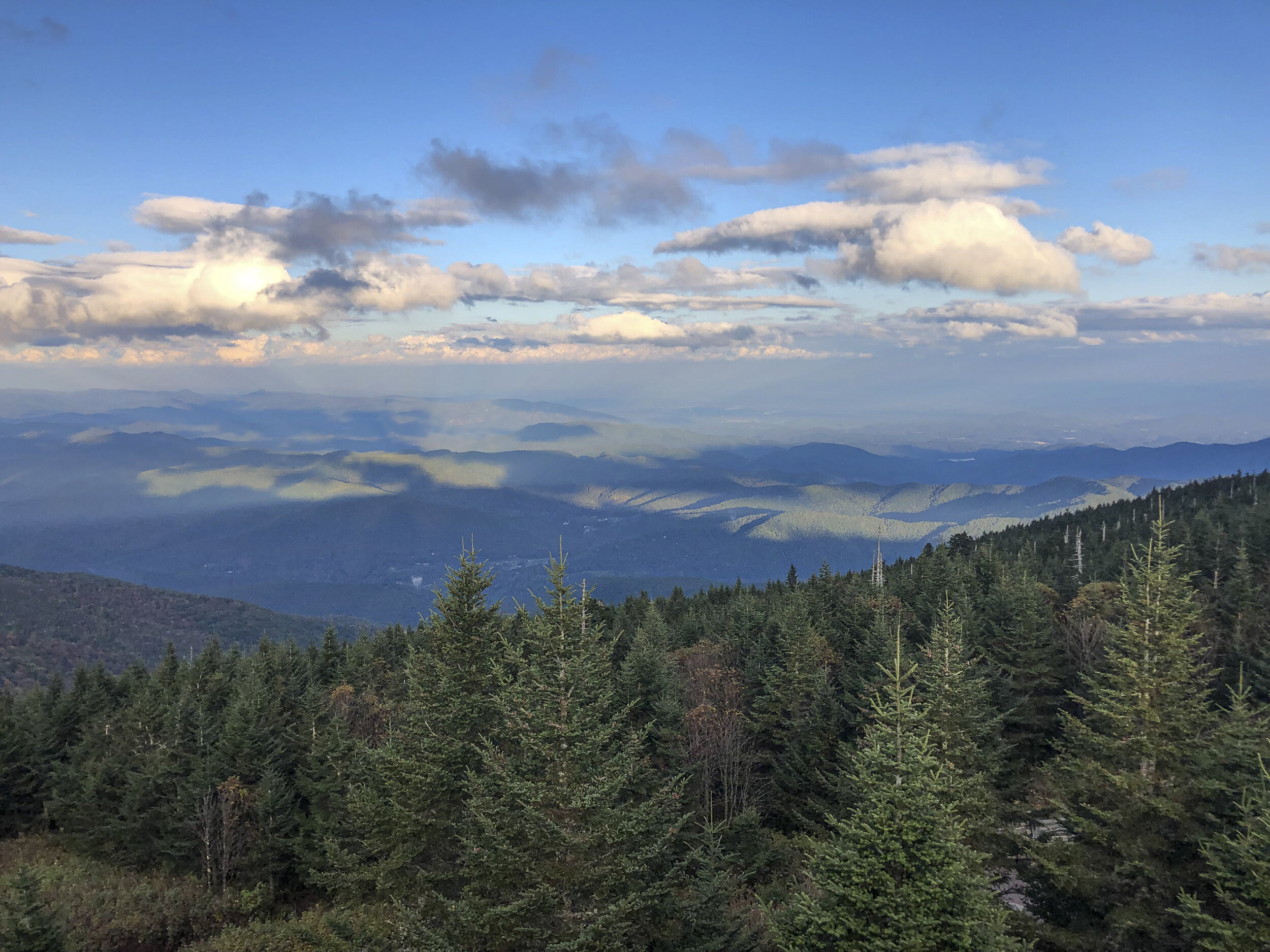
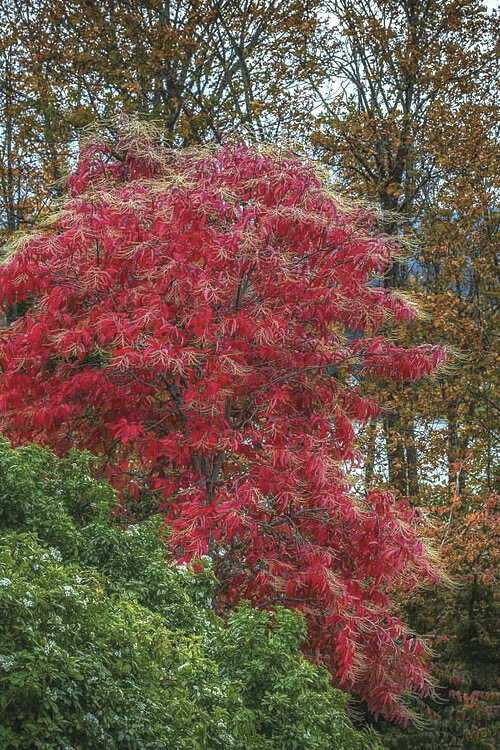
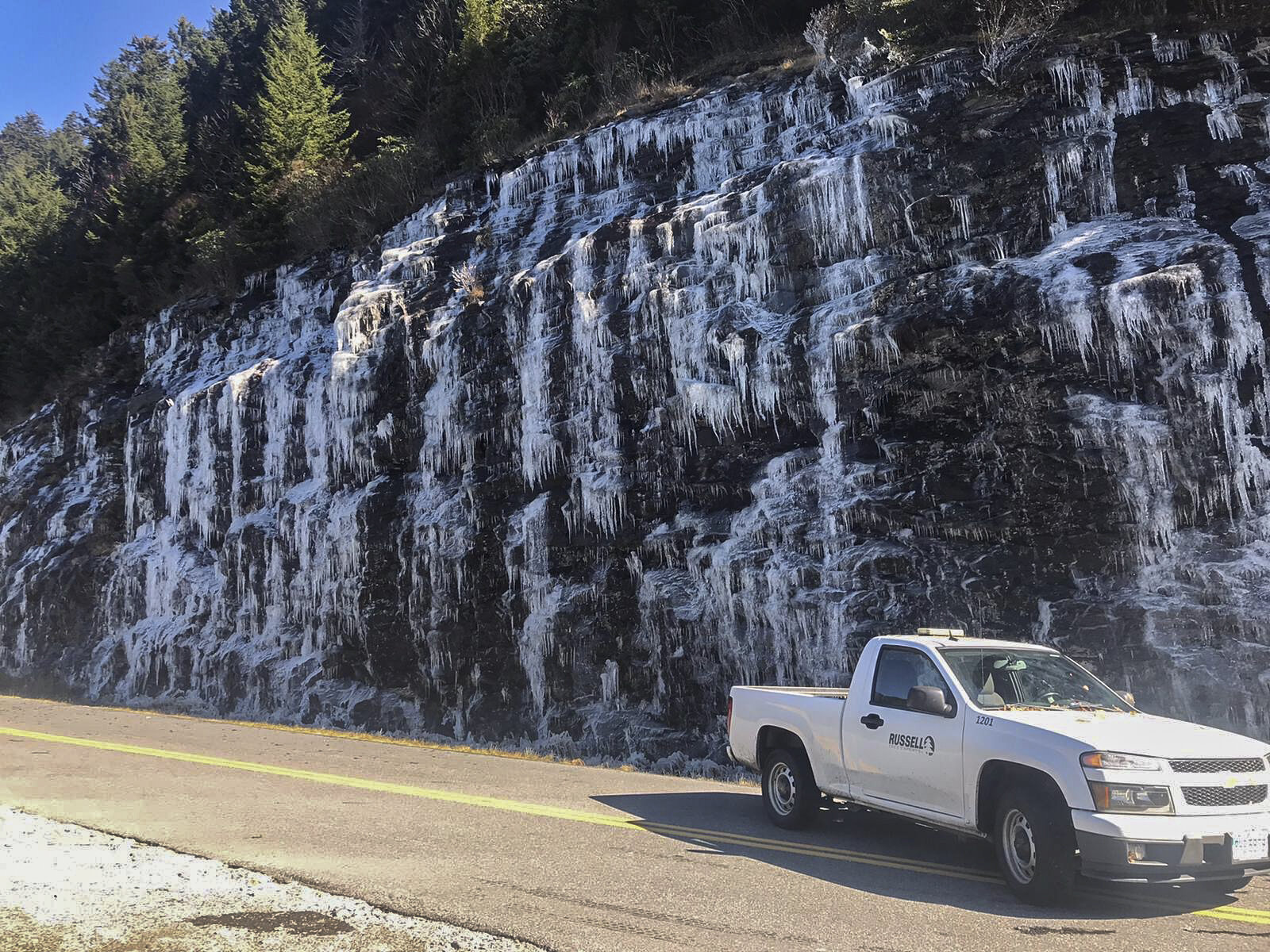
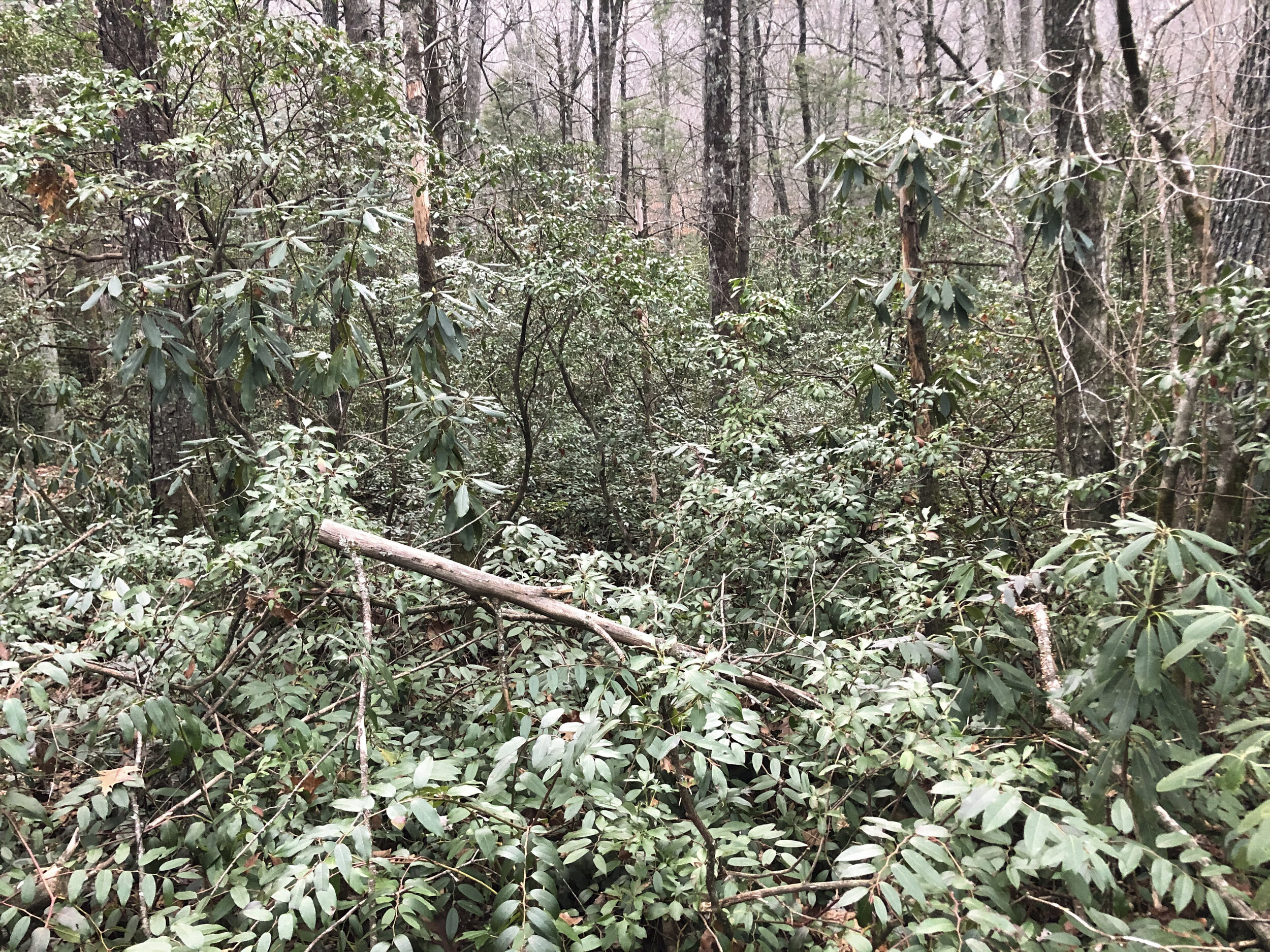
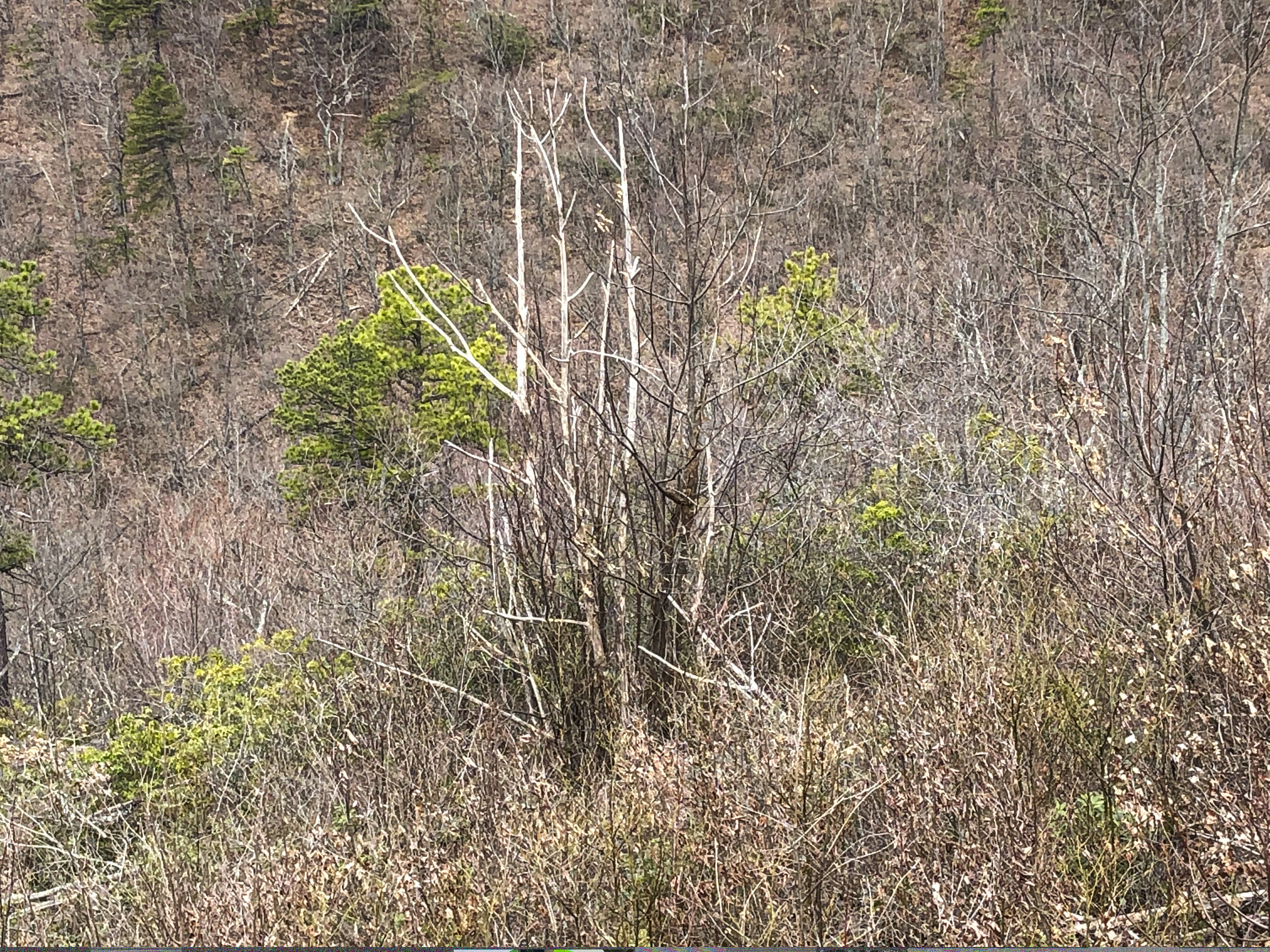
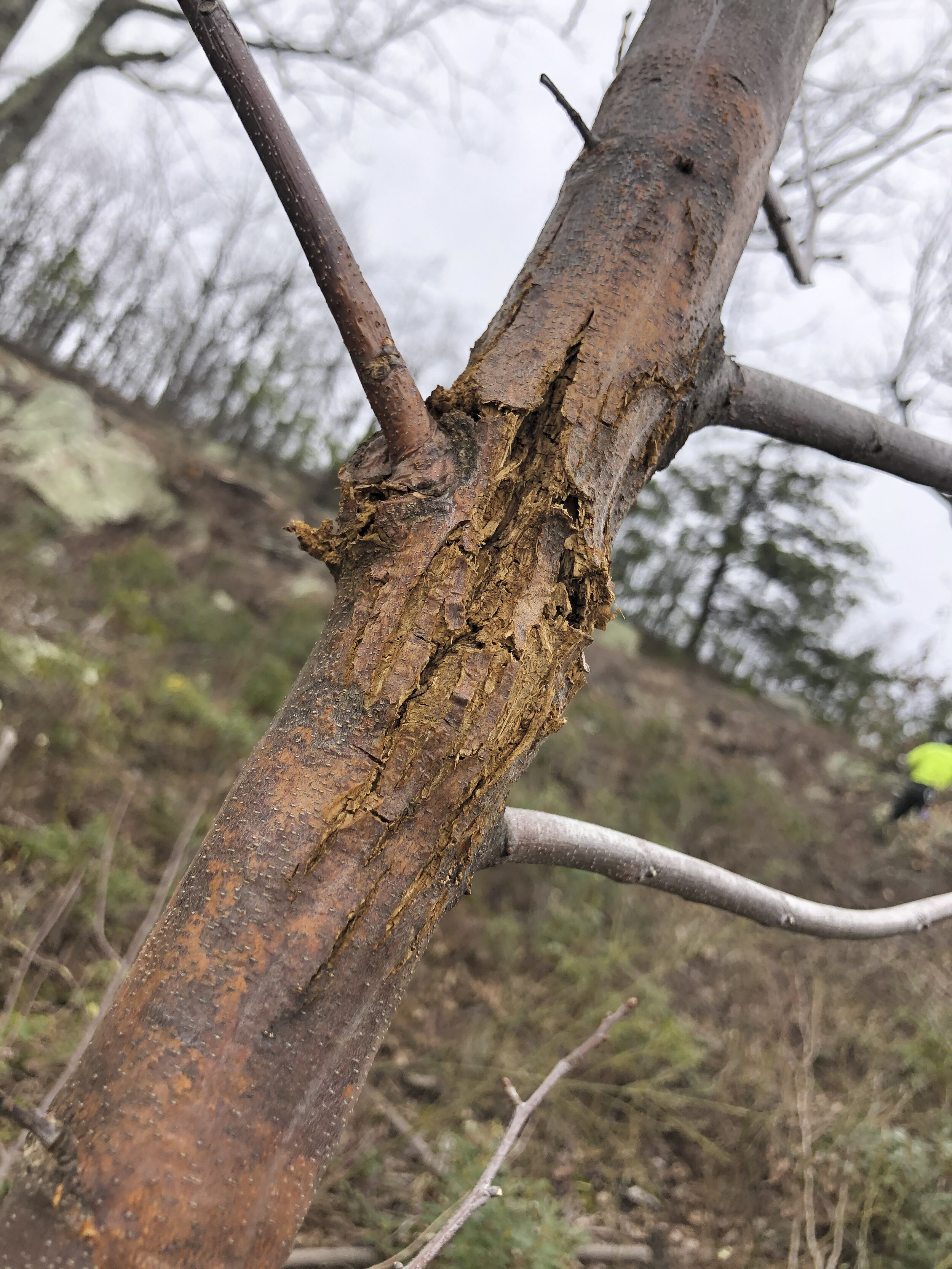
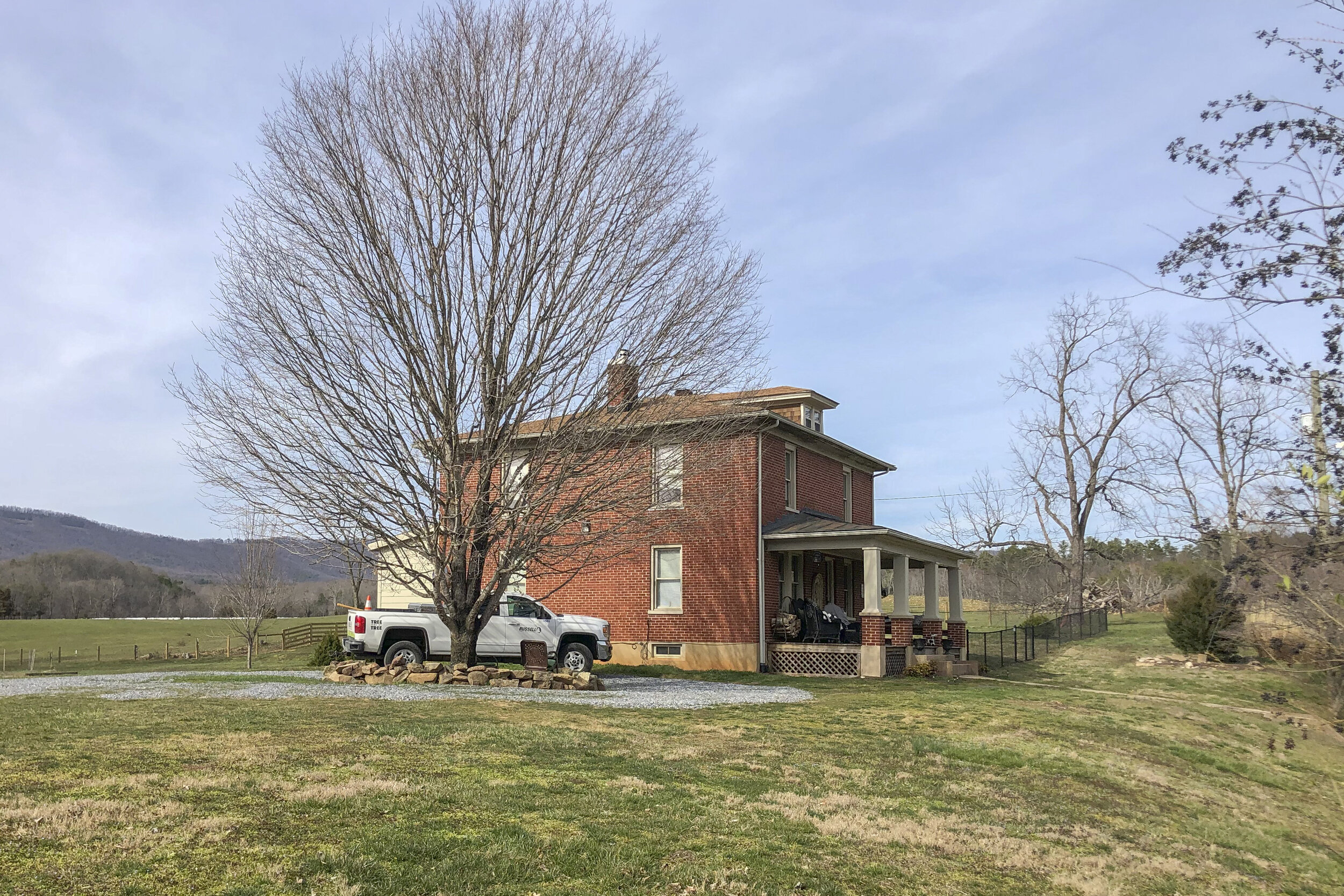
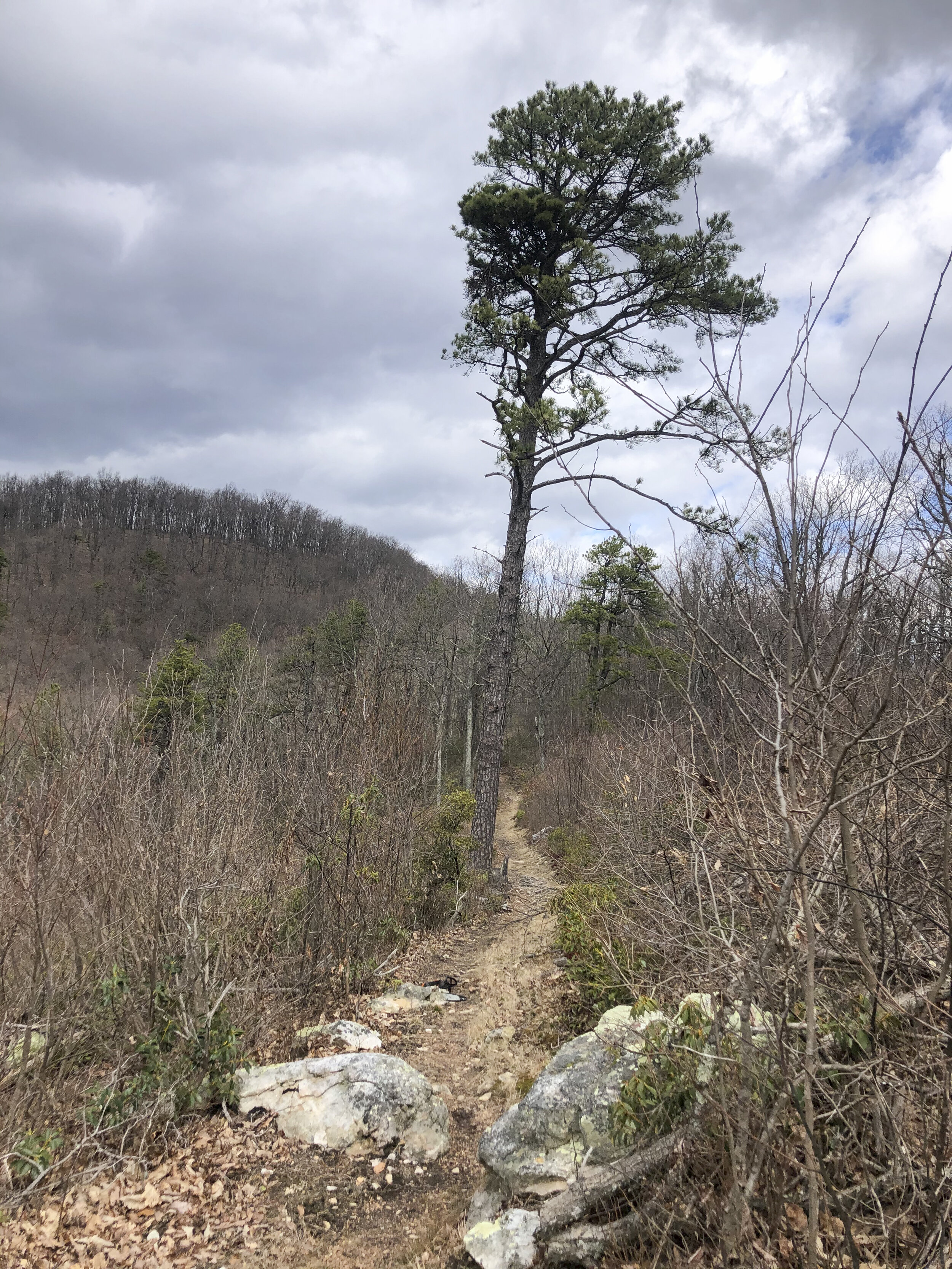
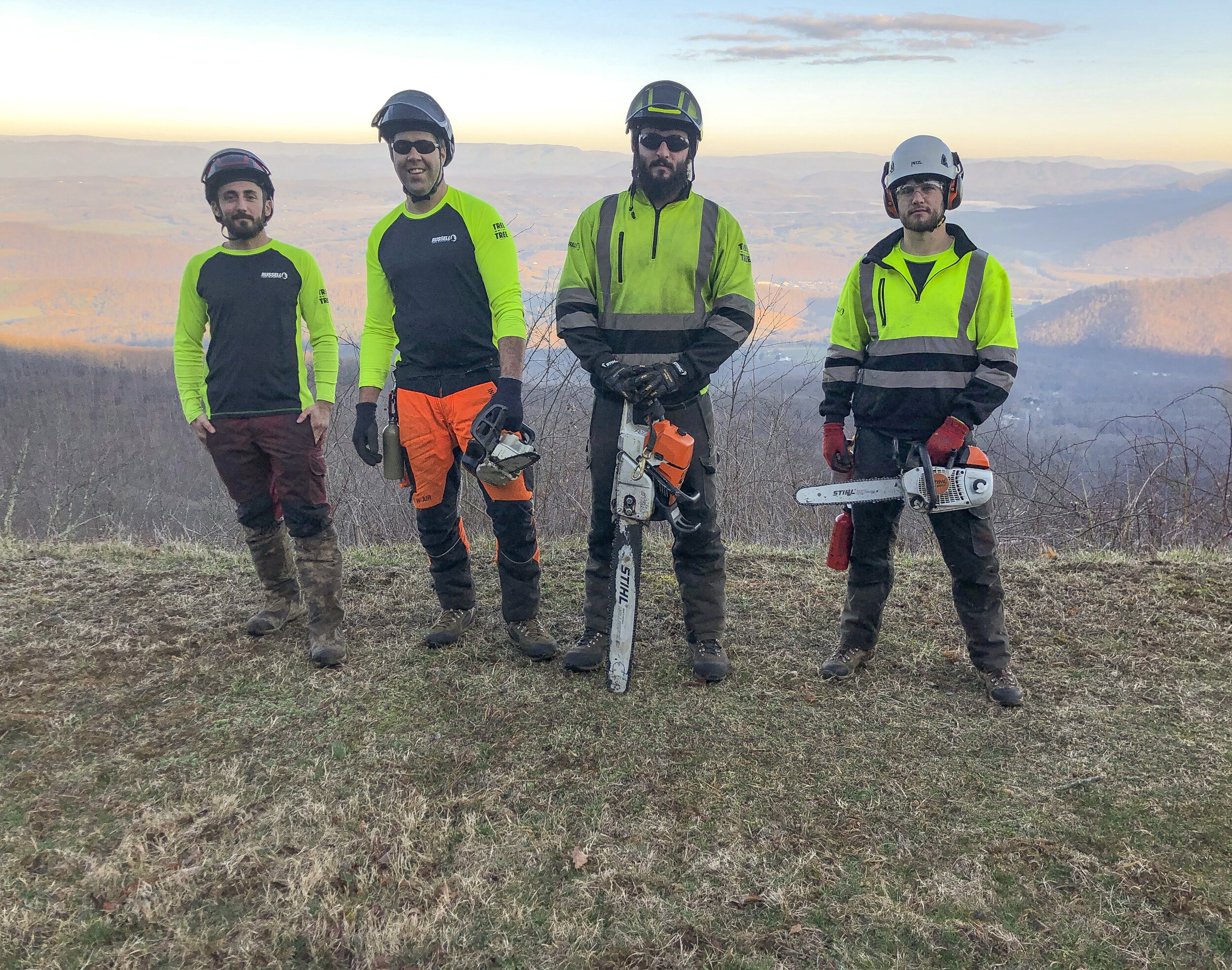
Every part of the Blue Ridge parkway is inspiring. It is open 24 hours a day (barring extreme weather events) and every part of it is free. There is a direct relationship between happiness and humans getting back into nature, and my time at the Blue Ridge Parkway reinforced that.

TJ Nagel | Scheduling Production Manager, Russell Tree Experts
ISA Certified Arborist® OH-6298A // Graduated from The Ohio State University in 2012, Earned B.S. in Agriculture with a major in Landscape Horticulture and minor in Entomology // Tree Risk Assessment Qualified (TRAQ) // Russell Tree Experts Arborist Since 2010
The Small Hours
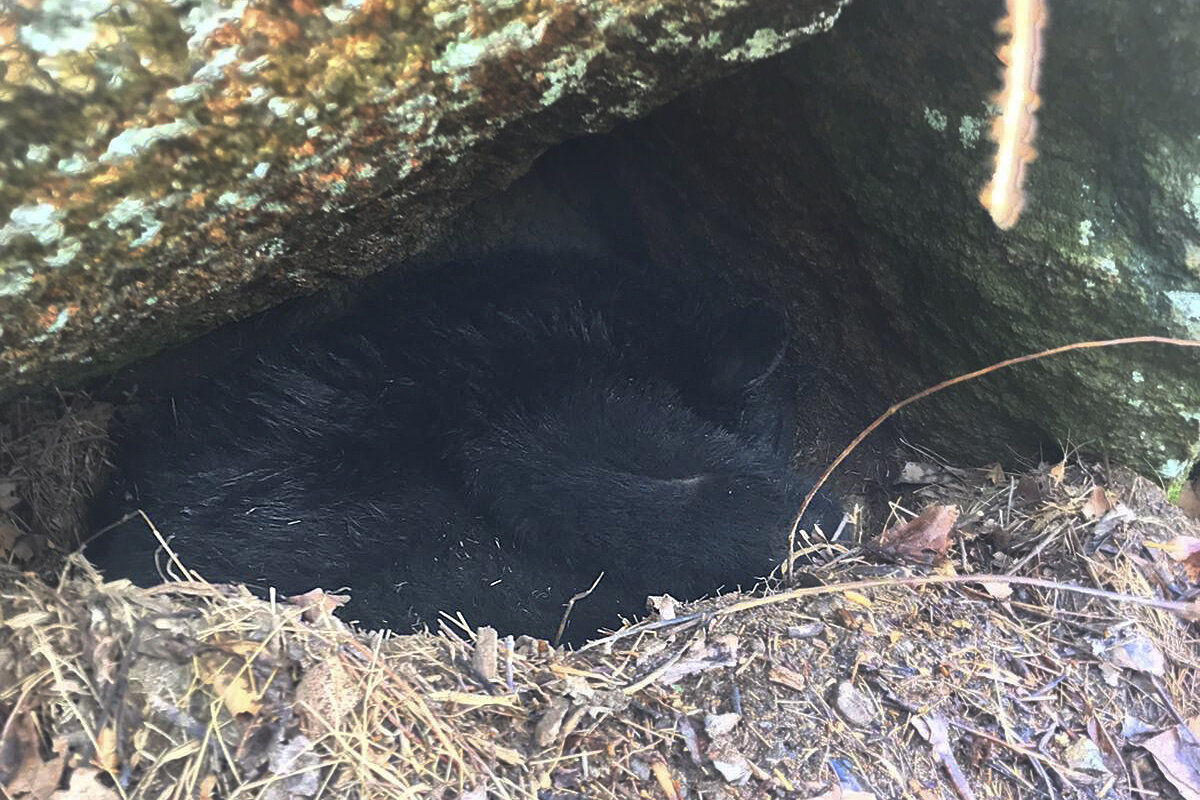
Welcome to the no man’s land that is the front line between a winter that does not want to surrender and a spring that is determined to break through. Two weekends ago on the 13th I did some late winter camping in reasonably mild weather with a forecast that promised no precipitation on the 14th. I spent the day in the woods with my father, clearing some paths and just enjoying being outside. I noticed buds on a spicebush (pictured below) that were getting a little excited and were starting to swell. Things are waking up! I love seeing the first signs of spring that remind me life is flowing beneath the surface.

© Russell Tree Experts
Dear Reader,
Welcome to the no man’s land that is the front line between a winter that does not want to surrender and a spring that is determined to break through. Two weekends ago on the 13th I did some late winter camping in reasonably mild weather with a forecast that promised no precipitation on the 14th. I spent the day in the woods with my father, clearing some paths and just enjoying being outside. I noticed buds on a spicebush (pictured below) that were getting a little excited and were starting to swell. Things are waking up! I love seeing the first signs of spring that remind me life is flowing beneath the surface.

© Russell Tree Experts
Sometime around midday we sat down on a log to eat some bread and cheese. That’s when I heard what sounded like someone was sprinkling sand onto us from up on high. I looked more closely: yes, sleet was falling and collecting on my clothes. As the afternoon progressed the sleet intensified, then got wetter, eventually turning into snow that did not stop through the two hour drive home. By the time we made it home there was a good inch of snow everywhere. Amazing how quickly things can change.
The snow was gone by Monday, and I spotted my first forsythia in bloom (below) at a client’s house. Another sign that winter is fading away! Supposedly there will be three more snows left after the forsythia blooms. I wish I knew if this forsythia had bloomed before or after the snow two days ago!

© Russell Tree Experts
My week progressed with more of the same. The earliest of spring flowers were coming out. They are usually not very conspicuous, only revealing themselves to those who are looking for them. These early bloomers are more demure, not willing to make a big splash this early in the party. Things are still quiet, but the arrival of these first guests means things are going to get louder very soon.
Here is a red maple in full bloom a day later:

© Russell Tree Experts
And one day later, on Wednesday, Cornelian-cherry dogwood, making its subtle statement…
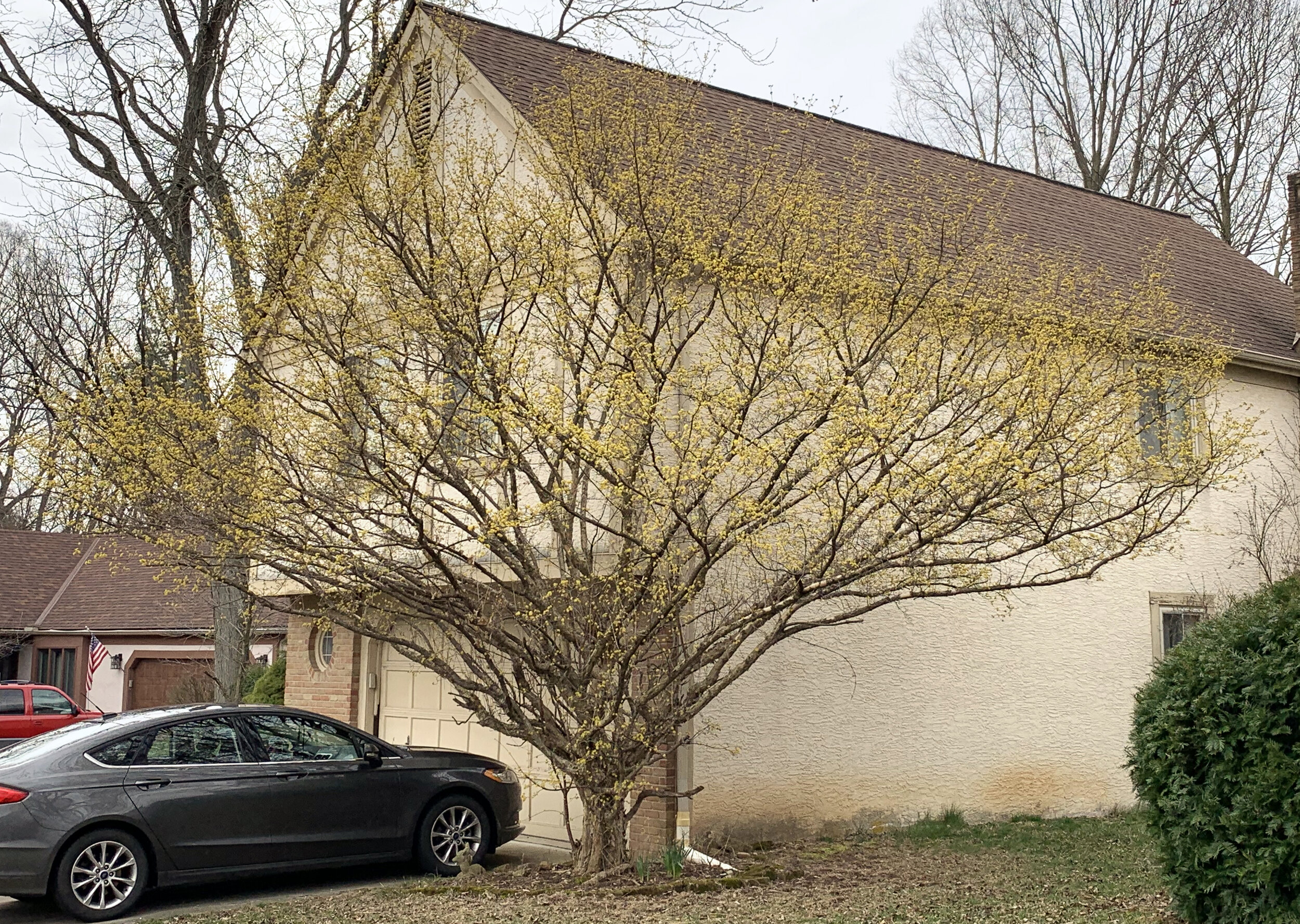
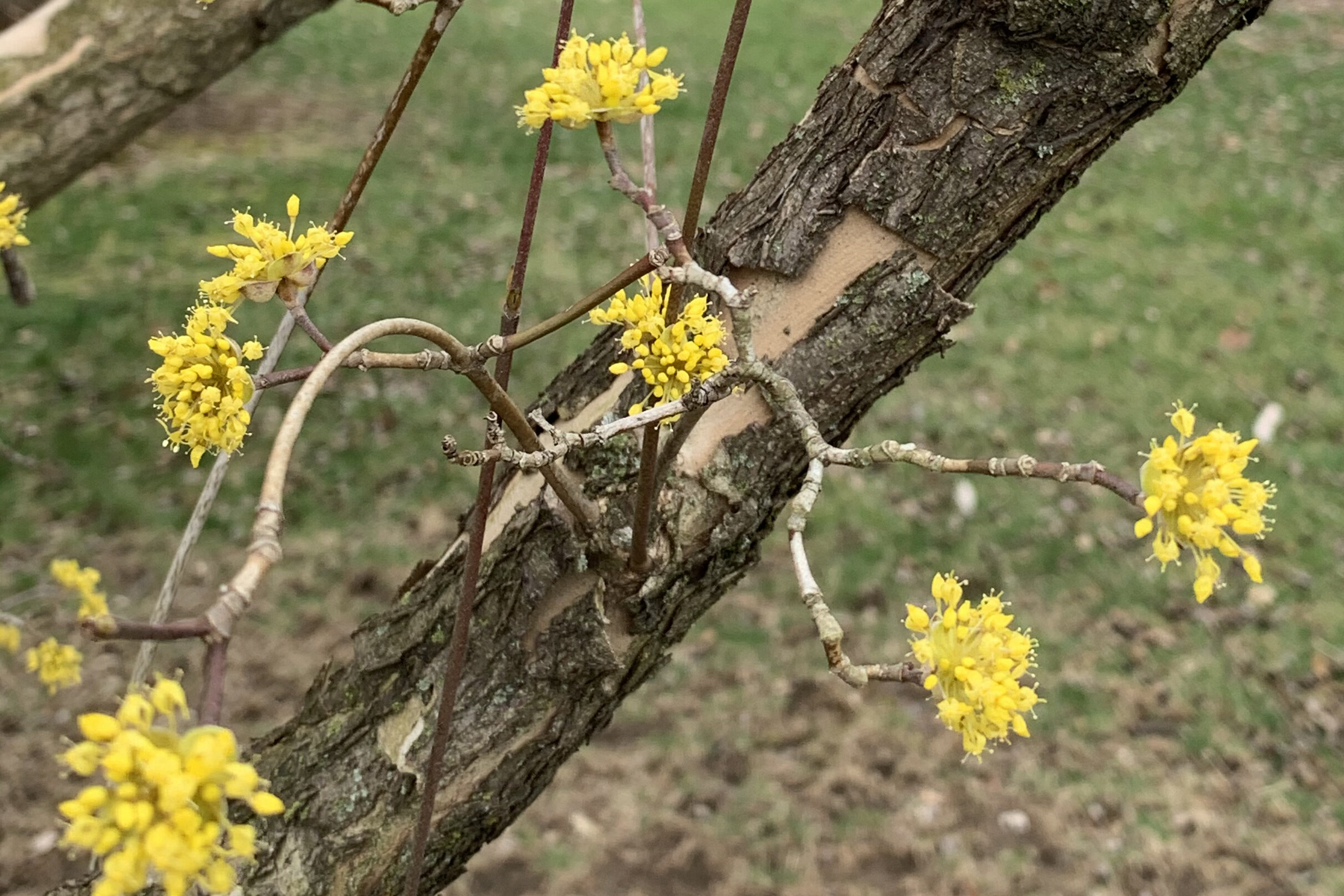
And on Thursday I had to stop and admire this pussy willow collecting raindrops on its swelling flower buds:

© Russell Tree Experts
All during this time I have noticed wildlife waking up as well. I saw a garter snake in my back field pretending I couldn’t see it. I walked around it not wanting to hurt its feelings. In the same area, some ants were slugglishly thinking about doing some spring cleaning; I could tell they still needed to finish stretching out a bit before they started to work. Birds are way ahead of them – I saw a wren picking through some straw for some nest building materials while her mate kept watch a few yards away. A pair of sparrows is nesting in one of my porch columns. Birds are singing away the silence of winter, and even the spring peepers did not stop their call through a low in the mid 20’s that weekend. I guess the plants and animals are just as tired of gray, cold weather as everyone else is.
As I reviewed these photos to share them with you I noticed the background in each one is gray, overcast skies. Given recent developments around the world and now in our own community I could not help but draw a parallel between these photos and what is happening in our world. The sky above seems gray, temperatures go up and down. News updates keep coming in. Today it’s rain, tomorrow it’s snow. We have to stay inside, looking out the window wondering if spring will really come. But I have been outside, and I’ve seen the buds swelling, the flowers emerging, the birds and animals getting on. I’ve had the true pleasure to be able to speak with several of you last week as we met in your lawns to discuss trees, plants, and other things. Yes, we had to keep our distance, but it’s amazing how there is no distance between a friendly smile and a word of encouragement shared between two people. Yes, it is amazing how quickly things can change. Yes, the sky overhead may seem gray, and we are tired of staying inside waiting for the world to change back into a more comfortable place. But I have seen the signs of life carrying on in your landscapes and in your hearts. Yes, for now we keep our distance, but a wave, a smile, a letter, a telephone call will serve to remind one another that this miracle we call life is far greater than we understand, and if we keep moving forward together, the gray skies will clear and we will see that the sun was always there behind the clouds.
“Sorrow may last for a night, but joy comes in the morning.” Winter would like to remain in the world and in our hearts, but life and light are so refreshingly and so reliably rebellious. May that spring morning come soon for all of us.
Your friendly neighborhood arborist,

José Fernández | Regional Manager, Russell Tree Experts
José became an ISA Certified Arborist® in 2004, and a Board-Certified Master Arborist® in 2015. Currently he is enrolled at The Ohio State University pursuing a Master’s Degree in Plant Health Management. José likes working around trees because he is still filled with wonder every time he walks in the woods. José has worked at Russell Tree Experts since 2012.
COVID-19 Update
As an Essential Business, Russell Tree Experts will remain open during this "Stay at Home" Order to provide services necessary to maintaining the safety and essential operation of residences and public infrastructure.
Please note that we will be prioritizing essential services such as the assessment and mitigation of hazardous or potentially hazardous limbs and trees, cabling or bracing of hazardous trees, utility and road clearance, emergency response readiness, public works contracts and other services deemed essential by the State of Ohio and Homeland Security.
In order to ensure the safety of our employees, we will be following enhanced guidelines to ensure a safe and hygienic workplace:
We will continue to monitor the body temperature of all employees.
We will continue to require staff who believe they are sick to remain home.
We will continue to have staff work remotely when possible.
We will continue to stagger crew start times.
We will continue to stock disinfectant and other cleaning materials for use by all staff.
We will continue to sanitize our facilities each day.
We are sanitizing the cab and shared areas of each truck, every day.
We will continue to observe social distancing guidelines by only scheduling one person per vehicle.
In addition, for your safety and ours, we would kindly ask that you not approach our crews or Regional Managers as they conduct tree work or assess your trees. We will be more than happy to address your questions by email at sales@russelltreeexperts.com.
We are thankful for your business and know that we will come through these difficult times together.
Sincerely,
Russell Tree Experts

My Experience as a Video Production Intern
Over the course of 12 weeks from late-May to mid-August of 2019, I was a full-time video production intern at Russell Tree Experts. During my time as an intern, I created service videos summarizing many of the various services that Russell Tree Experts offers such as pruning, stump grinding, and insect and disease management. I also created “video shorts” highlighting a specific job site or aspect of tree care.

© Russell Tree Experts
By Enrique Arayata
ISA Certified Arborist® OH-7252A
March 9, 2020
Over the course of 12 weeks from late-May to mid-August of 2019, I was a full-time video production intern at Russell Tree Experts. During my time as an intern, I created service videos summarizing many of the various services that Russell Tree Experts offers such as pruning, stump grinding, and insect and disease management. I also created “video shorts” highlighting a specific job site or aspect of tree care.
I was very excited to begin this new opportunity and adventure as I would have something productive to do over the summer while strengthening my video production skills. However, it was quite intimidating because of my lack of arboriculture knowledge. Prior to working at Russell Tree Experts, I used to call oak trees “acorn trees.” Nonetheless, I did not let that deter me from accepting the challenge and opportunity. I was excited that Kenny Greer, Shari Russell, and Matt Vaughn had every bit of faith in me as the person best fit for this internship position.
To help me step foot into this new career path, I was allotted time to study educational resources from Russell Tree Experts, American National Standards Institute (ANSI), and Occupational Safety and Health Administration (OSHA) to quickly learn the ins and outs of the tree industry. At times, I even looked at manuals for specific equipment such as chainsaws and articulated loaders. The most useful resource however was verbal communication with the staff at Russell Tree Experts. It is incredible how knowledgeable everyone is when it comes to not just tree removal or tree pruning, but with tree wellness, arboriculture, and horticulture. After getting to know many of my fellow coworkers and after visiting many job sites to record video, it was clear to me that the people of Russell Tree Experts are passionate about their work and that they know how to best diagnose a tree and recommend a specific service instead of defaulting to just removing the tree.
Now, I am a video production assistant at Russell Tree Experts. Currently, I am working on producing more service videos, producing training videos for incoming employees, and finding ways to leverage video for marketing and advertising purposes. My major is in moving image production with a double minor in film studies and photography. Russell Tree Experts is incredibly flexible and accommodating towards my class schedule and there are many opportunities to learn more about tree care or video production when needed. On a personal note, because of their work benefits and flexibility of hours, I am on track to graduate college debt free, and for that, I could not be more grateful. If you are interested in seeing what a typical day can be like for me, down below there is a video about it from my personal and self-titled YouTube channel: Enrique Arayata. Along with that are some of my favorite videos that I have created throughout my time at Russell Tree Experts!
Overall, my internship with Russell Tree Experts was life-changing and I learned so much about the tree industry. In terms of career building, I learned how to operate a camera drone, strengthened my video production skills, and reaffirmed my interest and career path towards video production. Most importantly, I expanded my network and created relationships with positive and supportive people who have the best interests in mind for myself, for each other, and for the company. I also know now that acorns come from oak trees.
What It’s Like Being A Video Production Intern For A Summer!
Careers at Russell Tree Experts
Stump Grinding Service Overview
Dam Debris Removal
Sincerely,

Enrique Arayata I Media Production Manager, Russell Tree Experts
Enrique is an ISA Certified Arborist® and FAA Certified Remote Pilot. In his free time, he enjoys working out, hanging out with his family and girlfriend, video production, photography, cars, technology, and cooking. Enrique has a BA in moving image production with a double minor in film studies and studio art specializing in photography from The Ohio State University, and an AA in web graphic design from DeVry University. His favorite tree is the Kwanzan cherry tree.
How to Beat the Winter Blues
I look out the window gazing upon the barren winter landscape. I miss the vibrant green leaves on my fragrant viburnums. I miss the beautiful red flowers on my roses. I even miss watching the bees in search of nectar dancing from one pesky dandelion to the next. Most of all I miss the sun and spending my evenings cultivating a new season’s garden. I feel safe to say I have succumbed to the winter blues…

© Russell Tree Experts
I look out the window gazing upon the barren winter landscape. I miss the vibrant green leaves on my fragrant viburnums. I miss the beautiful red flowers on my roses. I even miss watching the bees in search of nectar dancing from one pesky dandelion to the next. Most of all I miss the sun and spending my evenings cultivating a new season’s garden. I feel safe to say I have succumbed to the winter blues.
It happens to me this time every year. I survive through January and February only to be teased by March. We have a nice day here, a nice day there, and all the middle filled with what seems like more never ending winter. I stop at a local garden store dreaming of a sea of color, annuals and perennials as far as the eye can see, only to find out their nursery stock is only still beginning to arrive. What am I to do? I am ready to make my way out into the landscape but it appears winter is still here!
Have no fear, I have found the answer. These occasional beautiful March days aren’t to be wasted; they are the perfect opportunity to prepare your landscape for spring. Over the years I have developed a few ways to help “scratch” that itch from spring fever:
Pruning your shrubs and trees during dormancy are much appreciated by your plants. Pruning before bud break allows your plants to use its energy in areas you are encouraging as opposed to wasting it in areas you are going to be removing. It is also helpful in reducing the spread of certain pest and diseases.
Cut back and clean up your perennials. March is a great time to cut back your grasses to make way for the new year’s sprouts. Cut back any woody perennials such as butterfly bush or bluebeard to strong stems to prevent floppy plants the following year. Clean up any old foliage from the previous year. This will allow new buds to push through easier and help prevent the spread of pests and disease. Cleanliness is a key factor in reducing many problems in the landscape.
Weed preventer can also be applied in March. This can vary in timing between years but a weed preventer can save you many hours of weeding from just one application.
Start thinking about grass seed. Winter over seeding allows for the seed to germinate early in the season taking advantage of spring rain. Remember, do not apply a crabgrass preventer when over seeding as it can prevent germination of your grass seed.
These are just a few ideas for how I enjoy those warm March afternoons and I am happy to have shared my antidote to the winter blues with all of you. Hopefully you find its effects as fruitful as I have. Although none of these items need to be done right now, they are the perfect little jobs to fill up those randomly beautiful and sunny March days. I know I will be out there and hopefully you will be too.

Andy Bartram | Crew Production Manager, Russell Tree Experts
Planting Trees is Easy... Right?
Tree Planting; It’s easy right? Well that’s what I thought when I took a position years ago (with a different company) where we planted 650 balled and burlapped trees the first year I was there.

Planting Trees is Easy... Right?
Well that’s what I thought when I took a position years ago (with a different company) where we planted 650 balled and burlapped trees the first year I was there.
I had been in the tree industry for about 10 years at the time but didn’t have a lot of planting experience. We had a backhoe, 4 crew members and all the elementary kids in the city to help us. What could go wrong? Well apparently, a number of things. One of the first things we learned was it doesn’t matter how many times you mention to an elementary student that you should not stand on the root ball or hang on the tree trunk while planting the tree. We also learned that it is very hard to keep the elementary students attention for more than 1 or 2 tree plantings. As it turned out, dealing with the students was the easy part. We quickly learned that digging the planting hole with an inexperienced tree planting backhoe operator was also a mistake. As we discovered the following year, many of our trees were planted way to deep. We also had to deal with large chunks of soil which hinders the ability to avoid air pockets around the root balls and clean up was much harder. We later discovered that using a stump grinder to dig our planting holes was much easier and cleaner.
dotted line indicates the root flare
After that first planting season we noticed that we were losing a number of trees. So instead of just yanking them out of the ground we started inspecting each dead tree to see if we could determine what went wrong. A number of them were simply planted to deep. Remember the backhoe, many of the holes were dug to deep. We didn’t realize how important it is that the root flare be visible at grade or even slightly higher than grade.
After even more inspections we found that we planted the top of the root ball at grade, but the root flares were 6 inches deep in the root ball itself. Some of the trees even tried to develop a second root flare called adventitious roots. After that first year we learned that the majority of our losses were from planting too deep.
As the years went on, we continued to learn from our mistakes. One example that really taught us about planting depth were 6 to 7 English Oaks that we planted at one location where they survived but didn’t really grow much. Plans for the site changed a few months later and we decided to move them to a new location. As we were digging them up, we discovered how deeply they were planted. We were able to move them and planted them at the correct depth. They grew over a foot in the first year after being planted properly. It was like they said, “Thank you”.
Another observation that I made recently was at a small clearing job we did in Canal Winchester. The site was a nursery at one time. Apparently when the property changed hands, they left about 12 to 15 balled and burlapped trees just sitting on the ground near some Norway Spruces. Every one of those trees survived and took root in the ground below them and have been growing for several years. So, I guess if you’re not sure, planting trees higher is better than being planted too deep.
I will be following up this article with a tree planting video at a later date. There are many other tips that we learned the hard way that I will be happy to share later.

Mike McKee | Regional Manager, Russell Tree Experts
Mike graduated from Hocking College in 1983 with a degree in Natural Resources specializing in urban tree care. He has been a certified arborist since 1991. Mike started his career in the private industry in 1985 before becoming a municipal arborist in1989. He retired after serving thirty years before joining us at Russell Tree Experts in Sept. of 2018. His love of trees has never waned since trying to climb up the ridges of the massive Cottonwood tree in front of his childhood home.
Editor’s Note: Although Russell Tree Experts doesn’t sell or plant trees (other than for our TREE FOR A TREE® program), we highly value the importance of proper tree planting. See our recommended vendors list for your tree purchasing and planting needs.
Bend So You Don’t Break
Last summer, I had the opportunity to introduce our field staff to the practice of yoga. In heavy work boots and on a hard concrete floor, we made our way through Triangle Pose, Downward Facing Dog, and even a few Sun Salutations. Practicing yoga for 20 years and teaching it for the last 10, I’ve learned that the stretches and postures of yoga can help keep the joints and soft tissues of our body, like muscles and tendons, healthy and functional.

© Russell Tree Experts
Last summer, I had the opportunity to introduce our field staff to the practice of yoga. In heavy work boots and on a hard concrete floor, we made our way through Triangle Pose, Downward Facing Dog, and even a few Sun Salutations. Practicing yoga for 20 years and teaching it for the last 10, I’ve learned that the stretches and postures of yoga can help keep the joints and soft tissues of our body, like muscles and tendons, healthy and functional. Tree care consists of many tasks that are demanding on the physical body, and yoga is a great way to address tightness in areas like the neck and shoulders, hips and lower back, and even the hands and wrists. This can lead to greater mobility and functional movement when lifting heavy wood or climbing a tree. We now have a regular morning yoga practice at Russell Tree Experts(with mats!), every Tuesday and Thursday before the crews begin their day. Even our mechanics and office staff join in.
This combination of yoga and trees got me thinking back to a significant winter earlier in my career as an arborist. On December 22nd, 2004, Columbus was hit with a nasty winter storm. I was living far enough north of the city at the time that I saw nothing but snow at my home. Columbus, however, received a devastating combination of snow and ice. I was an ill-equipped new homeowner, so after hand-shoveling my 350ft gravel driveway (oh, to be 23 again…), I made my way to work and was in disbelief over what I saw. Because of the heavy ice accumulation, there were trees and limbs down in practically every yard. Many white pines and siberian elms had literally been stripped of every limb and left to look like totems or coat racks. There were also river birch and arborvitae bent over so much (but not broken) that their tops were touching and frozen to the ground. What is typically a slower time of year in the tree care industry proved to be very busy, and day after day of cleanup carried us straight into spring.
That winter provided me with valuable insight into the strengths and weaknesses of trees. Some types of trees with stiffer wood fibers didn’t fare as well, while others that had the ability to bend, but not break, held up much better under heavy loads. Many of those river birch and arborvitae that I mentioned righted themselves by mid-spring and were able to be preserved.
So what does all of this have to do with proper tree care? We obviously cannot change the inherent nature of a tree’s wood fibers and make them bend more or bend less. Nor can we prevent major weather events. But, we can proactively address existing weaknesses in a tree, and we can also ensure that pruning is performed properly, so as not to create a vulnerability that otherwise wouldn't have existed. Just like yoga can help us avoid injury or illness by keeping our bodies flexible and healthy, proper tree care can do the same for our trees. Here are a few examples:

Removing large cracked/broken limbs
These limbs are obvious hazards to targets like homes and pedestrians if they fall out of the tree, but they can also do additional damage to the tree itself. A structurally unsound limb, if left in the tree, can place unwanted stress on otherwise healthy limbs if it breaks but doesn’t fall out completely. Eliminating these defective parts of a tree allows the rest of the canopy to structurally function at its best.

Making proper pruning cuts
When pruning cuts are made correctly, a healthy tree will compartmentalize and attempt to close off the wound that was created. This helps to prevent decay of the woody portion of a limb or trunk that gives a tree its strength. Improper cuts don’t close up correctly and can become areas where decay eventually spreads into the tree. This greatly increases the risk of failure or breaking when forces like wind or ice act upon that part of the tree.

Avoiding “Lion’s Tailing”
This is a term used to describe the improper pruning of a tree where all the lateral branches have been removed from the larger limbs, leaving each of those limbs with brush only at the ends and looking like “lion’s tails”. Aside from aesthetically ruining a tree, this improper method of pruning can actually concentrate forces like wind or added weight at the point of attachment, rather than distributing it throughout the length of the limb. In high winds especially, this can lead to an increased risk of failure.
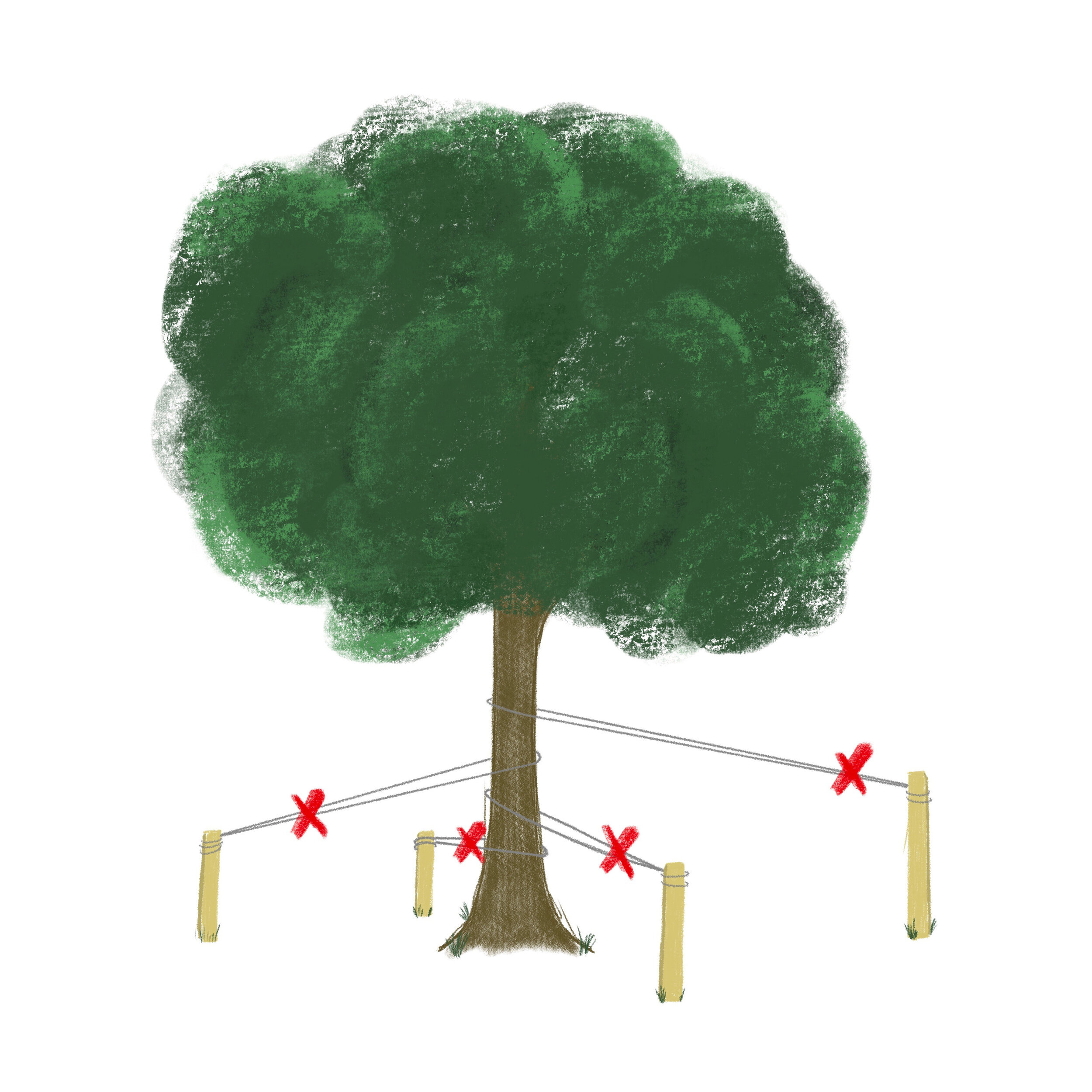
Minimize staking of new trees
This one has more to do with proper tree planting than it does with proper care of established trees, but it’s worthy of mentioning. Young trees will actually develop stronger roots and wood fibers in response to forces placed upon them. A newly planted tree needs to get “thrown around” a bit in the wind in order to properly establish and “bend” with future stressors rather than “break”(or blow over in this case). Staking a tree, especially beyond the first year, provides an artificial system of support that the tree will come to rely on for as long as it’s in place. Think of it as “tough love” for young trees.
These are just a few key examples of how proper tree care gives our trees a chance to thrive, adding function and value to our landscapes. Prevention is the best medicine - we know this to be true for ourselves, and it’s equally true for our trees.
Were you in Columbus for the winter ice storm of 2004? Leave your stories and experiences of that winter in the comments below. Or do you have a yoga practice and appreciate the strength that comes with flexibility? Share your thoughts with us.
For now, I’m going to work on getting my Oak to try something other than Tree Pose.

Walter Reins | Regional Manager, Russell Tree Experts
Walter has been an ISA Certified Arborist since 2003. He graduated from Montgomery College in Maryland with a degree in Landscape Horticulture, and has called Columbus, OH his home for nearly 20 years. Walter appreciates trees for their majesty and the critical role they play in our world.
Growing Degree Days
This semester I am enrolled in a class called Integrated Pest Management, taught by Dr. Luis Cañas at The Ohio State University. One of the first lectures we had was centered around the effects that the environment has on insect populations. As we explored this theme we soon came across the concept of “growing degree days”, and I was reminded of how useful this idea is to increase awareness of what is happening in the natural world around us and to be aware of when potentially damaging insect pests are about to emerge.

This semester I am enrolled in a class called Integrated Pest Management, taught by Dr. Luis Cañas at The Ohio State University. One of the first lectures we had was centered around the effects that the environment has on insect populations. As we explored this theme we soon came across the concept of “growing degree days”, and I was reminded of how useful this idea is to increase awareness of what is happening in the natural world around us and to be aware of when potentially damaging insect pests are about to emerge.
Reminded? Yes. At Russell Tree Experts we have been using growing degree days for years now as a tool to help when scheduling our tree wellness services. Seeing the concept again in class made me want to share it with all interested readers.
The concept of growing degree days is based on three basic principles which I will draw from my lecture notes provided by Dr. Cañas:
A “degree day” is the term used for the amount of heat accumulated above a specified base temperature within a 24-hour period.
The base temperature is (ideally) also the “lower temperature threshold”, which is the temperature below which a certain insect will not grow or develop. This is determined by research.
“Cumulative degree days” are just that: the number of degree days that have built up since a certain starting point (in general, since the beginning of the year).
What does this mean for living creatures? This is where things get interesting, so I’m glad you’ve read this far. Have you ever wondered how an insect knows it is time to hatch, or lay eggs, or go into pupation, or finish pupation so it can emerge as an adult? Is it increasing hours of daytime as days get longer after winter? (Maybe, but not quite directly). Is there some sort of internal clock that is ticking that just tells insects when to go into the next stage of development or propagation? But what if that clock went out of sync with environmental conditions? If you are reading this, you are very likely in central Ohio. Lovely state that it is, what do all Buckeyes say about the weather in our state? Exactly. Case in point: Here I am on Monday, February the 3rd, and today I was taking off clothes since I dressed for winter in the morning and got ambushed by 60 degrees and sunny. But the forecast looks like snow by Wednesday.
So what is it? Well, people devoted to these questions looked into it and found that apparently it is the accumulation of heat over time that causes insect development to proceed in synchrony with environmental conditions. So for a given insect, development will begin and continue above a certain temperature (low temperature threshold). Once so many degree days have accumulated (again, specific to the insect type), an egg will hatch, or an adult will emerge, or a nymph will grow into a more advanced stage, for example. These numbers can be identified for insects by watching and measuring. One simple formula (there are others that are more complicated) for tracking degree days is like this:
Starting on January 1st, the low temperature and the high temperature within that 24-hour period are logged. Those two temperatures are averaged, and the base temperature (low temperature threshold) is subtracted from the total.
For example: The high today was 61. The low was 50. 61+50= 111. 111/2 = 55.5, the average temperature. Let’s assume a certain insect, we can call it “Steve”, ceases all development when temperatures drop below 50 degrees. We would subtract 50 from 55.5, resulting in 5.5 degree days for today, February 3rd. Note that this number is only accurate for my specific area, since highs and lows are different throughout the state. This is another advantage of this system: It allows us to track Steve’s development in our own back yard!

Continuing with our friend, research has shown that Steve will emerge from pupation as a feeding adult after the accumulation of say, 548 cumulative degree days. What we would do is track degree days every day until we reach at least 548. After we reach that amount we would expect to start seeing Steves show up in our back yard on whatever plants Steves like to hang out on, doing whatever it is Steves like to do when they show up. The neat thing about this is that if we have a cold snap that lasts 3 weeks, even after two days of t-shirt weather in February (which is quite normal for Ohio right?), Steve’s development will simply pause, since degree day accumulation will slow down dramatically during the cold snap. Any day that there is at least 1 degree day, Steve will continue to develop, albeit much more slowly than if there were 20 degree days added on a given calendar date.
If you take the time to think this through you will start to connect all kinds of dots together that will make you marvel at the intricacy of our natural world, and how interconnected everything is. Nothing short of miraculous.
We’re almost done. One more tidbit: Plants seem to follow a similar pattern. This is not only neat, but useful! Since plants also follow this pattern it is only to be expected that certain plants will be at certain stages in their development each spring when Steve is at certain stages of his development each spring. So let’s say it just so happens that my Purple Robe Black Locust is starting to get all dressed up in her pink party dress at around 548 cumulative growing degree days, and that just happens to be the same amount of degree days that Steve needs to finish pupating and emerge as an adult. Instead of calculating degree days to watch for Steve, I can simply keep my eyes on my flowering tree. When I see her in full bloom I know that Steve is also out and about. In this case we call my Black Locust a “phenological indicator”. Her blooming is an outward sign of development in a plant that coincides with an important stage of insect development, thus serving as an indicator for that insect life stage.
The Ohio State University is full of very hard working citizens who study these things. Not only that, they track these things for us and give us a handy tool that does all the calculations (more complex versions than the basic one I shared) and tabulates events at the same time. Check out the resource here: https://www.oardc.ohio-state.edu/gdd/. Delve into it a bit. If you did not know about degree days and how they affect plants and insects, you will be amazed, if you are interested in the outdoors. If you already knew about these things before reading this article, I hope reading this made the concept a bit more accessible. Maybe now you can readily expound on the topic at the next ice cream social you are invited to. Be careful though- you would not want it to be your last. In any case, I am fairly certain you will not find a Steve on the OSU website I gave you above. Steves are not considered to be plant or tree pests so they have not been studied by our worthy scientists.
As always, thank you for reading. I am humbled by all the support I get from my readers. I have had the pleasure of conversing with many of you over the years and count myself blessed because of it.
Your friendly neighborhood arborist,

José Fernández | Regional Manager, Russell Tree Experts
José became an ISA Certified Arborist® in 2004, and a Board-Certified Master Arborist® in 2015. Currently he is enrolled at The Ohio State University pursuing a Master’s Degree in Plant Health Management. José likes working around trees because he is still filled with wonder every time he walks in the woods. José has worked at Russell Tree Experts since 2012.
Oak pruning, fascinating tree facts, and other thoughts
Here we are, fresh out of the holiday season, and the end of January is in sight! I wanted to reach out to you with some timely advice concerning trees, some reminders of why trees are so essential to life as we know it, and perhaps some other thoughts that might sneak out through my fingers as I type.
© Russell Tree Experts
Dear Reader,
Here we are, fresh out of the holiday season, and the end of January is in sight! I wanted to reach out to you with some timely advice concerning trees, some reminders of why trees are so essential to life as we know it, and perhaps some other thoughts that might sneak out through my fingers as I type.
I recently shared some of my experiences dealing with invasive plants with a nice group of folks who are part of PRISM (Partnership for Regional Invasive Species Management). At the end of my talk I went off topic for a moment to leave these people with a warning concerning Oak trees. Those of you who have been following our emails for a while probably recall we have devoted two separate issues entirely to oak wilt, since we had a laboratory confirmed case in Franklin County several years ago with one of my clients. I am disturbed by how many oak trees are still being removed and pruned within the window of time that is considered high risk for spreading the disease.
At Russell Tree Experts we decided that oak pruning would be scheduled in the fall and winter months, between October 1 and March 15, in order to avoid the time when Nitidulid beetles are active, attracted to pruning wounds, and potentially vectoring the disease pathogen from infected trees to healthy trees.

My purpose here is simply to remind you to please spread the word to raise awareness of this disease. I recently met a new client who had someone offer to prune his Red Oak for him. He politely inquired of the person making the offer if he was aware that it was not the proper time of year to prune oak trees because of the risk of oak wilt. The would-be tree pruner was not aware of this. Good job, Tom! If only more and more tree managers were able to do the same thing perhaps awareness of the fact that central Ohio residents know and care about their trees will eventually raise the standard of tree care in our communities. I am happy to say that reputable tree care companies are aware of oak wilt in our area and are able to communicate the proper way to deal with this problem.
I end this note with a quick reminder: If you have an oak tree you need to prune, please have the work done before March 15! Otherwise plan for a fall/winter pruning. Incidentally, the same practice is advisable if you have an elm tree. Dutch elm disease and oak wilt are very similar diseases on different species of trees.
On to other things
I attended a tree root seminar hosted by the Ohio Chapter of the ISA some weeks ago. Much of the material presented came from a resource that was new to me. I spoke to the moderator about this book and ordered it from Amazon before the lunch break was over. The book is called Applied Tree Biology, by Andrew Hirons and Peter Thomas. I was impressed at the amount of current information that has been brought together into one volume centered around the theme of how to use all the good research that is out there in order to promote tree health. I wanted to share several bits of information these authors put into their book, which was published in 2018.
From the first chapter (facts are italicized, followed by my comment in parenthesis);
There are three trillion trees around the world. (And just think, we actually need to plant more!)
Forests hold around 45% of the carbon stored on land (2780 gigatons).
Forests help determine weather patterns by how they can evaporate large amounts of water which form clouds, producing rain downwind. Recent discovery of a chemical made and released by trees called pinene can help clouds form to produce rain by acting as nuclei for water to form around. (Are you blown away by this? I was. There is so much we still do not know!)
All the world’s forests hold more than 80% of the world’s species.
The same chemicals that can cause cloud formation are known to reduce tension and mental stress in humans, increasing feelings of well-being and decreasing aggression and depression.
Over 100 million ash have been lost in the northeastern USA since 2002 due to the emerald ash borer. This loss of trees in urban environments has been linked to increased human mortality as a result of higher levels of cardiovascular and respiratory diseases. Increases in crime have also been linked to the loss of ash trees to EAB. (This brings it home, doesn’t it? I found it strange that one of the most present problems during my career as an arborist has provided study opportunities for learning about the seemingly intangible values of trees in relation to human society).
Incredibly, this book is in the format of a textbook. The authors are from the UK, and I am finding their writing style to be refreshingly accessible for a topic that can become rather dry even for an arborist who loves his work. Right before the table of contents there is a page titled “Epigraph” with a quote taken from a work from 1664 titled Sylva, by a fellow named John Evelyn. I was frankly astounded that I found such a quote in a textbook written in 2018. I will share it with you at the end of this installment. Some of you may like it, some of you may not. I merely share it as found. Reading the quote made me wonder what this textbook was going to be like. It also reignited in me the sense of a deeper mystery surrounding our everyday life that keeps me looking ahead for more. More of what? I don’t know exactly. Perhaps more of the mystery. This undercurrent of the ever present unknown is easy for me to lose sight of, but when I take the time to listen to a client, seeing the person rather than the tree that needs to be pruned, treated or removed I am reminded that all we do should be centered around the things that have value.
What has value? My neighbor. The animals and plants that are also struggling to make a life not very far from where you are seated right now. The fact that all this is something we have been given, not something any of us planned for before we entered the world. Think about this: Life has been given! Don’t miss it.
Your friendly neighborhood arborist,

José Fernández | Regional Manager, Russell Tree Experts
José became an ISA Certified Arborist® in 2004, and a Board-Certified Master Arborist® in 2015. Currently he is enrolled at The Ohio State University pursuing a Master’s Degree in Plant Health Management. José likes working around trees because he is still filled with wonder every time he walks in the woods. José has worked at Russell Tree Experts since 2012.
Epigraph
In a word, and to speak a bold and noble truth, trees and woods have twice saved the whole world; first by the ark, then by the cross; making full amends for the evil fruit of the tree in paradise, by that which was born on the tree in Golgotha.
From “Sylva”
by John Evelyn, 1664
(Shared directly from Applied Tree Biology, Andrew D. Hirons and Peter A. Thomas. Wiley Blackwell, Oxford, 2018.)
DID YOU KNOW? Tree Care In the Winter
In some cases, pruning trees in winter is actually more beneficial than during other times of the year due to increased canopy visibility and lower risk of disease. Check out the video above to learn more!
DID YOU KNOW?
In some cases, pruning trees in the winter is actually more beneficial than during other times of the year due to increased canopy visibility and lower risk of disease. Check out the video above to learn more!
