
COVID-19 Update
As an Essential Business, Russell Tree Experts will remain open during this "Stay at Home" Order to provide services necessary to maintaining the safety and essential operation of residences and public infrastructure.
Please note that we will be prioritizing essential services such as the assessment and mitigation of hazardous or potentially hazardous limbs and trees, cabling or bracing of hazardous trees, utility and road clearance, emergency response readiness, public works contracts and other services deemed essential by the State of Ohio and Homeland Security.
In order to ensure the safety of our employees, we will be following enhanced guidelines to ensure a safe and hygienic workplace:
We will continue to monitor the body temperature of all employees.
We will continue to require staff who believe they are sick to remain home.
We will continue to have staff work remotely when possible.
We will continue to stagger crew start times.
We will continue to stock disinfectant and other cleaning materials for use by all staff.
We will continue to sanitize our facilities each day.
We are sanitizing the cab and shared areas of each truck, every day.
We will continue to observe social distancing guidelines by only scheduling one person per vehicle.
In addition, for your safety and ours, we would kindly ask that you not approach our crews or Regional Managers as they conduct tree work or assess your trees. We will be more than happy to address your questions by email at sales@russelltreeexperts.com.
We are thankful for your business and know that we will come through these difficult times together.
Sincerely,
Russell Tree Experts

My Experience as a Video Production Intern
Over the course of 12 weeks from late-May to mid-August of 2019, I was a full-time video production intern at Russell Tree Experts. During my time as an intern, I created service videos summarizing many of the various services that Russell Tree Experts offers such as pruning, stump grinding, and insect and disease management. I also created “video shorts” highlighting a specific job site or aspect of tree care.

© Russell Tree Experts
By Enrique Arayata
ISA Certified Arborist® OH-7252A
March 9, 2020
Over the course of 12 weeks from late-May to mid-August of 2019, I was a full-time video production intern at Russell Tree Experts. During my time as an intern, I created service videos summarizing many of the various services that Russell Tree Experts offers such as pruning, stump grinding, and insect and disease management. I also created “video shorts” highlighting a specific job site or aspect of tree care.
I was very excited to begin this new opportunity and adventure as I would have something productive to do over the summer while strengthening my video production skills. However, it was quite intimidating because of my lack of arboriculture knowledge. Prior to working at Russell Tree Experts, I used to call oak trees “acorn trees.” Nonetheless, I did not let that deter me from accepting the challenge and opportunity. I was excited that Kenny Greer, Shari Russell, and Matt Vaughn had every bit of faith in me as the person best fit for this internship position.
To help me step foot into this new career path, I was allotted time to study educational resources from Russell Tree Experts, American National Standards Institute (ANSI), and Occupational Safety and Health Administration (OSHA) to quickly learn the ins and outs of the tree industry. At times, I even looked at manuals for specific equipment such as chainsaws and articulated loaders. The most useful resource however was verbal communication with the staff at Russell Tree Experts. It is incredible how knowledgeable everyone is when it comes to not just tree removal or tree pruning, but with tree wellness, arboriculture, and horticulture. After getting to know many of my fellow coworkers and after visiting many job sites to record video, it was clear to me that the people of Russell Tree Experts are passionate about their work and that they know how to best diagnose a tree and recommend a specific service instead of defaulting to just removing the tree.
Now, I am a video production assistant at Russell Tree Experts. Currently, I am working on producing more service videos, producing training videos for incoming employees, and finding ways to leverage video for marketing and advertising purposes. My major is in moving image production with a double minor in film studies and photography. Russell Tree Experts is incredibly flexible and accommodating towards my class schedule and there are many opportunities to learn more about tree care or video production when needed. On a personal note, because of their work benefits and flexibility of hours, I am on track to graduate college debt free, and for that, I could not be more grateful. If you are interested in seeing what a typical day can be like for me, down below there is a video about it from my personal and self-titled YouTube channel: Enrique Arayata. Along with that are some of my favorite videos that I have created throughout my time at Russell Tree Experts!
Overall, my internship with Russell Tree Experts was life-changing and I learned so much about the tree industry. In terms of career building, I learned how to operate a camera drone, strengthened my video production skills, and reaffirmed my interest and career path towards video production. Most importantly, I expanded my network and created relationships with positive and supportive people who have the best interests in mind for myself, for each other, and for the company. I also know now that acorns come from oak trees.
What It’s Like Being A Video Production Intern For A Summer!
Careers at Russell Tree Experts
Stump Grinding Service Overview
Dam Debris Removal
Sincerely,

Enrique Arayata I Media Production Manager, Russell Tree Experts
Enrique is an ISA Certified Arborist® and FAA Certified Remote Pilot. In his free time, he enjoys working out, hanging out with his family and girlfriend, video production, photography, cars, technology, and cooking. Enrique has a BA in moving image production with a double minor in film studies and studio art specializing in photography from The Ohio State University, and an AA in web graphic design from DeVry University. His favorite tree is the Kwanzan cherry tree.
How to Beat the Winter Blues
I look out the window gazing upon the barren winter landscape. I miss the vibrant green leaves on my fragrant viburnums. I miss the beautiful red flowers on my roses. I even miss watching the bees in search of nectar dancing from one pesky dandelion to the next. Most of all I miss the sun and spending my evenings cultivating a new season’s garden. I feel safe to say I have succumbed to the winter blues…

© Russell Tree Experts
I look out the window gazing upon the barren winter landscape. I miss the vibrant green leaves on my fragrant viburnums. I miss the beautiful red flowers on my roses. I even miss watching the bees in search of nectar dancing from one pesky dandelion to the next. Most of all I miss the sun and spending my evenings cultivating a new season’s garden. I feel safe to say I have succumbed to the winter blues.
It happens to me this time every year. I survive through January and February only to be teased by March. We have a nice day here, a nice day there, and all the middle filled with what seems like more never ending winter. I stop at a local garden store dreaming of a sea of color, annuals and perennials as far as the eye can see, only to find out their nursery stock is only still beginning to arrive. What am I to do? I am ready to make my way out into the landscape but it appears winter is still here!
Have no fear, I have found the answer. These occasional beautiful March days aren’t to be wasted; they are the perfect opportunity to prepare your landscape for spring. Over the years I have developed a few ways to help “scratch” that itch from spring fever:
Pruning your shrubs and trees during dormancy are much appreciated by your plants. Pruning before bud break allows your plants to use its energy in areas you are encouraging as opposed to wasting it in areas you are going to be removing. It is also helpful in reducing the spread of certain pest and diseases.
Cut back and clean up your perennials. March is a great time to cut back your grasses to make way for the new year’s sprouts. Cut back any woody perennials such as butterfly bush or bluebeard to strong stems to prevent floppy plants the following year. Clean up any old foliage from the previous year. This will allow new buds to push through easier and help prevent the spread of pests and disease. Cleanliness is a key factor in reducing many problems in the landscape.
Weed preventer can also be applied in March. This can vary in timing between years but a weed preventer can save you many hours of weeding from just one application.
Start thinking about grass seed. Winter over seeding allows for the seed to germinate early in the season taking advantage of spring rain. Remember, do not apply a crabgrass preventer when over seeding as it can prevent germination of your grass seed.
These are just a few ideas for how I enjoy those warm March afternoons and I am happy to have shared my antidote to the winter blues with all of you. Hopefully you find its effects as fruitful as I have. Although none of these items need to be done right now, they are the perfect little jobs to fill up those randomly beautiful and sunny March days. I know I will be out there and hopefully you will be too.

Andy Bartram | Crew Production Manager, Russell Tree Experts
Planting Trees is Easy... Right?
Tree Planting; It’s easy right? Well that’s what I thought when I took a position years ago (with a different company) where we planted 650 balled and burlapped trees the first year I was there.

Planting Trees is Easy... Right?
Well that’s what I thought when I took a position years ago (with a different company) where we planted 650 balled and burlapped trees the first year I was there.
I had been in the tree industry for about 10 years at the time but didn’t have a lot of planting experience. We had a backhoe, 4 crew members and all the elementary kids in the city to help us. What could go wrong? Well apparently, a number of things. One of the first things we learned was it doesn’t matter how many times you mention to an elementary student that you should not stand on the root ball or hang on the tree trunk while planting the tree. We also learned that it is very hard to keep the elementary students attention for more than 1 or 2 tree plantings. As it turned out, dealing with the students was the easy part. We quickly learned that digging the planting hole with an inexperienced tree planting backhoe operator was also a mistake. As we discovered the following year, many of our trees were planted way to deep. We also had to deal with large chunks of soil which hinders the ability to avoid air pockets around the root balls and clean up was much harder. We later discovered that using a stump grinder to dig our planting holes was much easier and cleaner.
dotted line indicates the root flare
After that first planting season we noticed that we were losing a number of trees. So instead of just yanking them out of the ground we started inspecting each dead tree to see if we could determine what went wrong. A number of them were simply planted to deep. Remember the backhoe, many of the holes were dug to deep. We didn’t realize how important it is that the root flare be visible at grade or even slightly higher than grade.
After even more inspections we found that we planted the top of the root ball at grade, but the root flares were 6 inches deep in the root ball itself. Some of the trees even tried to develop a second root flare called adventitious roots. After that first year we learned that the majority of our losses were from planting too deep.
As the years went on, we continued to learn from our mistakes. One example that really taught us about planting depth were 6 to 7 English Oaks that we planted at one location where they survived but didn’t really grow much. Plans for the site changed a few months later and we decided to move them to a new location. As we were digging them up, we discovered how deeply they were planted. We were able to move them and planted them at the correct depth. They grew over a foot in the first year after being planted properly. It was like they said, “Thank you”.
Another observation that I made recently was at a small clearing job we did in Canal Winchester. The site was a nursery at one time. Apparently when the property changed hands, they left about 12 to 15 balled and burlapped trees just sitting on the ground near some Norway Spruces. Every one of those trees survived and took root in the ground below them and have been growing for several years. So, I guess if you’re not sure, planting trees higher is better than being planted too deep.
I will be following up this article with a tree planting video at a later date. There are many other tips that we learned the hard way that I will be happy to share later.

Mike McKee | Regional Manager, Russell Tree Experts
Mike graduated from Hocking College in 1983 with a degree in Natural Resources specializing in urban tree care. He has been a certified arborist since 1991. Mike started his career in the private industry in 1985 before becoming a municipal arborist in1989. He retired after serving thirty years before joining us at Russell Tree Experts in Sept. of 2018. His love of trees has never waned since trying to climb up the ridges of the massive Cottonwood tree in front of his childhood home.
Editor’s Note: Although Russell Tree Experts doesn’t sell or plant trees (other than for our TREE FOR A TREE® program), we highly value the importance of proper tree planting. See our recommended vendors list for your tree purchasing and planting needs.
Bend So You Don’t Break
Last summer, I had the opportunity to introduce our field staff to the practice of yoga. In heavy work boots and on a hard concrete floor, we made our way through Triangle Pose, Downward Facing Dog, and even a few Sun Salutations. Practicing yoga for 20 years and teaching it for the last 10, I’ve learned that the stretches and postures of yoga can help keep the joints and soft tissues of our body, like muscles and tendons, healthy and functional.

© Russell Tree Experts
Last summer, I had the opportunity to introduce our field staff to the practice of yoga. In heavy work boots and on a hard concrete floor, we made our way through Triangle Pose, Downward Facing Dog, and even a few Sun Salutations. Practicing yoga for 20 years and teaching it for the last 10, I’ve learned that the stretches and postures of yoga can help keep the joints and soft tissues of our body, like muscles and tendons, healthy and functional. Tree care consists of many tasks that are demanding on the physical body, and yoga is a great way to address tightness in areas like the neck and shoulders, hips and lower back, and even the hands and wrists. This can lead to greater mobility and functional movement when lifting heavy wood or climbing a tree. We now have a regular morning yoga practice at Russell Tree Experts(with mats!), every Tuesday and Thursday before the crews begin their day. Even our mechanics and office staff join in.
This combination of yoga and trees got me thinking back to a significant winter earlier in my career as an arborist. On December 22nd, 2004, Columbus was hit with a nasty winter storm. I was living far enough north of the city at the time that I saw nothing but snow at my home. Columbus, however, received a devastating combination of snow and ice. I was an ill-equipped new homeowner, so after hand-shoveling my 350ft gravel driveway (oh, to be 23 again…), I made my way to work and was in disbelief over what I saw. Because of the heavy ice accumulation, there were trees and limbs down in practically every yard. Many white pines and siberian elms had literally been stripped of every limb and left to look like totems or coat racks. There were also river birch and arborvitae bent over so much (but not broken) that their tops were touching and frozen to the ground. What is typically a slower time of year in the tree care industry proved to be very busy, and day after day of cleanup carried us straight into spring.
That winter provided me with valuable insight into the strengths and weaknesses of trees. Some types of trees with stiffer wood fibers didn’t fare as well, while others that had the ability to bend, but not break, held up much better under heavy loads. Many of those river birch and arborvitae that I mentioned righted themselves by mid-spring and were able to be preserved.
So what does all of this have to do with proper tree care? We obviously cannot change the inherent nature of a tree’s wood fibers and make them bend more or bend less. Nor can we prevent major weather events. But, we can proactively address existing weaknesses in a tree, and we can also ensure that pruning is performed properly, so as not to create a vulnerability that otherwise wouldn't have existed. Just like yoga can help us avoid injury or illness by keeping our bodies flexible and healthy, proper tree care can do the same for our trees. Here are a few examples:

Removing large cracked/broken limbs
These limbs are obvious hazards to targets like homes and pedestrians if they fall out of the tree, but they can also do additional damage to the tree itself. A structurally unsound limb, if left in the tree, can place unwanted stress on otherwise healthy limbs if it breaks but doesn’t fall out completely. Eliminating these defective parts of a tree allows the rest of the canopy to structurally function at its best.

Making proper pruning cuts
When pruning cuts are made correctly, a healthy tree will compartmentalize and attempt to close off the wound that was created. This helps to prevent decay of the woody portion of a limb or trunk that gives a tree its strength. Improper cuts don’t close up correctly and can become areas where decay eventually spreads into the tree. This greatly increases the risk of failure or breaking when forces like wind or ice act upon that part of the tree.

Avoiding “Lion’s Tailing”
This is a term used to describe the improper pruning of a tree where all the lateral branches have been removed from the larger limbs, leaving each of those limbs with brush only at the ends and looking like “lion’s tails”. Aside from aesthetically ruining a tree, this improper method of pruning can actually concentrate forces like wind or added weight at the point of attachment, rather than distributing it throughout the length of the limb. In high winds especially, this can lead to an increased risk of failure.
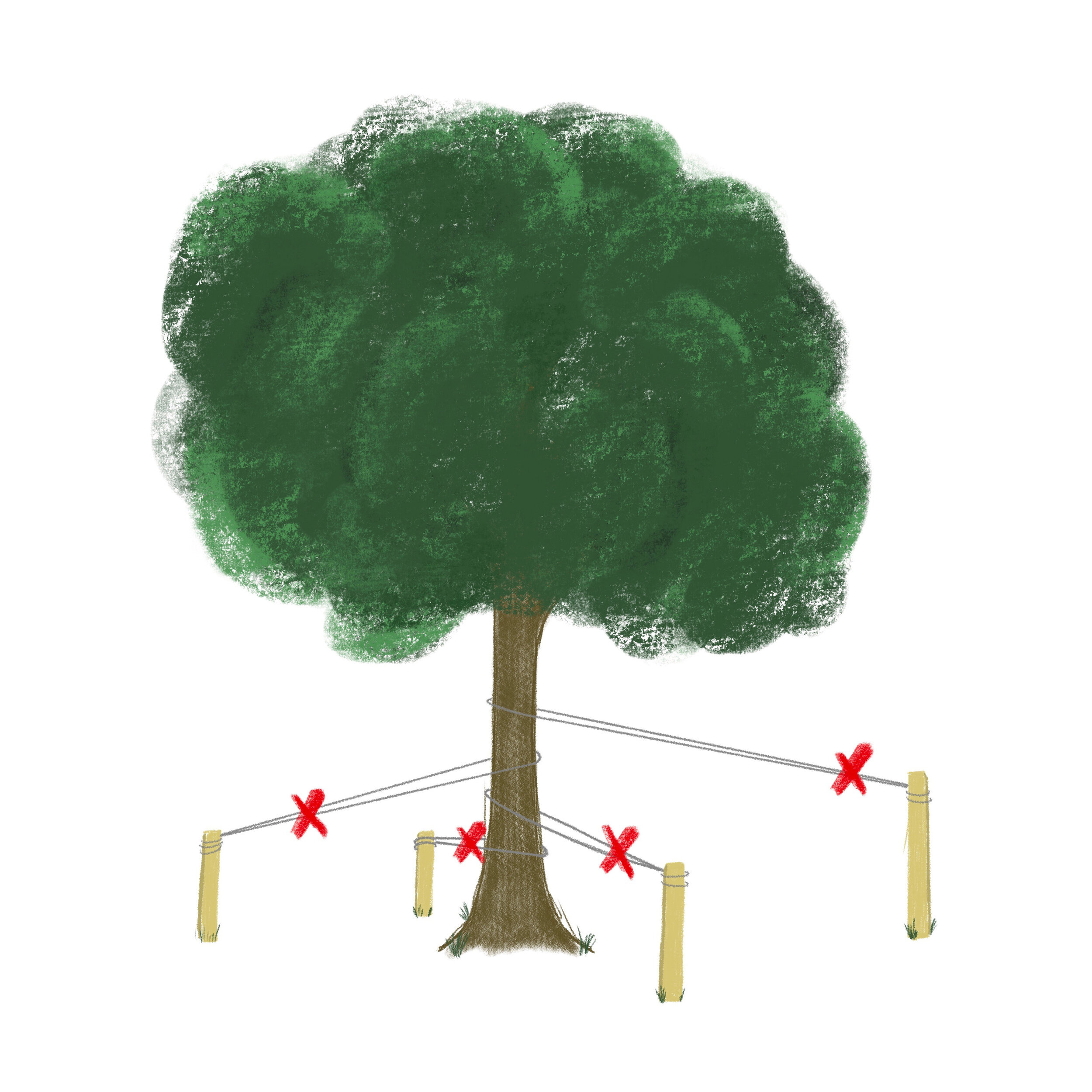
Minimize staking of new trees
This one has more to do with proper tree planting than it does with proper care of established trees, but it’s worthy of mentioning. Young trees will actually develop stronger roots and wood fibers in response to forces placed upon them. A newly planted tree needs to get “thrown around” a bit in the wind in order to properly establish and “bend” with future stressors rather than “break”(or blow over in this case). Staking a tree, especially beyond the first year, provides an artificial system of support that the tree will come to rely on for as long as it’s in place. Think of it as “tough love” for young trees.
These are just a few key examples of how proper tree care gives our trees a chance to thrive, adding function and value to our landscapes. Prevention is the best medicine - we know this to be true for ourselves, and it’s equally true for our trees.
Were you in Columbus for the winter ice storm of 2004? Leave your stories and experiences of that winter in the comments below. Or do you have a yoga practice and appreciate the strength that comes with flexibility? Share your thoughts with us.
For now, I’m going to work on getting my Oak to try something other than Tree Pose.

Walter Reins | Regional Manager, Russell Tree Experts
Walter has been an ISA Certified Arborist since 2003. He graduated from Montgomery College in Maryland with a degree in Landscape Horticulture, and has called Columbus, OH his home for nearly 20 years. Walter appreciates trees for their majesty and the critical role they play in our world.
Growing Degree Days
This semester I am enrolled in a class called Integrated Pest Management, taught by Dr. Luis Cañas at The Ohio State University. One of the first lectures we had was centered around the effects that the environment has on insect populations. As we explored this theme we soon came across the concept of “growing degree days”, and I was reminded of how useful this idea is to increase awareness of what is happening in the natural world around us and to be aware of when potentially damaging insect pests are about to emerge.

This semester I am enrolled in a class called Integrated Pest Management, taught by Dr. Luis Cañas at The Ohio State University. One of the first lectures we had was centered around the effects that the environment has on insect populations. As we explored this theme we soon came across the concept of “growing degree days”, and I was reminded of how useful this idea is to increase awareness of what is happening in the natural world around us and to be aware of when potentially damaging insect pests are about to emerge.
Reminded? Yes. At Russell Tree Experts we have been using growing degree days for years now as a tool to help when scheduling our tree wellness services. Seeing the concept again in class made me want to share it with all interested readers.
The concept of growing degree days is based on three basic principles which I will draw from my lecture notes provided by Dr. Cañas:
A “degree day” is the term used for the amount of heat accumulated above a specified base temperature within a 24-hour period.
The base temperature is (ideally) also the “lower temperature threshold”, which is the temperature below which a certain insect will not grow or develop. This is determined by research.
“Cumulative degree days” are just that: the number of degree days that have built up since a certain starting point (in general, since the beginning of the year).
What does this mean for living creatures? This is where things get interesting, so I’m glad you’ve read this far. Have you ever wondered how an insect knows it is time to hatch, or lay eggs, or go into pupation, or finish pupation so it can emerge as an adult? Is it increasing hours of daytime as days get longer after winter? (Maybe, but not quite directly). Is there some sort of internal clock that is ticking that just tells insects when to go into the next stage of development or propagation? But what if that clock went out of sync with environmental conditions? If you are reading this, you are very likely in central Ohio. Lovely state that it is, what do all Buckeyes say about the weather in our state? Exactly. Case in point: Here I am on Monday, February the 3rd, and today I was taking off clothes since I dressed for winter in the morning and got ambushed by 60 degrees and sunny. But the forecast looks like snow by Wednesday.
So what is it? Well, people devoted to these questions looked into it and found that apparently it is the accumulation of heat over time that causes insect development to proceed in synchrony with environmental conditions. So for a given insect, development will begin and continue above a certain temperature (low temperature threshold). Once so many degree days have accumulated (again, specific to the insect type), an egg will hatch, or an adult will emerge, or a nymph will grow into a more advanced stage, for example. These numbers can be identified for insects by watching and measuring. One simple formula (there are others that are more complicated) for tracking degree days is like this:
Starting on January 1st, the low temperature and the high temperature within that 24-hour period are logged. Those two temperatures are averaged, and the base temperature (low temperature threshold) is subtracted from the total.
For example: The high today was 61. The low was 50. 61+50= 111. 111/2 = 55.5, the average temperature. Let’s assume a certain insect, we can call it “Steve”, ceases all development when temperatures drop below 50 degrees. We would subtract 50 from 55.5, resulting in 5.5 degree days for today, February 3rd. Note that this number is only accurate for my specific area, since highs and lows are different throughout the state. This is another advantage of this system: It allows us to track Steve’s development in our own back yard!

Continuing with our friend, research has shown that Steve will emerge from pupation as a feeding adult after the accumulation of say, 548 cumulative degree days. What we would do is track degree days every day until we reach at least 548. After we reach that amount we would expect to start seeing Steves show up in our back yard on whatever plants Steves like to hang out on, doing whatever it is Steves like to do when they show up. The neat thing about this is that if we have a cold snap that lasts 3 weeks, even after two days of t-shirt weather in February (which is quite normal for Ohio right?), Steve’s development will simply pause, since degree day accumulation will slow down dramatically during the cold snap. Any day that there is at least 1 degree day, Steve will continue to develop, albeit much more slowly than if there were 20 degree days added on a given calendar date.
If you take the time to think this through you will start to connect all kinds of dots together that will make you marvel at the intricacy of our natural world, and how interconnected everything is. Nothing short of miraculous.
We’re almost done. One more tidbit: Plants seem to follow a similar pattern. This is not only neat, but useful! Since plants also follow this pattern it is only to be expected that certain plants will be at certain stages in their development each spring when Steve is at certain stages of his development each spring. So let’s say it just so happens that my Purple Robe Black Locust is starting to get all dressed up in her pink party dress at around 548 cumulative growing degree days, and that just happens to be the same amount of degree days that Steve needs to finish pupating and emerge as an adult. Instead of calculating degree days to watch for Steve, I can simply keep my eyes on my flowering tree. When I see her in full bloom I know that Steve is also out and about. In this case we call my Black Locust a “phenological indicator”. Her blooming is an outward sign of development in a plant that coincides with an important stage of insect development, thus serving as an indicator for that insect life stage.
The Ohio State University is full of very hard working citizens who study these things. Not only that, they track these things for us and give us a handy tool that does all the calculations (more complex versions than the basic one I shared) and tabulates events at the same time. Check out the resource here: https://www.oardc.ohio-state.edu/gdd/. Delve into it a bit. If you did not know about degree days and how they affect plants and insects, you will be amazed, if you are interested in the outdoors. If you already knew about these things before reading this article, I hope reading this made the concept a bit more accessible. Maybe now you can readily expound on the topic at the next ice cream social you are invited to. Be careful though- you would not want it to be your last. In any case, I am fairly certain you will not find a Steve on the OSU website I gave you above. Steves are not considered to be plant or tree pests so they have not been studied by our worthy scientists.
As always, thank you for reading. I am humbled by all the support I get from my readers. I have had the pleasure of conversing with many of you over the years and count myself blessed because of it.
Your friendly neighborhood arborist,

José Fernández | Regional Manager, Russell Tree Experts
José became an ISA Certified Arborist® in 2004, and a Board-Certified Master Arborist® in 2015. Currently he is enrolled at The Ohio State University pursuing a Master’s Degree in Plant Health Management. José likes working around trees because he is still filled with wonder every time he walks in the woods. José has worked at Russell Tree Experts since 2012.
Oak pruning, fascinating tree facts, and other thoughts
Here we are, fresh out of the holiday season, and the end of January is in sight! I wanted to reach out to you with some timely advice concerning trees, some reminders of why trees are so essential to life as we know it, and perhaps some other thoughts that might sneak out through my fingers as I type.
© Russell Tree Experts
Dear Reader,
Here we are, fresh out of the holiday season, and the end of January is in sight! I wanted to reach out to you with some timely advice concerning trees, some reminders of why trees are so essential to life as we know it, and perhaps some other thoughts that might sneak out through my fingers as I type.
I recently shared some of my experiences dealing with invasive plants with a nice group of folks who are part of PRISM (Partnership for Regional Invasive Species Management). At the end of my talk I went off topic for a moment to leave these people with a warning concerning Oak trees. Those of you who have been following our emails for a while probably recall we have devoted two separate issues entirely to oak wilt, since we had a laboratory confirmed case in Franklin County several years ago with one of my clients. I am disturbed by how many oak trees are still being removed and pruned within the window of time that is considered high risk for spreading the disease.
At Russell Tree Experts we decided that oak pruning would be scheduled in the fall and winter months, between October 1 and March 15, in order to avoid the time when Nitidulid beetles are active, attracted to pruning wounds, and potentially vectoring the disease pathogen from infected trees to healthy trees.

My purpose here is simply to remind you to please spread the word to raise awareness of this disease. I recently met a new client who had someone offer to prune his Red Oak for him. He politely inquired of the person making the offer if he was aware that it was not the proper time of year to prune oak trees because of the risk of oak wilt. The would-be tree pruner was not aware of this. Good job, Tom! If only more and more tree managers were able to do the same thing perhaps awareness of the fact that central Ohio residents know and care about their trees will eventually raise the standard of tree care in our communities. I am happy to say that reputable tree care companies are aware of oak wilt in our area and are able to communicate the proper way to deal with this problem.
I end this note with a quick reminder: If you have an oak tree you need to prune, please have the work done before March 15! Otherwise plan for a fall/winter pruning. Incidentally, the same practice is advisable if you have an elm tree. Dutch elm disease and oak wilt are very similar diseases on different species of trees.
On to other things
I attended a tree root seminar hosted by the Ohio Chapter of the ISA some weeks ago. Much of the material presented came from a resource that was new to me. I spoke to the moderator about this book and ordered it from Amazon before the lunch break was over. The book is called Applied Tree Biology, by Andrew Hirons and Peter Thomas. I was impressed at the amount of current information that has been brought together into one volume centered around the theme of how to use all the good research that is out there in order to promote tree health. I wanted to share several bits of information these authors put into their book, which was published in 2018.
From the first chapter (facts are italicized, followed by my comment in parenthesis);
There are three trillion trees around the world. (And just think, we actually need to plant more!)
Forests hold around 45% of the carbon stored on land (2780 gigatons).
Forests help determine weather patterns by how they can evaporate large amounts of water which form clouds, producing rain downwind. Recent discovery of a chemical made and released by trees called pinene can help clouds form to produce rain by acting as nuclei for water to form around. (Are you blown away by this? I was. There is so much we still do not know!)
All the world’s forests hold more than 80% of the world’s species.
The same chemicals that can cause cloud formation are known to reduce tension and mental stress in humans, increasing feelings of well-being and decreasing aggression and depression.
Over 100 million ash have been lost in the northeastern USA since 2002 due to the emerald ash borer. This loss of trees in urban environments has been linked to increased human mortality as a result of higher levels of cardiovascular and respiratory diseases. Increases in crime have also been linked to the loss of ash trees to EAB. (This brings it home, doesn’t it? I found it strange that one of the most present problems during my career as an arborist has provided study opportunities for learning about the seemingly intangible values of trees in relation to human society).
Incredibly, this book is in the format of a textbook. The authors are from the UK, and I am finding their writing style to be refreshingly accessible for a topic that can become rather dry even for an arborist who loves his work. Right before the table of contents there is a page titled “Epigraph” with a quote taken from a work from 1664 titled Sylva, by a fellow named John Evelyn. I was frankly astounded that I found such a quote in a textbook written in 2018. I will share it with you at the end of this installment. Some of you may like it, some of you may not. I merely share it as found. Reading the quote made me wonder what this textbook was going to be like. It also reignited in me the sense of a deeper mystery surrounding our everyday life that keeps me looking ahead for more. More of what? I don’t know exactly. Perhaps more of the mystery. This undercurrent of the ever present unknown is easy for me to lose sight of, but when I take the time to listen to a client, seeing the person rather than the tree that needs to be pruned, treated or removed I am reminded that all we do should be centered around the things that have value.
What has value? My neighbor. The animals and plants that are also struggling to make a life not very far from where you are seated right now. The fact that all this is something we have been given, not something any of us planned for before we entered the world. Think about this: Life has been given! Don’t miss it.
Your friendly neighborhood arborist,

José Fernández | Regional Manager, Russell Tree Experts
José became an ISA Certified Arborist® in 2004, and a Board-Certified Master Arborist® in 2015. Currently he is enrolled at The Ohio State University pursuing a Master’s Degree in Plant Health Management. José likes working around trees because he is still filled with wonder every time he walks in the woods. José has worked at Russell Tree Experts since 2012.
Epigraph
In a word, and to speak a bold and noble truth, trees and woods have twice saved the whole world; first by the ark, then by the cross; making full amends for the evil fruit of the tree in paradise, by that which was born on the tree in Golgotha.
From “Sylva”
by John Evelyn, 1664
(Shared directly from Applied Tree Biology, Andrew D. Hirons and Peter A. Thomas. Wiley Blackwell, Oxford, 2018.)
DID YOU KNOW? Tree Care In the Winter
In some cases, pruning trees in winter is actually more beneficial than during other times of the year due to increased canopy visibility and lower risk of disease. Check out the video above to learn more!
DID YOU KNOW?
In some cases, pruning trees in the winter is actually more beneficial than during other times of the year due to increased canopy visibility and lower risk of disease. Check out the video above to learn more!

"Can you recommend a tree that is not messy?"
“Can you recommend a tree that is not messy? One that will not drop fruit, or twigs, or stuff all over the place.” This is perhaps the request I run into the most when someone wants advice on what trees to plant. The first time I heard this one I had to fight the urge to smile and reply that yes, there are trees like that which also happen to be disease-free, not attacked by any pest, grow quickly (instantly, in fact) to the desired size, shape, and color you want them to be and never need to be pruned…
“Can you recommend a tree that is not messy? One that will not drop fruit, or twigs, or stuff all over the place.” This is perhaps the request I run into the most when someone wants advice on what trees to plant. The first time I heard this one I had to fight the urge to smile and reply that yes, there are trees like that which also happen to be disease-free, not attacked by any pest, grow quickly (instantly, in fact) to the desired size, shape, and color you want them to be and never need to be pruned. The only maintenance required is a yearly power washing to make them as good as new. But I chose to leave that reply unspoken. Sometimes my attempt at harmless humor or a friendly jab in the ribs does not go over well. Of course, dear readers, now I am wondering how many of you are wondering what kind of tree I was thinking of, and where can one be acquired? I will leave that response for another day. In this installment I would like to highlight a different type of tree for you.
I realized this week that there is one shade tree that almost, just almost, fits the bill for being a non-messy tree, with a few caveats. For those who want to know immediately which tree I am thinking of, skip right down to somewhere near the bottom and find the answer. For those who want to test their ability to identify trees, see how many clues are needed before you figure it out… [Some of the following points may be trick statements, designed to point you the wrong way! Read carefully.]
In prehistory, this tree was native to North America. In more recent history, this tree is considered to be native to somewhere on the other side of the world.
Like most conifers, this tree is a gymnosperm.
Some consider the fruit to be edible, and other plant parts are touted to help with hearing disorders. (Is that right? I’m not sure… perhaps if I took more of this herbal remedy I would remember).
Fruit? Yes, if the tree is female. So definitely make sure you source a male cultivar to stay with the non-messy design requirement. Otherwise this tree will eventually produce loads and loads of fruit, and based on the odor of the fruit alone, you probably would not consider it to be edible in any way. (Actually, I think the nut inside is the edible part. I don’t know many people with the fortitude of character required to get to the nut. Most people downwind of the fallen fruit quickly walk the other way, or cross to the other side of the street).
As other trees who are the only members of their genus, this tree has no pests or diseases of any importance.
This tree has a beautiful bright yellow fall color, and is known for dropping all its leaves at once, making leaf cleanup a one-time event.
I recently read an article in Arborist News about these trees. There are very old individuals in China that are visited each year by crowds of people who want to witness the annual leaf fall. Apparently certain trees will drop their leaves on a predictable schedule and people like being a part of that. As I read the article I reflected that I have seen recently fallen leaves under this species, but have never witnessed the sudden leaf drop, nor did I know this happened. When the leaves do fall, there is a soft carpet of bright yellow completely under the tree – this I had seen several times.
This fall I was in a Columbus neighborhood to inspect a nice large Oak tree in the client’s back yard. As I pulled up, I noted a mature Ginkgo planted in the neighbor’s front yard. Lo and behold, it had started dropping leaves that morning of November 8, and was steadily raining leaves. There was a light breeze, so the yellow carpet was stretching into and down the street, and I found myself feeling as if I had received an unexpected gift. I watched the leaves falling for a minute or two, then carried on with my business. The entire time I was in my client’s back yard I could hear the steady soft murmur of falling leaves, and I would walk over to take a peek to see if the stream of leaves changed in any way. The rate of leaf fall remained steady, with increasing waves when the breeze picked up. As the breeze died down, the leaves continued to fall more slowly, making a sound like quiet rain, but with a more distinct, feathery quality. I could see how this would truly be a unique experience, to be somewhere in rural China under an ancient Maidenhair Tree (another name for Ginkgo) watching the leaves fall steadily until the tree remained bare for the winter.
I walked back to my truck and watched the tree some more. I wanted to stay to see if what I had read was true. Would the leaves really all fall off? Some toward the bottom still looked like they had not fully turned yellow yet and I wondered if they would come down too, or wait until later. The morning was beautiful, cold, crisp and clear like they rarely are in fall/winter in Ohio, and I wanted to soak it in. The leaves continued to fall. Thinking back now I am reminded of a poem called Spring Dreams by Li Po (if I recall correctly) that stuck with me after reading it years ago. Different season, but possibly the same sentiment:
In the spring I dream through dawn, but hear birds everywhere, singing.
Oh voice of all night wind and rain, do you count the petals that are falling?
This time I needed to move on, so after a few more moments I got back in my truck thinking I should drive by later to see if the tree had shed all its clothing, or if it would wait demurely until a bit later. I did not make it back that day, and haven’t yet, but I do want to return next year to see if it is on schedule.
As we head toward the end of the year, deeper into winter, I hope this fall memory and this tree will remind you all that the continuing cycle of seasons is assured to us. Maidenhair leaves turn a brilliant yellow, as if giving us one last memory of the summer sun, then are shed voluntarily at their proper time to make way for new growth next season. Life pulses steadily in rhythms that change in color, temperature, and tempo, but the measure carries on. We have much to be thankful for.
Wishing you the best as the end of the year approaches,

José Fernández | Regional Manager, Russell Tree Experts
José became an ISA Certified Arborist® in 2004, and a Board-Certified Master Arborist® in 2015. Currently he is enrolled at The Ohio State University pursuing a Master’s Degree in Plant Health Management. José likes working around trees because he is still filled with wonder every time he walks in the woods. José has worked at Russell Tree Experts since 2012.
Identifying & Managing Rhizosphaera Needle Cast
Rhizosphaera needle cast (RNC) – quite a mouthful, especially when one is an arborist in training, still green in the green industry. My supervisor had just handed me a photocopy of a fact sheet on the disease since I had asked him about spruce trees I had been seeing with defoliating branches.
Rhizosphaera needle cast (RNC) – quite a mouthful, especially when one is an arborist in training, still green in the green industry. My supervisor had just handed me a photocopy of a fact sheet on the disease since I had asked him about spruce trees I had been seeing with defoliating branches.
This took place early in my career, 14 years ago or so, here in central Ohio. Fast forward to the present when the disease has become so prevalent that news stories on local television and in local papers have covered the issue. For several years my colleagues at Russell Tree Experts and I have discussed the need for a short article about this since we have this conversation so often with clients, but we never have made a point to write one! So much to do in so little time. I think I run into declining spruce trees with this disease 3-5 times per week so I know there are many readers who will benefit from this topic, or know someone who will.
Colorado spruce (Picea pungens) is a species that is probably overused due to its attractive evergreen foliage. In particular, the “Blue” varieties (‘Glauca’, ‘Hoopsii’, among others) seem to be the most popular, used as accent plants where they really stand out against a larger backdrop of more traditional green foliage. Interestingly, a quick check of the literature does not show that the species is prone to very serious disease, even though needle cast disease is mentioned as a possibility.
This is the reason why I seem to have suddenly shifted from one topic (RNC) to another (Colorado spruce). The tree is widely used (and therefore widely available) yet there is not a lot of information about how the species is performing in central Ohio. Please keep in mind that as an arborist I am trained to consider long term performance of a tree as opposed to short term. This means that I view trees as potentially permanent part of the landscape that we can choose to work around when subsequent changes in site use or design are necessary. This view is not shared by all, and my purpose here is not to defend my position against others. I mention this because Colorado spruce may still be a great choice of tree if its purpose is short-lived by design. I find that most individuals who plant trees do so because they treasure the feeling of starting a living process that will continue long after they are gone from this life. I am in this category, and I derive great benefit from seeing a tree remain healthy as it grows, changing and maturing. I help the tree along and it becomes a living, contributing part of my local environment.
I have come to believe that Colorado spruce is not a good option for a long term investment of resources (time, space, money). I would guess that about 90% of these trees eventually develop RNC to an extent that makes removal necessary as symptoms progress, causing the tree to lose its needles prematurely.
RNC is caused by a fungal pathogen. The fungus reproduces by forming spores in fruiting bodies (see photo above) that grow in the leaf stomata (openings in the leaf or needle, usually on the underside, that allow for gas exchange with the environment). Because of this, one diagnostic tool is to look for small black fruiting bodies lined up nicely on the underside of a spruce needle. Usually the stomata are white, which makes fungal fruiting bodies stand out when they are present. The spores spread with wind or rain, moving into the tree. In the case of RNC, disease symptoms soon follow, usually marked by needles that first turn a purplish color, then brown (see photo below), then dropping.
The defoliation pattern will be from the inside of the tree moving outward, and generally from the bottom of the tree moving upward, although sometimes it can move downward as well. Cool, moist conditions will favor the development of most fungal diseases, including RNC. Hosts of this pathogen include most spruce, several pine, and some fir and hemlock species. I have found several Norway spruce with RNC, but generally I consider this tree to be resistant consistent with the literature. To my knowledge I have not seen this disease on any pine or hemlock, although the early disease symptoms present differently and I may have missed it. For example, in Norway spruce the browning pattern is preceded by a mottled yellowing of the needles rather than the purplish color seen in Colorado spruce. The “fall color” (see photo below) of Norway Spruce can be confused with needle cast symptoms.
To differentiate between the two, the diagnostician should look for the fungal fruiting bodies and evaluate the pattern and extent of needle loss in the tree. I still heartily recommend Norway spruce as a good option for us in central Ohio, but for several years now have discouraged people from planting Colorado spruce simply because I am either removing them, waiting to remove them, or spraying them with fungicides.
Fungicide sprays for this disease are mostly protectant rather than curative. For this reason multiple applications are recommended each season, with the goal of providing a chemical barrier over newly emerging needles as growth occurs each spring. Once past the cool, moist spring conditions the needles harden off, climate gets warmer and drier, and infection is less likely, but still a possibility. One of my colleagues visited Colorado a few years ago. When he returned he said two things to me: “There are still streets with ash trees in Colorado, and the spruces don’t have needle cast”. Why do our Colorado spruce get needle cast? Our climate is much warmer, much more humid. Our soil tends to be poorly drained, and alkaline. Bring a tree genetically adapted to a specific environment into a different environment and it will likely become stressed, making it vulnerable to disease. In central Ohio, I have seen a trend with Colorado spruce: The trees look great when they are newly planted. If the site is very poor, they quickly develop RNC or decline for other reasons. If the site is reasonable, the trees grow very well and remain beautiful. Then we get to that 90% mark I mentioned earlier, which seems to be with trees that have done reasonably well for 15-25 years, but now have entered into rapid, noticeable decline resulting in tree death within 10 years. Most people choose to have the trees removed well before the trees are completely dead since they lose their beauty and no longer serve as screening plants. This is why I consider this species to be useful if the intended design is only for the next 15 years or so.
If you have a Colorado spruce you want to preserve here are some things that will help:
I recommend repeat applications of fungicides on a seasonal basis to protect newly emerging needles. Note that this does not guarantee that your tree(s) will remain disease free, but it will greatly reduce the infection rate.
Change any existing irrigation so that water is not being sprayed onto the tree foliage. Water the tree with drip irrigation at the base.
Weeds and neighboring plants should be kept away from the lower foliage to increase sunlight and air penetration to try to reduce moisture and humidity levels.
You may consider enjoying your Colorado spruce (whether a green or blue variety) for as long as it looks good, but plant some replacement trees nearby to get them started now. Concolor fir is an evergreen tree that has a bluish cast to it and will perform well given well drained, biologically active soil. Norway Spruce is a good option if the space requirements are met, as this tree will grow large. Western redcedar is proving to be a top performing tree for us, and is also a good screening evergreen plant.
In closing, it is worth mentioning that the dwarf forms of Colorado spruce, whether blue or not, seem highly resistant to RNC. I rarely see this disease on the dwarf varieties.
Thank you for reading! My sincere hope is that this information is useful to you.
Your friendly neighborhood arborist,

José Fernández | Regional Manager, Russell Tree Experts
José became an ISA Certified Arborist® in 2004, and a Board-Certified Master Arborist® in 2015. Currently he is enrolled at The Ohio State University pursuing a Master’s Degree in Plant Health Management. José likes working around trees because he is still filled with wonder every time he walks in the woods. José has worked at Russell Tree Experts since 2012.
"Stop and Notice Me" said the Pawpaw Tree
Last weekend I was in southern Ohio, working on a personal building project that needs to reach a certain stage of completion while the dry summer weather persists. Usually a time of relaxation, my weekend visits to this site have become slightly stressful due to time constraints. As I moved about the building frame, I kept dodging low branches from several Pawpaw trees growing about the place.
Last weekend I was in southern Ohio, working on a personal building project that needs to reach a certain stage of completion while the dry summer weather persists. Usually a time of relaxation, my weekend visits to this site have become slightly stressful due to time constraints. As I moved about the building frame, I kept dodging low branches from several Pawpaw trees growing about the place.
The plan is to remove the trees eventually, but my father and I are partial to the fruit, so we are waiting until after the harvest before we cut them down. We are also a bit attached to these trees since they are the last remnant of a group of volunteer seedlings we left in place 10 years ago, and we have enjoyed lots of fruit and shade from them in the last two years.
My head down, I moved about the building: Fetch the hammer; back around for the level; measure from here...
BUMP. Just ran into a green pawpaw, but kept my head down, busy with the task at hand.
30 seconds later…
BUMP. Ran into the same fruit again. Continued doing what I was doing, when about a minute later…
BUMP. The exact same fruit, exact same spot on my head. I’m feeling so pressed for time that I am distracted and not really connecting with the moment.
After arriving back home the next day, that pawpaw kept bumping into my thoughts, so I took some time to pay attention to it.
Asimina triloba, Common Pawpaw or Custard Apple (see Michael Dirr, Manual of Woody Landscape Plants). I have been told this tree produces the largest native fruit in North America. My father and I like the tree because it has a tropical look to it – large leaves somewhat irregularly attached in clusters. The flowers appear early in spring, before other trees and plants have started leafing out. They are easy to miss because they are not very large, maybe an inch in diameter, and they are a purplish brown color.
Usually found as an understory tree, it also does well in full sunlight. I have seen it growing in well-drained uplands, but have also seen entire stands of large trees (30-40 feet is large for this species) growing in bottomlands along streams and rivers.
The fruit is a large, curious thing that also makes one think of tropical fruits when trying to describe it. There is some variation in taste and color depending on what part of Ohio the trees are growing in, based on my experience.
There is much more I can say about this tree, such as mentioning the unique caterpillars that feed on the foliage, festivals that are held to celebrate the fruit, and the time TJ Nagel (of Russell Tree Experts) brought me in a prize fruit which mysteriously went missing before I got my hands on it. But since trees serve to ground me in the moment, as well as raising me above the moment, I can’t help but feel that this fruit was bumping me in the head, repeatedly, to let me know it was time to stop for a minute.

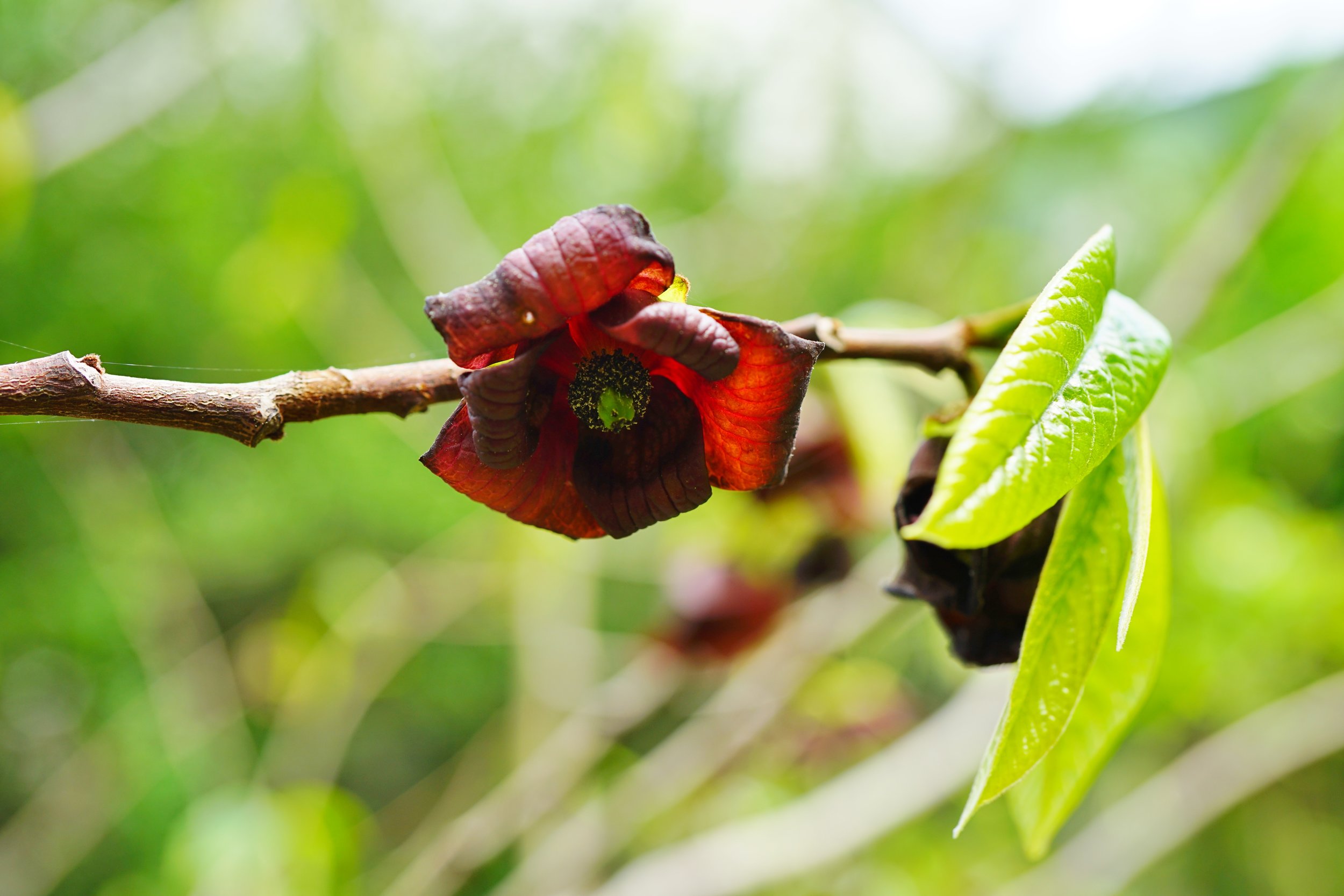
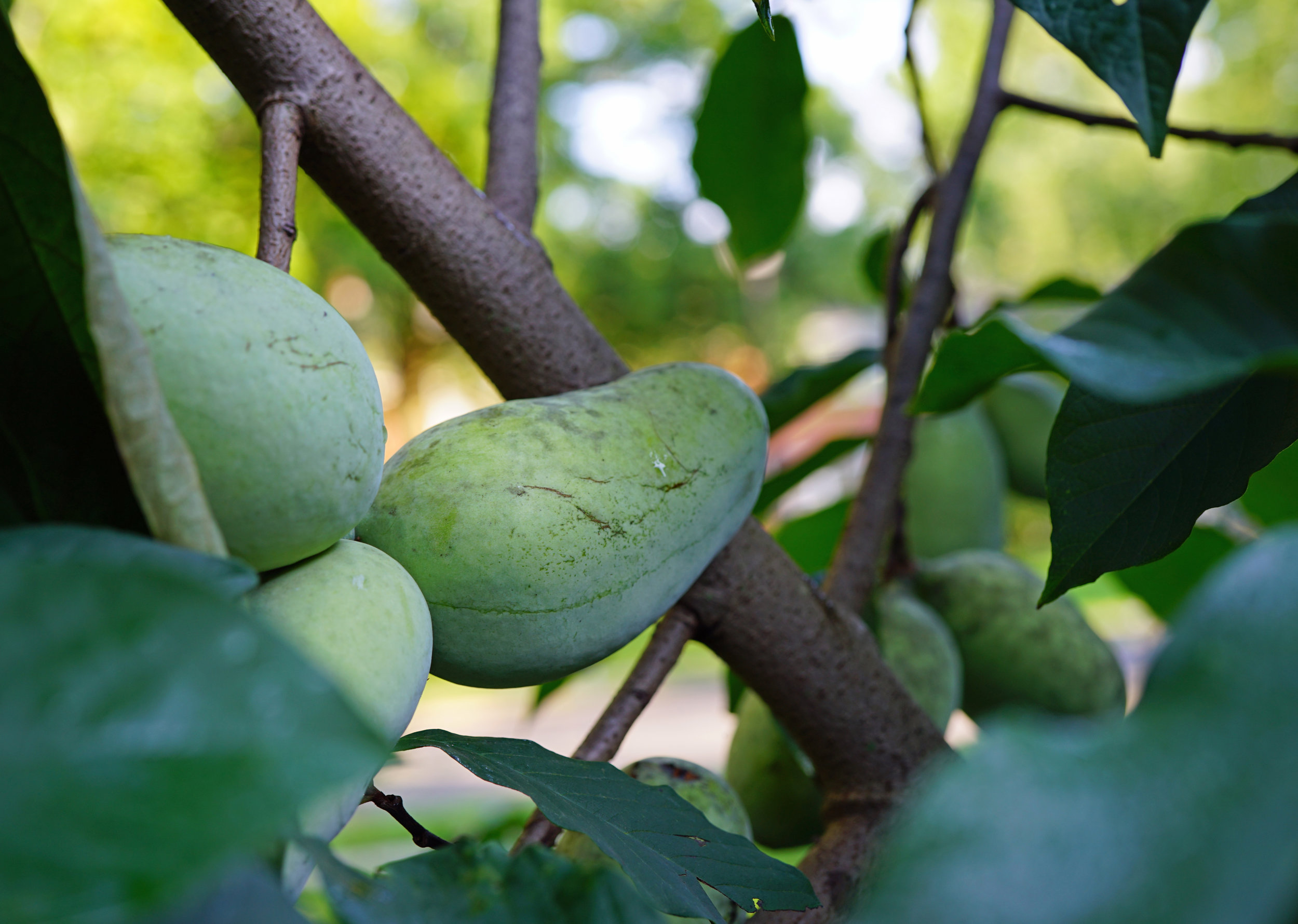
Things have been unusually hectic this season, and the last several months have blown by in a blur of work, travel, projects – each pulling in a different direction. One can only be pulled so far before something starts to give. With me, that something is peace, sister to joy. And last weekend, one tree bent down to tap me on the head. Three times. To tell me to hit the pause button.
Work is still as busy as ever. I have unfinished landscaping and building projects at home. My new trees need to be watered every few days to get them through this drought. The new semester starts today. I would like to spend some more time with my wife and family. I would like to get some use out of my mountain bike. I have a stack of books I keep falling asleep under.
When will it stop? Well, it won’t, really. But I am thankful for a pawpaw giving me a gentle knock on the head. “Notice me”, it said. “Stop and notice me”.
So here I am.
Get out this September and sample a pawpaw or two. You might not like it, but it’s worth trying. While you are there under the tree, take a look and a listen; think about something you love, or someone you miss. Don’t wait for a bump on the head to bring you back to what matters.
Wishing you all the best,

José Fernández | Regional Manager, Russell Tree Experts
José became an ISA Certified Arborist® in 2004, and a Board-Certified Master Arborist® in 2015. Currently he is enrolled at The Ohio State University pursuing a Master’s Degree in Plant Health Management. José likes working around trees because he is still filled with wonder every time he walks in the woods. José has worked at Russell Tree Experts since 2012.
Join Me!

On Friday, September 13th, at 9AM join us for a 90-minute tree tour through Indian Run Falls with José Fernández of Russell Tree Experts. José (ISA Board Certified Master Arborist®) will take you into the woods and introduce you to the many trees of Central Ohio. You'll learn a TON about each tree (root systems, bark, growth speeds, fruits, and more!) and in the end, you'll have an even greater appreciation for nature and the trees around you!
Humid Air: Tough for Plants and People
Summer in central Ohio brings good times outside but also often brings hot humid air. Heat and humidity can aggravate some foliar fungal disease on trees and shrubs. One of the most common diseases we see is rhizosphaera needle cast on Blue Spruce trees.
Summer in central Ohio brings good times outside but also often brings hot humid air. Heat and humidity can aggravate some foliar fungal disease on trees and shrubs. One of the most common diseases we see is rhizosphaera needle cast on Blue Spruce trees.
This disease manifests itself in needles causing them to turn brown and even purplish before they fall off of the tree. Blue Spruce will often show the first signs of infection on the interior and lower needles where moisture persists, looking thinner and sickly in the middle during the early years of an infestation. Left to run wild without a managment plan, rhizosphaera needle cast will eventually kill its host tree.
If you have a mature Blue Spruce that has lost less than approx. 25-35% of its needles from needle cast, a treatment plan may include:
Raking up and disposing of all of the old fallen needles under the tree that can still host the fungal spores.
Pruning out dead branches.
Adjust irrigation equipment to make sure that water is not directly sprayed onto the needles of the tree, this spreads the spores and accelerates the advancement of needle cast.
Three rounds of fungicides applied in the spring, shortly after bud break can protect new growth from becoming infected.

Joe Russell | Member & Co-Owner, Russell Tree Experts
Joe Russell has been an ISA Certified Arborist® since 2003. He graduated from Ohio State University with his bachelors in Landscape Horticulture with a minor in Ag Business and started Russell Tree Experts with his wife Shari in 2005. Joe grew up in the Ohio Valley near Wellsville, Ohio and is a resident of Galena, Ohio.
New Video: Our Family-Owned Company
Welcome to Russell Tree Experts. We are a family-owned business located in Westerville, Ohio. We opened our doors in 2005, and our goal - every single day - is to provide the best tree care and arboriculture resources to you. Our office representatives are kind, caring, and eager to answer your questions; Our arborists are highly educated, industry trained, and have years of experience; Our business leaders are always focused on education, safety, and quality of work. Simply put, we believe our employees are the finest in the industry and they are what make our company special.
Welcome to Russell Tree Experts. We are a family-owned business located in Westerville, Ohio. We opened our doors in 2005, and our goal - every single day - is to provide the best tree care and arboriculture resources to you. Our office representatives are kind, caring, and eager to answer your questions; Our arborists are highly educated, industry trained, and have years of experience; Our business leaders are always focused on education, safety, and quality of work. Simply put, we believe our employees are the finest in the industry and they are what make our company special. Whether you need your tree pruned, removed, cabled, fertilized, inspected, or treated for a disease or pest, you will have the confidence knowing that Russell Tree Experts has the expertise to solve your tree care needs. And everyone at Russell Tree Experts strives to keep Ohio green, so check out treeforatree.com for more information. Our company started with love in 2005 and that love continues through to today. From our family to yours, let’s grow happy trees.

The Mighty Bur Oak
Few species of trees have such a universally recognized name as the Oak. Worldwide, there are some 600 species of Oaks, and in Ohio alone we have over a dozen. Here in Columbus, they tower over the homes of Clintonville, line the streets of Upper Arlington, and bathe the yards of Bexley with their shade. Oaks in Ohio can be divided into two groups - Red Oaks and White Oaks. Many of the large Oaks we see throughout the city in urban landscapes are of the Red Oak group. Less commonly planted are Oaks in the White Oak group, of which the Bur Oak belongs. Let’s take a closer look at this under-utilized tree that is native to most parts of our state.
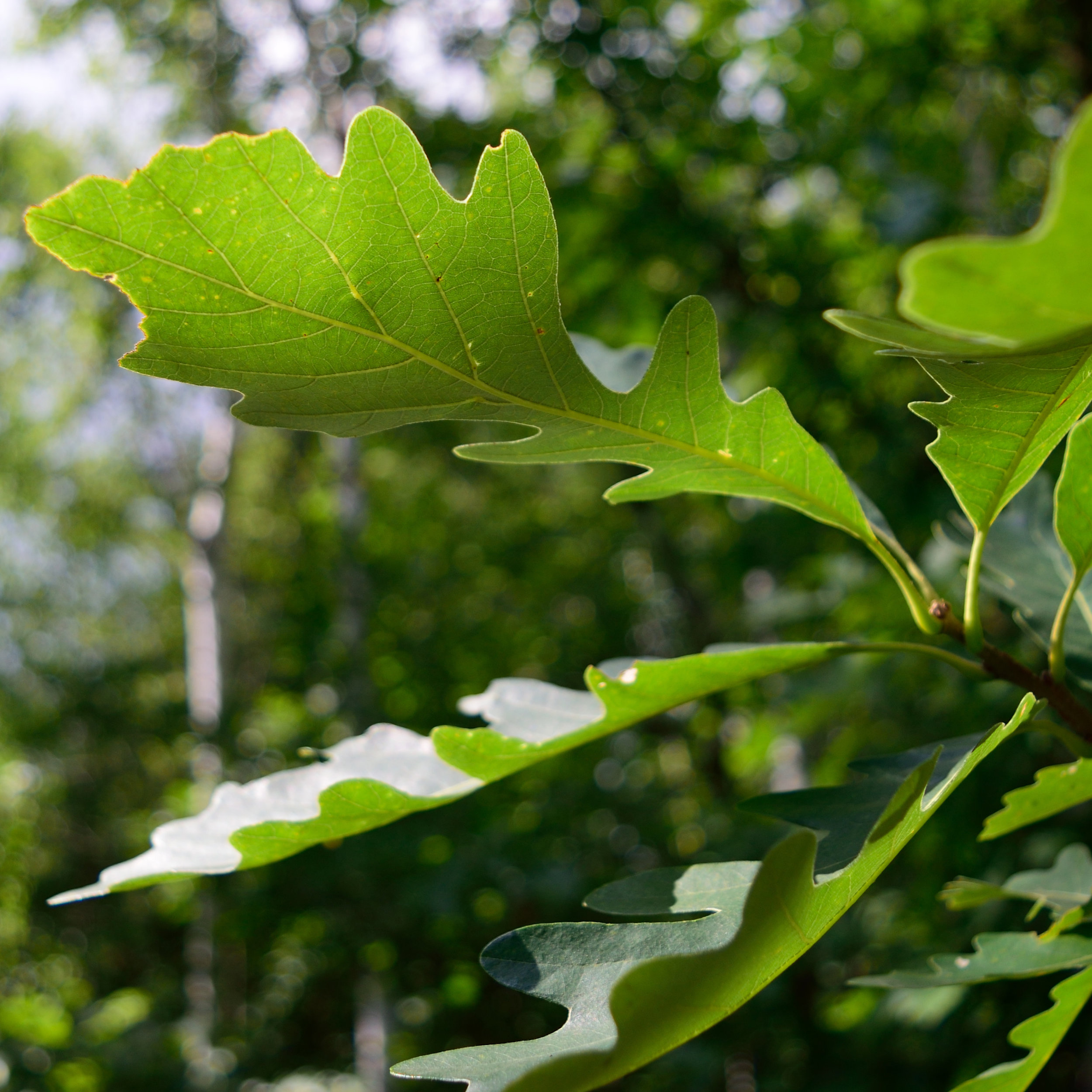
Bur Oak Leaves
©Russell Tree Experts
Few species of trees have such a universally recognized name as the Oak. Worldwide, there are some 600 species of Oaks, and in Ohio alone we have over a dozen. Here in Columbus, they tower over the homes of Clintonville, line the streets of Upper Arlington, and bathe the yards of Bexley with their shade. Oaks in Ohio can be divided into two groups - Red Oaks and White Oaks. Many of the large Oaks we see throughout the city in urban landscapes are of the Red Oak group. Less commonly planted are Oaks in the White Oak group, of which the Bur Oak belongs. Let’s take a closer look at this under-utilized tree that is native to most parts of our state.
The Bur Oak, sometimes spelled Burr Oak and alternatively named the Mossycup Oak, is a large shade tree at maturity, growing to 80 feet or more in height and spread. For this reason, the proper siting of this tree in the urban landscape is essential. There’s an old saying, “A society grows great when old men plant trees in whose shade they know they shall never sit.” I think it’s equally true to say that a property grows in beauty and value when it’s owner plants trees with consideration for a mature size that he/she will likely never see. Bur Oaks get BIG. They also have one of the largest acorns of the Oaks, another consideration when deciding where to plant.

Chlorosis in a Pin Oak in Bexley, Ohio
©Russell Tree Experts
One of the characteristics that I love about this tree is that it tolerates, and even prefers, slightly alkaline soils. A common problem we as arborists see in landscapes everyday throughout Central Ohio is chlorosis, or yellowing of tree leaves due to nutrient deficiencies, which leads to slow decline and potential death of a tree. Because we tend to have higher pH levels, certain micronutrients, although present in the soil, become less available for uptake by plants, and some trees are more sensitive to this. We often see this in Oaks of the Red Oak group like Red Oak and Pin Oak, two very common landscape trees. Because a higher pH level of the soil isn’t an issue for Bur Oaks, they typically avoid the problem of chlorosis.
Another notable characteristic of Bur Oaks is that they do exceptionally well on their own. In their native habitat, Bur Oaks are often found growing in a more open area where they develop large, strong lateral limbs. One reason this may occur is because of their ability to grow in adverse conditions that other trees won’t tolerate. This makes them suitable for the urban landscape where we often plant large shade trees as stand-alone additions in the yard.
Last but not least, because the Bur Oak is a member of the White Oak group it tends to be less susceptible to Oak Wilt. Oak Wilt is a vascular disease caused by a fungus, and can lead to the decline and death of otherwise healthy Oak trees. Because of its continued spread, it is unfortunately something we’re now having to take into consideration with how we care for Oak trees in Central Ohio. Considering a Bur Oak or other White Oak species for your landscape is a simple step towards reducing the prevalence of this disease.
The Bur Oak might just be the perfect shade tree for less than perfect conditions. Consider this quick list of pros and cons in deciding whether it’s the right tree for your landscape:

The BIG Bur Oak Acorns
©Russell Tree Experts
Large size, long-lived, and a dominant landscape feature at maturity, not appropriate for small yards
Beautiful, majestic habit when mature
Tolerant of soil conditions that adversely affect some common species of Oak, notably high soil pH
Less susceptible to Oak Wilt, a disease of growing concern in Central Ohio
Large fruit (acorns) that may not be preferred near driveways or over a home
Does not transplant as well, so it’s sometimes hard to find at nurseries and garden centers

Walter Reins | Regional Manager, Russell Tree Experts
Walter has been an ISA Certified Arborist since 2003. He graduated from Montgomery College in Maryland with a degree in Landscape Horticulture, and has called Columbus, OH his home for nearly 20 years. Walter appreciates trees for their majesty and the critical role they play in our world.
Soil Compaction = Not Good for Trees
Soil compaction is a big no-no for trees. When soil is compacted (above left graphic), water and oxygen cannot get to the vital root system of the tree. Water will collect on the surface and evaporate since it is unable to penetrate the soil. Seeing as trees need water and oxygen to live, compacted soil can quickly and severely impact the health of a tree.
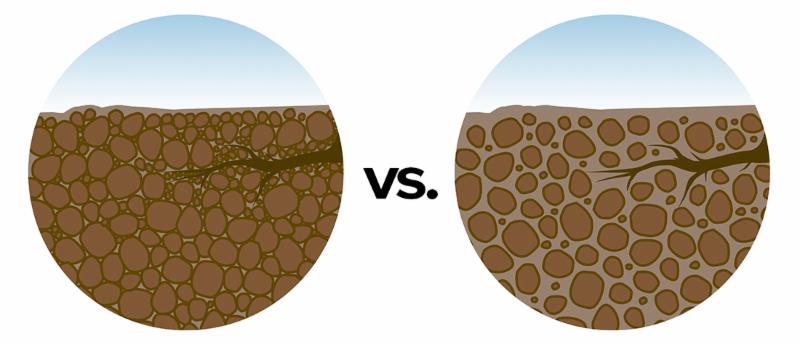
Soil compaction is a big no-no for trees. When soil is compacted (above left graphic), water and oxygen cannot get to the vital root system of the tree. Water will collect on the surface and evaporate since it is unable to penetrate the soil. Seeing as trees need water and oxygen to live, compacted soil can quickly and severely impact the health of a tree.
DID YOU KNOW?
80% of a tree’s absorption roots are in the top 12” of the soil. That is way soil compaction is so detrimental to a tree’s health.
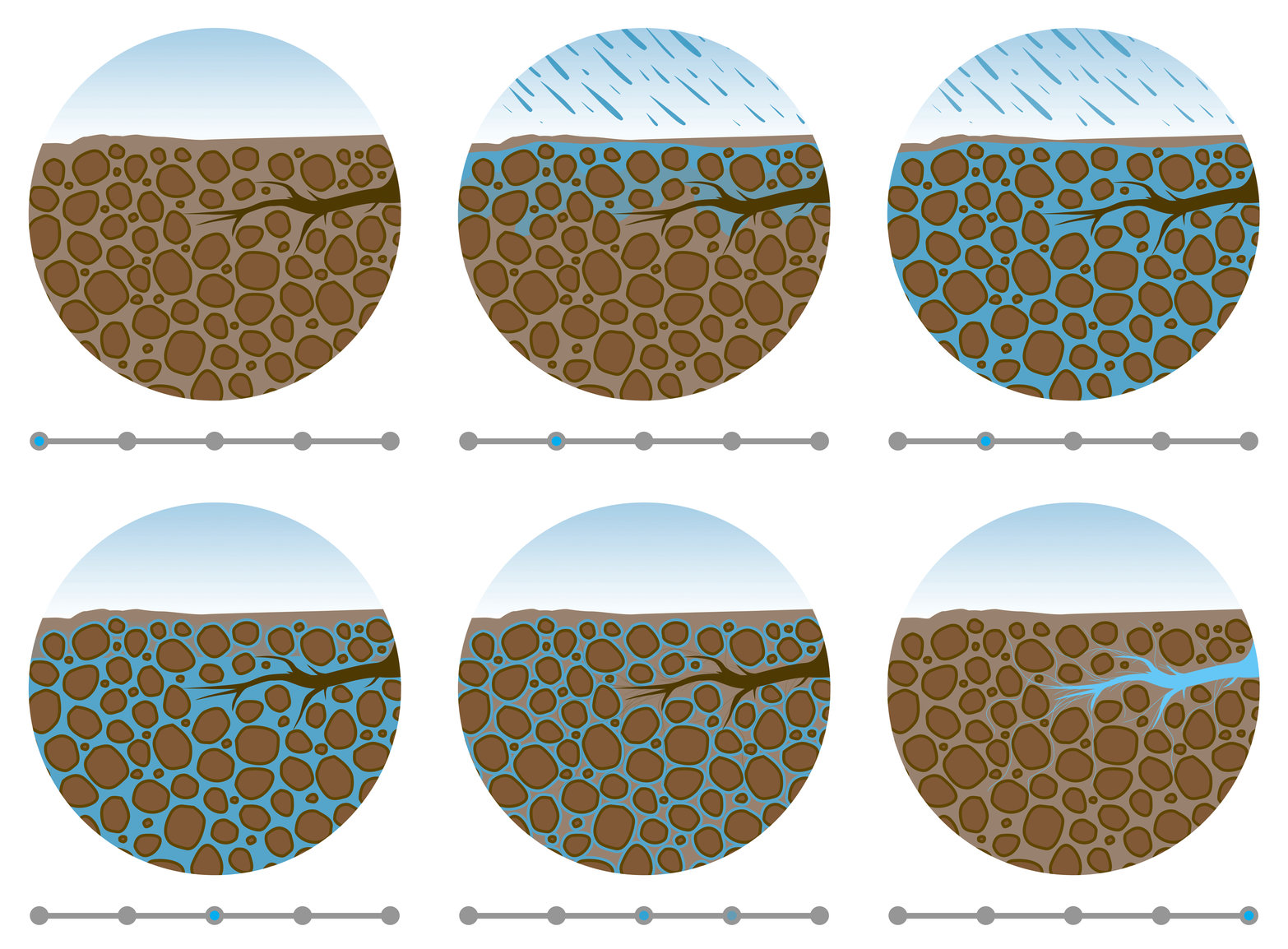
To treat this issue we often recommend a Root Zone Invigoration which is performed by using a supersonic air tilling tool (called an AirSpade) that infuses organic matter into the soil and alleviates compaction around mature trees and shrubs. The result (above right graphic) is a greatly improved environment for your trees to thrive - beautifully tilled soil with all critical fibrous roots still intact.
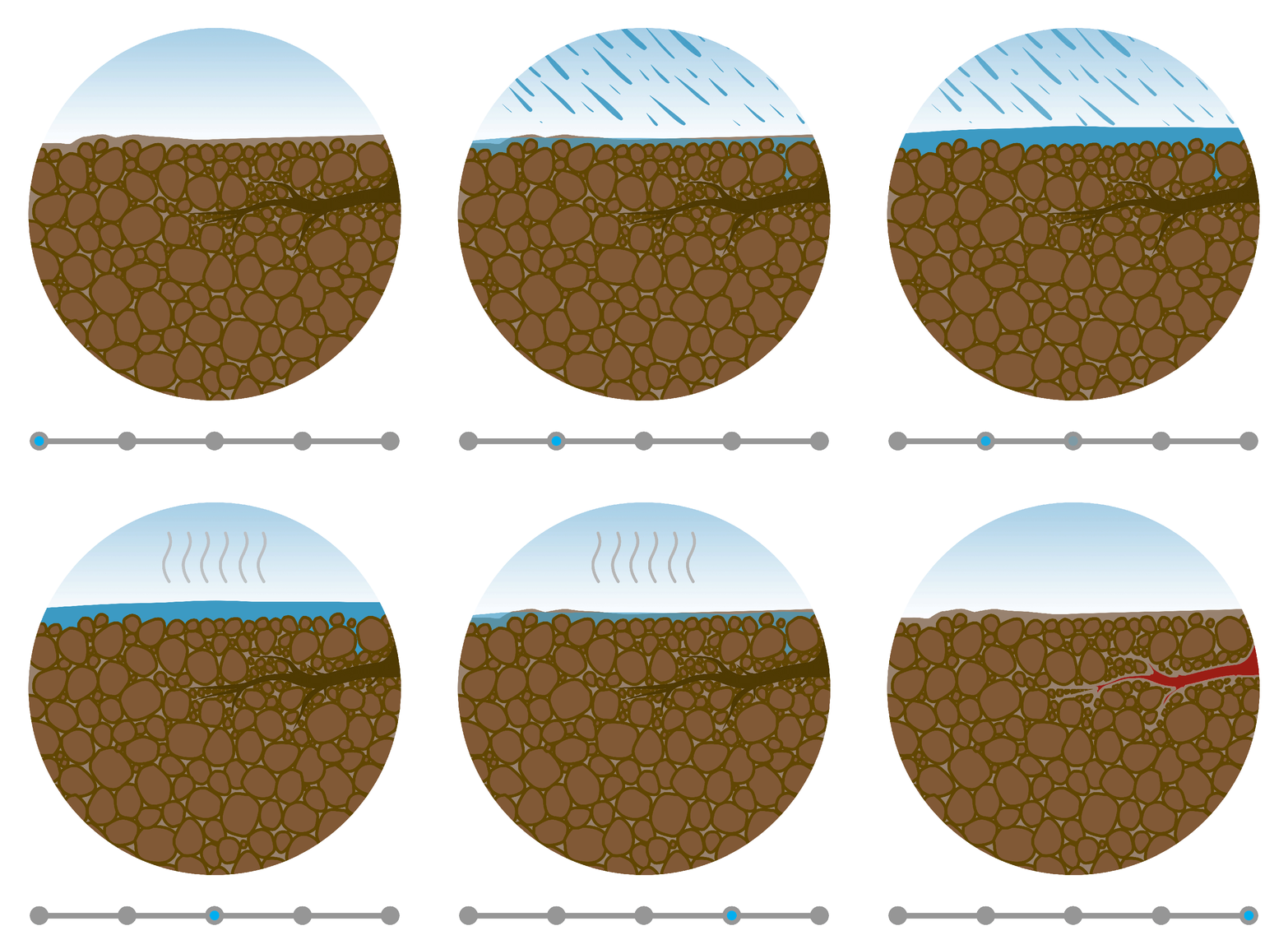
Check out the below animations which illustrate how water interacts with soil before and after a Root Zone Invigoration:
BEFORE
AFTER

Kenny Greer | Marketing Director, Russell Tree Experts
Kenny graduated from The Ohio State University with a BFA in Photography. He enjoys photography, graphic design, improv comedy, movies (except for the scary ones), and spending time with his wife and 2 kids.
Take a Walk on the Wild Side (no, really!)
When people in Japan coined the term ‘shinrin-yoku’ in 1982, they likely weren’t inspired by Lou Reed’s now classic 1972 hit. But shinrin-yoku, which translates in english to ‘forest bathing’, is a practice that takes us back to our wild side, back to experiencing the calming and healing qualities of the forest and all of the plants and animals that reside there.

Please note: This article was originally published on 5/13/2019 and was republished on 5/20/2021.
When people in Japan coined the term ‘shinrin-yoku’ in 1982, they likely weren’t inspired by Lou Reed’s now classic 1972 hit. But shinrin-yoku, which translates in english to ‘forest bathing’, is a practice that takes us back to our wild side, back to experiencing the calming and healing qualities of the forest and all of the plants and animals that reside there.
Forest bathing, also commonly called forest therapy or nature therapy, is a practice that involves spending time in a natural setting like a forest, and allowing our minds to slow down and set aside the “to do” list. We’re not literally bathing, but instead “soaking” in all of our surroundings. Scientific research has shown significant and remarkable health benefits from this practice, and some research suggests that the compounds and essential oils that are released by trees contribute to these benefits. These include decreased blood pressure, lower levels of cortisol (stress hormone) and an increased ability to focus.
Have you ever heard the expression “spend more time being, not doing”? In forest bathing, we look to spend time being - being present to all that’s around us, and taking in the forest and nature through all of our senses. The sights, sounds, smells, and tactile experiences we find in the forest are uniquely wild. Even our sense of taste can be entertained with many edible wild foods.
While forest bathing as a growing trend is joining the ranks of other mindfulness practices like yoga, tai chi, and meditation, the concept of reconnecting to the natural world is anything but new. Over a hundred years ago, Henry David Thoreau wrote in his essay titled ‘Walking’:
“At present, in this vicinity, the best part of the land is not private property; the landscape is not owned, and the walker enjoys comparative freedom. But possibly the day will come when it will be partitioned off into so-called pleasure-grounds, in which a few will take a narrow and exclusive pleasure only--when fences shall be multiplied, and man-traps and other engines invented to confine men to the public road, and walking over the surface of God's earth shall be construed to mean trespassing on some gentleman's grounds. To enjoy a thing exclusively is commonly to exclude yourself from the true enjoyment of it. Let us improve our opportunities, then, before the evil days come.”
Consider that Thoreau wrote this in the mid 1800s and was already compelled to express his view on the ill-effect of urban settings and a loss of connection to the natural world. Fast forward to present day, where the natural places seem less and less, and technology and the pace it requires of us becomes more and more. Stepping away from our phones and computers and into natural surroundings - even for just a short time - gives us the chance to reconnect with a simpler, slower and more peaceful world.
In central Ohio, we are fortunate to have so many wonderful Metro Parks that offer up natural settings and scenery. Take advantage of this time of year, when the forests and fields are filled with plants bursting with new foliage and eager to impress with showy and fragrant flowers. And before you set out on your trek into the woods, consider this bit of advice: silence your phone when you get there and commit to not using it, especially for pictures. There’s a good chance that when you pull out your phone to capture a photo of that patch of moss, red-tailed hawk, or a peculiar mushroom growing on a stump, an email, text or some notification is waiting to take you away from that present, mindful moment.
To quote Thoreau in ‘Walking’ once more,
“What business have I in the woods, if I am thinking of something out of the woods?”

Walter Reins | Regional Manager, Russell Tree Experts
Walter has been an ISA Certified Arborist since 2003. He graduated from Montgomery College in Maryland with a degree in Landscape Horticulture, and has called Columbus, OH his home for nearly 20 years. Walter appreciates trees for their majesty and the critical role they play in our world.
A New Favorite: Blackhaw Viburnum
My palette of favorite trees is always changing. This spring, while I was hiking in Noble county’s Wolf Run State park another woody plant found its way onto my list: Blackhaw viburnum, Viburnum prunifolium. I have admired this plant for years for being native, for its adaptability, ease of establishment, its ability to easily naturalize into new areas, and because it provides forage for birds, bees and butterflies. I have observed Blackhaw viburnum in arboreta, gardens, and native area across the state but this past weekend it really stood out to me in the woods amongst the redbuds, dogwoods and other spring flowering plants.
My palette of favorite trees is always changing. This spring, while I was hiking in Noble county’s Wolf Run State park another woody plant found its way onto my list: Blackhaw viburnum, Viburnum prunifolium. I have admired this plant for years for being native, for its adaptability, ease of establishment, its ability to easily naturalize into new areas, and because it provides forage for birds, bees and butterflies. I have observed Blackhaw viburnum in arboreta, gardens, and native area across the state but this past weekend it really stood out to me in the woods amongst the redbuds, dogwoods and other spring flowering plants.
I observed some that were shrubbier in appearance like typical viburnum and others that had grown into small trees, reminiscent of Hawthorn (as pictured). The flowers were a beautiful creamy white, the foliage a lustrous green and the bark stood out with interesting characteristics that reminded me of mature Black Tupelo or Persimmon. The sun was shining, and the pollinators were out - it was a perfect afternoon in the woods.
I think this is an important plant to consider for those of you with wooded sites and for folks looking for native plants to add to their landscape. Blackhaw viburnum can be used as a specimen tree, in shrub borders or in groupings. I see it thriving in full sun to full shade and it could make a great replacement plant for anyone working to eradicate amur honeysuckle, privet, burning bush or autumn olive from native areas. The flowers give way to a pinkish fruit that matures in late summer to a bluish black edible drupe that can be appreciated by both wildlife and humans. This fall I’m going to try my hand at viburnum pie - I’ll let you know how it comes out.
On a separate note - check out this small garter snake I found sunbathing in my weeping Serbian spruce. It was about four feet off the ground and sat in this spot for several hours while I worked around it in the garden.
Weeping Serbian Spruce (with guest)
©Russell Tree Experts

TJ Nagel | Production Manager, Russell Tree Experts
ISA Certified Arborist® OH-6298A // Graduated from The Ohio State University in 2012, Earned B.S. in Agriculture with a major in Landscape Horticulture and minor in Entomology // Tree Risk Assessment Qualified (TRAQ) // Russell Tree Experts Arborist Since 2010
5,000 Trees Planted!
Last Friday (April 26th, 2019) was Arbor Day and to celebrate, all of us at Russell Tree Experts teamed up to give back to the central Ohio environment by planting 5,000 trees (via our TREE FOR A TREE® program) at Scioto Grove Metro Park. The section at Scioto Grove Metro Park that received the trees is a donated addition that park managers are actively working to reforest. For decades the land was used for farming crops; in the future, the area will be a lush forest to be enjoyed by the community.

©Russell Tree Experts
Last Friday (April 26th, 2019) was Arbor Day and to celebrate, all of us at Russell Tree Experts teamed up to give back to the central Ohio environment by planting 5,000 trees (via our TREE FOR A TREE® program) at Scioto Grove Metro Park. The section of Scioto Grove Metro Park that received the trees is a donated addition that park managers are actively working to reforest. For decades the land was used for farming crops; in the future, the area will be a lush forest to be enjoyed by the community.

A breakdown of the 5,000 trees planted at Scioto Grove Metro Park on April 26, 2019 (Arbor Day)
It was an awesome experience seeing our team come together on Arbor Day. Our typical work days consist of operating in small teams of 2-3 people while on Arbor Day we had the majority of our employees (including our field and office staff) working together at one location! #TeamBuilding!
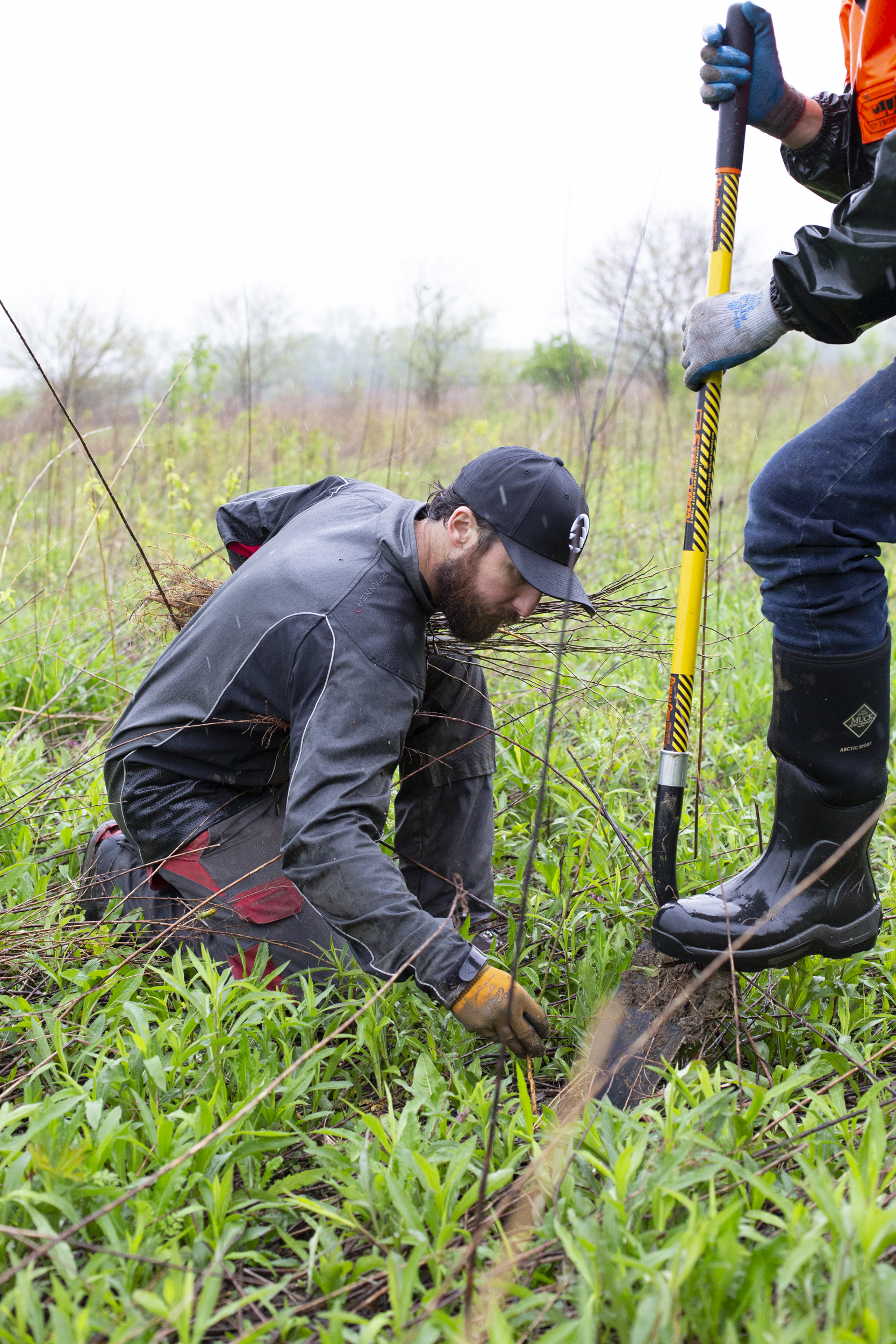
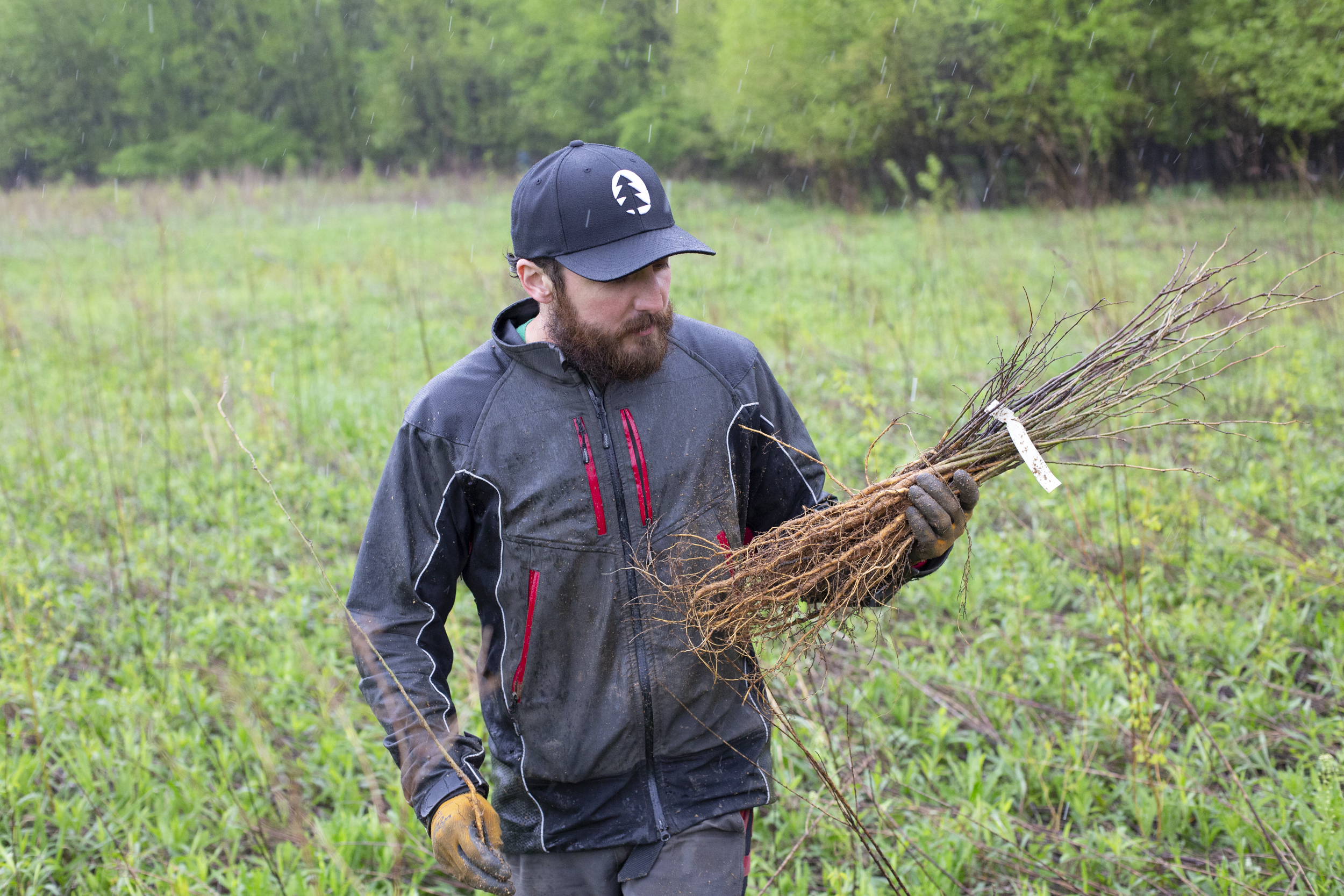
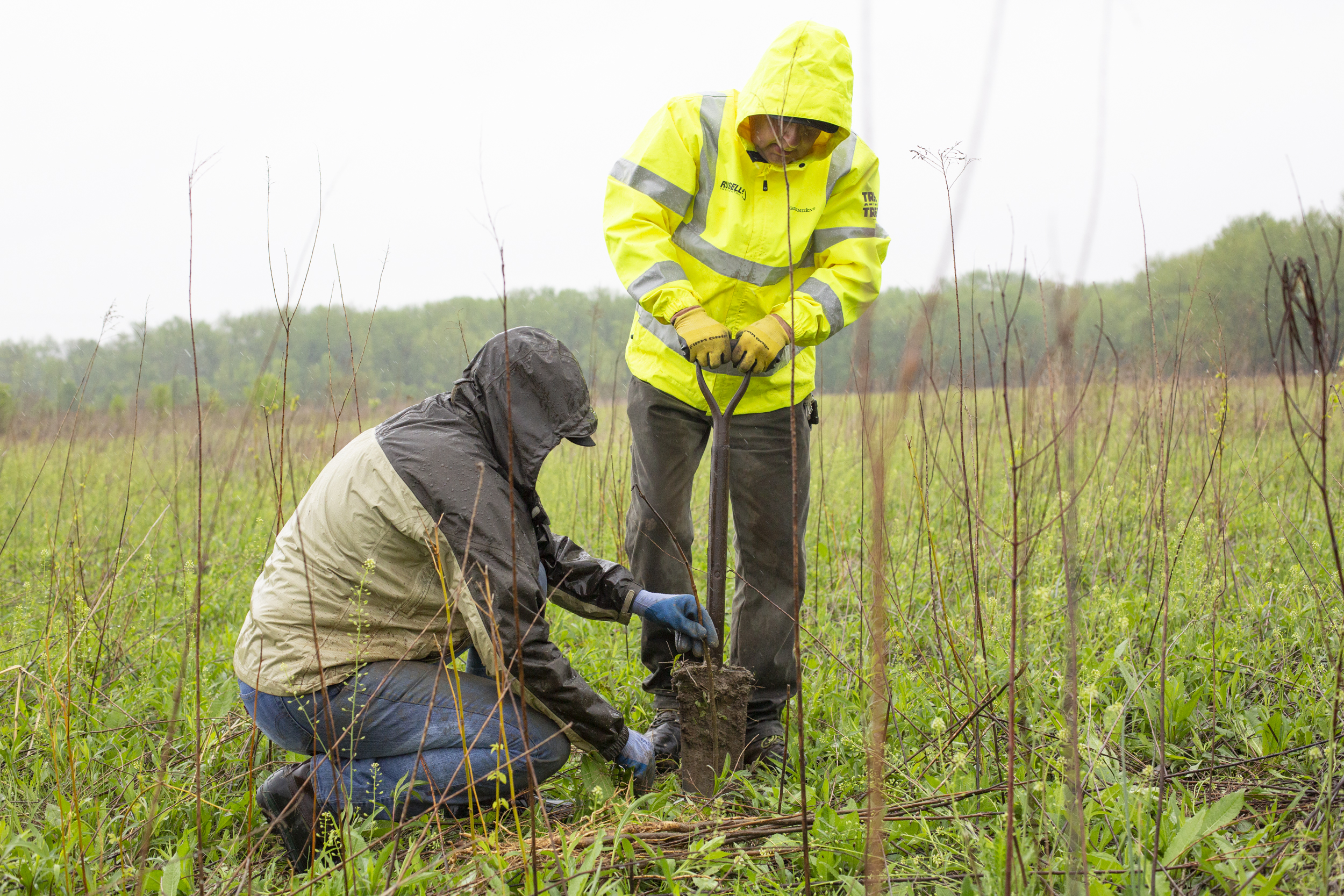
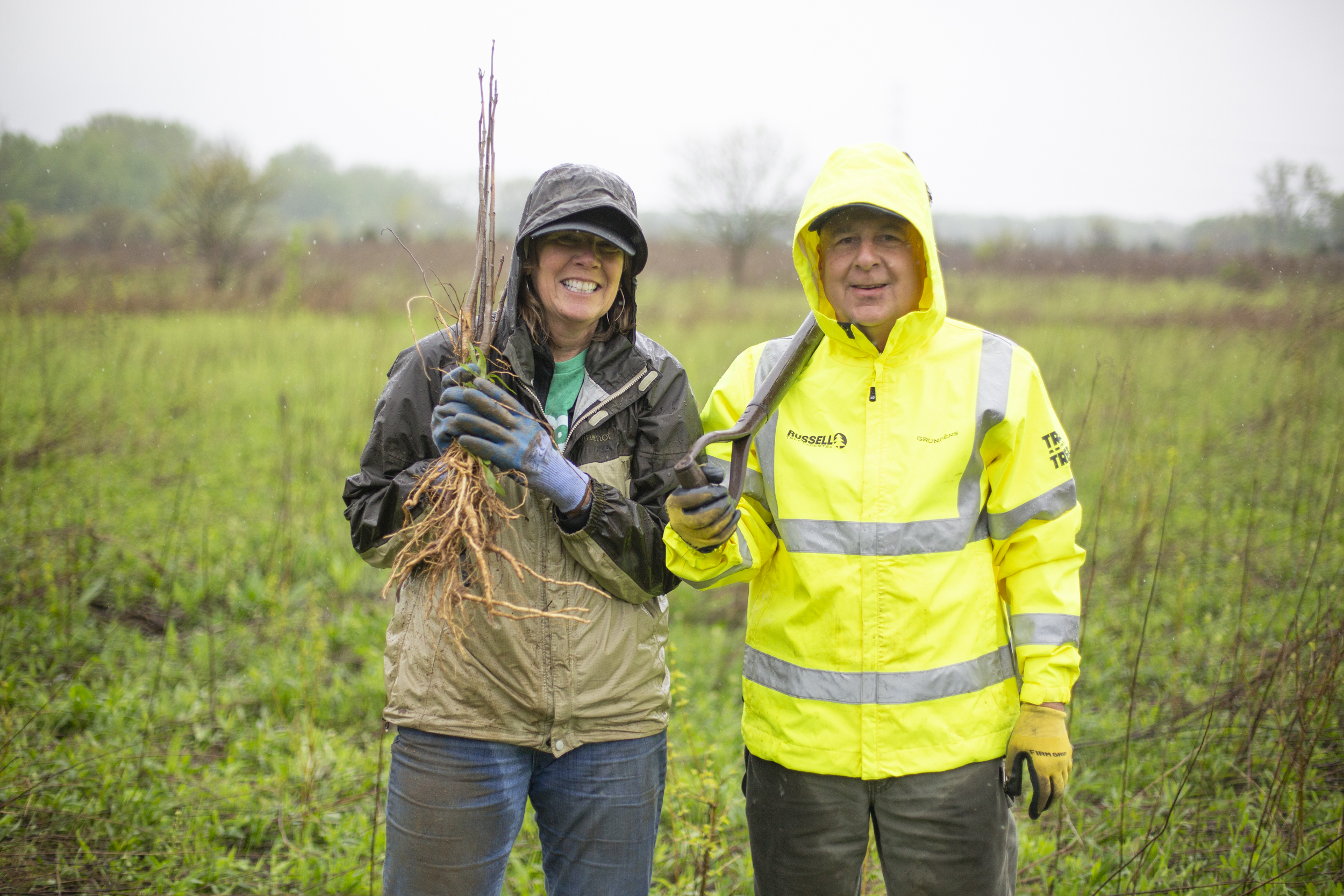
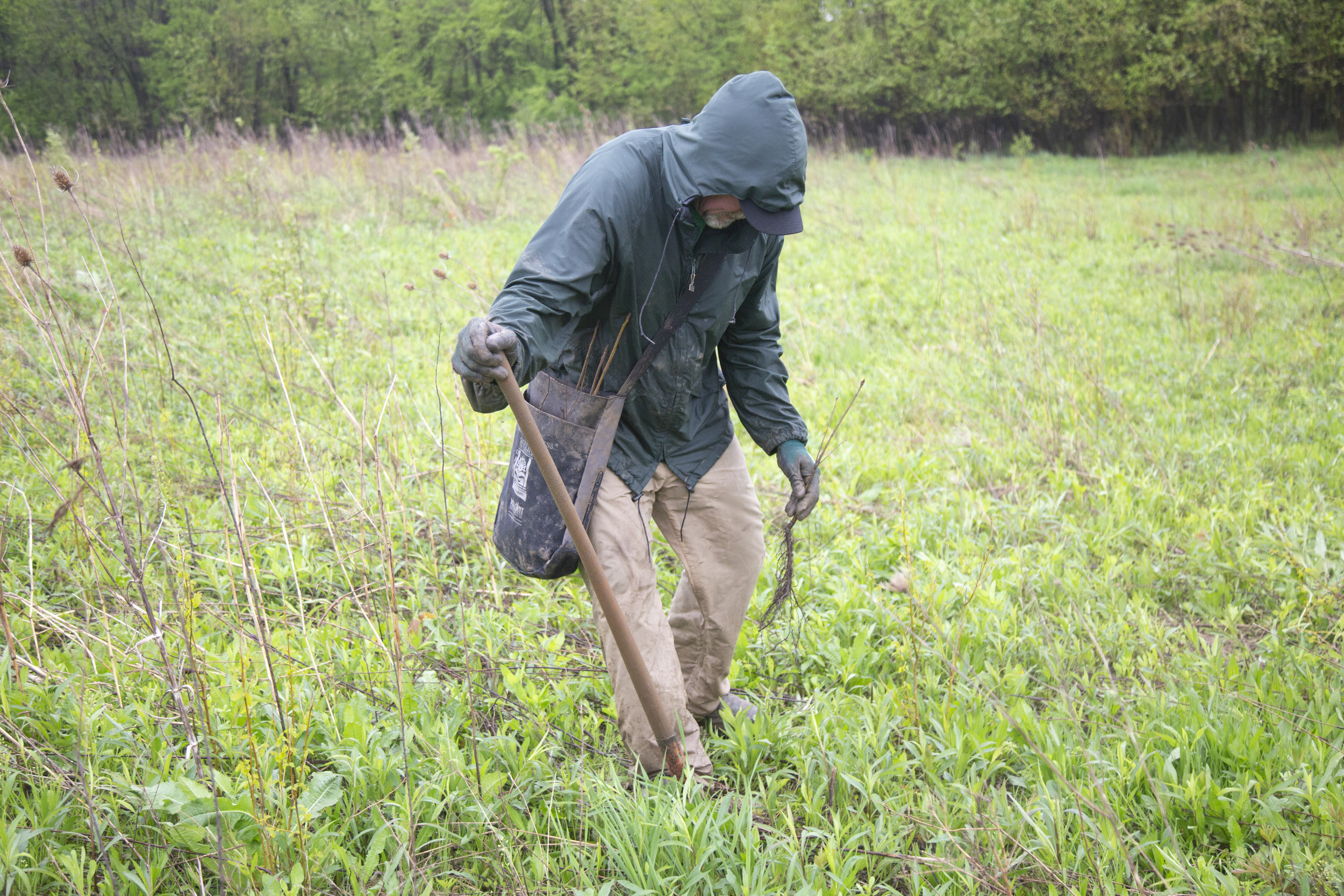
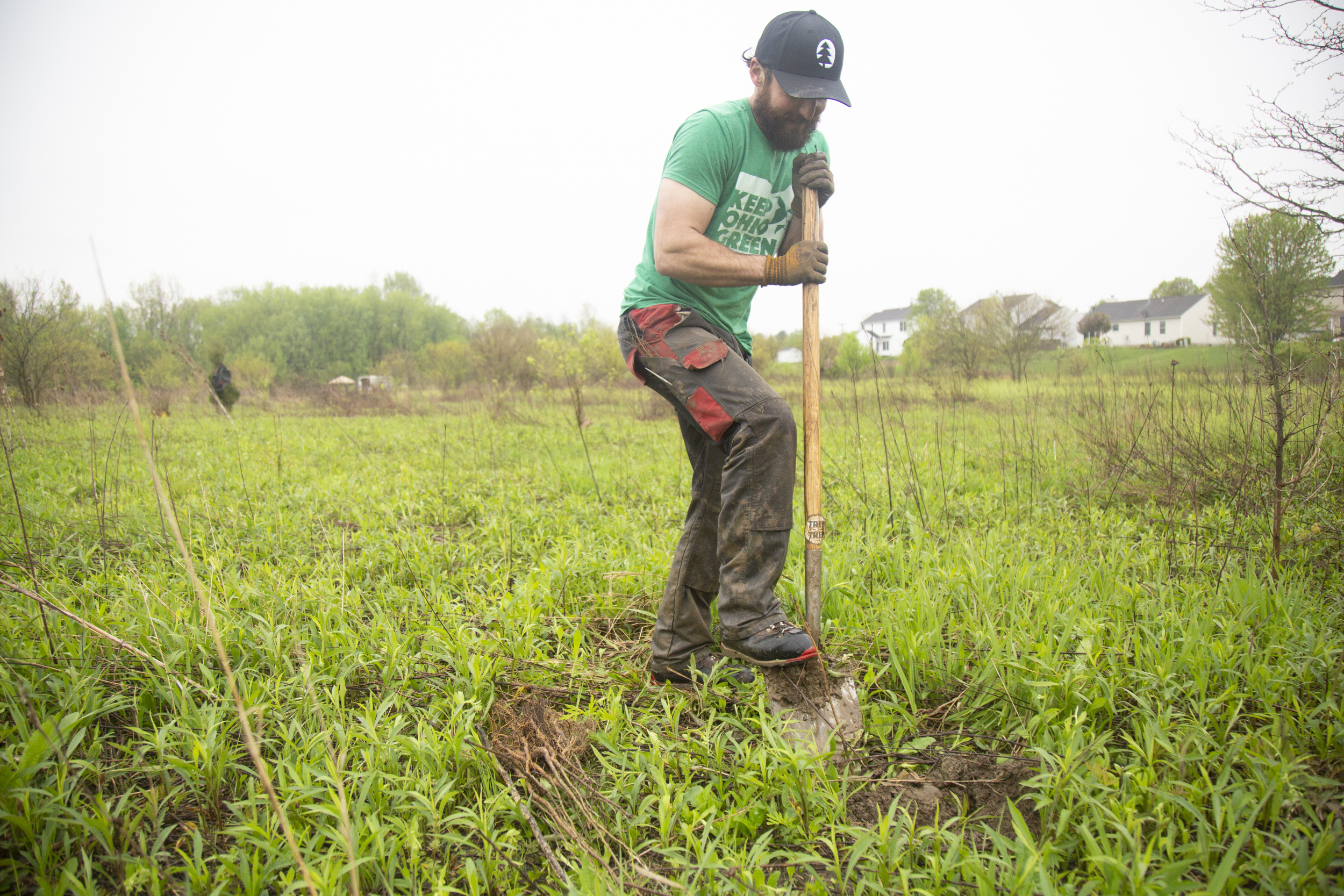
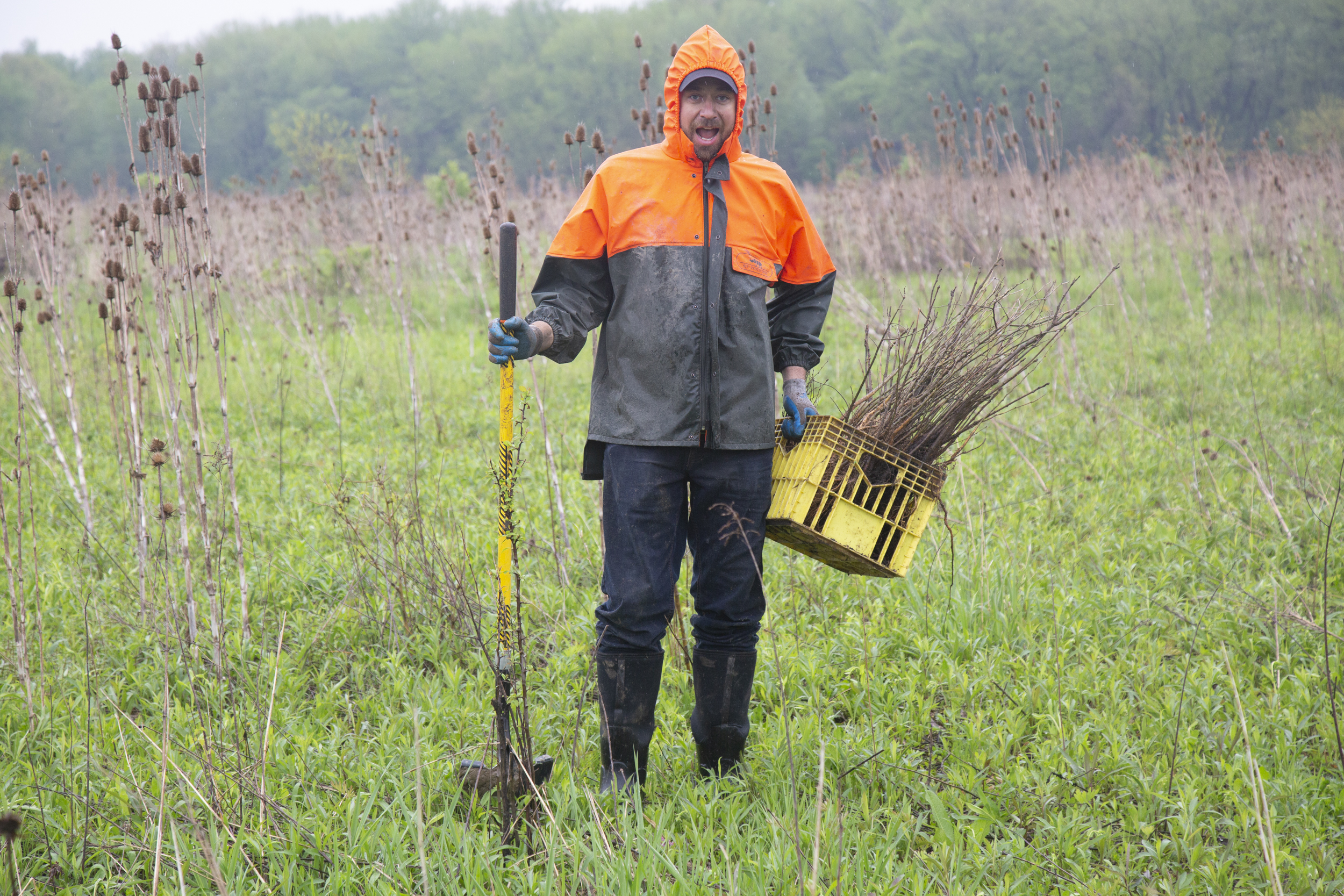
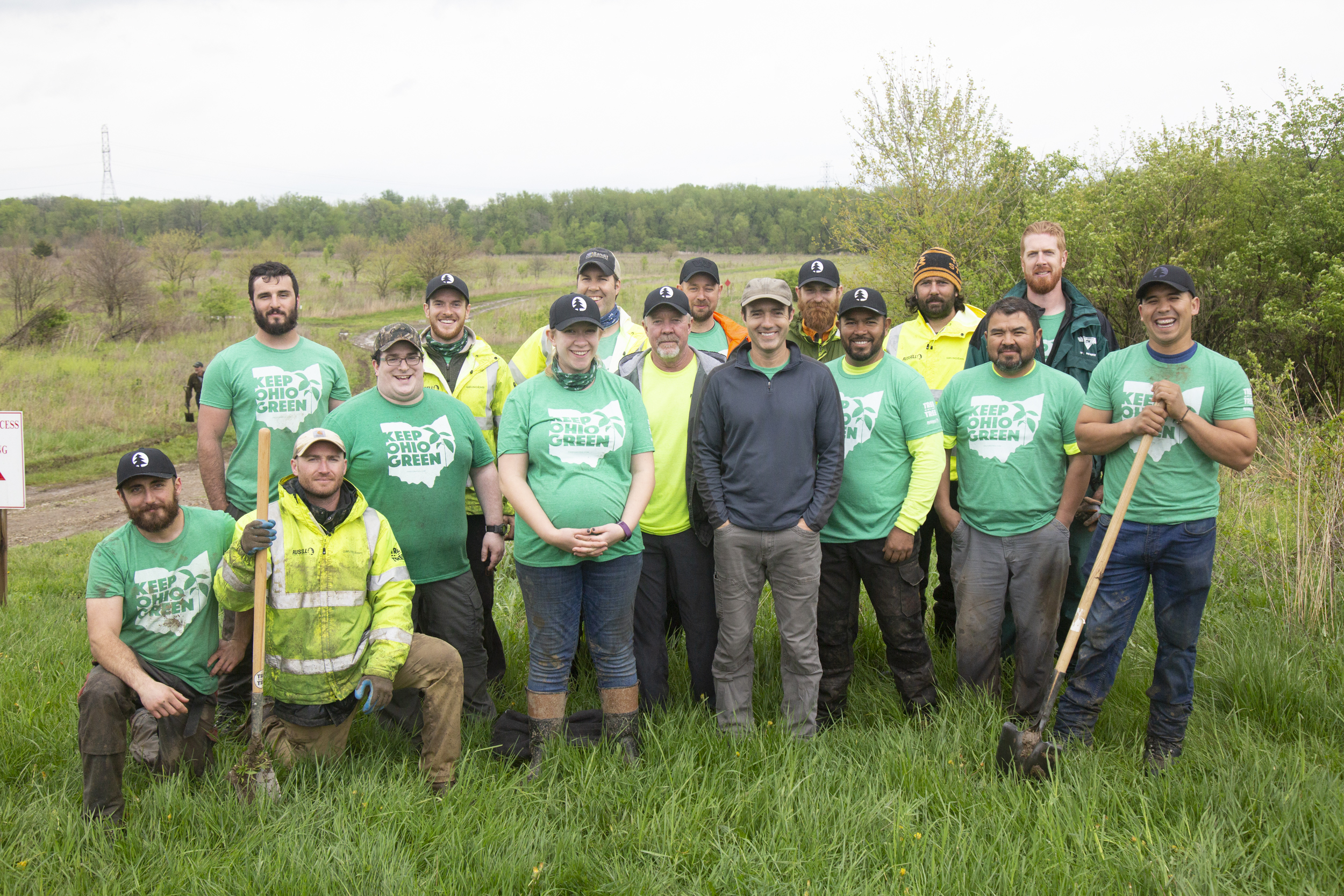
We created the TREE FOR A TREE© program in the winter of 2017 — as a result of our company wanting to offset the many trees we remove each year. It’s an unfortunate but necessary part of the tree service industry that many trees need to be removed each year, therefore, we decided that creating this program where we plant a tree for every tree we remove would be a great way to “KEEP OHIO GREEN” (see t-shirt).
Visit treeforatree.com to learn more about the program. You can nominate a planting location, sign-up to be a planting volunteer, see an interactive map of our planting locations, and more!
Thank you! Comment below with any questions you may have!

Kenny Greer | Marketing Director, Russell Tree Experts
Kenny graduated from The Ohio State University with a BFA in Photography. He enjoys photography, graphic design, improv comedy, movies (except for the scary ones), and spending time with his wife and 2 kids.
Mulch Mounds! Oh My!
Two days ago I stopped by the local gas station/grocery store compound around sunrise to replenish my truck’s fuel tank. As I drove on the service road passing the commercial property I felt something strange tugging at my peripheral vision, like large chocolate chips dotting the edge of my field of view. I took my eyes off the road for a moment, and sure enough, seemingly overnight the landscape had changed. It was as if a very large community of rodents had decided to move in and dig burrows in the landscape, leaving all the soil in regular mounds, perfectly spaced on the lawn. The next moment I saw that each mound had a tree growing out of it. Then the colors of breaking dawn also brought the light of knowledge to me as I realized “It’s spring, and the mulch mounders are at it again”.
Please note: This article was originally published on 4/15/2019 and was republished on 4/8/2021.
Two days ago I stopped by the local gas station/grocery store compound around sunrise to replenish my truck’s fuel tank. As I drove on the service road passing the commercial property I felt something strange tugging at my peripheral vision, like large chocolate chips dotting the edge of my field of view. I took my eyes off the road for a moment, and sure enough, seemingly overnight the landscape had changed. It was as if a very large community of rodents had decided to move in and dig burrows in the landscape, leaving all the soil in regular mounds, perfectly spaced on the lawn. The next moment I saw that each mound had a tree growing out of it. Then the colors of breaking dawn also brought the light of knowledge to me as I realized “It’s spring, and the mulch mounders are at it again”.

©Russell Tree Experts
You know when these mysterious beings have been in your neighborhood because all of a sudden trees look like they decided to burst fully formed out of the soil, shouldering through the earth’s crust, leaving it mounded up at the base of their trunk. You know you have been visited by a very dedicated contingent of mounders when even telephone poles or street signs are enjoying the benefits of multiplying mulch. (Yes, though this sight was unrecorded, I have heard eyewitnesses testify to it).
Please forgive my attempts at humor. It really is light-hearted, and I bear no ill will to the people who deliver the mulch so generously. As an arborist, I do take issue with the practice itself though, for three main reasons that perhaps are not immediately evident to those trying to do a good deed:
Mulch can create a hardened hydrophobic layer that actually sheds water. This effect is made worse when the mulch is mounded in a way that directs water away from the root crown of a tree, where all the roots are on a newly planted tree.
When the root crown is buried in such thick mulch, new roots start forming, trying to grow up to a more favorable place (the surface), where water and oxygen are more readily available. While they grow, they will likely stay contained within the mulch ring, which can contribute to a circular pattern of growth, causing girdling of the stem in later years. (See photo).
When enough water is provided to saturate the mulch, moisture will persist for longer periods of time around the trunk tissue. This, combined with warm temperatures from the composting process, provides a favorable environment for pathogens like bacteria and fungi to develop and cause disease.
Bad vs. Good mulching techniques // Proper mulching around a tree keeps the root flare visible while having about 2 inches of mulch depth on the root zone.
Why do we mulch anyway? For very good reasons. Established mulch rings help keep weeds away, help maintain moisture levels, provide organic matter for the soil (improving both chemistry and structure), and maintain a clear zone where mowers will not enter and cause soil compaction or mechanical damage to the tree. Like anything else in life, any good thing carried to an extreme usually ceases being a good thing. Overmulching actually defeats some of the reasons for mulching to begin with!
There you have it. Even the topic of mulch leads to a basic principle in life: Too much of a good thing… can lead away from what is good.
Here’s another one: Mulch mounders are people too, and I can live alongside them in peace as fellow human beings. But the practice of mounding mulch makes life difficult for trees. They can’t run away, they can’t open up their mouth and bawl for help. So I have to speak up for them if I can.
And I can.
Thank you for reading! I appreciate your comments and your thoughts.
Your friendly neighborhood arborist,

José Fernández | Regional Manager, Russell Tree Experts
José became an ISA Certified Arborist® in 2004, and a Board-Certified Master Arborist® in 2015. Currently he is enrolled at The Ohio State University pursuing a Master’s Degree in Plant Health Management. José likes working around trees because he is still filled with wonder every time he walks in the woods. José has worked at Russell Tree Experts since 2012.
Tree Law: "Who Owns This Tree?"
First and most importantly, I am not an attorney. What I am is a concerned business owner who has an interest in the law. Having recently read Arboriculture and the Law co-authored by Victor D. Merullo and Michael J. Valentine, I am inclined to share my findings in hopes of answering a few common questions we receive every year dealing with liability basics and the general risks associated with tree ownership.
Boundary Line Tree: Neither of the property owners is at liberty to cut the [boundary line] tree without the consent of the other.
First and most importantly, I am not an attorney. What I am is a concerned business owner who has an interest in the law. Having recently read Arboriculture and the Law co-authored by Victor D. Merullo and Michael J. Valentine, I am inclined to share my findings in hopes of answering a few common questions we receive every year dealing with liability basics and the general risks associated with tree ownership.
“Who, in fact, owns this tree?” is a question our company is faced with each and every day. Tree ownership is a big deal. Owning a tree makes one responsible for the potential (and actual) damage caused by that tree if it fails, but when? What about when trees fail in severe weather events or the most baffling, when a tree that shows no signs of stress or decay uproots and fails anyway? All these questions are even more challenging when a tree grows directly on a property line or is encroaching on a neighbor’s property. If undesirable limbs, which originate from an adjoining neighbor’s tree, hang over your property line, what rights do you have in removing them? According to the authors’ research, some. “May I treat an ash tree to protect against the Emerald Ash Borer if the majority of the tree is located on my neighbor's property?” Good question. The answer: yes, and no.
Trees that grow directly on a property line (split directly down the middle) are called boundary line trees and are owned by both property owners as “tenants in common.” According to the authors, “neither of the property owners is at liberty to cut the [boundary line] tree without the consent of the other, nor to cut away the part which extends into the property owner’s land if the injury would result to the common property in the tree” (Merullo, Valentine, 1992, p. 24). For instance, if one of the tenants in common is to perform work to the tree which results in death to the tree, that may lead to legal consequences initiated by the other tenant. So although it may be tempting, one cannot simply cut the tree down the middle without expecting one fierce legal headache. Often times property lines are not clearly defined and it can be difficult for arborists to determine if a tree exists between two properties. When in doubt, before signing a tree contractor’s contract accepting full ownership, speak to your neighbor(s) and get written permission prior to any work to a boundary line tree. Maybe offer them warm chocolate chip cookies first.
Tenants in common of boundary line trees must respect the joint ownership of the tree completely whereas a tree that is not directly on the property line has different implications. “It is generally held that when a neighboring landowner’s tree limb hangs over an adjoining landowner’s property, the adjoining property owner has an absolute right to cut the tree limbs off the tree up to the property line” (Merullo, Valentine, 1992, p. 33). We often tell clients to imagine an imaginary vertical line (as if Luke Skywalker was pointing his lightsaber directly to the stars) running along the property line. All plant material that is on the client's side of the lightsaber, may be removed with confidence. However, a challenging issue we often face is the practicality of performing the tree work without the necessity of accessing the neighbor’s (non-client's) property. This can be especially hard when said neighbor may or may not be that into Star Wars if you know what I mean. We must respect private property and avoid trespassing at all times; as a result, there have been a handful of jobs we have not been able to commit to because the work could not be safely done without gaining access (and permission) to the adjoining property.
The Luke Skywalker property line pruning method
The issue of trespassing also weighs heavily in regards to Tree Wellness applications. As mentioned earlier, trees that are close to property lines can be difficult to treat properly without consent from both property owners. Perhaps the health of a beautiful ash tree that hangs over a property line is extremely important to one neighbor and not at all to the other - our arborists may only be able to treat the tree with trunk injections from one side, which means the tree may not be getting the best preventative care. The same goes for deep root fertilization which is ultimately beneficial if applied around the entire drip line of the tree canopy. Again, possibly improving one’s baking skills may lead to healthier, happier trees? It’s worth a try.
Our American beech tree that recently succumbed to high winds
©Russell Tree Experts
Even if one crosses every t and dots every i, some things are beyond all control. I have seen it first hand in my own woods; large mature trees which look perfectly healthy one day are lying on the forest floor the next (see photo). Two certified arborists in one house, taking every precaution to protect family, property and the public and yet massive winds or sudden soil erosion uproot trees around us. Nature is unpredictable even to the trained eye, however what I read in chapter ten of the book was reassuring: “the landowner is exempt from liability for injuries caused by trees resulting from natural conditions, but the landowner will be responsible for injuries which the landowner could have taken measures to prevent” (Merullo, Valentine, 1992, p. 91). This is important because although some tree failures cannot be predicted, just like the weather, many are avoidable with the help of an educated, experienced arborist. Simply planting a tree properly in the right location can be the difference between long-lasting health and increased liability.
I can recall a serious tree failure in a Worthington neighborhood a few years ago. A very large, mature Siberian Elm tree suddenly uprooted and slammed to the street blocking traffic in both directions. This was and is a street children ride their bikes up and down and that I pushed a stroller along nearly every day. The reason the tree most likely failed? A paved driveway was installed too close to the trunk of the tree, cutting off and smothering the vital root system that exists in the top twelve inches of soil. It may take years before the compression from asphalt and the lack of water to roots from construction projects lead to catastrophe, which is a daunting reality for the unsuspecting homeowner. On a warm summer day after a night of heavy rain, the elm tree totally failed. By sheer luck (or perhaps a bi-conditional “act of God” ?), no one was injured.
Our team has collectively seen many unfortunate tree related situations which have helped us communicate the importance of knowing what it really means to own a tree. There are a few simple measures a homeowner can take to demonstrate an awareness of the risks associated with tree ownership and by doing so hopefully eliminate a great deal of legal stress. For instance, learning how to properly protect trees during construction or if installing a cabling system may mitigate the potential for tree failure under increased stress (from wind and/or ice) can be determined through a discussion with an experienced arborist.
Lastly, it may seem obvious that we begin all tree work with a signed contract from the person, company or municipality that hired us which states the client(s) have sole ownership of all trees listed on the quote however language clarifying this responsibility is not only to release Russell Tree Experts from liability, but because we recognize the work we do cannot be reversed. I hear Joe Russell often saying, “the best time to plant a tree is 20 years ago.” As avid tree lovers, we recognize and appreciate that adage more than most. Mature, healthy trees are highly valuable and hard to come by. A personal goal of mine is for each of our clients to be able to look out their windows, gaze at their gorgeous trees and smile, big. If that isn’t possible yet, again with the cookies.

Shari Russell | Managing Member & Co-Owner, Russell Tree Experts
Shari Russell graduated magna cum laude from The Ohio State University with a Bachelors in Landscape Horticulture and Cultural Anthropology. She is a member of the International Society of Arboriculture and has been a Certified Arborist since 2008. She is currently preparing for the June 2019 LSAT.