
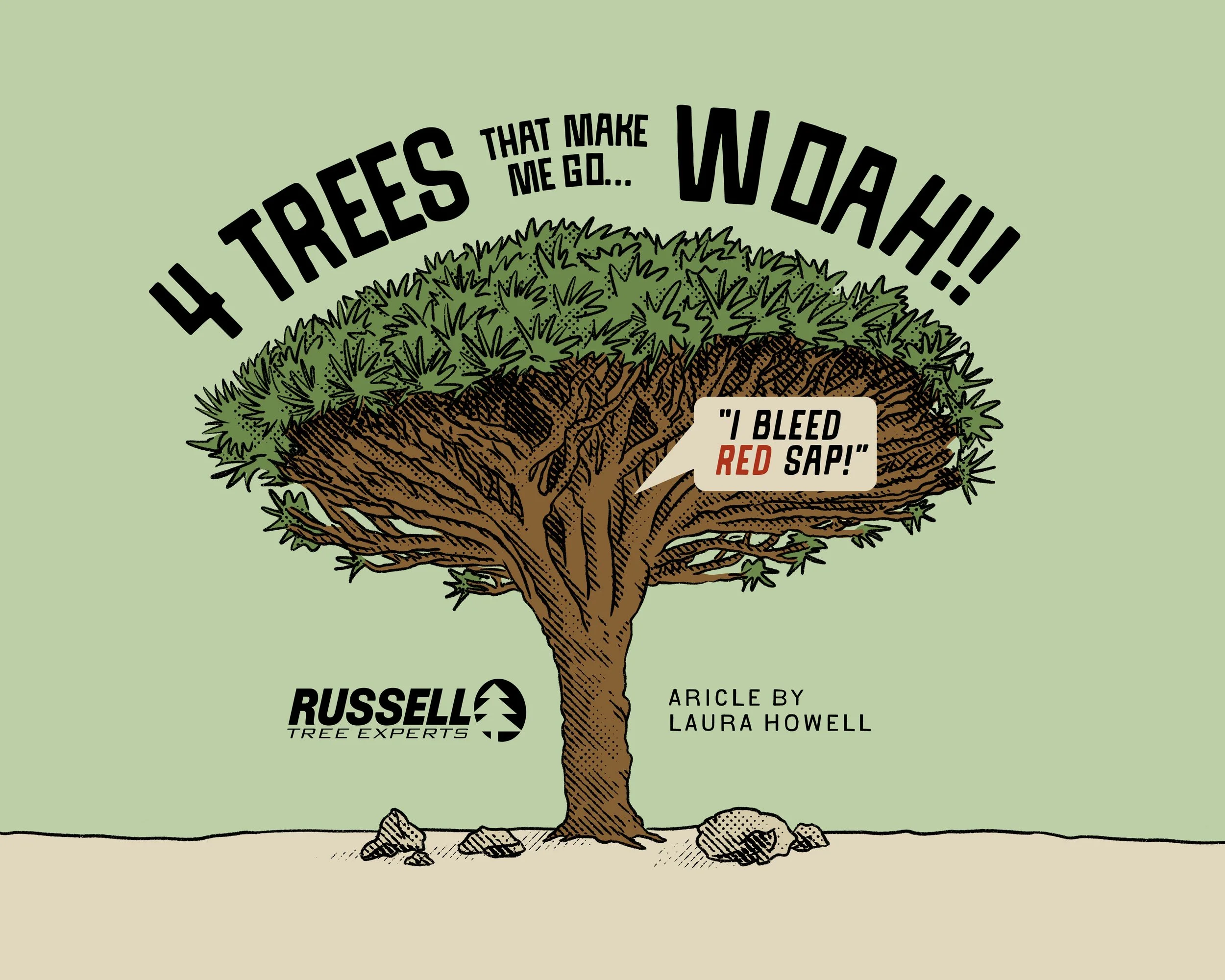
By Laura Howell
January 22, 2026
There are 60,000+ tree species around the globe, making it hard not to be amazed by their diversity, uses, adaptations, and unique appearances. In this article, I’m going to highlight four trees that have always captivated me for their form, resilience, and remarkable adaptations.
1) Rainbow Eucalyptus Tree (Eucalyptus deglupta)
What do you think of when someone mentions eucalyptus? How it’s helpful when you have a stuffy nose or maybe cute koalas eating their leaves? But do you think of their trunks? What many people may not know is how beautiful eucalyptus trees, particularly their trunks, are. In 2019, I was driving down the coast of California and got to see a eucalyptus forest for the first time. The most beautiful, in my opinion, is the rainbow eucalyptus tree. That may be a bit of a grand statement given I have only seen a few of the 700 types of eucalyptus trees.
The rainbow eucalyptus bark peels off and exposes the colorful layers underneath a few times a year, as a form of shedding. When the bark first peels off, it is green underneath. As the new layer is exposed to air, the colors begin shifting because of the tannins in their cells. The colors displayed through the tannins are shades of pink, purple, blue, orange, and maroon. Because the bark peels at different times, the missing strips are all different colors causing the trees to look painted. If you want to see one in person, you can find them in the US in California, Texas, Florida, and Hawaii.
Fast facts
Scientific name - Eucalyptus deglupta
Mature Height – In the US: 60 to 125 feet tall; in the rainforest (natural habitat): 100 - 250+ feet tall
Growth Rate – Fast up to 3 feet annually
Interesting Fact – While the rainbow eucalyptus isn’t native to the US, the monarch butterfly has begun over wintering in the California eucalyptus trees.
2) Dragon Blood Tree (Dracaena cinnabari)
I remember seeing a bottle of “dragons’ blood” in a store. I bought it for the curiosity’s sake of what this dragon’s blood might look like, and it was indeed bright red, like blood. It turns out this bottle of “blood” came from dragon blood trees. These trees grow in the high mountains of Socotra Archipelago, Yemeni islands. The sap has been used throughout history for its medicinal purposes and as red dye. The tree itself doesn’t produce visions of large flying reptiles or dramatic blood colored sap; it’s always reminded me of a large umbrella that has been turned inside out from the wind.
Like an umbrella, this tree uses its long waxy upturned leaves to capture the morning mist and channel it down the branches to its trunk. Because of the hot and dry climate, the dense canopy provides protection to any water that might accidentally drop onto the ground from evaporation. Even though the dragon blood tree struggles for each drop of water, it still produces flowers in the spring and fruit that takes five months to ripen that is eaten by local wildlife.
Fast facts
Scientific name - Dracaena cinnabari
Mature Height – 30 to 40 feet tall
Growth Rate – Very slow can take up to 10 years to reach 4 feet
Interesting Fact – The dragon blood tree does not have rings that can be used for aging
3) Quaking Aspen (Populus tremuloides)
The quaking aspen tree is a newer species of tree that I’ve been learning about, and I am excited to share some of the highlights. The specific male quaking aspen I am going to share details on is called the Pando tree located in Utah. Pando means ‘I spread’ in Latin. The reason this is a fascinating tree in my opinion is because this tree clones itself. The Pando has over 40,000 cloned stems that spread across over 100 acres. When the Pando loses a “tree,” aka clone in the colony to age/damage/disease, through a process called suckering, it will send a new genetically identical shoot upwards.
The root system which connects and supports all of the clones is over 16,000 years old. The cloned trees themselves are not older than 130 years. While the age of the root system is incredible, it does not make this an old growth because the individual trees are only at most, about 130 years old. The root system makes it one of the oldest and largest single organisms in the world. Both male and female quaking aspen trees clone themselves through suckering. Because of this, any single colony will be male or female. While quaking aspen trees are able to produce new trees through seeds, the most common method is cloning.
Fast Facts
Scientific name - Populus tremuloides
Age – Roots 16,000 years and trees 0 to 130 years
Mature Height – 20 to 50 feet tall
Growth Rate – 1.5 to 2 feet per year
Interesting Fact - Quaking aspens grow year round
I was torn with which tree to close this article out with. The two trees I went back and forth on were the weeping beech and the dawn redwood. Both hold a place in my heart, but the dawn redwood won for the Ohio connection and an amazing comeback story.
4) Dawn Redwood (Metasequoia glyptostroboides)
According to fossil records, the dawn redwood existed 50-100 million years ago before going practically extinct. It is a unique tree because it is one of the few conifers in its family that loses its leaves in the fall – making this conifer a deciduous tree. With it being a deciduous tree, it is believed that that is why it’s so common in fossil records until its assumed extinction after the last ice age. But in the 1940’s, a Chinese forester named Wang Zhan found a living specimen in the Sichuan province of China, making this tree known as a living fossil!
In 1948, a seed gathering mission begun in China to protect the dawn redwood from actual extinction. Now for the Ohio connection, there were two universities that received seeds from that first gathering mission: OSU and… OSU! Oregon State University and The Ohio State University. There are multiple places around Ohio where you can personally go see the living fossil.
The Ohio State University - Main Campus
OSU Secrest Arboretum in Wooster – Planted in 1953
Dawes Arboretum – largest grove outside of China
Shepley Garden in Birmingham
Akron Zoo
Fast Facts
Scientific name - Metasequoia glyptostroboides
Age – Oldest known is approximately 400 years old
Mature Height – 70 to 100 feet tall.
Growth Rate – FAST. Up to 4 feet per year in ideal, native conditions
Interesting Fact - Dawn redwoods can grow in the northern hemisphere in zones 4-8
We often admire trees for their beauty or shade, but when you look closer, you discover entire histories written in bark, roots, sap, and leaves. I hope you’ve enjoyed exploring these trees as much as I’ve enjoyed sharing them!
ADDITIONAL ARBOR ED™ ARTICLES!



Laura Howell | Human Resources Generalist, Russell Tree Experts
Laura joined Russell Tree Experts in January 2025. She supports our staff through her role in the HR department. Laura is an alum from Franklin University and CSCC with degrees in forensic accounting and finance. Outside of work she enjoys traveling, gardening, and camping.