
Asian Trees for the Ohio Landscape [Part 2]
In this second part of our “Asian trees for the Ohio landscape” series, we’re taking a closer look at the Japanese tree lilac (Syringa reticulata subsp. reticulata), a small to medium-sized tree that is suitable for many locations in the landscape

In this second part of our “Asian trees for the Ohio landscape” series, we’re taking a closer look at the Japanese tree lilac (Syringa reticulata subsp. reticulata), a small to medium-sized tree that is suitable for many locations in the landscape. If you’re interested in a larger shade tree for your yard, check out part 1 of this article series here, where we discuss the Japanese katsura tree.
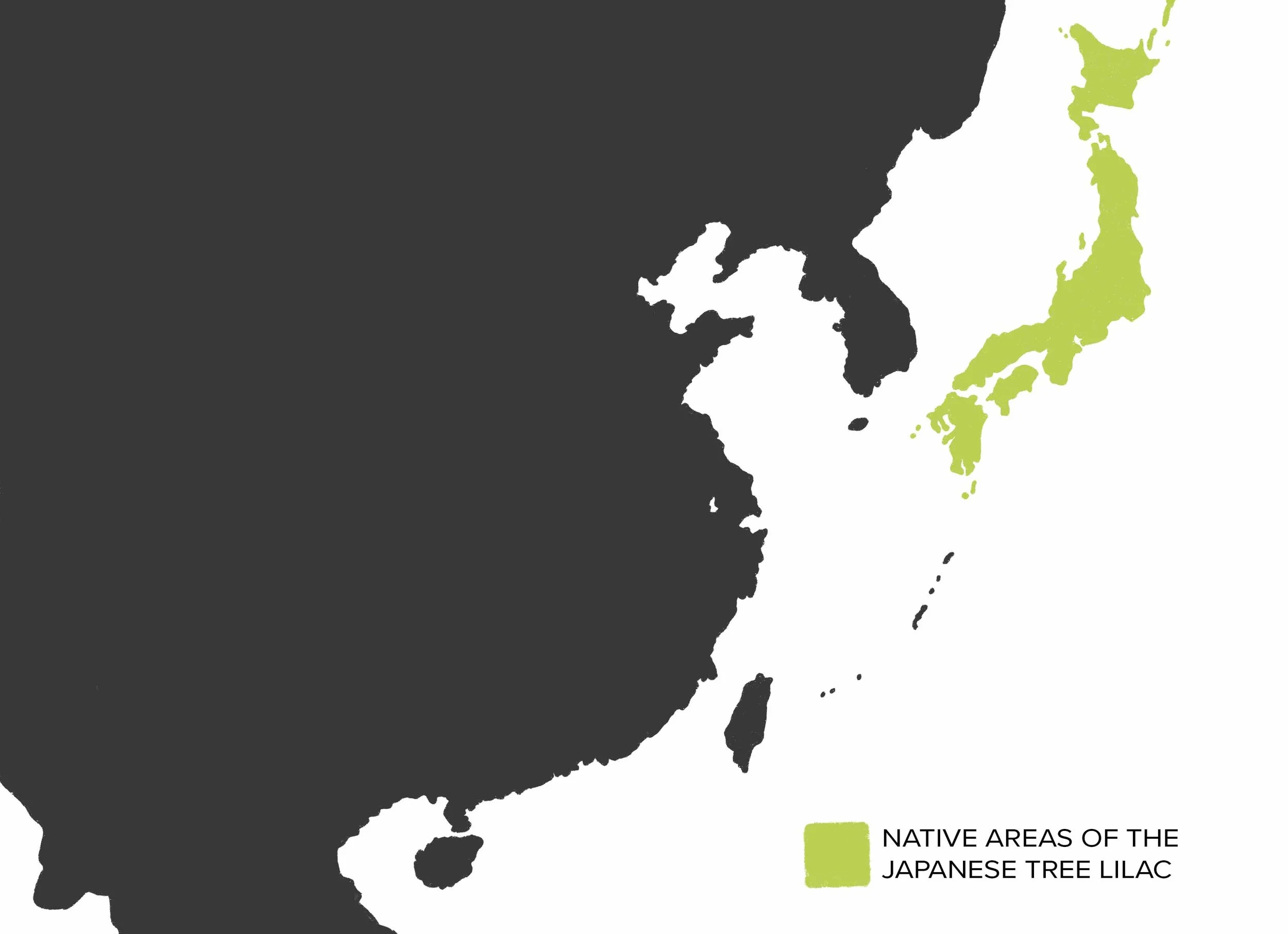
The Japanese tree lilac is native to Japan. It is in the same genus as shrub-type lilacs, but as the name implies, has a tree-like form that provides for a different application in the landscape. With a mature height of 20-30’ and width of 15-20’, it’s a great choice for smaller spaces near patios or closer to homes, or when used in group plantings along a large driveway. It is also an appropriate option for a street tree, as it can be easily maintained to clear streets and sidewalks with a more upright, rounded canopy.
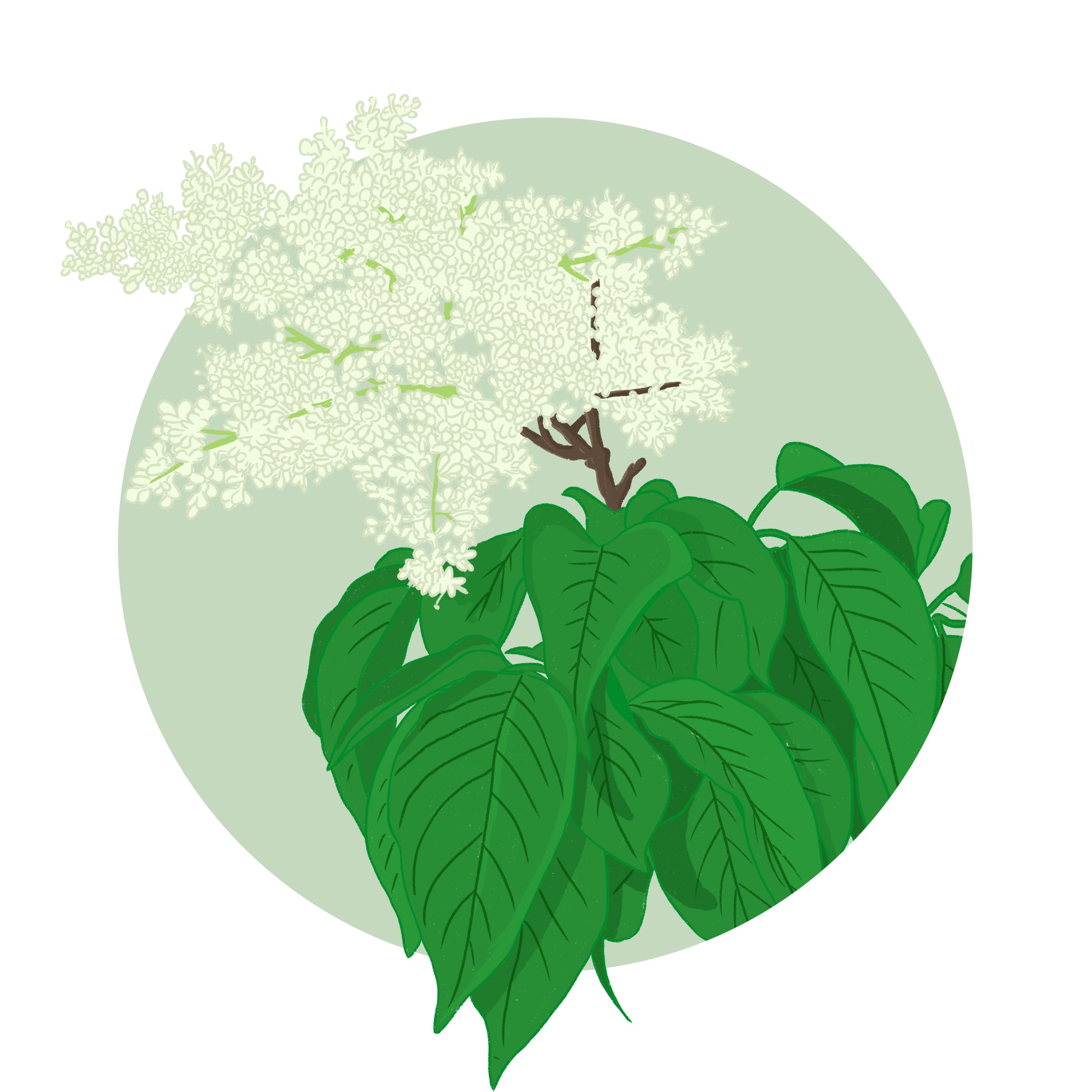
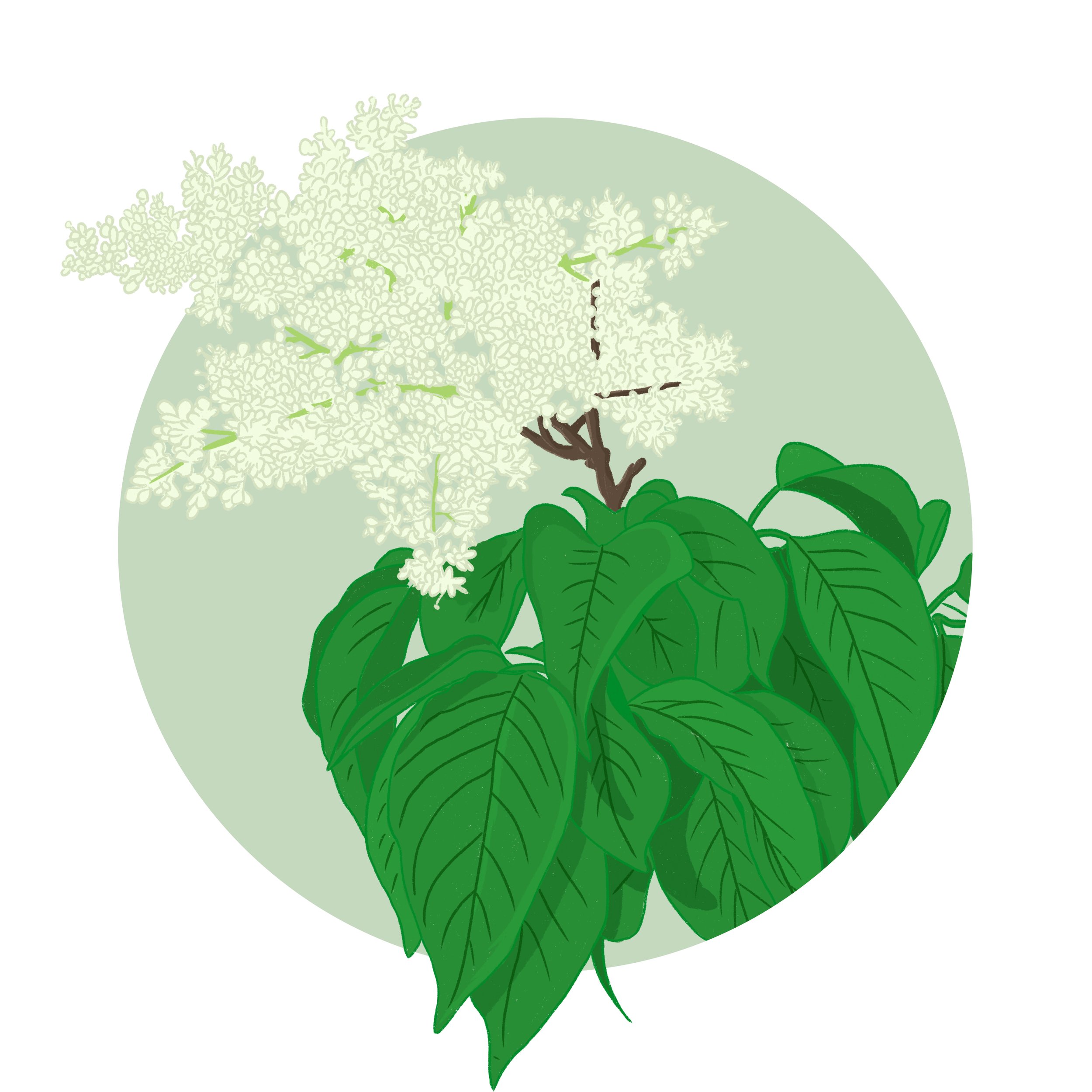
When selecting shrub-like lilacs for the landscape, homeowners often do so for the beautiful and aromatic flowers that emerge each spring. The Japanese tree lilac makes no exception in this manner, producing large clusters of white, fragrant flowers in early summer. Its foliage is similar in shape to that of a common flowering lilac, with no particularly notable fall color before leaf drop. Its bark has distinctive markings (lenticels), closely resembling that of a cherry tree.
When planting a Japanese tree lilac, be sure to select a location that gets plenty of sun throughout the day. It will tolerate less than ideal soil conditions including compact and dry sites, but thrives in well-drained, moist and fertile soils. As is the case with virtually all trees, proper amendment of the soil when planting the tree and proper after-care (watering and fertilization) will set it up for success in subsequent years.
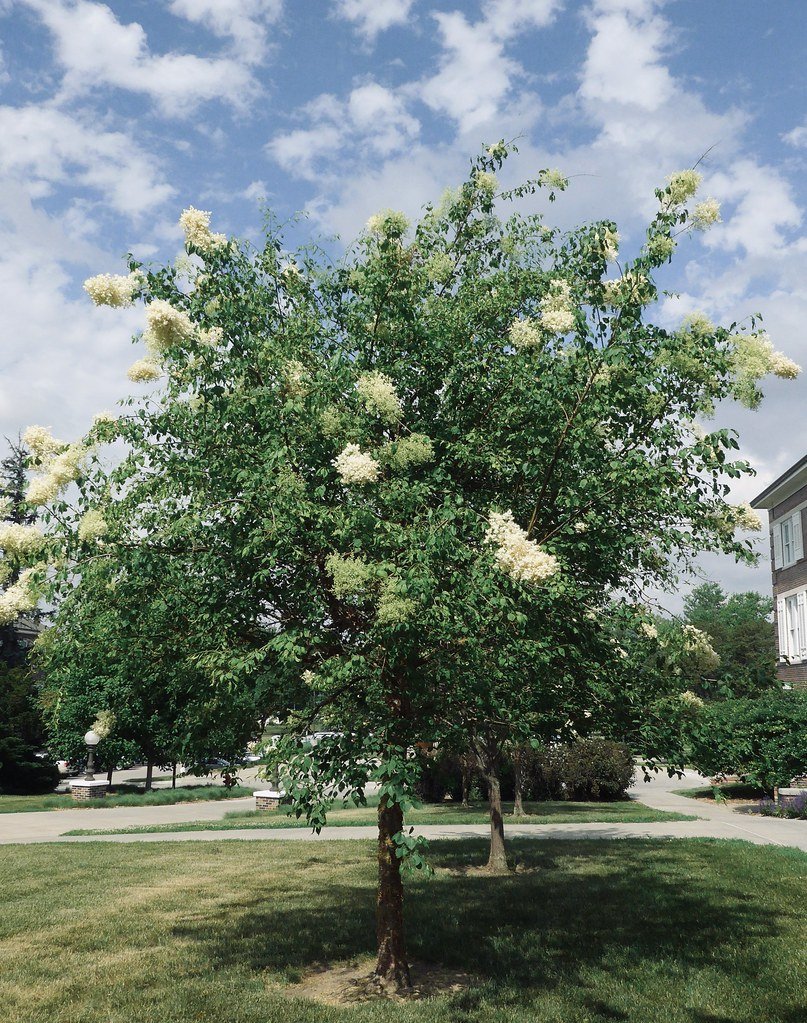
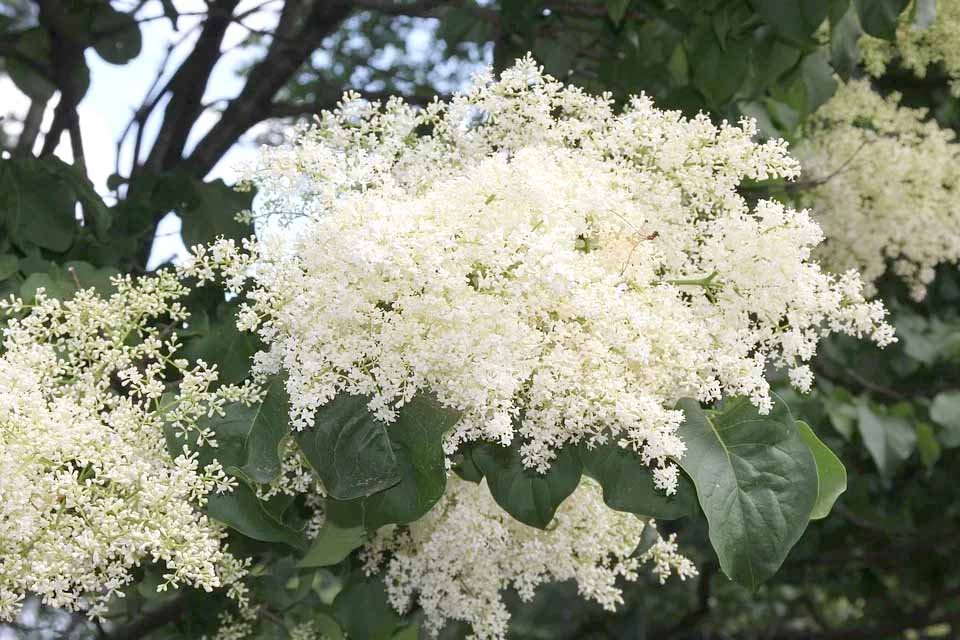
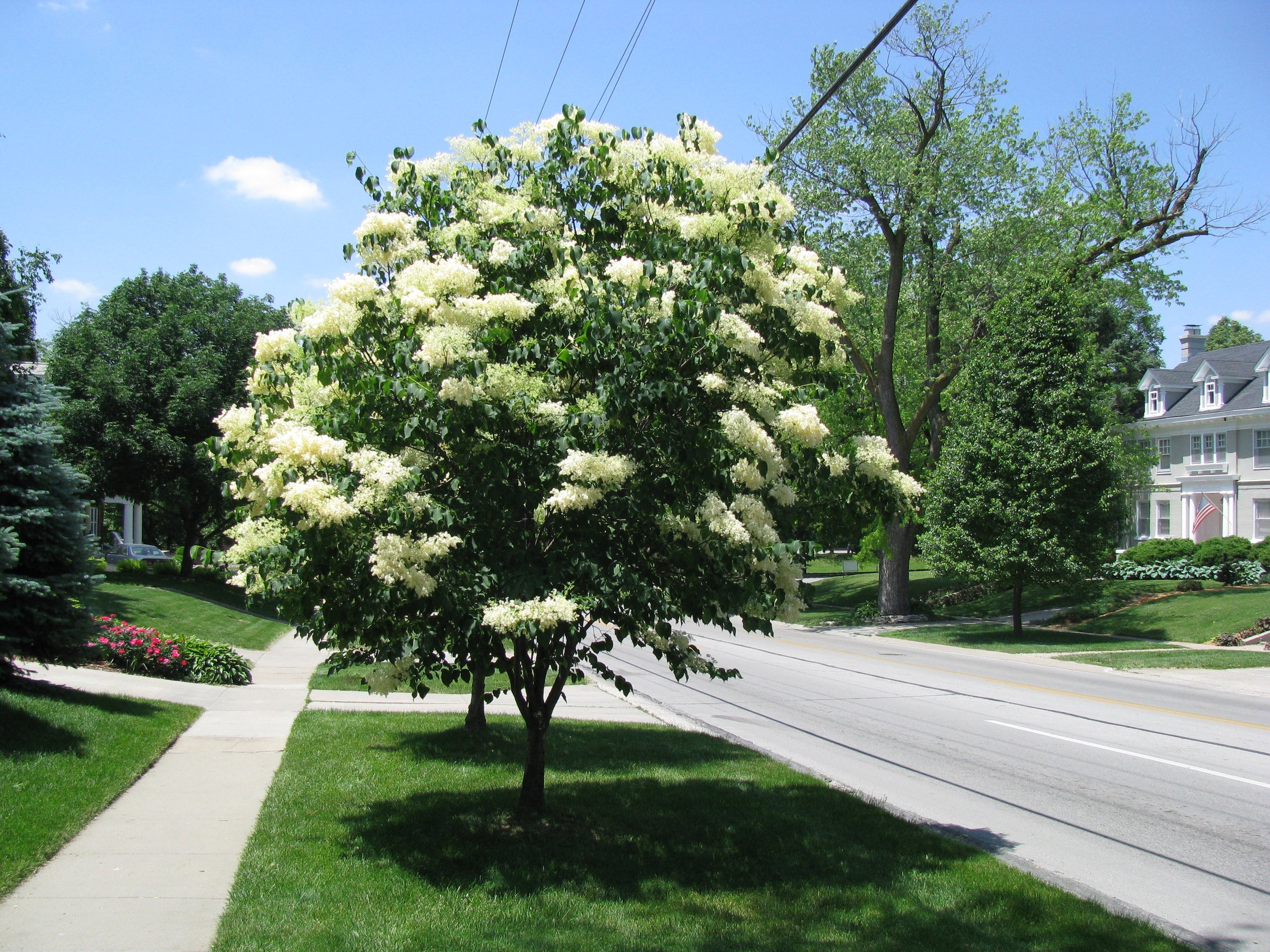
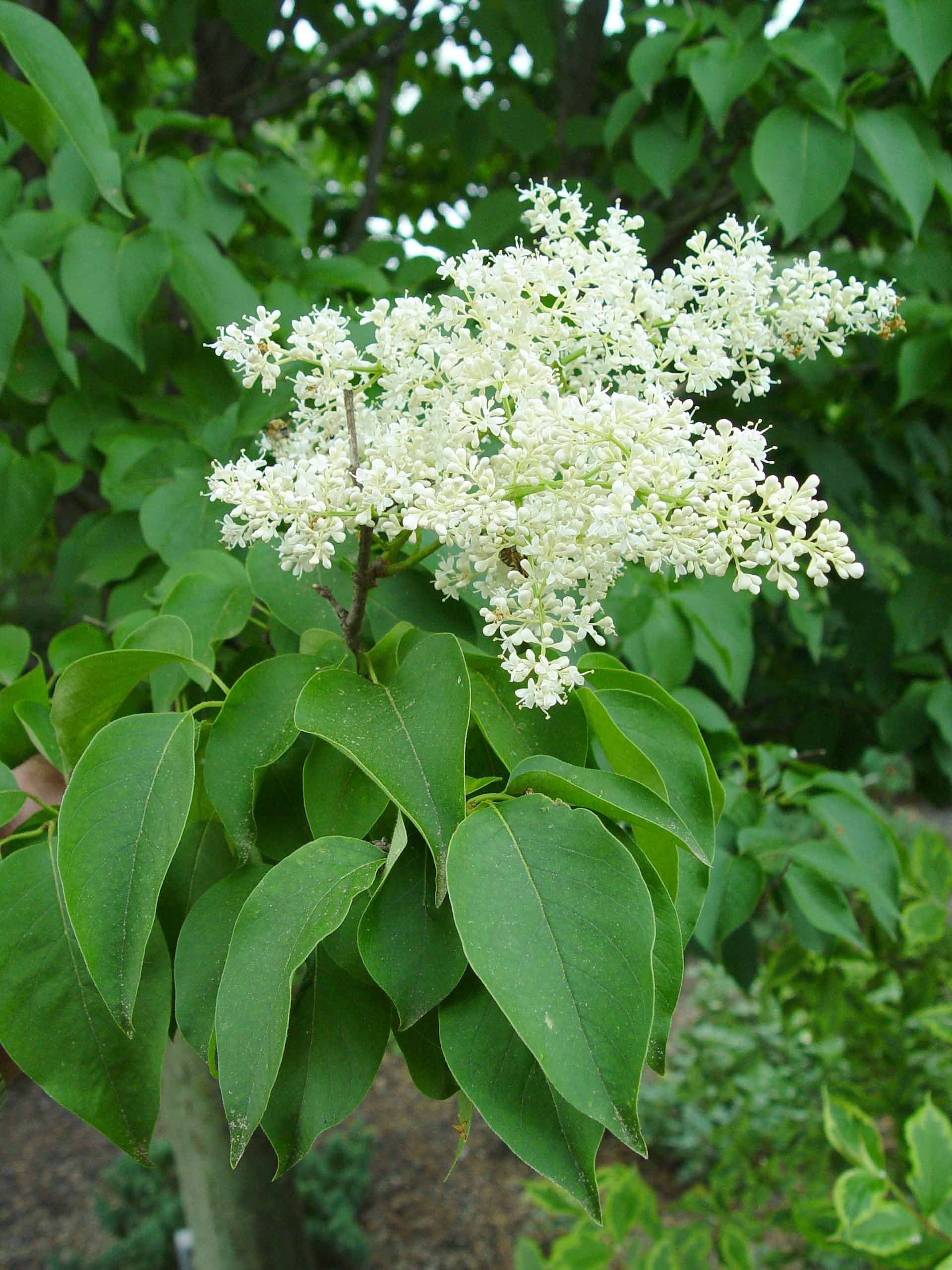
The Japanese tree lilac has a medium growth rate. It is susceptible to a few insect and disease issues if growing in a stressful environment, but is widely considered to be the most pest-free lilac. A popular variety of Japanese tree lilac that can be found in local nurseries is ‘Ivory Silk’, a cultivar that matures to approximately 20’ in height and flowers at a young age.
The Entire 3-Part Series


Walter Reins | Regional Manager, Russell Tree Experts
Walter has been an ISA Certified Arborist since 2003. He graduated from Montgomery College in Maryland with a degree in Landscape Horticulture, and has called Columbus, OH his home for nearly 20 years. Walter appreciates trees for their majesty and the critical role they play in our world.
Asian Trees for the Ohio Landscape [Part 1]
In Ohio and much of the Midwest, many of the non-native trees and shrubs that can be found in the landscape are Asian in origin, due to the similar climate we share with that region of the world. This gives us a great opportunity to expand our options beyond native trees and shrubs when selecting suitable replacements or additions to our yards.

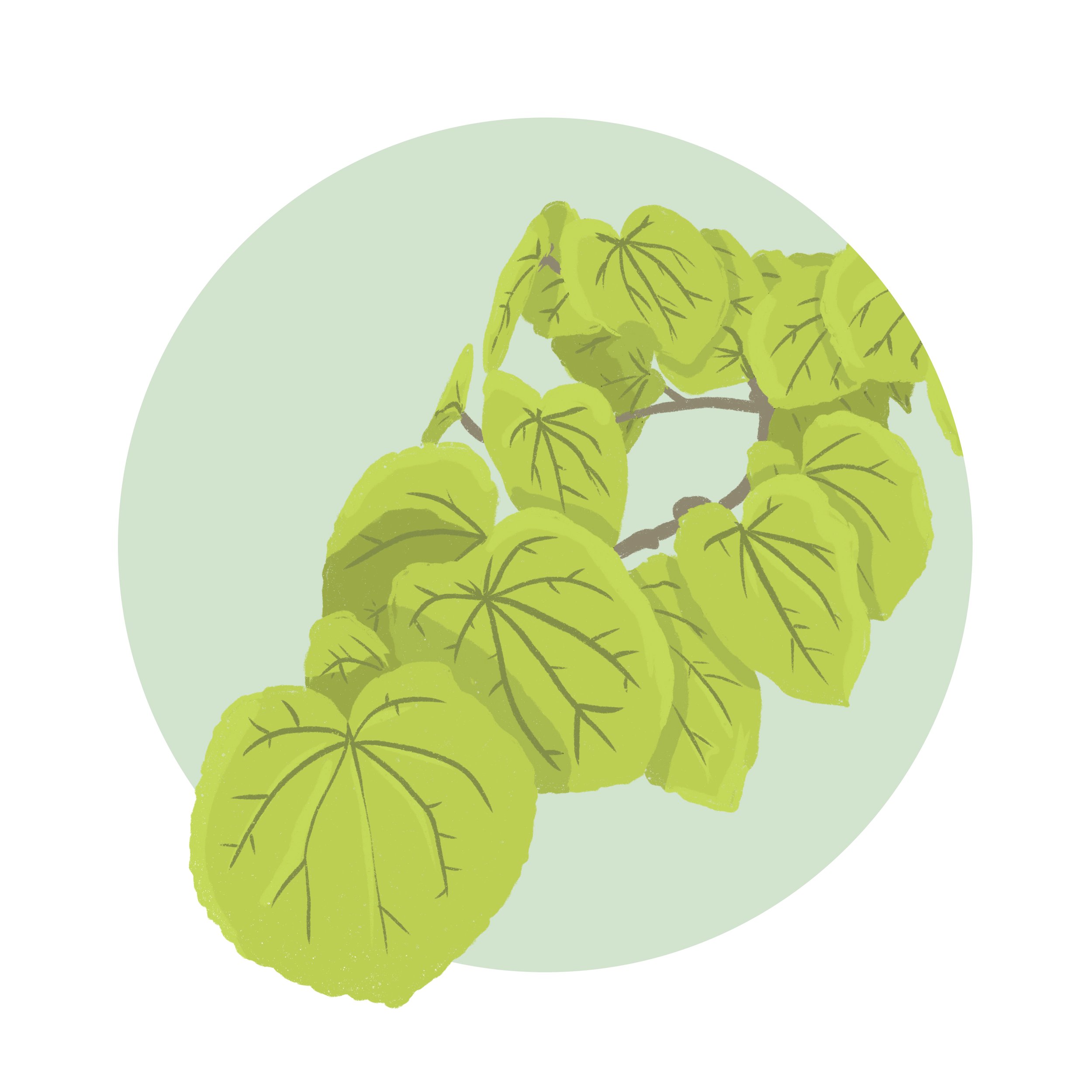
In Ohio and much of the Midwest, many of the non-native trees and shrubs that can be found in the landscape are Asian in origin, due to the similar climate we share with that region of the world. This gives us a great opportunity to expand our options beyond native trees and shrubs when selecting suitable replacements or additions to our yards. Some non-native trees, such as Japanese maples, have become staples in our landscapes. In this article, we’ll discuss the Japanese katsura tree (Cercidiphyllum japonicum), a medium to large tree in maturity that is largely underutilized in the midwestern landscape, but might just be the perfect tree for your property.
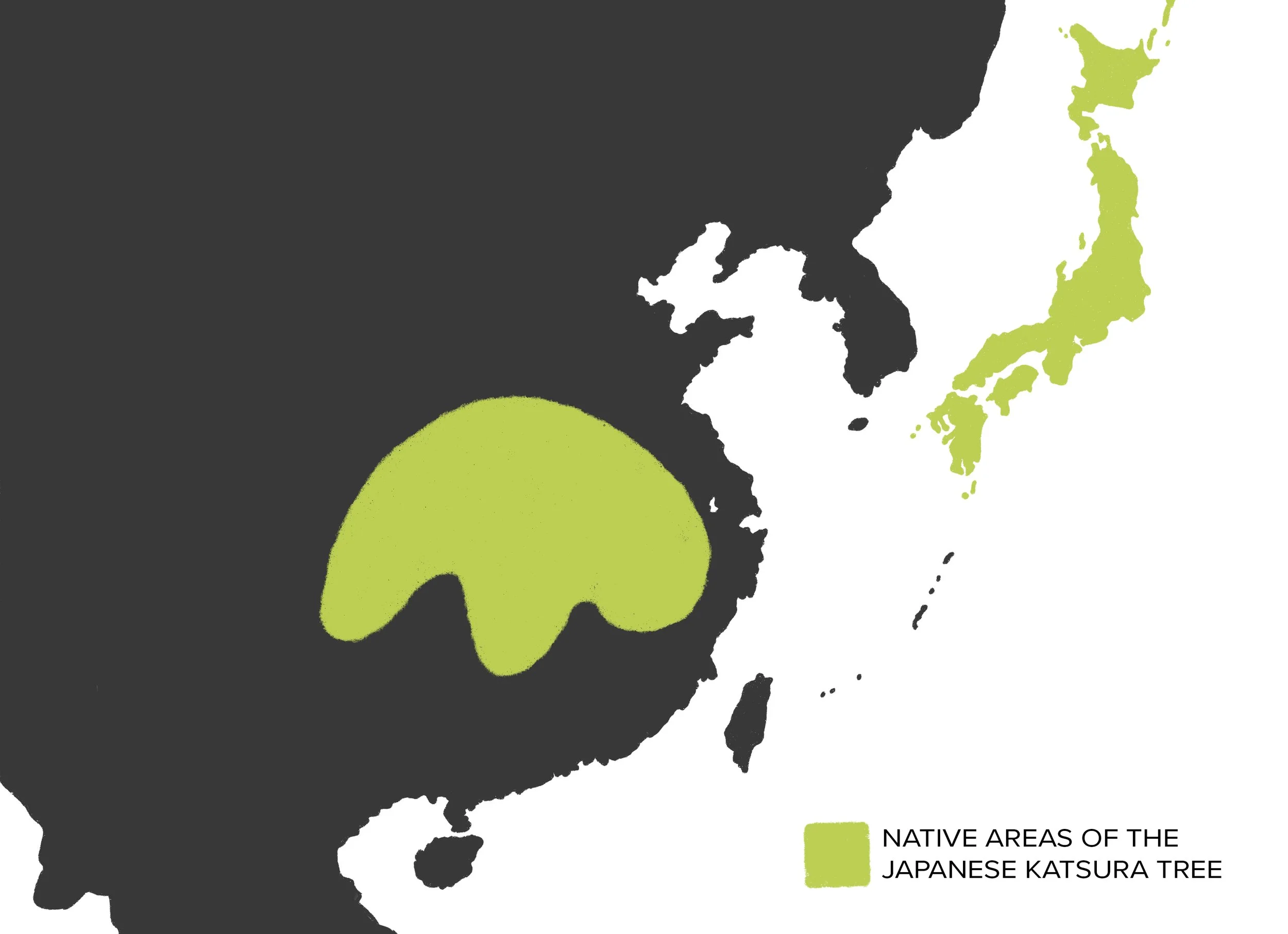
The Japanese katsura tree is native to Japan and parts of China. Though it can grow to more than 100’ in height in its native wild habitat, it will generally reach 40-60’ in a landscape setting. Because of its larger size, the Japanese katsura tree should be planted in a location where it has room to grow and eventually become a shade tree.
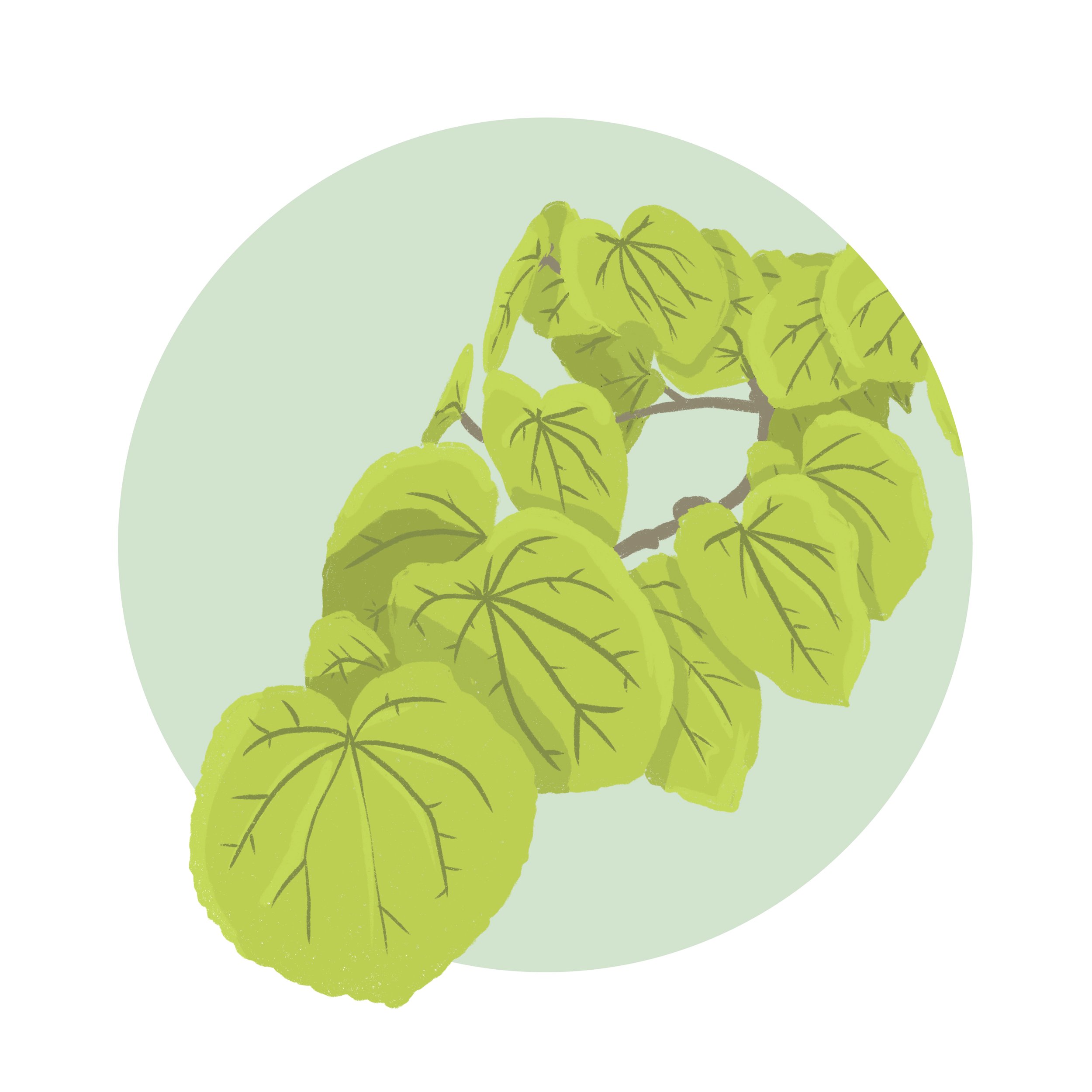
The Japanese katsura tree has rounded, heart-shaped leaves and is deciduous (dropping its leaves in autumn). It has a wonderful yellow to slightly orange fall color that is accompanied by a distinctive smell, often described as burnt brown sugar or cotton candy, when the leaves begin to fall and decay. It prefers full sun but some protection from the wind, is generally insect and disease-free, and has a medium to fast growth rate under ideal conditions. It has a pyramidal shape when young, but matures into a more rounded canopy, reaching 30-40’ in width.
The Japanese katsura tree will tolerate the alkaline and clay soils often found in central Ohio, but it does prefer consistently moist and well drained soils (as do many trees!). For this reason, it’s important to give the tree a great start in the landscape with proper planting and after care for the first 1-2 years.
When younger, the Japanese katsura tree does have thinner bark, so it's trunk should be protected if you tend to have deer activity in your yard, as the antler rubbing from male whitetail deer in the late summer and early fall can severely damage or kill a tree. Also, care should be taken to maintain a mulch ring or landscape bed around the tree, as thinner barked trees are generally more susceptible to mechanical damage from mowers and string trimmers.
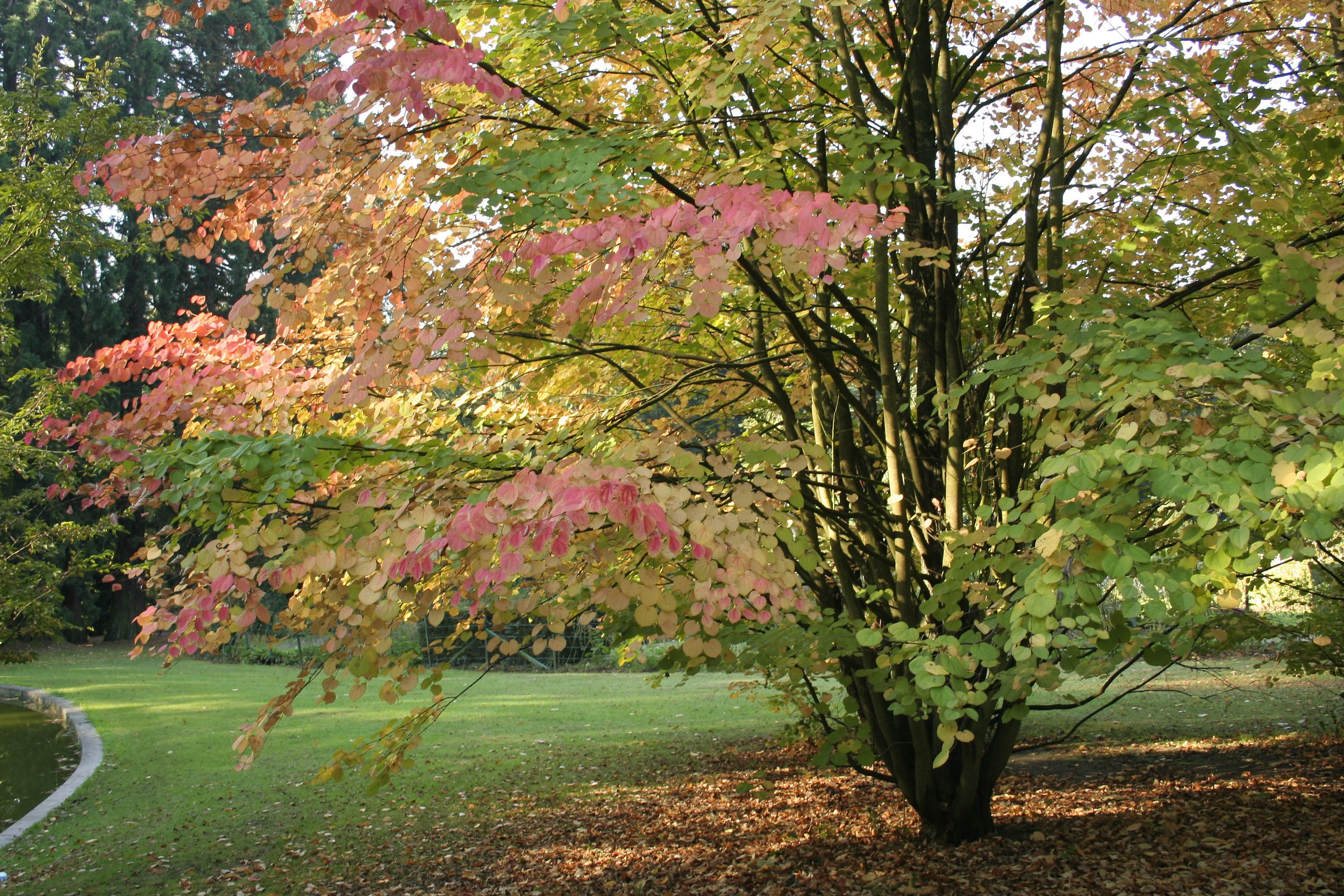
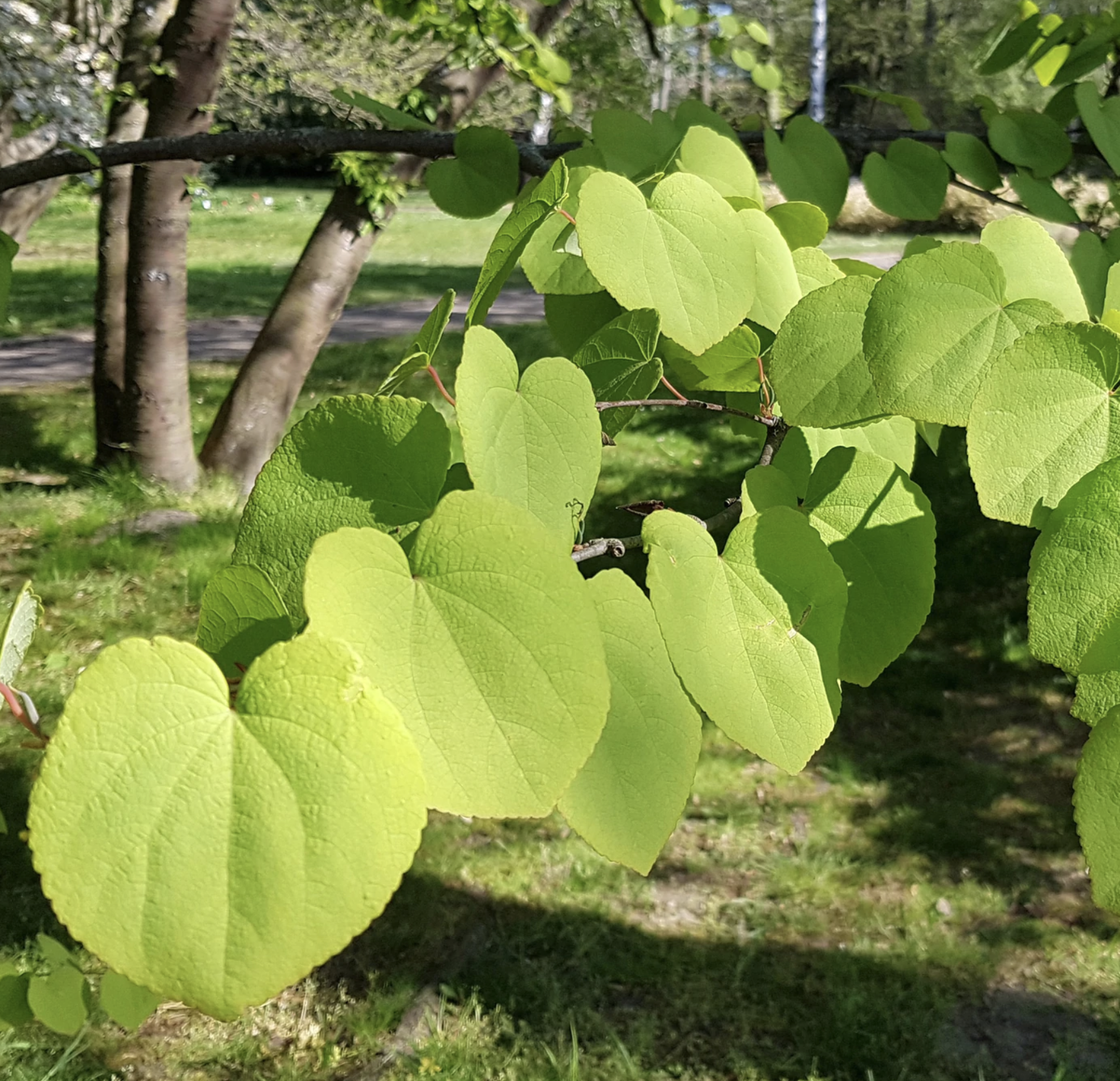
Overall, the Japanese katsura tree is a great choice for a central Ohio landscape. If you’re looking to plant a tree this year, be sure to do so in the spring or fall when temperatures and soil moisture are favorable, and give the Japanese katsura tree some consideration. It’s a great alternative option to our native shade trees, and will add wonderful form, color, and variety to your landscape.
The Entire 3-PArt series:

Walter Reins | Regional Manager, Russell Tree Experts
Walter has been an ISA Certified Arborist since 2003. He graduated from Montgomery College in Maryland with a degree in Landscape Horticulture, and has called Columbus, OH his home for nearly 20 years. Walter appreciates trees for their majesty and the critical role they play in our world.
Right of Way: Understanding City-Owned Trees
Many people assume that they are responsible for the trees located in their lawns in front of their homes. In many cases, this is not true.

Many people assume that they are responsible for the trees located in their lawns in front of their homes. In many cases, this is not true.
Many cities and municipalities maintain what is called a “right of way” in front of your property and sometimes in the back as well. I have worked for three different communities over my career, and all three had different policies regarding “street trees”, as they are usually called.
Many communities simply create an ordinance passing that responsibly to the property owner, but in central Ohio, there are several communities that have created forestry departments that maintain trees located in the city “right of way.” That’s where the tricky part comes in as there are many different approaches in how each department operates. We (Russell Tree Experts) are currently completing several tree pruning contracts for different communities in central Ohio at this time. Some communities have arborists on staff to complete their work and contract some as well.
Most communities in central Ohio allow the property owner to maintain their city-owned trees if it is completed without harming the tree and completed in a professional manner. Some communities require that a tree company working on city trees must be registered with the city and have a certified arborist on staff. In most cases, removing a city-owned tree is not allowed without prior approval and it can be quite costly (fines) if you remove a city tree without permission.
Finding out what the “right of way” is prior to any work is always a good idea. Most communities can provide that info over the phone. Another good resource in Franklin County is the auditor site. If you pull up your address you can go into mapping where you can determine the right of ways associated with your property.

In the above example, the red line is property line. Trees outside of these lines would likely be the city’s responsibility - depending on the city’s rules. [the above is a screenshot for the Franklin County Auditor Site.]
Most people do not realize that in some cases the right of way can extend well beyond the sidewalk. If you have an alley behind your property, there may be some easement associated with that as well. In the communities that I have worked for, the alley “right of way” was only the width of the pavement. If your property is a corner lot or surrounded by streets, you may not be responsible for near as many trees as you once thought.
In closing, I would highly recommend that you identify which trees you are responsible for prior to hiring an arborist. This could save you a lot of money in the long run. Not only if you are not responsible, but so you don’t cut down or improperly prune a city-owned tree, and get fined.
Questions? Comment below and we’ll get back to you.
What to learn more? Check out the article “Tree Law: Who Owns This Tree?” written by Shari Russell which details who owns a tree when it grows on a property line.

Mike McKee | Regional Manager, Russell Tree Experts
Mike graduated from Hocking College in 1983 with a degree in Natural Resources specializing in urban tree care. He has been a certified arborist since 1991. Mike started his career in the private industry in 1985 before becoming a municipal arborist in 1989. He retired after serving thirty years before joining us at Russell Tree Experts in Sept. of 2018. His love of trees has never waned since trying to climb up the ridges of the massive Cottonwood tree in front of his childhood home.
Spotted Lanternfly: They Are Getting Close!
If you are among those of us in the tree or insect world, you’ve likely heard of the Spotted Lanternfly (SLF). This pest showed up in the Southeastern region of our neighboring state of Pennsylvania in 2014. This is an invasive sap sucking insect that has the potential to disrupt a variety of industries.

If you are among those of us in the tree or insect world, you’ve likely heard of the Spotted Lanternfly (SLF). This pest showed up in the Southeastern region of our neighboring state of Pennsylvania in 2014. This is an invasive sap sucking insect that has the potential to disrupt a variety of industries. The preferred host is the infamous Tree of Heaven which initially may sound like good news; let’s have an invasive insect wipe out an invasive plant! (See TJ’s article about Tree of Heaven). However, Tree of Heaven is not its only target. If Tree of Heaven isn’t around, it will simply jump onto the nearest tree until it finds something it likes. SLF has been documented feeding on over 100 different species of plants. The most susceptible, other than Tree of Heaven, is Grapevine, apple and peach trees, hops, blueberries, Black Walnuts, and Maples, but again, this pest doesn't discriminate! Another reason why it is so invasive is that it doesn’t have any natural predators. The flashy color on the Spotted Lanternfly warns potential predators that “I don’t taste good!”
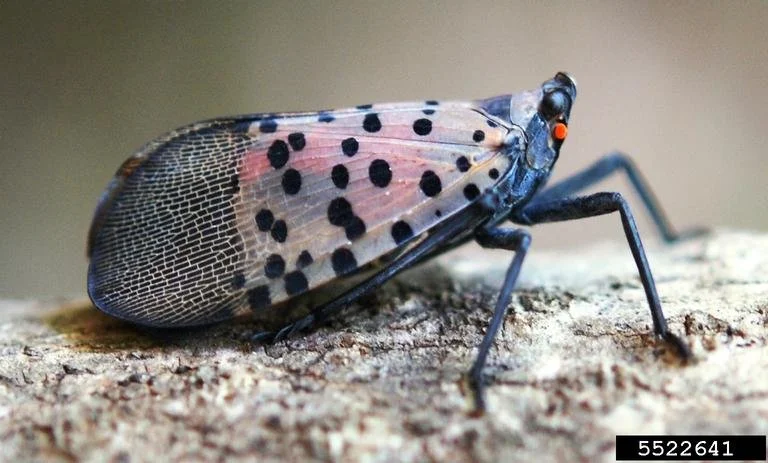

The OSU Extension office is currently researching best treatment options. Unfortunately, so far, they do not have any recommendations but we are watching the situation closely and when we have more information, we will give everyone an update. For now, it’s important to be aware of the potential infestation in your area and monitor. If you see any suspected SLF activity, report it to the OSU Extension office and they will confirm.
What can we do to slow the spread?
Known areas of infestation in Pennsylvania have a quarantine mandate requiring to go through a checklist before traveling or moving within or out of the quarantined area. In Ohio, the Department of Agriculture has put together this checklist to help slow the spread of this pest.
If eggs are found, you can scrape the eggs into a bag to seal them/crush them or kill them in an alcohol solution. During these early stages of spread, it is important to document anything you find; please take pictures of any suspected Spotted Lanternfly or collect a sample if possible and send it to the OSU Extension office along with the location you collected the sample.
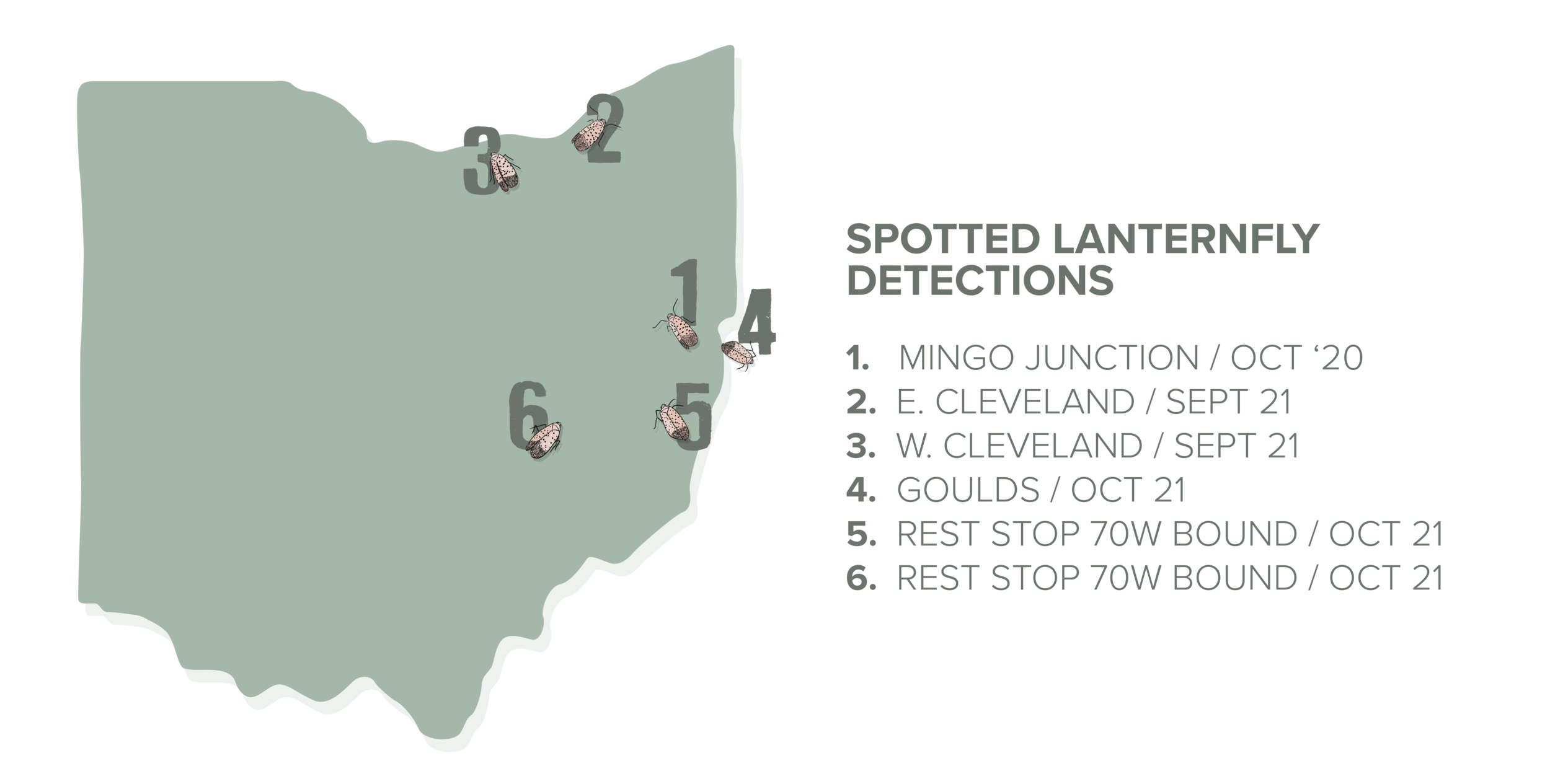
So far, six populations of Spotted Lanternfly in been confirmed in Ohio:
To do now:
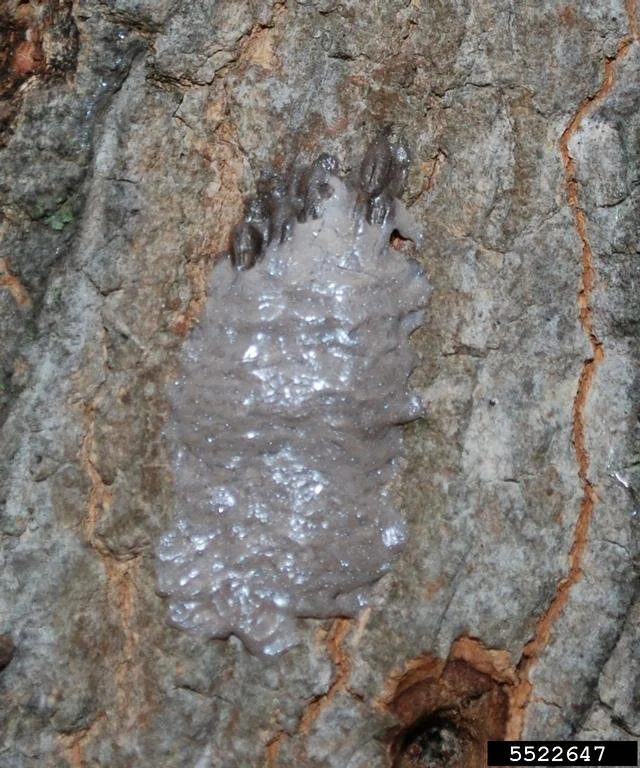
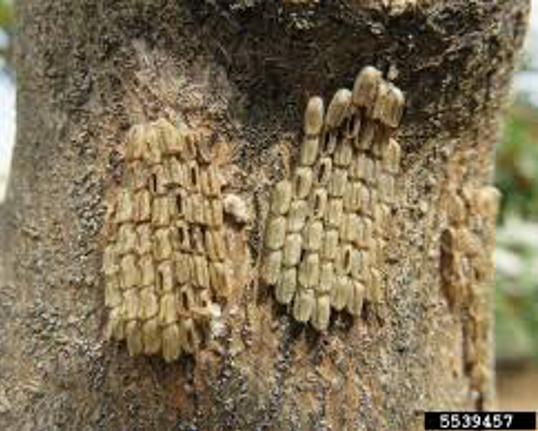
Look for egg masses. They lay eggs from September-December and are hard to see but we need to search and destroy them! The eggs will start hatching this spring, likely around May (GDD 270).

Late spring/early summer:
When they start hatching, they will look like little black insects with white spots, and they will not turn red until about mid-summer. Watch out for the combination of honeydew/black sooty mold/wasp swarms around your trees, because it could be an indicator of an invasion.


In Review
To review, Spotted Lanternfly is an invasive insect that is on the move and we need to try and stop the spread. Its primary host is Tree of Heaven but it can feed on the sap of over 70 different species of plants. When travelling and vacationing this summer, please be diligent in inspecting your vehicles, camping equipment, and basically anything that is exposed and stationary for more than a couple of hours, especially in known outbreak areas. If found, please report it to the OSU Extension office so we can help better understand this insect. We will keep everyone up to date (check our ARBOR ED™ section) on any new information and let you all know if we receive any news about confirmed populations in our area.
[Images courtesy of Ohio State University Extension, New Jersey DOA, Pennsylvania DOA / Drawings by Kenny Greer, Russell Tree Experts]
Lindsey Rice | Office Manager, Russell Tree Experts
Lindsey joined Russell Tree Experts in 2015 with a B.S. in Agribusiness and a minor in Horticulture from The Ohio State University. Growing up in Northwest Ohio, she participated in various sports, band, and FFA which ultimately inspired her love for the tree industry. She loves to spend her free time outdoors with her husband and daughters.
I Speak for the Trees
“I am the Lorax, I speak for the trees. I speak for the trees for the trees have no tongues.” As a representative of a tree company based out of Central Ohio, I feel that I have the responsibility to speak for the trees. Much like my friend the Lorax, written into this world by Dr. Seuss…

“I am the Lorax, I speak for the trees. I speak for the trees, for the trees have no tongues.”
As a representative of a tree company based out of Central Ohio, I feel that I have the responsibility to speak for the trees. Much like my friend The Lorax, written into this world by Dr. Seuss, someone needs to “speak for the trees, for the trees have no tongues.” What is our environmental responsibility as humans? To protect the environment we live in for future generations to be able to enjoy and thrive. One way to do this is to promote plant diversity which ensures we do not experience the devastation of wiping out all plant material with one fell swoop of a disease or pest. We have already seen things come through such as Dutch elm disease and the Emerald Ash Borer which wiped out thousands of elm trees and ash trees across the area. Amazingly, from these events, we saw an emergence of resistant species which is such a great example of how Mother Nature perseveres!
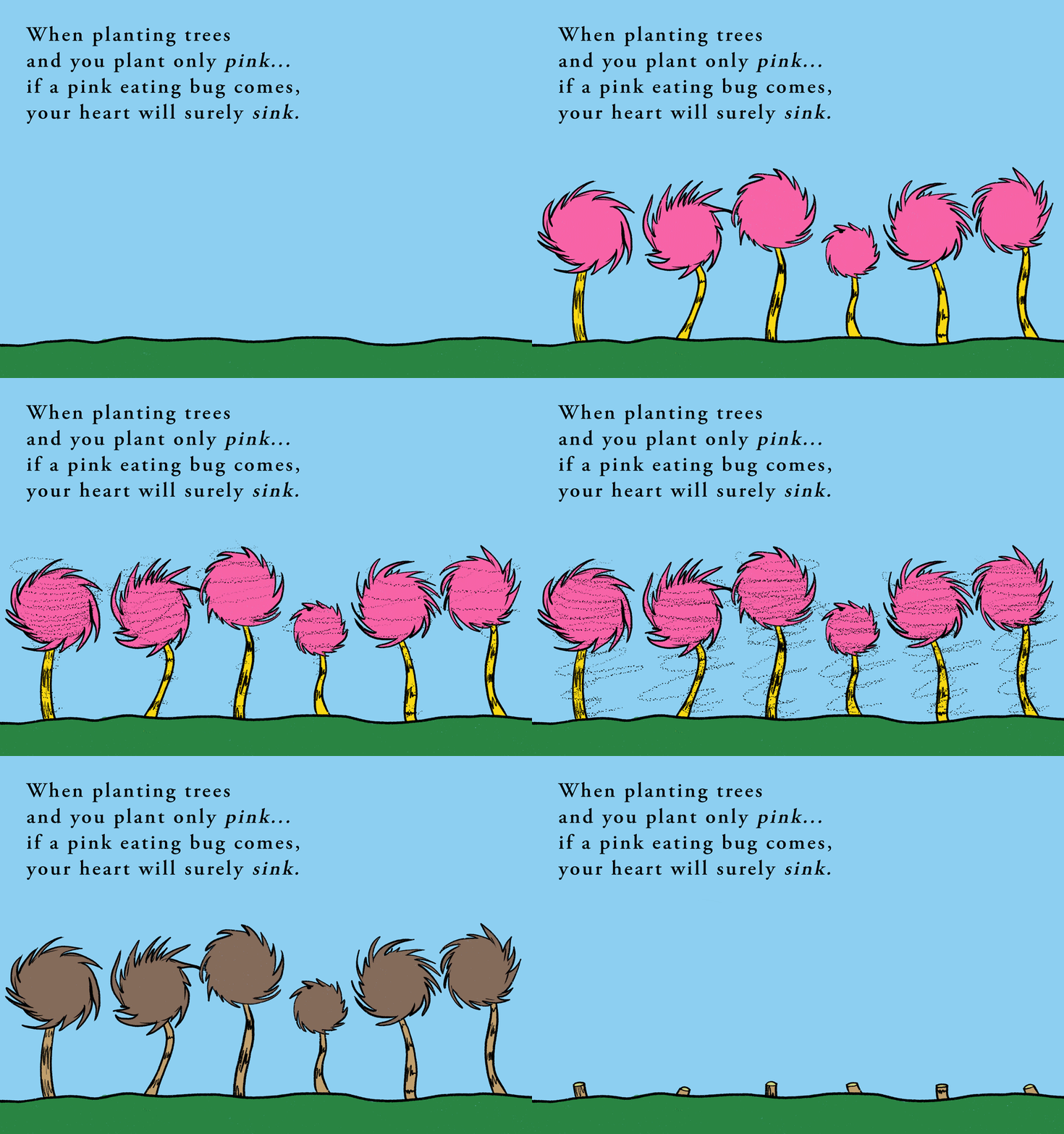
Illustration & text by Russell Tree Experts (Inspired by Dr. Seuss, of course!)
Humans have an Earthly responsibility to help Mother Nature — we are just a guest in her house and we need to treat it as such. By cultivating a variety of plant species, in both urban and rural settings, we can aid Mother Nature in replenishing her home with beautiful foliage and ensure that it isn’t all wiped out with one disease or pest. If we as a society decided to only plant trees in one family, a pest or disease could come along that affects only that species and suddenly, all of our landscapes are devastated. By planting more trees, and a variety of them, we can ensure their length of life is optimized while simultaneously aid in combating the toxins released by daily human activity. Each day we make several choices to either help or turn a blind eye. We live in a world where it is easy to forget the environmental impact of our actions because we do not see and perhaps will never see the consequences of our actions.

Illustration & text by Russell Tree Experts (Inspired by Dr. Seuss, of course!)
In January of 2020, my family and I made a 1-month commitment to removing all animal products from our diet for both health and environmental reasons. My cholesterol was through the roof, particularly when I was pregnant with my second daughter, and I had recently learned that the animal agriculture industry is responsible for about half of all worldwide greenhouse gas emissions. Also, producing 1 pound of meat requires approximately 50 times more water than producing a pound of plant-based nutrients in the way of fruits, vegetables, and grains. During that one-month commitment, I felt so much better; my energy levels, my mood, and I just felt generally healthier. I decided to keep my commitment going and my cholesterol numbers came down to within a normal range. Beyond that, I also felt like I was doing more for the environment and doing my part to be a good house guest to Mother Nature. It felt good making these health changes that impacted both me and my surroundings.
Human intervention is infamously detrimental to the world we live in; pollution, carbon emissions, urban monocultures, and the list goes on. Everyone should be conscious of their impacts and we should do our best to lessen the strain on Mother Nature and promote a more symbiotic relationship. One way Russell Tree Experts works to help the environment is with our TREE FOR A TREE® program; for every residential tree we remove, we plant another in its place at a local park or nominated location. We focus on a diverse selection of trees that are native to the area such as Bur Oak, Sycamore, and Red Bud.
Like my friend The Lorax, I speak for the trees, and more specifically, my environment. At Russell Tree Experts, we do our best to do what we can for Mother Nature to ensure she will be around for years to come.

Lindsey Rice | Office Manager, Russell Tree Experts
Lindsey joined Russell Tree Experts in 2015 with a B.S. in Agribusiness and a minor in Horticulture from The Ohio State University. Growing up in Northwest Ohio, she participated in various sports, band, and FFA which ultimately inspired her love for the tree industry. She loves to spend her free time outdoors with her husband and daughters.
The 3 Cut Method
There are times when the professionals at Russell Tree Experts should be utilized, although I realize there may be situations when removing a single branch is something very achievable by you, the homeowner.

By Mike Wilson
ISA Certified Arborist® OH-6806A
February 13, 2025
[Please note: This article was revised and republished on 2/13/25 from its original publish date of 6/30/21]
There are times when the professionals at Russell Tree Experts should be utilized, although I realize there may be situations when removing a single branch is something very achievable by you, the homeowner. I feel it's safe to assume if you're reading this article, you have a bit of a green thumb and you like to get your hands dirty by maintaining as much of your landscape as possible. This article isn't to dive deep into the various pruning techniques or strategies we use in the field, rather, it's to help homeowners make proper pruning cuts on trees throughout their property. Keep in mind, even though you may have seen us swinging about your trees like monkeys, we're trained to do so in the safest manner possible and I discourage you from putting yourself in harm’s way pruning your tree(s).
The reasons for pruning a branch or limb from a tree are vast. Whether it's removing a pesky branch that keeps slapping you in the face during weekly lawn maintenance to getting rid of that one dead branch that you see every time you look out your window, I'm here to help you make a cut that will ultimately compartmentalize naturally.
Trees have a natural response known as CODIT (Compartmentalization of Decay in Trees) which allows them to wall-off or seal wounds to help prevent decay or entry of harmful diseases. Cuts that are too flush with the parent stem (or left too long) are unlikely to seal properly and could potentially degrade the health of your tree.
key branch landmarks

So, now, let's get into the nitty-gritty of proper pruning cuts. It's critical to be able to identify key branch landmarks that help guide where your final cut will be: the 'Branch Bark Ridge' and the 'Branch Collar'. The branch bark ridge can be seen as the raised strip of bark on top of the branch where it joins with the main parent stem or trunk of the tree. The branch collar is the slightly raised or swollen portion around the sides and bottom of the branch, this portion may or may not be distinguishable. The imaginary line connecting these two landmarks determines where the final cut should be made.
Step by step: The 3 Cut Method
To begin, whether using a handsaw/polesaw/chainsaw, I'll teach you how to remove a branch using the 3 cut method:

1st Cut / Bottom cut
Create a cut on the underside (undercut) of the branch roughly 1/3 of the way through. This is a crucial step in the branch removal process as it eliminates the risk of the branch peeling down and further harming the tree.

2nd Cut / Top Cut
Next is a second distal cut on top of the limb (further from the trunk) to remove the limb (topcut).

3rd Cut / Final cut
Now, with only a stub remaining, is when you should identify that imaginary line I described above. This will be the site for your final cut that will eventually seal properly as long as the tree is healthy and capable.
How-to Video: The 3 Cut Method
I’m not the biggest fan of being on camera so I’ve asked Kenny Greer (Our marketing guy at Russell Tree Experts) to demonstrate the 3 Cut Method in the below video! Check it out!
proper pruning results
A proper final cut will become a minor blemish guarding your tree against decay and harmful organisms. Here are some beautiful examples:


Please Note — In the past, it was believed that paint would help seal fresh wounds, although this has since been proven to only slow down the natural CODIT process. Can any of you guess when we would apply this "wound paint?" If you'd like to find out, I encourage you to read Lindsey Rice’s ARBOR ED™ article on oak wilt and dutch elm disease, my fellow coworker and ISA Certified Arborist®!
Questions? Comments? Leave them below and we will get back to you as soon as possible! Thanks for reading and watching! As always, if you’re interested in a free tree work quote from one of our 20+ ISA Certified Arborists®, give us a call at (614) 895-7000 or visit RussellTreeExperts.com/Quote!
ADDITIONAL ARBOR ED ARTICLES!


Mike Wilson | Regional Manager, Russell Tree Experts
Mike joined RTE in 2013 and has been in the green industry for over 12 years! He is an ISA Certified Arborist® and a graduate of Oregon State University. Mike is an outdoor enthusiast and a US Army Medic Veteran!
What's Wrong with my Sycamore & Maple?
"Why does my beautiful maple have ugly black spots on its leaves?" "Why is my American sycamore bare this year” …To answer these questions, we need to go back to a chilly, wet evening 5 weeks ago. On May 5th, the temperature dropped overnight to 41 degrees just after an early morning shower that day. We continued this cool, wet trend for 10 lousy days, and…
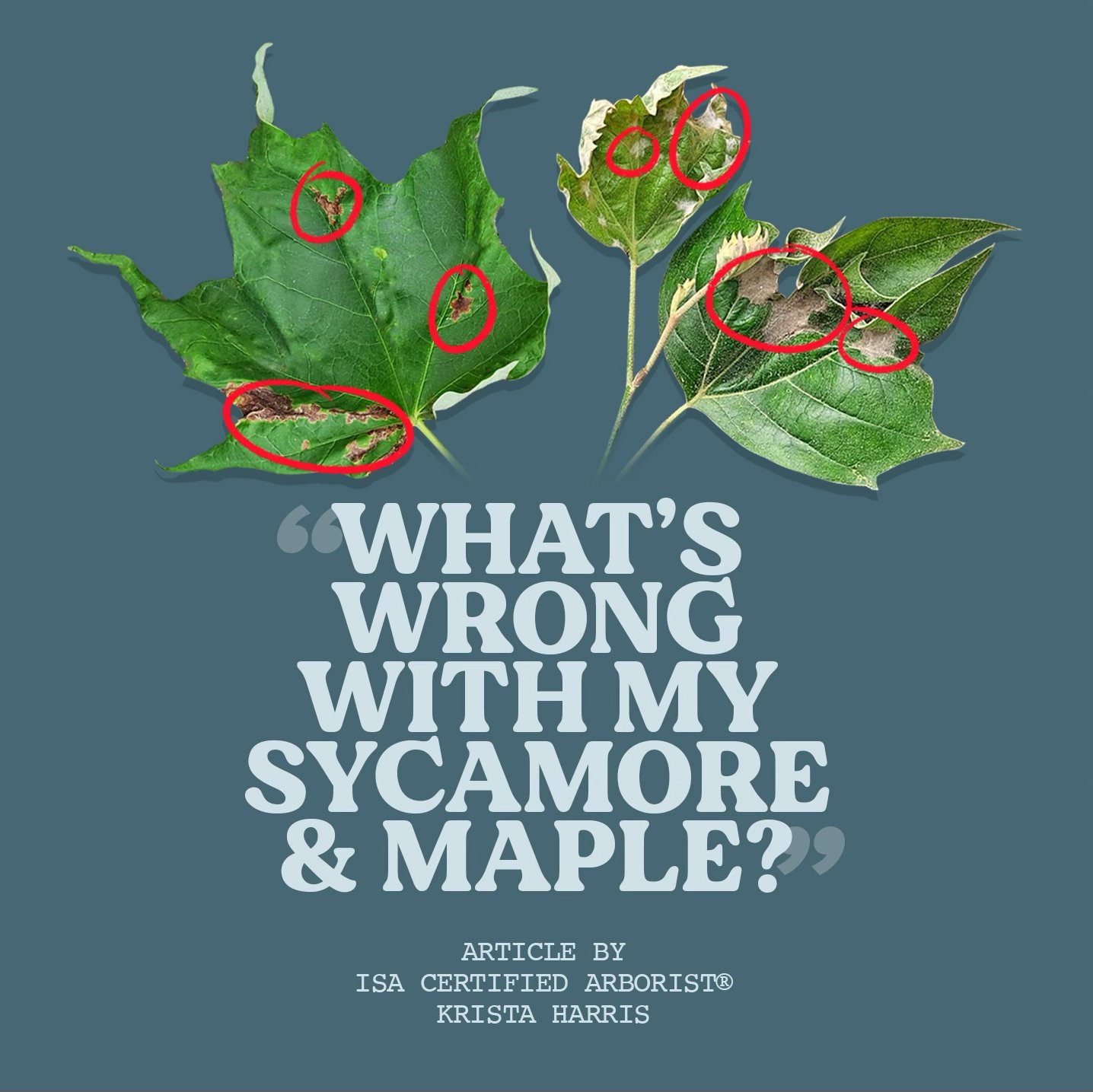
"Why does my beautiful maple have ugly black spots on its leaves?""Why is my American sycamore bare this year?"By Krista Harris
ISA Certified Arborist® OH-6699A
May 22, 2025
Anthracnose fungus attacks newly emerging leaves in the spring when the weather is just right for disease development. The symptoms vary from host to host, but typically infected leaves will have irregular dark spots along veins. Eventually, the leaf will curl, die, and fall. In the case of the sycamore, often the leaf buds are killed before they have even had a chance to emerge.
[Sugar Maple leaf before and after anthracnose fungus]
Anthracnose fungus affects many deciduous trees and seems to be most noticeable this year on sycamore and maple in our area. I have had at least 10 customers per week concerned that their beloved trees were dying due to this fungus. I have also been driving by my favorite American sycamores around my home, only to find them very sparsely leafed and struggling. This includes Upper Arlington's oldest tree, an amazing 3 stemmed beauty that our team pruned a few months ago.

[American Sycamore leaves with anthracnose fungus]Thankfully, I have wonderful news for the stewards of these afflicted trees. Anthracnose is a cosmetic disease for the majority of trees! If the tree is otherwise healthy and well established, it will be just fine. It will replace those lost leaves in July when conditions no longer favor anthracnose development.
How can you help trees with this seasonal infection?
Water your trees during our hot, dry summers! Concentrate the water at the ground level only, do not splash the leaves. All trees will appreciate the extra water, but those that have lost their leaves and are attempting to replace them will relish it! ARTICLE: HOW TO WATER YOUR TREES
Prune your trees for better air circulation and light penetration. This will help the leaves dry faster and it will be harder for the fungus to spread.
Dispose of affected leaves so that the spores are not hanging around next year to re-infect your tree.
Consider fertilizing your trees in the spring so that they have the needed nutrients to stay healthy (and possibly put on 2 sets of leaves if it is another good year for anthracnose infection).
Above all, do not panic! We cannot control the weather or the fungus. Just concentrate on overall tree health and by mid-summer, the trees will have recovered and this disease will be just a bad memory. For a free tree quote by one of our 20+ ISA Certified Arborists®, visit RussellTreeExperts.com/Quote or speaker to our friendly, local office staff at (614) 895-7000!
Please note: This article was originally published on 6/14/2021 and was revised on 5/22/2025.
ADDITIONAL ARBOR ED™ ARTICLES!


Krista Harris | Journeyperson, Russell Tree Experts
Krista grew up in the central Ohio area and became an ISA Certified Arborist® in 2017. She graduated from The Ohio State University with a Bachelor of Science in Crop Science and a minor in Plant Pathology in 2000 and has been in the green industry ever since. Her favorite trees are the American sycamore, American beech, and giant sequoia. [BS in Horticulture Crop Science, The Ohio State University / ISA Certified Arborist® OH-6699A / ODA Comm. Pesticide Lic. #148078]
Brood X Cicada: Facts & Tips
Our arborists first saw the Brood X cicadas emerge on May 21st, 2021. They are expected to be present within our environment for the next 6-8 weeks (maybe even longer)!


EMERGENCE
Our arborists first saw the Brood X cicadas emerge on May 21st, 2021. They are expected to be present within our environment for the next 6-8 weeks (maybe even longer)!

SIZE
The Brood X cicadas are 1.25-1.5" long with red eyes. When they first emerge from their exoskeletons their bodies are a yellowish color but they soon darken to black/dark brown.

HARMLESS TO HUMANS
They won't/can't bite people but they are clumsy flyers so they will fly into things!

A Natural Process
The brood X cicadas have emerged every 17 years for centuries (!!!) and they are a natural part of our ecosystem. Many of the trees you see throughout the area have likely survived a few brood X "invasions" already!

Medium/Large Trees:
LOW RISK
For medium and large trees, they are harmless. The cicadas will likely feed and lay eggs on the trees but they will not cause any long-term damage. You may see some dead leaves and twigs but the tree will be just fine in the long term.

Smaller/Recently Planted Trees:
MEDIUM RISK
Smaller and recently planted trees may be more susceptible to long-term health issues from cicadas. You may consider wrapping these trees to prevent the possibility of damage. Check out the below video on how to properly wrap your tree!
How to Video:
Protecting a Tree from Cicada Damage
Why Can’t I Plant a Tree Just Anywhere?
When I first began working at Russell Tree Experts as a video production assistant, I had no significant prior knowledge of arboriculture, and I never really understood the concept of tree planting. My overall impression was that trees are good for the environment as they provide oxygen, contribute to an ecosystem, and are visually pleasing to look at and enjoy.

By Enrique Arayata
ISA Certified Arborist® OH-7252A
May 13, 2021
When I first began working at Russell Tree Experts as a video production assistant, I had no significant prior knowledge of arboriculture, and I never really understood the concept of tree planting. My overall impression was that trees are good for the environment as they provide oxygen, contribute to an ecosystem, and are visually pleasing to look at and enjoy. However, after working at Russell Tree Experts for almost two years now and after taking a World of Plants class at The Ohio State University, I learned that it’s not that simple. For many reasons, a tree cannot simply be planted anywhere, as it may be planted in the wrong location, leading to a low survival rate or a negative impact on the local ecosystem.
Hardiness Zones

One reason why a tree cannot just be planted anywhere is because it may be planted in the wrong hardiness zone. The USDA Hardiness Zone Map is a map of the United States that divides the country into different zones based on the area’s average annual minimum winter temperature. In relation to arboriculture, it can often reveal where a tree has or does not have a strong likelihood of survival and growth. For example, palm trees (Arecaceae) can be expected to grow in hardiness zones 8 and above. If it were planted in Columbus, Ohio, which has a hardiness zone of approximately 6a, it would not have a strong likelihood of growth and survival and may require extensive care and maintenance. However, if that palm tree were to be planted in Miami, Florida, which has a hardiness zone of 10b, it would have a higher chance of successful growth and survival, which makes sense as palm trees can be commonly seen in Miami and not in Columbus.
Native vs Non-Native


Even if a tree is planted in the proper hardiness zone, it may still not survive or grow well if it is in a non-native area. When compared to non-native trees, native trees are adapted to the local climate and soil conditions and experience fewer insect and disease problems. They may also require little to no fertilizers, pesticides, or added water. Native insects, birds, and animals also rely on native trees for food and shelter and might not adapt well to a non-native tree. Although many trees have been planted and grown outside of their native area, some non-native trees may be more susceptible to insect and disease problems or may even spread an insect and disease problem if planted in a non-native area. For example, the Colorado blue spruce (Picea pungens) is natively found in the southern Rocky Mountains area, such as Colorado. Although it can be expected to grow in hardiness zones 2 through 7, which Ohio falls under, a Colorado blue spruce planted in Columbus, Ohio has a significantly higher chance of suffering from rhizosphaera needle cast, a fungal disease causing needles to turn brown and fall off, due to Ohio’s local ecosystem and weather conditions.
Invasive

The highly invasive amur honeysuckle
Invasive Tree
/inˈvāsiv trē/

Definition: An exotic, indigenous, or non-native tree species that has a negative or harmful effect on the growth of commercial, nearby, or native tree species.
Invasive trees will survive, reproduce, and quickly spread in large numbers at considerable distances from the parent tree with little to no maintenance or aid. They will also threaten the native or natural ecosystem or habitat by outcompeting the neighboring trees and plants for resources like sunlight, water, nutrients, soil, and space. Finally (and maybe most troublingly), they can also change the character, form, condition, or nature of their planted ecosystem in favor of their conditions rather than the native species’ conditions. These invasive species can be introduced purposely or by accident, but regardless, they are serious environmental pests. It can lead to the loss of biodiversity, habitat degradation, and economic damage in some cases. Examples of invasive species in Ohio include, but are not limited to, amur honeysuckle, autumn olive, multiflora rose, and the tree of heaven. For more information on invasive species in Ohio, visit this link: Ohio Department of Agriculture.
Additional Factors
Let’s say you are ready to plant a tree in your yard and you have chosen a native, non-invasive tree with little to no insect or disease problems that is suitable for your local area’s hardiness zone; there are still a few things to consider that could impact the lifespan of your tree.
SUNLIGHT PREFERENCE
Trees have a sun preference (full, partial, full shade) and if a tree were to be planted outside of its sun preference, it may lead to less than ideal results: stunted growth in a tree’s height potential, poor flowering/fruiting ability, dehydration, low survival rate, and more. To determine a planting site’s sun allowance, observe the area’s amount of sun or shade throughout the day.
SOIL PREFERENCE
Trees have a wide range of soil preferences based on moisture, material, and pH level. For example, a tree may prefer certain moisture of soil like well-drained soil, a certain soil material like clay soil, or a certain pH level like alkaline or acidic pH soil. pH is a method of measuring a solution or soil’s acidity or alkalinity ranging from 0 to 14. 0 is acidic, 7 is neutral, and 14 is basic. If a tree that prefers a low soil pH, such as a pin oak tree, is planted in soil that has a high pH, it may lead to issues such as chlorotic leaves or the need for seasonal fertilization to maintain a certain pH level. Studies have shown that soil near recently paved sidewalks may have a higher pH due to limestone in the cement mixture. To measure a planting site’s soil pH level, give us a call and we can arrange a soil test.
Ask Yourself
So before you plant that tree in your yard, as yourself the following questions:
Is this tree appropriate for this hardiness zone?
Is this tree native to this location?
Is this tree not deemed invasive?
Am I planting this tree in an area with the ideal sunlight for the species?
Am I planting this tree in an area with the ideal soil for the species?
If you answer “Yes” to all five then you are likely good to start digging! PS - we recommend that you don’t plant your trees during the summer months as the heat adds additional stress to young trees.
Additional Reads
Feel free to also check out our ARBOR ED™ tree planting articles for more information written by my fellow coworkers! I hope this helps, good luck, and have fun on your next tree planting project!
Sincerely,

Enrique Arayata I Media Production Manager, Russell Tree Experts
Enrique is an ISA Certified Arborist® and FAA Certified Remote Pilot. In his free time, he enjoys working out, hanging out with his family and girlfriend, video production, photography, cars, technology, and cooking. Enrique has a BA in moving image production with a double minor in film studies and studio art specializing in photography from The Ohio State University, and an AA in web graphic design from DeVry University. His favorite tree is the Kwanzan cherry tree.
Recap: Arbor Day 2021
Hello! Arbor Day was last Friday (April 30th, 2021) — Check out the above video to see why it’s our favorite day of the year!Hello! Arbor Day was last Friday (April 30th, 2021) — Check out the above video to see why it’s our favorite day of the year! We'd also like to give a HUGE KUDOS (!!!) to everyone involved in making Arbor Day 2021 a success! It was a joy to share our love for trees with so many wonderful people!
Free Trees to Celebrate Arbor Day!
Arbor Day is tomorrow (!!!) and to celebrate we are giving away 300 tree saplings! Stop by our office (directions below) today (April 29th) starting at 10AM for a contact-free pick up of a bundle of 5 trees!

Arbor Day is tomorrow (!!!) and to celebrate we are giving away 300 tree saplings! Stop by our office (directions below) today (April 29th) starting at 10AM for a contact-free pick up of a bundle of 5 trees!
Then tomorrow (Arbor Day!!!) plant your new saplings to celebrate the greatest holiday ever PLUS check us out on Instagram (@RussellTreeExperts) as our entire crew will be joining forces to plant 5,000 trees at Walnut Woods Metro Park for our TREE FOR A TREE® program!
Arbor Day is the greatest day, right?!
0 BUNDLES REMAINING!
Pick-Up Location
To pick up your free trees, visit our office (address below) and pull into the front parking lot. The trees will be available on the table in front of our office door. Please only take one bundle per household. Enjoy! Address: 3427 E Dublin-Granville Rd Westerville, Ohio 43081
Tree TYPES
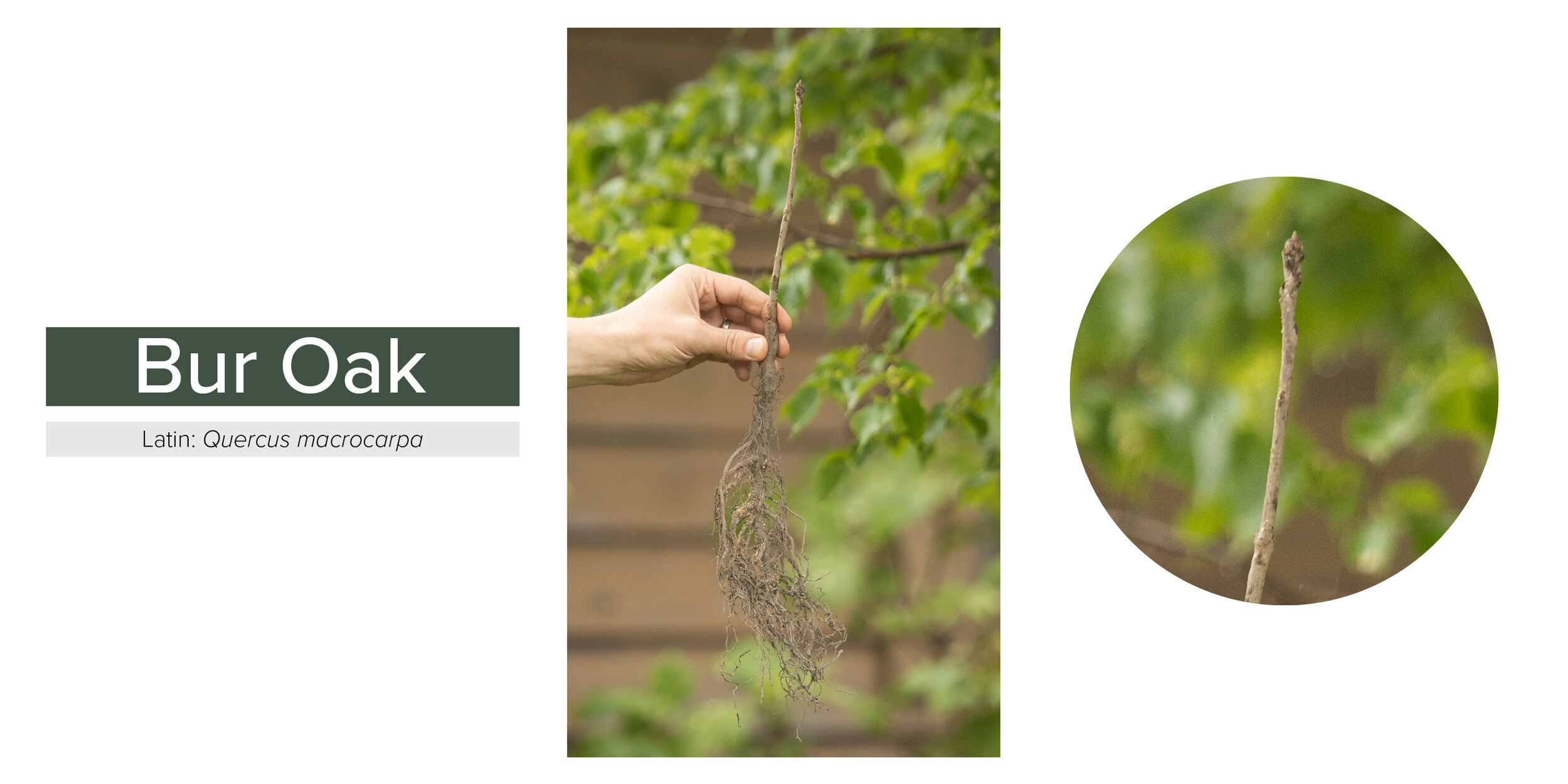
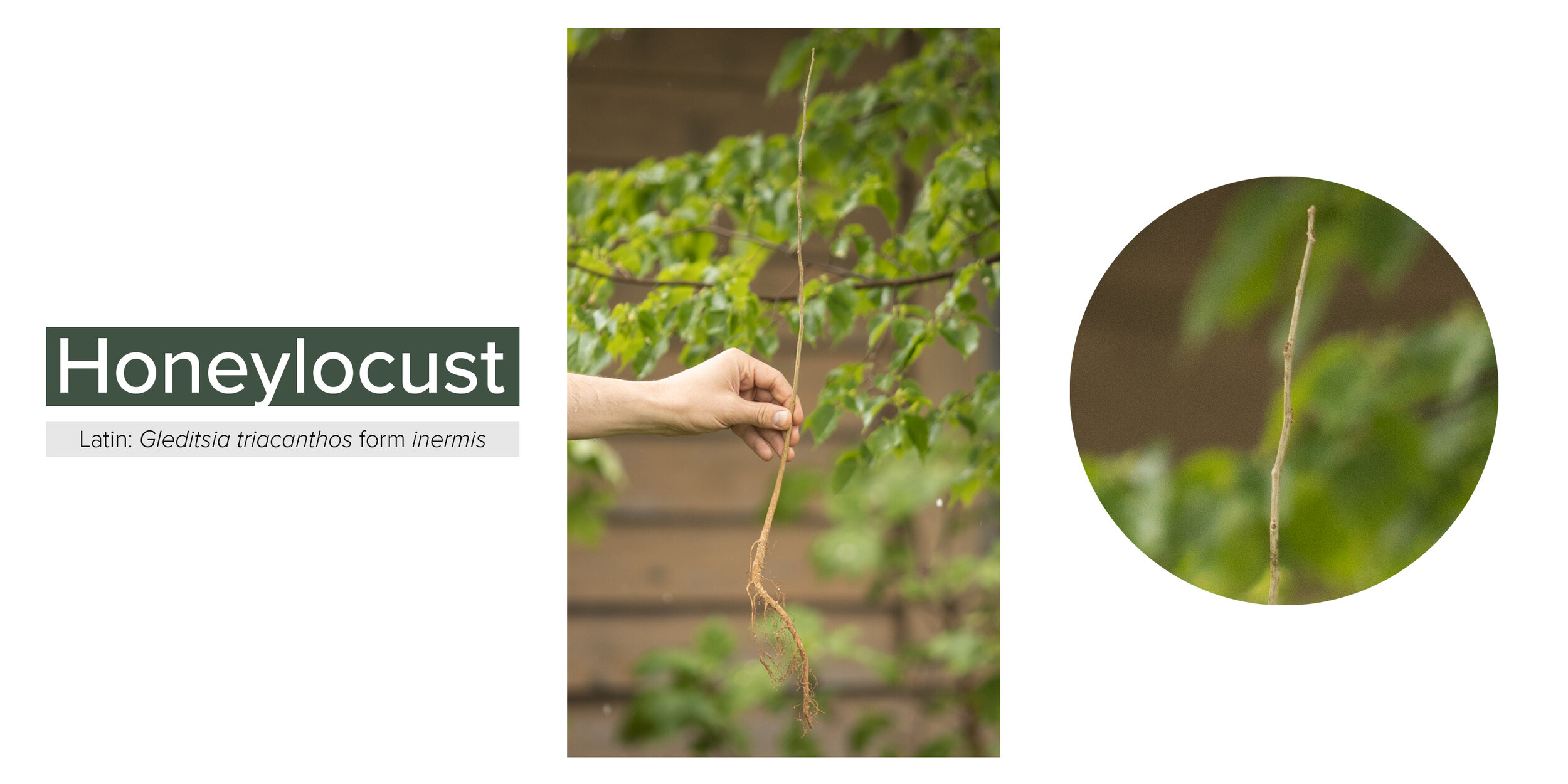
Each bundle includes five tree saplings: Bur Oak, Redbud, Swamp White Oak, Sycamore, and thornless Honeylocust. Please note, these are tree saplings that range from 6-24 inches tall.
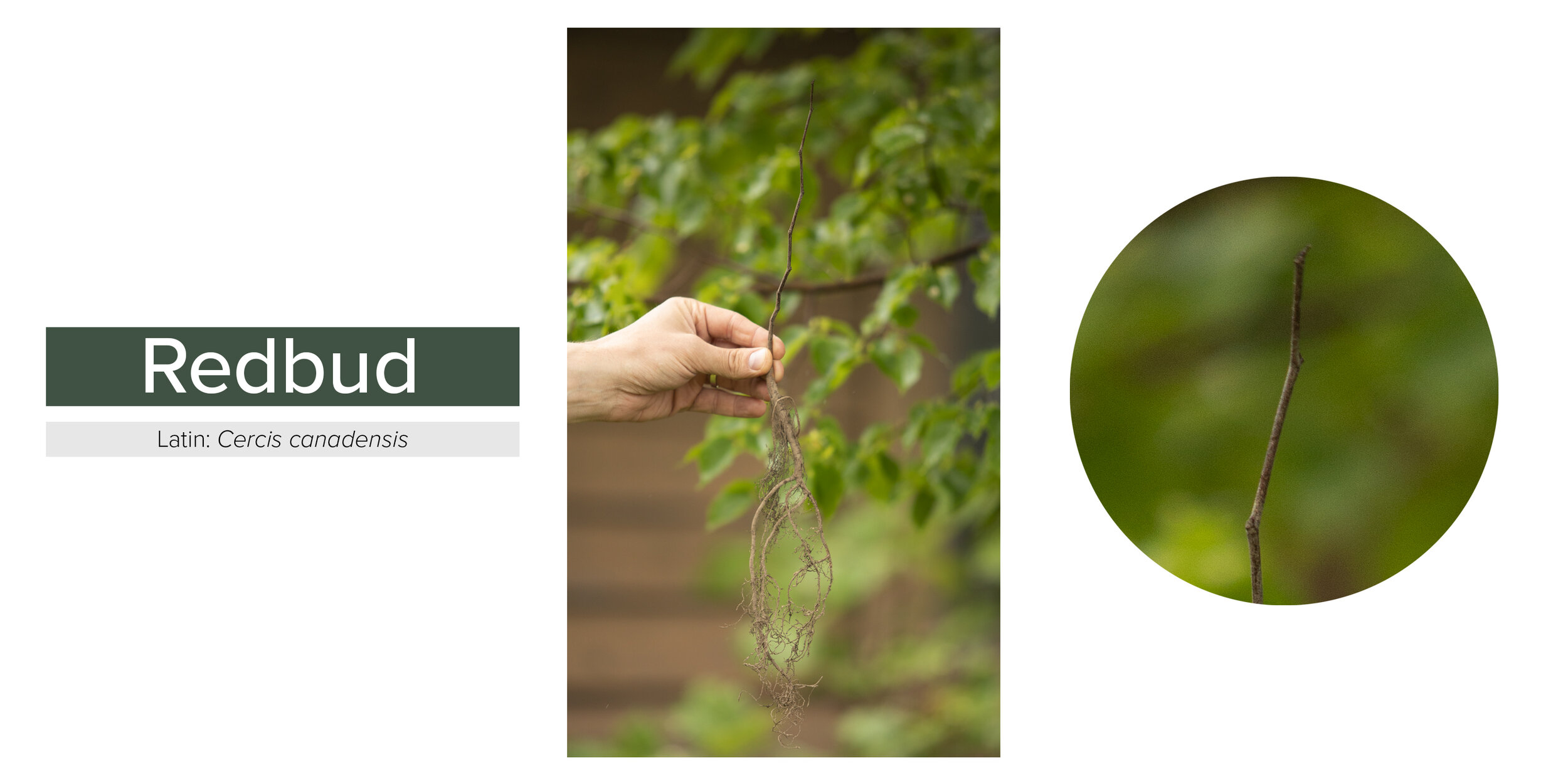
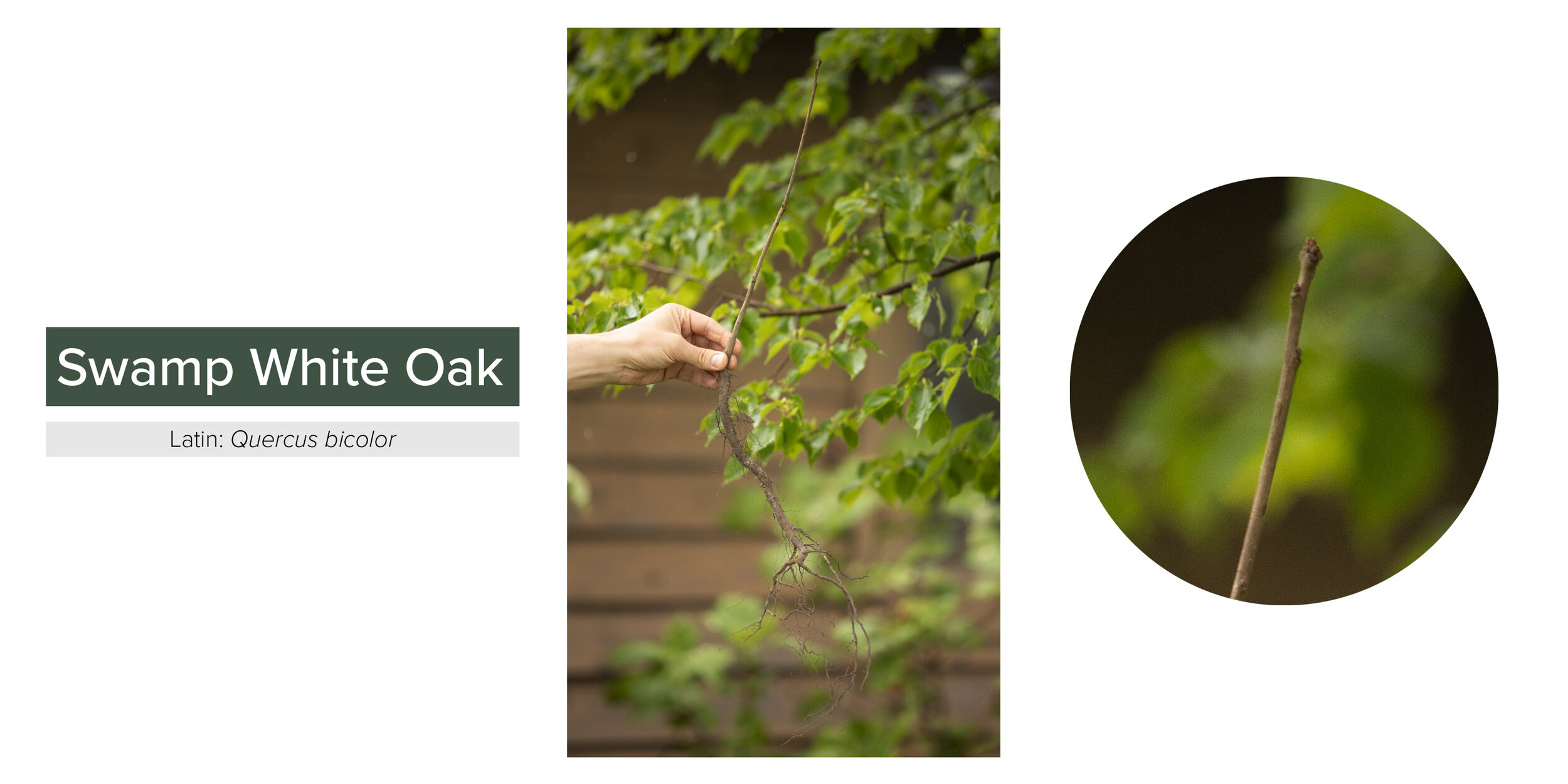
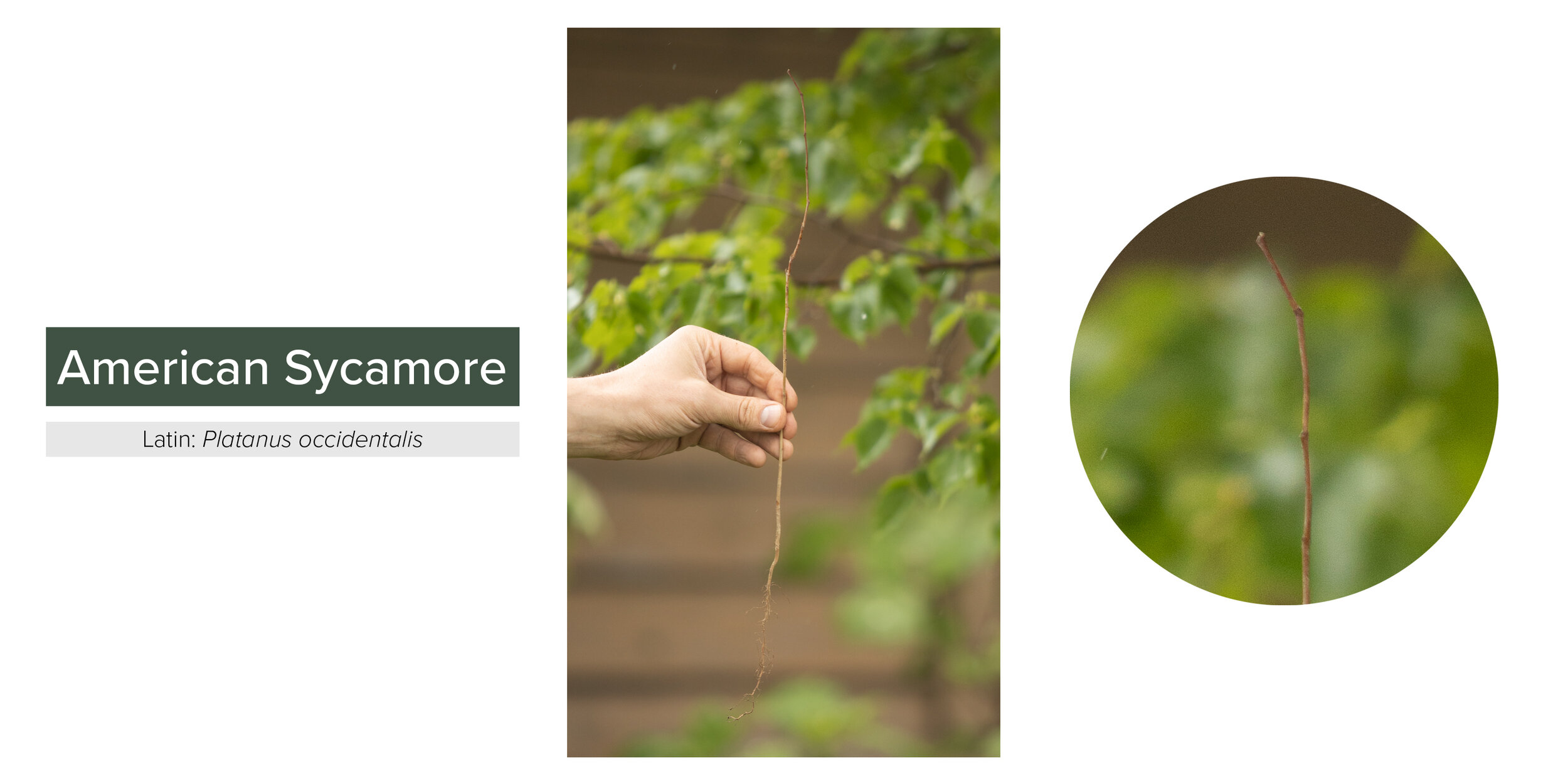
How to Plant Your Trees!
STEP 1
Soak your tree sapling in water for 5 to 7 minutes to thoroughly moisten the sapling’s root system.
STEP 2
Select your tree planting site. Avoid planting your sapling within 5 to 10 feet of any large obstructions such as mature trees or buildings.
STEP 3
Measure the sapling’s base of the root to its root flare to determine the depth of your hole.
STEP 4
Dig your hole!
STEP 5
Ensure that your hole is the appropriate depth. To do so, place your sapling in the hole and ensure that the root flare is equal with the surrounding soil level.
STEP 6
Make adjustments to the hole’s depth if necessary.
STEP 7
Fill in your hole with the dug-up soil. Lightly compact the soil as you begin to reach ground level.
STEP 8
Ensure the root flare is fully exposed to oxygen and not mounded with soil.
STEP 9
Take a picture and tag @RussellTreeExperts on Instagram & Facebook! You are now finished planting your tree sapling!
STEP 10
Learn more about the TREE FOR A TREE® program!
17
Seventeen years ago near this season I was starting my second year as an arborist in training. A few months more into the year and I would be applying to the ISA to sit for the Certified Arborist examination, which thankfully I would pass. At this point in my career, I was fortunate to be working under a foreman who was (and is) passionate about trees, so as I learned primarily about climbing and pruning, I was also being taught about CODIT, tree identification, and common tree pests and diseases.

Seventeen years ago near this season I was starting my second year as an arborist in training. A few months more into the year and I would be applying to the ISA to sit for the Certified Arborist examination, which thankfully I would pass. At this point in my career, I was fortunate to be working under a foreman who was (and is) passionate about trees, so as I learned primarily about climbing and pruning, I was also being taught about CODIT, tree identification, and common tree pests and diseases.
For those who mark time by political events, George W. Bush was president at the time, serving the first of what would be two consecutive terms.
Technologically, the first iPhone was still not to be available for another 3 years, so we were truly living in a different world. I think it was around this time that I purchased my first mobile telephone after stubbornly holding out for several years.
Ecologically, 2004 was the first year I directly experienced the effects of the 17-year cicada. Since then the world has turned and changed until the different cogs and wheels have aligned once more to allow the offspring of that very brood to emerge. As I sit and write this, the final instar (development stage) of those eggs that were laid 17 years ago are undergoing the last steps of maturation, soon to emerge as adults. I imagine them crawling up out of the ground, squinting at the sunlight (as they would if they had eyelids), crawling up a tree, a fence post, and going to sleep one last time. The sleep of pupation ends with an awakening into a new form. For 17 years these nymphs have been slowly growing, feeding on roots underground, changing mostly only in size. Now, something shifts inside and they decide to crawl into that great world above and go to sleep in the sun. And lo and behold, this time they awake as something very different. Who could have guessed that winged creatures would emerge from these slow, crawling, subsurface dwellers? They cast off the old husk of what they were and take to the sky, flying from tree to tree. The world aboveground has changed into something very different from what it was when these eggs were first laid. The changes that humans experience at times so tumultuously may have been experienced by these nymphs as distant rumblings or far off vibrations, or not at all.
What to expect
I have had several clients already ask me about the 17-year cicada, and what should be expected this season. Here is what I recall from my second year as an arborist:
1.
For the squeamish, these insects are a challenge. They are harmless, but they are large and very imposing. As less than graceful fliers, they can be startling when several of them fly into you if you walk past an infested tree. They make a buzzing sound as they fly, clumsily careening off of branches, arms, and faces.
2.
Also for the squeamish, despite the fact that they are harmless, they do not look so. I remember an insect with large clear wings, blackish body, and large, beady, red eyes.
3.
The 17-year cicada makes up for the fact that it is hardly ever around by emerging in large numbers. The noise made by the males as they sing for the females can be quite deafening and is mostly constant. One thinks that the females must be attracted not by the quality of the song, but by the male who can keep shrieking the longest. (And the “singing” is not really that – I imagine the sound is produced by rubbing body parts together similar to a cricket).
4.
The females use an ovipositor to cut slits into the outer twigs of trees, usually choosing twig growth from the previous year. Looking closely at these slits, the eggs are visible as whitish, elongated structures carefully lined up in the slit.

Cicada damage to a branch from a previous year
5.
This ovipositing can weaken the stem, causing it to break and hang off the tree. The leaves on the stem die, making the tree appear to have brown flags all over the canopy.
6.
Many times the twigs do not break off, but the wounding on the stem allows an opening for pathogens to enter the tree. I have seen sugar maples with cankers formed on each and every twig that had cicada oviposition, creating a very spectacular appearance in the tree.
I have also noted mature pear trees going into decline in the years following a cicada infestation – the declining growth can be traced back to the year the eggs were laid on the stem.
Regarding that last point – I always wondered if the decline was associated with some unknown pathogen vectored by the cicadas. Then I recently listened to a lecture by Dr. Klooster at OSU. She explained that in the final year prior to cicada adult emergence the nymphs were at their largest size, and fed most heavily on tree roots prior to emerging for their pupation into adults. Given the decline in trees that I had traced back to the year of oviposition, in my mind I correlated this heavy root feeding with an additional taxing of tree resources which could cause a temporary decline in the tree. This taxing of resources coupled with potential pathogen entry into the tree at the canopy and root level could definitely cause decline.
As tree owners, what do we do?
The trees I have noticed going into decline following a cicada infestation are thankfully few and far between. For the most part, mature trees deal with the issue quite well. Newly planted trees are another story. A tree that has been recently transplanted is already going through transplant stress. The added stress of twig damage and possible foliage loss from the ovipositing female can harm smaller trees. Given their size, these trees can be wrapped with netting to keep the cicadas from accessing the outer canopy. My wife was able to find a sale of material called tulle – it is a light netting that I hope to be able to use to wrap my younger trees to avoid most of the damage. If I am successful, this means that I will also avoid the first hatchling nymphs dropping into the soil below my trees and feeding on the tree roots for the next 17 years. My advice is to wait until the new leaves have hardened off and then use a light netting small enough to keep the cicadas out. Cover the tree canopy and monitor to make sure no adults are getting in. Once the cicadas are gone the netting can be removed. From what I recall it seemed like the cicadas emerged sometime in June and persisted for several weeks into the summer. I can state with confidence that if this brood is going to be a damaging presence in your landscape you will not be unaware of it.
In closing
In closing, I think of all the changes that have taken place since 2004. We are on our fifth presidential term since President Bush’s first term 17 years ago. Most of us now possess a smartphone of some kind, and spend a lot of time staring at it. In 2004 I never dreamed I would live through a pandemic! My hair has gone gray, and I have a lot less of it. A friend introduced me to an amazing woman who later agreed to become my wife. More than half of the time I have been part of the team at Russell Tree Experts.
Take stock for a moment. This is an interesting milestone. The 17-year cicadas may be an inconvenience, but the regularity of this brood (and there are several other broods that emerge at different time intervals) is actually quite fascinating. Why 17 years? And how 17 years? Who is counting for the insect? Theories abound, and other stories, but the rebellious part of me enjoys knowing that we don’t really know. In the meantime, I will sign off, wondering for a moment where I will be 17 years from now. Just think, it will be 2038. We will have gone through three or four more presidents after President Biden. Who knows what technology will be in our pockets? If I am not retired yet, I will be looking at retirement right in the face.
Go out and plant a tree this fall. In 17 years it will be big enough that you won’t have to worry about wrapping it with netting.
Nothing like a bit of perspective to balance your day. When the next 17-year cicada brood emerges, most of our current struggles will be almost all forgotten. I hope that serves to keep us from getting too worked up about some things we are going through today.
Your friendly neighborhood arborist, wishing you all the best,

José Fernández | Regional Manager, Russell Tree Experts
José became an ISA Certified Arborist® in 2004, and a Board-Certified Master Arborist® in 2015. Currently he is enrolled at The Ohio State University pursuing a Master’s Degree in Plant Health Management. José likes working around trees because he is still filled with wonder every time he walks in the woods. José has worked at Russell Tree Experts since 2012.
How to Mulch Around a Tree
By Enrique Arayata
ISA Certified Arborist® OH-7252A
April 7, 2021
Mulching is an important aspect of tree maintenance that is both functional and decorative, adding to your tree’s lifespan and helping it look its best. The main benefits of tree mulching are that it deters weeds, improves soil quality, protects trees from lawnmower damage, insulates soil from extreme temperatures, and retains moisture during hot weather. Today, I would like to talk about some tips and tricks on how to properly mulch a tree. At the top of this article is an instructional video hosted by ISA Certified Arborist Lindsey Rice that can be used to follow along while mulching your own tree!

Example of a properly mulched tree
To mulch a tree, you will need organic wood chip mulch, a shovel, a rake, and personal protective equipment such as safety glasses, gloves, and boots. A wheelbarrow or air spade may potentially be needed depending on the situation. The best time to mulch a tree is in the fall or spring. Many trees are incorrectly mulched when the mulch is too high or when it covers the root collar of the tree, which is where the trunk and roots meet. The mulch only needs to be 1 to 2 inches deep and the root collar should be completely exposed in order to properly receive oxygen. This will help prevent girdling roots, which are roots that wrap around the trunk in search of oxygen. This can suffocate a tree and add unnecessary stress. If your tree has girdling roots or a mulch volcano, you will need to resolve these issues prior to mulching.
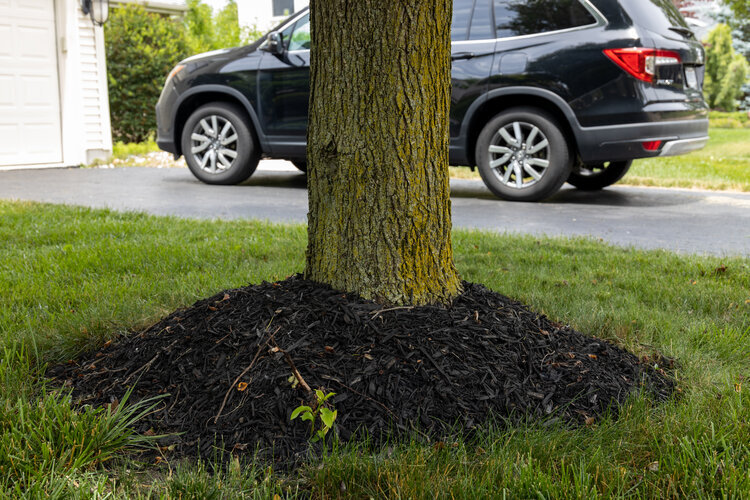
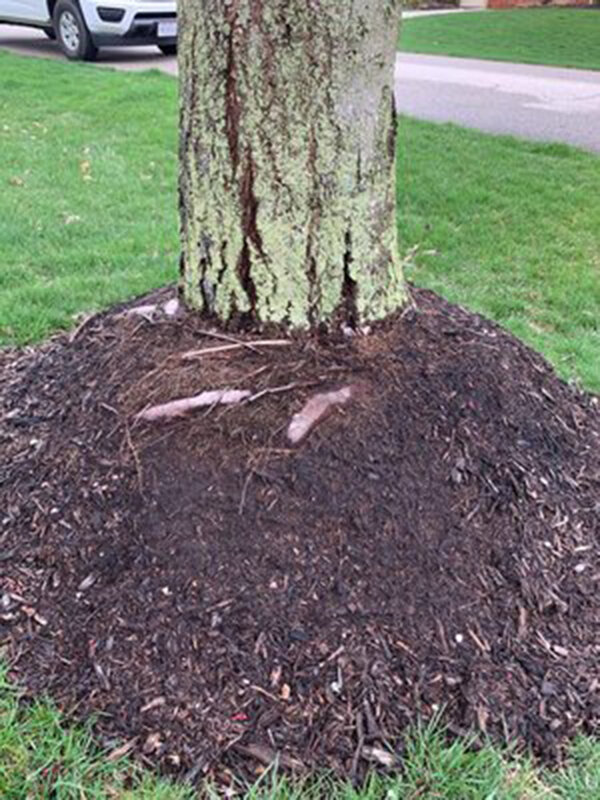
If there are no girdling roots, the first step is to pull out any weeds surrounding the base of the tree. Then, you may begin applying mulch in a wide and evenly spread area. For younger trees, it is ideal to mulch all the way out to the canopy drip line, which is where the majority of a tree’s roots extend, but you may have to compromise depending on your landscape.
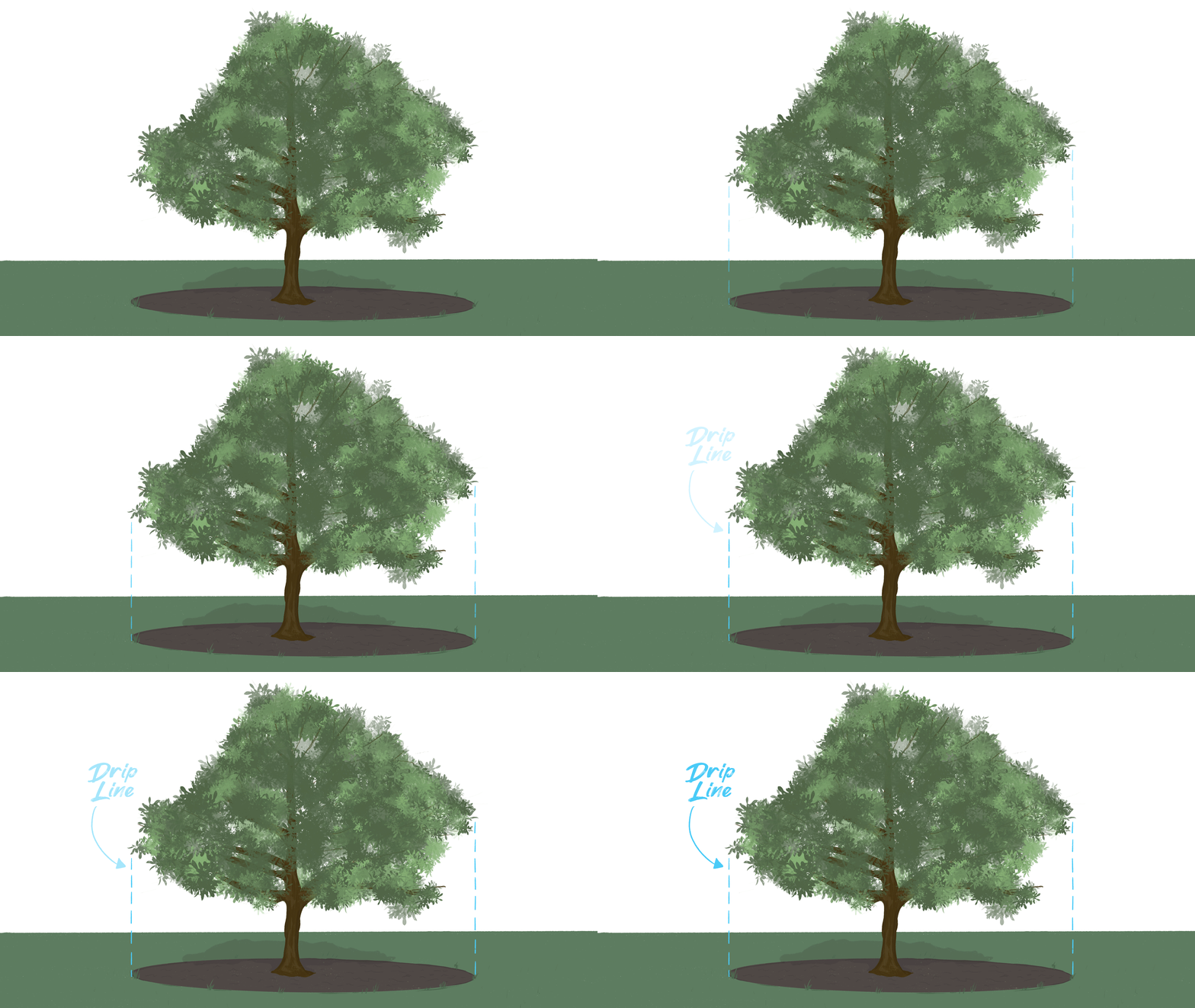
Example of a canopy drip line
For older trees, this is not as important. You should still see similar results when bringing the mulch out about 3 to 5 feet from the base. You can use a rake, shovel, or your hands to evenly distribute the mulch. The mulch only has to be about 1 to 2 inches deep at most, so make sure you avoid mounding, Leave about 2 to 3 inches of space between the mulch and the root collar in order for the tree to properly receive oxygen and to prevent girdling roots. This will also help prevent any moisture issues, which can lead to disease and rotting. Afterwards, you are all set!
For maintenance, water your mulch whenever it looks dry. Ohio can have inconsistent weather, so there is no need to water it on a scheduled basis. Also, only add mulch whenever it is looking sparse and below that 1 to 2 inch needed depth. Make sure you break up, turn over, and mix in the old mulch to prolong the mulch’s lifespan, prevent any clumping, and to allow maximum movement of oxygen and water. If there are any questions, please feel free to leave them in the comments section below and be sure to watch ISA Certified Arborist Lindsey Rice’s video for a visual guide on this topic! Good luck on your next mulching project!
Additional Reads!
Below are two excellent articles written by our ISA Certified Arborists related to mulch volcanoes and girdling roots.
”Mulch Mounds! Oh My!”
by ISA Board Certified Master Arborist José Fernández
“Are Your Trees Being Suffocated By Their Own Roots?”
by ISA Certified Arborist Chris Gill

Enrique Arayata I Media Production Manager, Russell Tree Experts
Enrique is an ISA Certified Arborist® and FAA Certified Remote Pilot. In his free time, he enjoys working out, hanging out with his family and girlfriend, video production, photography, cars, technology, and cooking. Enrique has a BA in moving image production with a double minor in film studies and studio art specializing in photography from The Ohio State University, and an AA in web graphic design from DeVry University. His favorite tree is the Kwanzan cherry tree.
How to Verify a Certified Arborist Credential

Recently, it was brought to my attention that there are some people performing tree work in the area claiming to be “certified arborists” when in fact, they are not. So… how can you tell if someone is telling the truth? One way is to ask for a business card or ask for their ISA Certified Arborist® credential number which will be in the following format: [state abbreviation] – [four digits] [letter]. Here is an example of a business card (mine!) with the credential number explicitly listed:

The best way to verify this credential number is to search on the ISA Certified Arborist® database. Simply go to treesaregood.org, click the “Find an Arborist” section then choose “Verify a Credential.” From there, enter the credential certification number and submit the request to see if the credential is in fact genuine.

Over my time working at Russell Tree Experts, I’ve sadly heard countless stories of “door knockers” coming by a person’s home and ruining their beloved tree. It’s a very sad occurrence in our industry and we hope through education these stories can lessen.
Improper tree work not only can cause irreparable damage to the tree or property, but there is also potential for spreading disease to nearby trees and affecting others’ landscapes. Tree care can also be very dangerous work, for both the property owner and the person doing the work. We highly recommend hiring an ISA Certified professional (even if it’s not us!) with the proper equipment, knowledge, and experience to perform your challenging tree work. The health of our environment relies on proper care for our trees so we may enjoy their countless benefits from improving air quality to providing homes for wildlife and beyond!
We’re very proud to have 19 ISA Certified Arborists® on our staff! Feel free to double-check their credentials at treesaregood.org! :)


Lindsey Rice | Office Manager, Russell Tree Experts
Lindsey joined Russell Tree Experts in 2015 with a B.S. in Agribusiness and a minor in Horticulture from The Ohio State University. Growing up in Northwest Ohio, she participated in various sports, band, and FFA which ultimately inspired her love for the tree industry. She loves to spend her free time outdoors with her husband and daughters.
Is my boxwood trying to tell me something?
A truly fascinating and audible phenomenon is happening in Ohio gardens right now. The tiny worm-like larvae of the boxwood leaf miner have awoken and are voraciously feeding inside boxwood leaves.

A truly fascinating and audible phenomenon is happening in Ohio gardens right now. The tiny worm-like larvae of the boxwood leaf miner have awoken and are voraciously feeding inside boxwood leaves. This chewing can be so noisy that it can be heard standing several feet away, as I experienced while inspecting a property in Lewis Center last week. Typically, though, a crackling noise can be heard by putting your ear near an “unhealthy-looking” boxwood this time of year. If you gently break open a leaf, you will discover the hungry invaders, wiggling between the leaf surfaces.
Hear the sound of larvae feeding on the leaves of a boxwood — just Ignore the sound of the chirping birds!
These larvae will soon, within weeks, finish their development and exit the leaves as adult flies. They resemble small yellow or orange mosquitoes that hover around the shrub while they breed and lay eggs inside the new boxwood spring leaves. The eggs hatch in summer and begin to devour the internal leaf tissue causing blister-like wounds. A boxwood that has been infested for a few years will look sickly in general with yellow, orange, or brown splotches on the leaves. Defoliation and even death is possible if the infestation is extensive and left untreated.

Gently break open a leaf to witness the hungry invaders
If you notice a ruckus coming from your shrubs this spring, do not ignore it. Eavesdrop on them yourself or call Russell Tree Experts to have one of our knowledgeable arborists diagnose this pest and evict them from your shrubbery.
I wish you a lovely spring filled with the sounds of songbirds, not munching maggots.

Krista Harris | Regional Manager, Russell Tree Experts
Krista grew up in the central Ohio area and became an ISA certified arborist in 2017. She graduated from The Ohio State University with a Bachelor of Science in Crop Science and a minor in Plant Pathology in 2000 and has been in the green industry ever since. Her favorite trees are the American sycamore, American beech, and giant sequoia.
Pruning Upper Arlington's Oldest Tree
We are honored that The City of Upper Arlington entrusted our arborists to prune their oldest tree - a towering, beautiful American sycamore. This massive tree is around 100 feet tall, 90 feet wide, and likely over
First, check out the above video — then read below! :)
By Enrique Arayata
ISA Certified Arborist® OH-7252A
March 18, 2021
While working on a street tree pruning project with Upper Arlington, Ohio, where we are pruning approximately 2,500 trees, we had the opportunity and pleasure to prune, according to the Upper Arlington, Ohio Tree Commission, the oldest tree in Upper Arlington: an American sycamore tree (Platanus occidentalis) approximately 100 feet tall and approximately 90 feet wide. It is unclear how old this ancient tree is, but when reaching out to my fellow coworker ISA Certified Arborist Walter Reins, he approximated that this tree is likely over a century old. This tree took half a day to prune as ISA Certified Arborist Mac McGuire skillfully pruned this tree using a bucket truck to remove deadwood, diseased limbs, broken branches, and hangers. Elevation pruning was also performed over Cambridge Boulevard to provide proper clearance for vehicles traveling on the road below. Through years of proper care and periodic pruning, this American sycamore has been able to reach its full potential and grow to this enormous size.
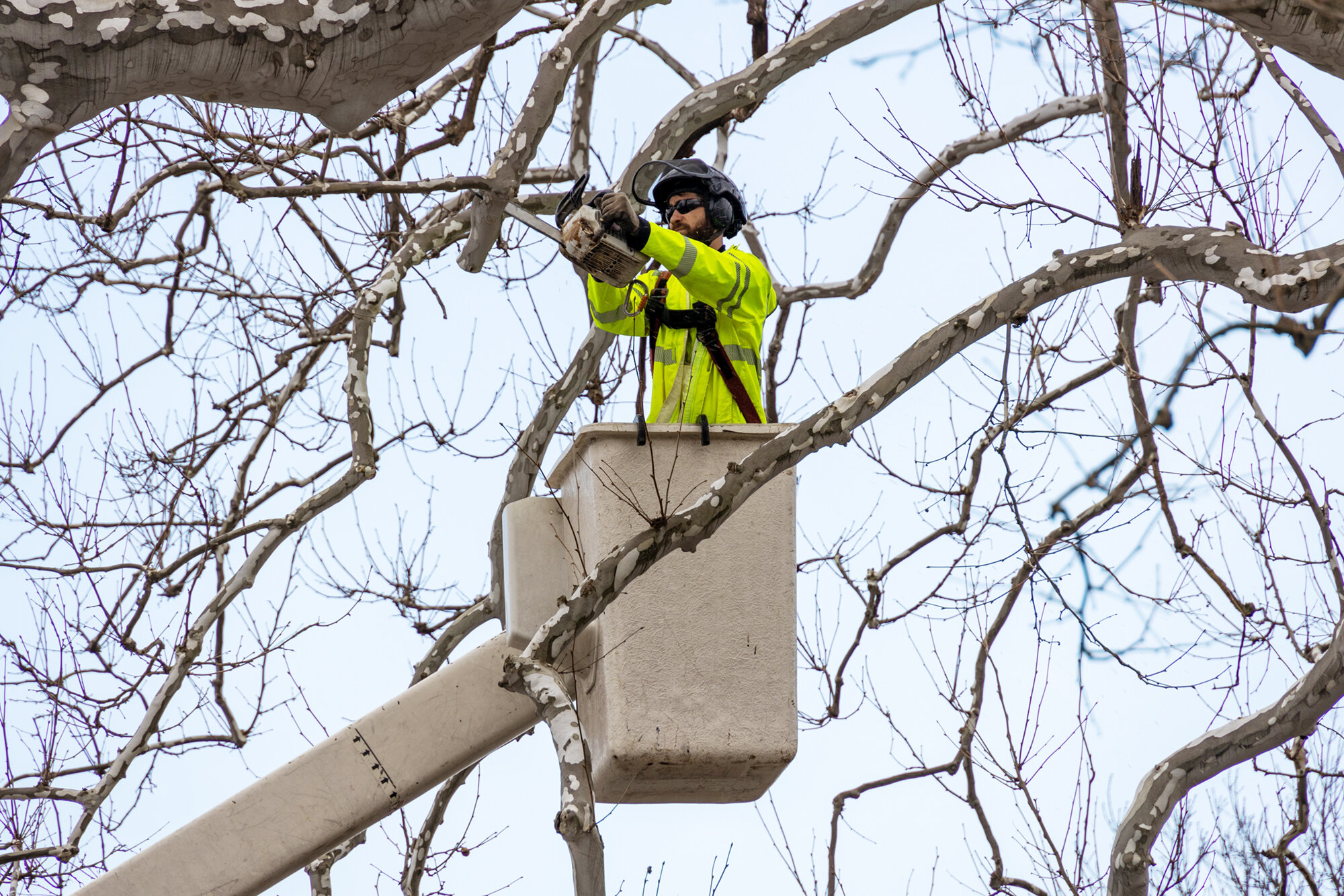
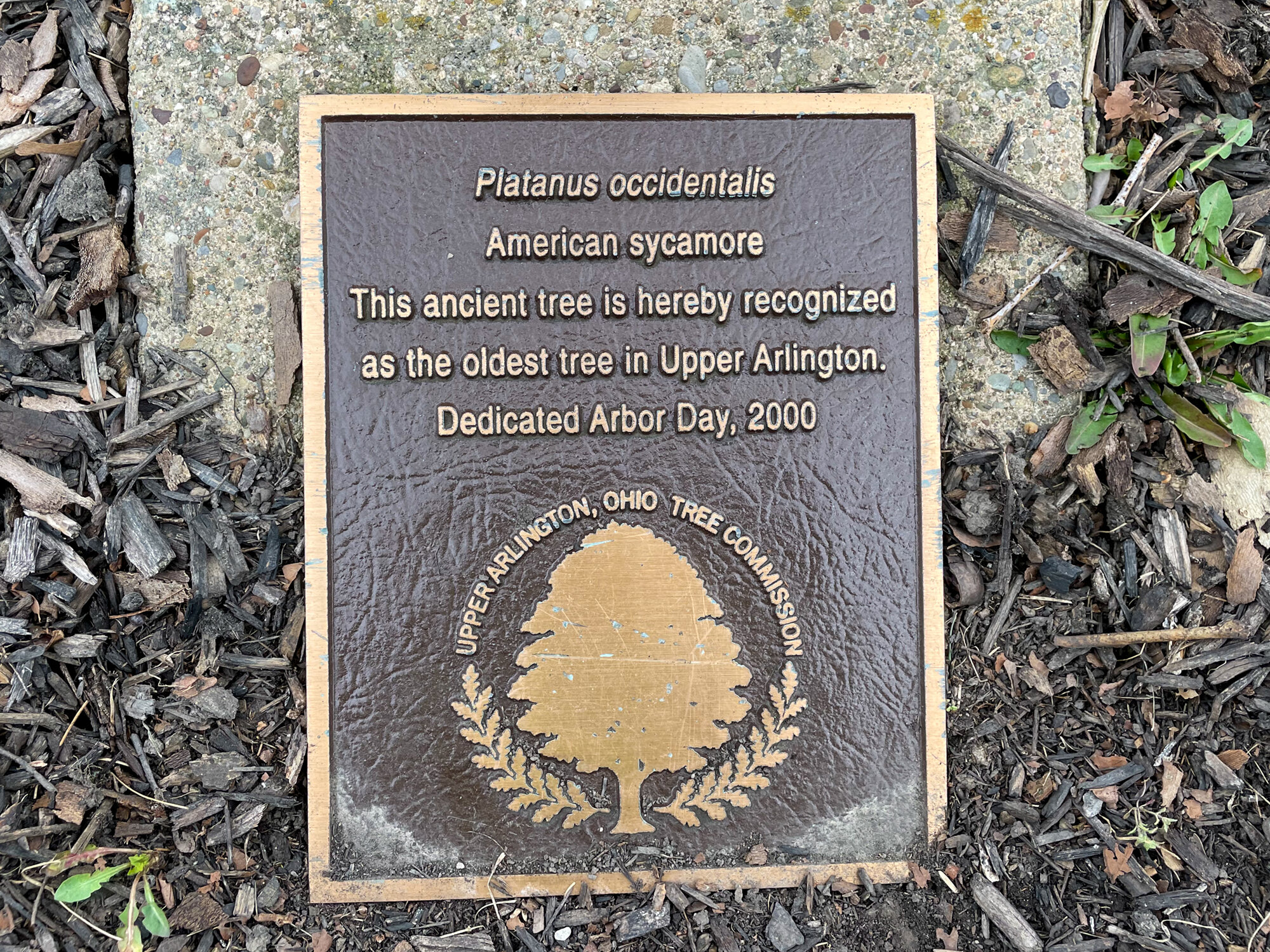
The American sycamore tree (Platanus occidentalis) is native to Ohio and can typically grow to a height and spread of up to 75 to 100 feet. The tree prefers and grows best in partial to full sun and in moderately to well-drained soils. Along with being native to Ohio, the American Sycamore can be natively found anywhere ranging from zones 4 through 9 on the eastern half of the United States (see map below).

Hardiness Zone Map Courtesy of the Arbor Day Foundation
In nature, one can often find this tree along creeks and rivers. They can be identified by their tall height and unique bark, featuring a camouflage-like pattern of green, tan, and white. Its leaves can have truncate or cordate bases with three to five lobes, loosely resembling a maple leaf. Alongside the leaves are round fruit approximately 1.5 inches in diameter that are attractive to birds. Potential issues that arise from the American sycamore are anthracnose, a fungus that can destroy emergent leaves in the spring, hollow trunks that can be prone to storm damage, and overgrowth in tight, urban areas that may call for pruning or removal.
We are honored to help contribute to the long-term health of Upper Arlington Ohio’s oldest tree. We are excited to see what other interesting trees we encounter while continuing on with our street tree pruning project! Check out this amazing tree by visiting the corner of Cambridge Boulevard and Yorkshire Road in Upper Arlington, Ohio!
Sincerely,

Enrique Arayata I Media Production Manager, Russell Tree Experts
Enrique is an ISA Certified Arborist® and FAA Certified Remote Pilot. In his free time, he enjoys working out, hanging out with his family and girlfriend, video production, photography, cars, technology, and cooking. Enrique has a BA in moving image production with a double minor in film studies and studio art specializing in photography from The Ohio State University, and an AA in web graphic design from DeVry University. His favorite tree is the Kwanzan cherry tree.
New Disease Control Measures for Oak & Elm Trees
… I hope everyone is having a great week and enjoying this sunshiny weather! I love being able to get outside with my girls and get some vitamin D and open our windows and get some fresh air. With spring around the corner, I wanted to bring to your attention that Russell Tree Experts is implementing some new Oak tree and Elm tree safety procedures to ensure the health and safety of these types of trees in the Columbus area.
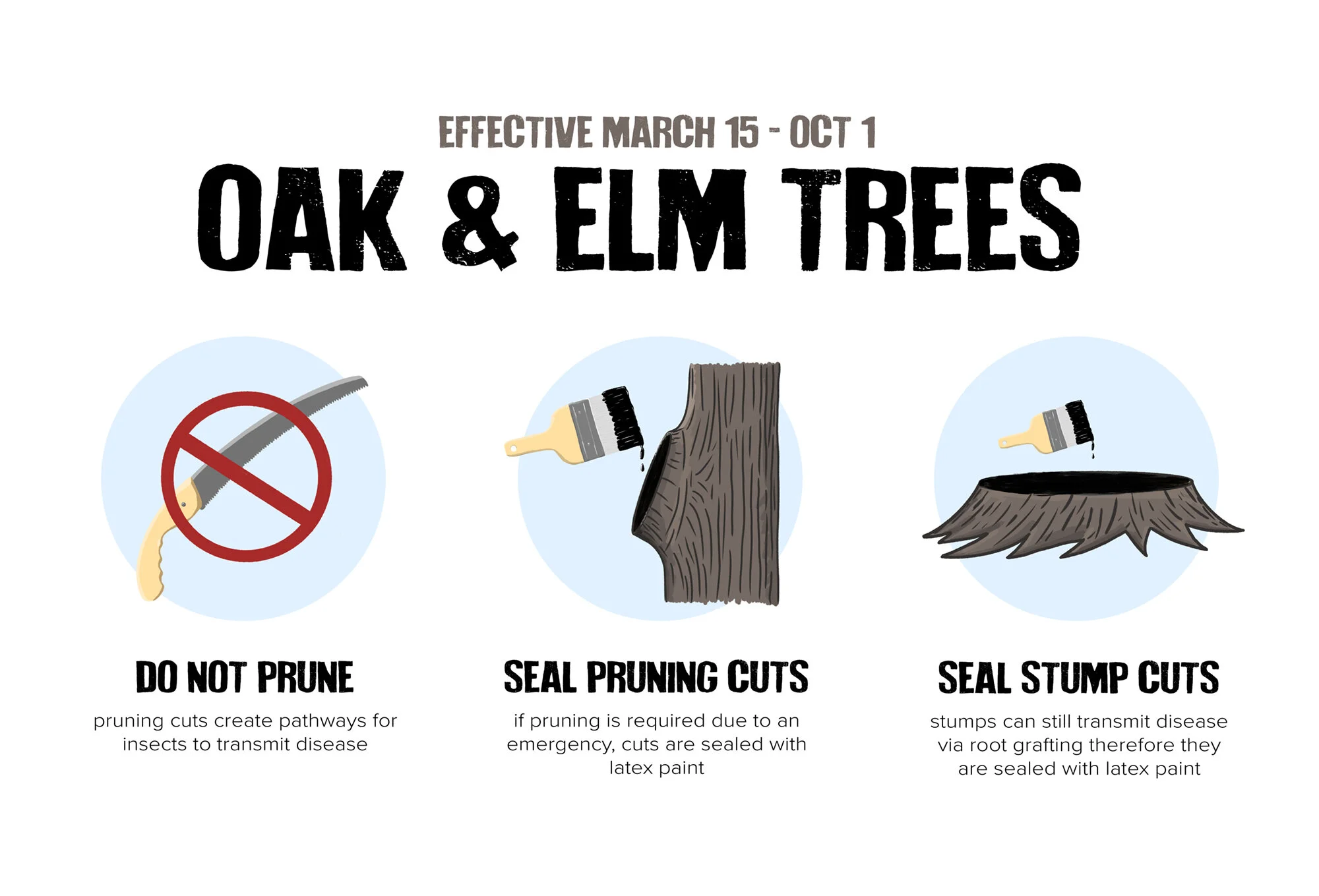
Good afternoon and I hope everyone is having a great week and enjoying this sunshiny weather! I love being able to get outside with my girls and get some vitamin D and open our windows and get some fresh air. With spring around the corner, I wanted to bring to your attention that Russell Tree Experts is implementing some new Oak tree and Elm tree safety procedures to ensure the health and safety of these types of trees in the Columbus area.
As you may have seen in some of our previous articles, we advise not pruning any Oak trees (or Elm trees) between March 15th and October 1st. If you are a current customer of ours and have Oak trees, you may know that it has taken us most of the winter to work through and complete all of the Oak pruning work we have accumulated over the year. Please note that if you require any future Oak pruning work, it will be done during the pruning window (October 1st - March 15) and despite everyone’s desires (including my own), not everyone’s Oak trees will be able to be pruned the first week of October, because of sheer capacity and manpower. As always, we will do our best to accommodate anyone’s specific situation. If we come across an instance where an Oak or Elm tree MUST be pruned in this window (such as safety concerns), the wounds will be painted with tree paint or wound dressing to help deter the Nitidulid beetles that spread Oak Wilt from entering the tree and ultimately spreading the disease. This is something that we have been doing for the past few years since Oak Wilt became an issue in the area and we became aware of these best practices.
It is vital to seal oak wounds/cuts between March 15 - October 1st to limit the transmission of oak wilt.
[Click to enlarge]
Upon reading up on some neighboring states’ tree removal contracts, I have found that it is also recommended in parts of Michigan to immediately paint any stump from a freshly removed Oak tree so the beetles will not be attracted to this wound as well. In Michigan, Oak Wilt has been more prevalent than here in Ohio but I believe it is necessary to take their findings and apply them to our own situation at home. Painting the stump is an effective mitigation method is because one of the ways Oak Wilt can spread to other trees is by root grafts. Even though the tree has been removed, it is possible the Nitidulid beetles may still enter the stump, carrying the pathogen, and the disease could be spread through the roots of the newly infected tree (or now stump) to a neighboring oak tree through the root grafts, which could be as far as 100 feet away. Although the spread of the disease this way may be unlikely, for the amount of effort it takes to paint a stump, it is an easy way to reduce the risk of spreading such a deadly disease.
Even the stump of an oak can transmit oak wilt therefore stump cuts between March 15 - October 1 will be sealed.
[Click to enlarge]
We are including Elm trees into this new practice as well is because the spread of the infamous Dutch Elm Disease is spread in a similar way.
As always, if you have Oak trees and expect you may have Oak Wilt, please give us a call and our experts would be happy to advise you on next steps and how we can confirm a diagnosis. It is best to try and find out sooner rather than later to try and reduce the spread to neighboring Oak trees.
Have a great rest of the week and be sure to get outside and soak up some rays!

Lindsey Rice | Regional Manager, Russell Tree Experts
Lindsey joined Russell Tree Experts in 2015 with a B.S. in Agribusiness and a minor in Horticulture from The Ohio State University. Growing up in Northwest Ohio, she participated in various sports, band, and FFA which ultimately inspired her love for the tree industry. In her free time she loves to spend it outdoors with her husband and daughters.
Here... There... (and what feels like) Everywhere
Despite the snow and cold temperatures, Russell Tree Experts is staying busy this winter with several interesting projects.

Despite the snow and cold temperatures, Russell Tree Experts is staying busy this winter with several interesting projects.
In mid-November 2020 we mobilized to Gatlinburg, TN to begin a 5-month project for the Smoky Mountains National Park system. The bulk of this project is removing dead and hazardous trees along roadways, campgrounds, and parking areas throughout the park. Many of the trees being removed have been killed by wooly adelgid or severely damaged by the Gatlinburg wildfire of 2016. We are also safety pruning over high traffic areas and clearing several scenic vistas.
From mid-November 2020 through January 2021, we had crews working in Johnstown, Pennsylvania clearing the historic Lake Conemaugh. Lake Conemaugh, which no longer exists as a true lake, became famous in May of 1889 after the failure of its South Fork dam sent a current, comparable to the flow of the Mississippi River, through the town of Johnstown, PA resulting in the deaths of over 2,200 people. The purpose of our work was to clear vegetation that had established in the former lakebed, helping to visually represent the water level of the lake prior to the flood event. The original lakebed covers over 40 acres and had gone unmanaged for years. With our work there completed, Pennsylvania Parks and Rec along with their Division of Forestry will manage the area going forward with prescribed fires, mowing, and the use of goats on some of the steeper rocky slopes.
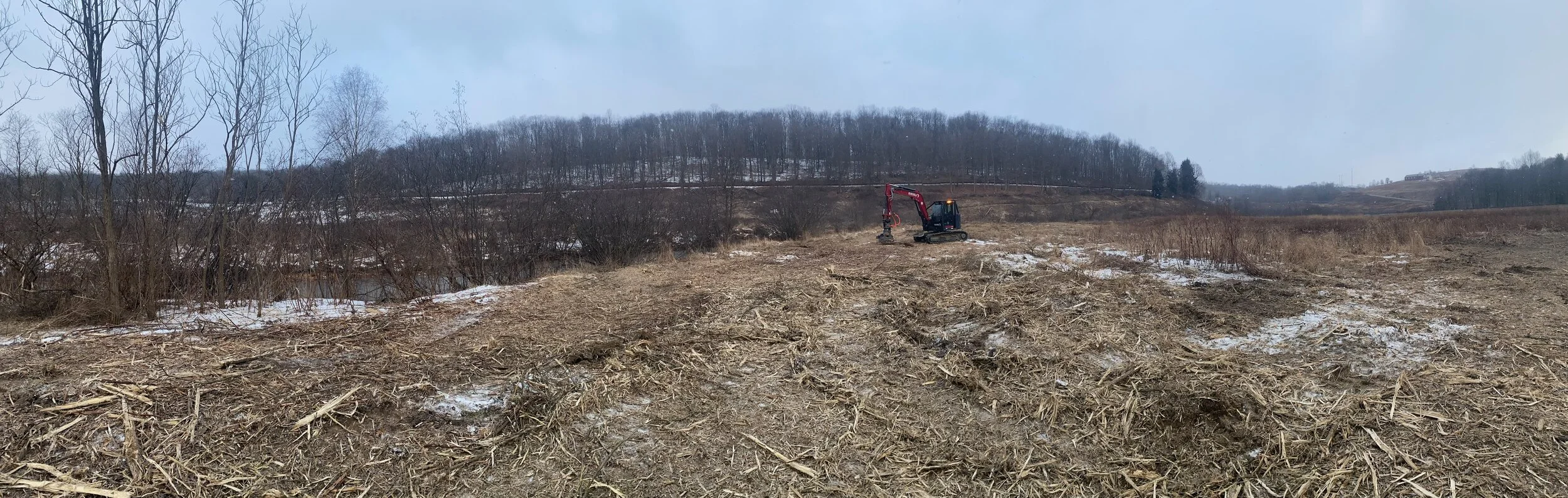
Excavator mulching woody vegetation in the previous footprint of Lake Conemaugh
On January 2nd, 2021 we mobilized crews to Oklahoma City, OK for 5 weeks to assist in vegetation clean-up from a historic ice storm that struck there toward the end of October 2020. October is a time when many deciduous trees in Oklahoma are still holding onto their foliage, so the ice accumulation and damage was particularly bad, toppling thousands of trees and leaving hundreds of thousands of people without power for several days.
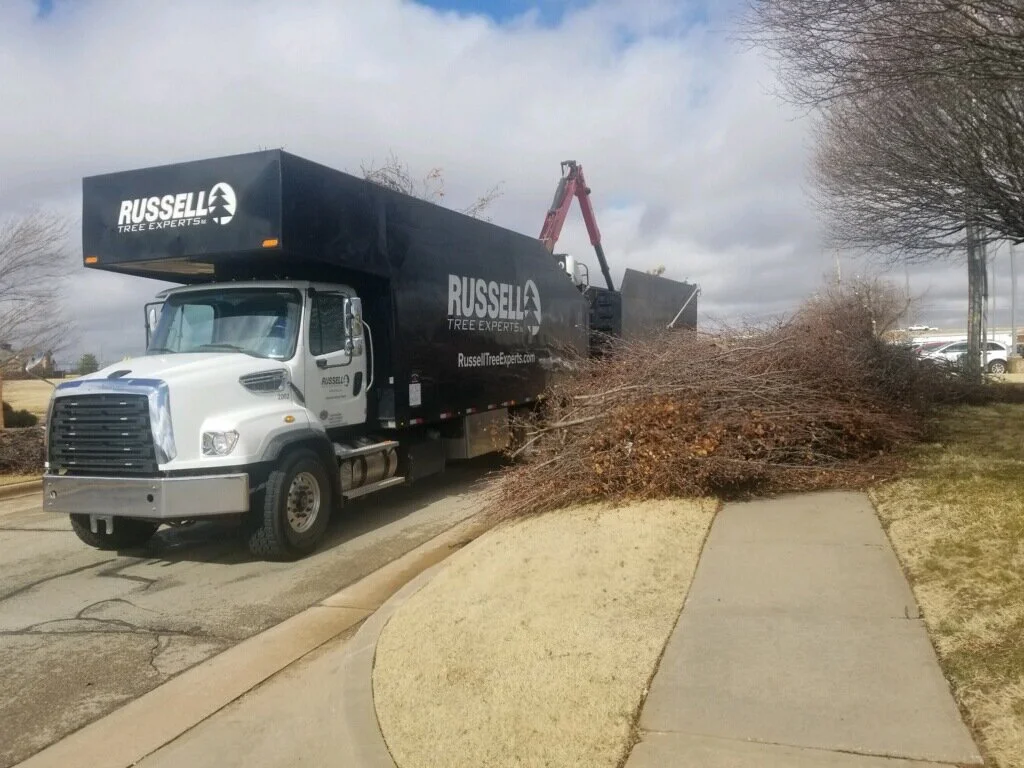
Picking up the remnants of the Oklahoma City ice storm
From January 11, 2021 to the present, we have had crews working in Virginia on the Blue Ridge Parkway. This is an approximately 10-week project where we are clearing 122 vistas from Buena Vista, VA North to the Shenandoah Valley. Our main objective is to maintain a clean line of sight from the road to the spectacular viewing areas that the park service installed when the parkway was created. Our progress has been slowed by the epic amount of snow we’ve received in the higher elevations, but our cabin is cozy, and the mountains are inspiring.


And locally, our home team has kept busy with a mix of tree preservation, tree pruning, and tree removal work. We are currently working through several municipal street tree pruning projects and working hard to wrap up our oak and elm pruning before the start of spring. The weather conditions these past few weeks have made this winter one of the more challenging we have worked through, so I want to thank everyone for their patience, flexibility, and understanding as we work to adjust with mother nature.
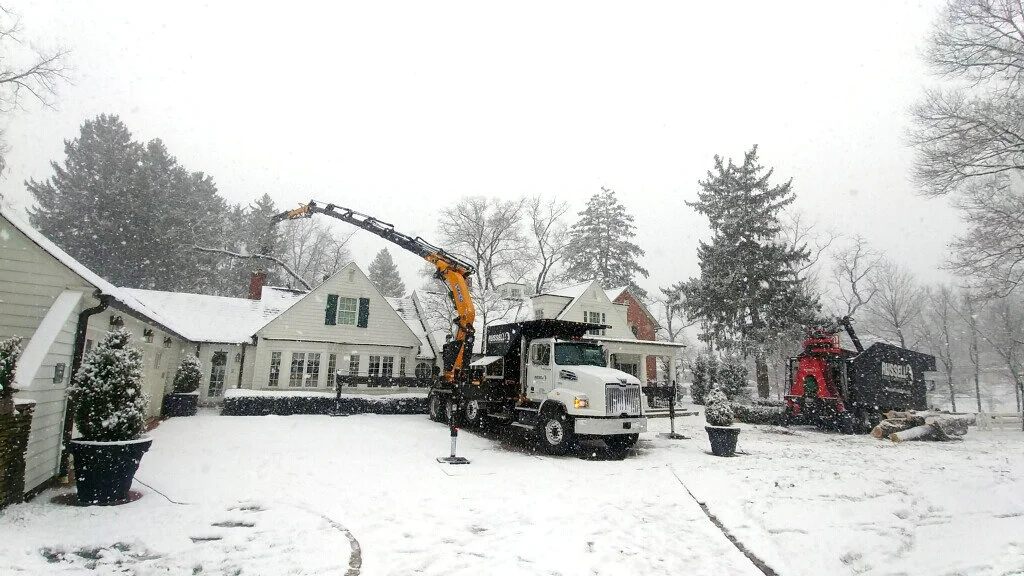
Our knuckle boom crane set up to remove a declining sugar maple from a back yard (Columbus, Ohio)
Russell Tree Experts is proud to have our roots in central Ohio and we have a deep appreciation for all our clients at home. We cannot thank you enough!

TJ Nagel | Scheduling Production Manager, Russell Tree Experts
ISA Certified Arborist® OH-6298A // Graduated from The Ohio State University in 2012, Earned B.S. in Agriculture with a major in Landscape Horticulture and minor in Entomology // Tree Risk Assessment Qualified (TRAQ) // Russell Tree Experts Arborist Since 2010
Lecanium Scale (Part Two)
Recently one of my clients in Dublin ended up with three crabapple trees that had a heavy infestation of lecanium scale. We tried some treatments but the trees had declined and the client made the wise decision to remove and replace them.

[Note: For an introduction to this insect pest and as background for this article, please read Part One here, if you have not already done so.]
What I Found, and What I Predict
I started working with Russell Tree Experts in April of 2012. Soon after that my colleagues and I became aware of a major epidemic of lecanium scale in communities on the east side of Columbus. Entire streets had trees that were covered in scale, noticeable to the eyes of discerning arborists because of how black the trees looked as we drove by. We watched in chagrin as the epidemic worked its way west. As the scale populations increased in my areas (central and western communities), I could no longer jokingly rib my colleagues about how they were not taking care of the trees in their areas. We were doing what we could, but many of the infested trees were larger ornamental pear, crabapple, and cherry trees that are not the best candidates for cover sprays. Recently one of my clients in Dublin ended up with three crabapple trees that had a heavy infestation of lecanium scale. We tried some treatments but the trees had declined and the client made the wise decision to remove and replace them.
Last year during a regular fertilization visit to this property, Andy, one of our Tree Wellness arborists, made a note that another tree had scale, this time in the back yard. I stopped out soon after to take a look. Here is what I found:

Second-instar nymphs that overwintered on the tree stems. Note white waxy covering beginning to form. Scales are in their final fixed position, actively feeding and growing. Note droplets of honeydew here and there.
Each of these nymphs will mature into adult females that will be about 10 times their current size by the time they lay their clutch of 100 or more eggs.
This is a new infestation. An old infestation would also have the dead female bodies of last year’s adults alongside the current generation. They would be dark brown and about the size of BBs used for air gun ammunition.
I made some notes for treatment recommendations and discussed options with the client. He decided not to pursue treatment. This was on April 23rd.
Nearly 6 weeks later in early June, I went back to this property for a different reason. While I was here I inspected the small crabapple. Much to my surprise, the second-instar nymphs had not grown. By this time they should have been at or near adult size, and they would be soft and slimy when crushed. I brushed some of the scales with my fingers and they rubbed off the tree stem like gray ash. They were dead. I checked the tree all over – no adults, all scales were dead. This tree had been treated with something very effective. You will recall from the first article that the insect stage most vulnerable to treatment is the first-instar nymph stage, which hatches from eggs laid by the adults that these second-instar nymphs would have become.
I knocked on the door.
During the ensuing conversation I found out that indeed, the tree had been sprayed with an unknown solution recommended somewhere on the internet. I encouraged my client, feeling very proud that they had taken matters into their own hands. “You killed every single scale!” I told him.
I shared the story with TJ back at the office and asked TJ to ask the client for the recipe when he talked to him to confirm our next visit to the property.
A week or two later, another client appeared on my calendar. Her problem was dieback on a crabapple, and Oakland nursery had recommended that she call us. As I walked around the front corner of the house I noticed lecanium scale on a shrub in the front bed. “Hmmm…” I thought. So I was not surprised when I saw the crabapple, a nice one, also had a heavy infestation of lecanium scale. There were the adults as expected.
Then I looked more closely. By this time of year there should have only been dying and dead adults on the tree, with possibly some first-instar nymphs feeding on the leaves. But here were dead adults alongside second-instar nymphs on the twigs. Not a single first-instar nymph to be found under a single leaf. I rubbed my finger across a few of the nymphs… Sure enough, they rubbed off easily, like ash.
Now my thoughts went back to the first client who had sprayed his tree with a home-cooked remedy. I carefully interviewed the current client and she was positive that no treatment of any kind had been made on her tree. I started to wonder.
This became a trend for the next few weeks, such that when I encountered lecanium scale several more times I was no longer surprised to see the same thing. This made me realize that the problem for the scale, and the blessing for the infested trees, had to be environmental.
Late winter of 2020 we had a two-week period of what I called “false spring”, when temperatures were far too warm for the season and I silently directed my thoughts to my trees, asking them not to believe that winter was over. Of course they ignored me and began to leaf out and flower. Then winter raged back in and the new growth was burnt, flower buds died, and spring looked less vibrant when it actually came on its normal schedule weeks later.
After that false spring, we had no less than 4 nights during two separate weeks when temperatures dropped well below freezing. I disguised my Japanese maples as ghosts using bedsheets to protect them from freezing after they had budded out. It was to no avail - all the new growth got burnt off. The same thing happened to many of you as well, since the cold snaps were widespread.
I propose the hypothesis that the second-instar nymphs of lecanium scale also believed in the false spring, and emerged along with their host plants. When the temperatures plunged below freezing four times during a prolonged cold spring all those nymphs were killed. Just like that, entire populations of this scale were dead. How many of you recall that we had snow on Mother’s Day last year? Well, if my hypothesis is correct, I present you with a blessing disguised as a late snow: For many of my clients the problem of a large population of a serious insect pest had been solved without applying a single drop of insecticide. That greatly helped me bear the disappointment of my disfigured Japanese maples!
Based on this hypothesis I close this article by making the prediction that this 2021 season my colleagues and I will continue to confirm a crash in the general population of lecanium scale. Those large trees that were not good candidates for topical sprays? No need to spray them after all. Though lecanium scales have their place within their ecosystem, when their population reaches damaging levels it is gratifying to see widespread control that has taken place with no human intervention. My only hope is that beneficial insects did not suffer in the same way.
As I close I have mixed feelings about how plants and insects are very much at the mercy of the environment. But I hope I have achieved my goal in sharing all this with you. By writing this I hoped you could see a little of what it is like when arborists try to decipher the clues they find from client to client, from tree to tree, from insect to insect. And I am still relieved to know that the lecanium epidemic may very well have been stopped in its tracks, at least for a time.
May you all be well, and may this coming season be full of “long days and pleasant nights.”
Your friendly neighborhood arborist,

José Fernández | Regional Manager, Russell Tree Experts
José became an ISA Certified Arborist® in 2004, and a Board-Certified Master Arborist® in 2015. Currently he is enrolled at The Ohio State University pursuing a Master’s Degree in Plant Health Management. José likes working around trees because he is still filled with wonder every time he walks in the woods. José has worked at Russell Tree Experts since 2012.
Lecanium Scale (Part One)
If “Lecanium” is a new word for you, consider yourself lucky, or at worst, blissfully ignorant. If you have experienced species of this genus in your landscape you may know how devastating, unsightly, and generally… uncomfortable this insect can be. If you have ever stood under a tree covered in a scale population which is actively feeding and digesting you will know why the word “uncomfortable” came to mind. In this installment I will briefly describe Lecanium scale and its life cycle. In the next installment, I will share an unusual finding from last season, and stand out on a limb to make a forecast for this season.

A Brief Description of a Common Pest:
If “Lecanium” is a new word for you, consider yourself lucky, or at worst, blissfully ignorant. If you have experienced species of this genus in your landscape you may know how devastating, unsightly, and generally… uncomfortable this insect can be. If you have ever stood under a tree covered in a scale population which is actively feeding and digesting you will know why the word “uncomfortable” came to mind. In this installment I will briefly describe Lecanium scale and its life cycle. In the next installment, I will share an unusual finding from last season, and stand out on a limb to make a forecast for this season.
Lecanium is a genus in the family Coccidae. Within this genus there are many different species of scale insects, but fortunately they are very similar in their appearance, feeding habits, and life cycle. This helps arborists identify the insect when populations reach a threatening level on a plant. Because the life cycle is similar from one species to another (with very few exceptions), treatment intervention is relatively straightforward. For the purpose of this article, and for discussion among arborists, we lump these scale species into a generic type we call lecanium scale.

Lecanium scale starts life as an egg. In central Ohio egg hatch usually takes place in June, when Washington hawthorn is blooming. (This event is a phenological indicator for lecanium scale hatch. For more on that topic, read my article here). The first nymphal form (called an instar) is the most mobile state within the lifecycle of the insect. Because of this we call this form a crawler. Crawlers will move out onto the leaf of a plant or tree and affix themselves adjacent to the veins of the leaf where they will feed through the summer. Sometime in late summer these crawlers turn into the second-instar form, and they move back onto the twigs to overwinter. Here one must pause for a moment of silence and ponder the question: How do these nymphs know that their host’s leaves are going to fall off for the winter? Do they really “know” at all? Why do they do what they do?

Female lecanium scale
Moving on, we find these second-instar nymphs waking up with the rest of the plant and insect world the following spring. They begin to feed on the twigs now, and are no longer mobile. A waxy covering begins to form over their bodies as they grow. Most of the lecanium scales will have a domed appearance, some flatter than others, some with different colors, but easily recognizable as lecanium scales once you know what to look for. When the adult female matures, she lays her clutch of eggs underneath her “shell” and dies soon after. The eggs hatch soon and the cycle continues.
Now some comments to finish up the picture:
Many plant hosts are targeted by this insect, including oak, hickory, honeylocust, crabapple, cherry, pear.
There is only one generation per year, which greatly simplifies the treatment process.
The crawler stage is the most vulnerable to treatment and is the one we try to target for control.
The most damaging stage is the second-instar nymph which feeds voraciously on plant sap in order to grow into an adult and lay eggs.
During this stage, digested sap is excreted as honeydew, a sweet substance that coats leaves, sidewalks, cars, and yes, people if you stand under the tree for too long. This honeydew is fed upon by sooty mold, turning the surfaces black.
Large populations can weaken a plant, causing dieback, stress, and even plant death due to the amount of sap extracted during feeding. Sooty mold interferes with photosynthesis, further stressing plants.
How new scale populations arrive onto formerly uninfested trees seems to be a bit of a mystery.
Lecanium scales are grouped with sucking insects (as opposed to chewing insects). They insert a proboscis into plant tissue to feed on sugars and other nutrients in the sap.
So much for the entomology lesson. Congratulations to you stalwart readers who have made it this far! You now have a good base of knowledge that will help you understand how I came to certain conclusions about the 2020 population of this pest, and what this might mean for 2021. I hope you can meet me here once more next week for the final installment!
>> (2/15/21 Update: Read Part 2!) <<
Your friendly neighborhood arborist,

José Fernández | Regional Manager, Russell Tree Experts
José became an ISA Certified Arborist® in 2004, and a Board-Certified Master Arborist® in 2015. Currently he is enrolled at The Ohio State University pursuing a Master’s Degree in Plant Health Management. José likes working around trees because he is still filled with wonder every time he walks in the woods. José has worked at Russell Tree Experts since 2012.
[Some technical notes retrieved, and some fact-checking facilitated by W. T. Johnson and H. H. Lyon, Insects That Feed On Trees and Shrubs, Second Edition, Cornell University, 1991.]