
Growing Degree Days
This semester I am enrolled in a class called Integrated Pest Management, taught by Dr. Luis Cañas at The Ohio State University. One of the first lectures we had was centered around the effects that the environment has on insect populations. As we explored this theme we soon came across the concept of “growing degree days”, and I was reminded of how useful this idea is to increase awareness of what is happening in the natural world around us and to be aware of when potentially damaging insect pests are about to emerge.

This semester I am enrolled in a class called Integrated Pest Management, taught by Dr. Luis Cañas at The Ohio State University. One of the first lectures we had was centered around the effects that the environment has on insect populations. As we explored this theme we soon came across the concept of “growing degree days”, and I was reminded of how useful this idea is to increase awareness of what is happening in the natural world around us and to be aware of when potentially damaging insect pests are about to emerge.
Reminded? Yes. At Russell Tree Experts we have been using growing degree days for years now as a tool to help when scheduling our tree wellness services. Seeing the concept again in class made me want to share it with all interested readers.
The concept of growing degree days is based on three basic principles which I will draw from my lecture notes provided by Dr. Cañas:
A “degree day” is the term used for the amount of heat accumulated above a specified base temperature within a 24-hour period.
The base temperature is (ideally) also the “lower temperature threshold”, which is the temperature below which a certain insect will not grow or develop. This is determined by research.
“Cumulative degree days” are just that: the number of degree days that have built up since a certain starting point (in general, since the beginning of the year).
What does this mean for living creatures? This is where things get interesting, so I’m glad you’ve read this far. Have you ever wondered how an insect knows it is time to hatch, or lay eggs, or go into pupation, or finish pupation so it can emerge as an adult? Is it increasing hours of daytime as days get longer after winter? (Maybe, but not quite directly). Is there some sort of internal clock that is ticking that just tells insects when to go into the next stage of development or propagation? But what if that clock went out of sync with environmental conditions? If you are reading this, you are very likely in central Ohio. Lovely state that it is, what do all Buckeyes say about the weather in our state? Exactly. Case in point: Here I am on Monday, February the 3rd, and today I was taking off clothes since I dressed for winter in the morning and got ambushed by 60 degrees and sunny. But the forecast looks like snow by Wednesday.
So what is it? Well, people devoted to these questions looked into it and found that apparently it is the accumulation of heat over time that causes insect development to proceed in synchrony with environmental conditions. So for a given insect, development will begin and continue above a certain temperature (low temperature threshold). Once so many degree days have accumulated (again, specific to the insect type), an egg will hatch, or an adult will emerge, or a nymph will grow into a more advanced stage, for example. These numbers can be identified for insects by watching and measuring. One simple formula (there are others that are more complicated) for tracking degree days is like this:
Starting on January 1st, the low temperature and the high temperature within that 24-hour period are logged. Those two temperatures are averaged, and the base temperature (low temperature threshold) is subtracted from the total.
For example: The high today was 61. The low was 50. 61+50= 111. 111/2 = 55.5, the average temperature. Let’s assume a certain insect, we can call it “Steve”, ceases all development when temperatures drop below 50 degrees. We would subtract 50 from 55.5, resulting in 5.5 degree days for today, February 3rd. Note that this number is only accurate for my specific area, since highs and lows are different throughout the state. This is another advantage of this system: It allows us to track Steve’s development in our own back yard!

Continuing with our friend, research has shown that Steve will emerge from pupation as a feeding adult after the accumulation of say, 548 cumulative degree days. What we would do is track degree days every day until we reach at least 548. After we reach that amount we would expect to start seeing Steves show up in our back yard on whatever plants Steves like to hang out on, doing whatever it is Steves like to do when they show up. The neat thing about this is that if we have a cold snap that lasts 3 weeks, even after two days of t-shirt weather in February (which is quite normal for Ohio right?), Steve’s development will simply pause, since degree day accumulation will slow down dramatically during the cold snap. Any day that there is at least 1 degree day, Steve will continue to develop, albeit much more slowly than if there were 20 degree days added on a given calendar date.
If you take the time to think this through you will start to connect all kinds of dots together that will make you marvel at the intricacy of our natural world, and how interconnected everything is. Nothing short of miraculous.
We’re almost done. One more tidbit: Plants seem to follow a similar pattern. This is not only neat, but useful! Since plants also follow this pattern it is only to be expected that certain plants will be at certain stages in their development each spring when Steve is at certain stages of his development each spring. So let’s say it just so happens that my Purple Robe Black Locust is starting to get all dressed up in her pink party dress at around 548 cumulative growing degree days, and that just happens to be the same amount of degree days that Steve needs to finish pupating and emerge as an adult. Instead of calculating degree days to watch for Steve, I can simply keep my eyes on my flowering tree. When I see her in full bloom I know that Steve is also out and about. In this case we call my Black Locust a “phenological indicator”. Her blooming is an outward sign of development in a plant that coincides with an important stage of insect development, thus serving as an indicator for that insect life stage.
The Ohio State University is full of very hard working citizens who study these things. Not only that, they track these things for us and give us a handy tool that does all the calculations (more complex versions than the basic one I shared) and tabulates events at the same time. Check out the resource here: https://www.oardc.ohio-state.edu/gdd/. Delve into it a bit. If you did not know about degree days and how they affect plants and insects, you will be amazed, if you are interested in the outdoors. If you already knew about these things before reading this article, I hope reading this made the concept a bit more accessible. Maybe now you can readily expound on the topic at the next ice cream social you are invited to. Be careful though- you would not want it to be your last. In any case, I am fairly certain you will not find a Steve on the OSU website I gave you above. Steves are not considered to be plant or tree pests so they have not been studied by our worthy scientists.
As always, thank you for reading. I am humbled by all the support I get from my readers. I have had the pleasure of conversing with many of you over the years and count myself blessed because of it.
Your friendly neighborhood arborist,

José Fernández | Regional Manager, Russell Tree Experts
José became an ISA Certified Arborist® in 2004, and a Board-Certified Master Arborist® in 2015. Currently he is enrolled at The Ohio State University pursuing a Master’s Degree in Plant Health Management. José likes working around trees because he is still filled with wonder every time he walks in the woods. José has worked at Russell Tree Experts since 2012.
Identifying & Managing Rhizosphaera Needle Cast
Rhizosphaera needle cast (RNC) – quite a mouthful, especially when one is an arborist in training, still green in the green industry. My supervisor had just handed me a photocopy of a fact sheet on the disease since I had asked him about spruce trees I had been seeing with defoliating branches.
Rhizosphaera needle cast (RNC) – quite a mouthful, especially when one is an arborist in training, still green in the green industry. My supervisor had just handed me a photocopy of a fact sheet on the disease since I had asked him about spruce trees I had been seeing with defoliating branches.
This took place early in my career, 14 years ago or so, here in central Ohio. Fast forward to the present when the disease has become so prevalent that news stories on local television and in local papers have covered the issue. For several years my colleagues at Russell Tree Experts and I have discussed the need for a short article about this since we have this conversation so often with clients, but we never have made a point to write one! So much to do in so little time. I think I run into declining spruce trees with this disease 3-5 times per week so I know there are many readers who will benefit from this topic, or know someone who will.
Colorado spruce (Picea pungens) is a species that is probably overused due to its attractive evergreen foliage. In particular, the “Blue” varieties (‘Glauca’, ‘Hoopsii’, among others) seem to be the most popular, used as accent plants where they really stand out against a larger backdrop of more traditional green foliage. Interestingly, a quick check of the literature does not show that the species is prone to very serious disease, even though needle cast disease is mentioned as a possibility.
This is the reason why I seem to have suddenly shifted from one topic (RNC) to another (Colorado spruce). The tree is widely used (and therefore widely available) yet there is not a lot of information about how the species is performing in central Ohio. Please keep in mind that as an arborist I am trained to consider long term performance of a tree as opposed to short term. This means that I view trees as potentially permanent part of the landscape that we can choose to work around when subsequent changes in site use or design are necessary. This view is not shared by all, and my purpose here is not to defend my position against others. I mention this because Colorado spruce may still be a great choice of tree if its purpose is short-lived by design. I find that most individuals who plant trees do so because they treasure the feeling of starting a living process that will continue long after they are gone from this life. I am in this category, and I derive great benefit from seeing a tree remain healthy as it grows, changing and maturing. I help the tree along and it becomes a living, contributing part of my local environment.
I have come to believe that Colorado spruce is not a good option for a long term investment of resources (time, space, money). I would guess that about 90% of these trees eventually develop RNC to an extent that makes removal necessary as symptoms progress, causing the tree to lose its needles prematurely.
RNC is caused by a fungal pathogen. The fungus reproduces by forming spores in fruiting bodies (see photo above) that grow in the leaf stomata (openings in the leaf or needle, usually on the underside, that allow for gas exchange with the environment). Because of this, one diagnostic tool is to look for small black fruiting bodies lined up nicely on the underside of a spruce needle. Usually the stomata are white, which makes fungal fruiting bodies stand out when they are present. The spores spread with wind or rain, moving into the tree. In the case of RNC, disease symptoms soon follow, usually marked by needles that first turn a purplish color, then brown (see photo below), then dropping.
The defoliation pattern will be from the inside of the tree moving outward, and generally from the bottom of the tree moving upward, although sometimes it can move downward as well. Cool, moist conditions will favor the development of most fungal diseases, including RNC. Hosts of this pathogen include most spruce, several pine, and some fir and hemlock species. I have found several Norway spruce with RNC, but generally I consider this tree to be resistant consistent with the literature. To my knowledge I have not seen this disease on any pine or hemlock, although the early disease symptoms present differently and I may have missed it. For example, in Norway spruce the browning pattern is preceded by a mottled yellowing of the needles rather than the purplish color seen in Colorado spruce. The “fall color” (see photo below) of Norway Spruce can be confused with needle cast symptoms.
To differentiate between the two, the diagnostician should look for the fungal fruiting bodies and evaluate the pattern and extent of needle loss in the tree. I still heartily recommend Norway spruce as a good option for us in central Ohio, but for several years now have discouraged people from planting Colorado spruce simply because I am either removing them, waiting to remove them, or spraying them with fungicides.
Fungicide sprays for this disease are mostly protectant rather than curative. For this reason multiple applications are recommended each season, with the goal of providing a chemical barrier over newly emerging needles as growth occurs each spring. Once past the cool, moist spring conditions the needles harden off, climate gets warmer and drier, and infection is less likely, but still a possibility. One of my colleagues visited Colorado a few years ago. When he returned he said two things to me: “There are still streets with ash trees in Colorado, and the spruces don’t have needle cast”. Why do our Colorado spruce get needle cast? Our climate is much warmer, much more humid. Our soil tends to be poorly drained, and alkaline. Bring a tree genetically adapted to a specific environment into a different environment and it will likely become stressed, making it vulnerable to disease. In central Ohio, I have seen a trend with Colorado spruce: The trees look great when they are newly planted. If the site is very poor, they quickly develop RNC or decline for other reasons. If the site is reasonable, the trees grow very well and remain beautiful. Then we get to that 90% mark I mentioned earlier, which seems to be with trees that have done reasonably well for 15-25 years, but now have entered into rapid, noticeable decline resulting in tree death within 10 years. Most people choose to have the trees removed well before the trees are completely dead since they lose their beauty and no longer serve as screening plants. This is why I consider this species to be useful if the intended design is only for the next 15 years or so.
If you have a Colorado spruce you want to preserve here are some things that will help:
I recommend repeat applications of fungicides on a seasonal basis to protect newly emerging needles. Note that this does not guarantee that your tree(s) will remain disease free, but it will greatly reduce the infection rate.
Change any existing irrigation so that water is not being sprayed onto the tree foliage. Water the tree with drip irrigation at the base.
Weeds and neighboring plants should be kept away from the lower foliage to increase sunlight and air penetration to try to reduce moisture and humidity levels.
You may consider enjoying your Colorado spruce (whether a green or blue variety) for as long as it looks good, but plant some replacement trees nearby to get them started now. Concolor fir is an evergreen tree that has a bluish cast to it and will perform well given well drained, biologically active soil. Norway Spruce is a good option if the space requirements are met, as this tree will grow large. Western redcedar is proving to be a top performing tree for us, and is also a good screening evergreen plant.
In closing, it is worth mentioning that the dwarf forms of Colorado spruce, whether blue or not, seem highly resistant to RNC. I rarely see this disease on the dwarf varieties.
Thank you for reading! My sincere hope is that this information is useful to you.
Your friendly neighborhood arborist,

José Fernández | Regional Manager, Russell Tree Experts
José became an ISA Certified Arborist® in 2004, and a Board-Certified Master Arborist® in 2015. Currently he is enrolled at The Ohio State University pursuing a Master’s Degree in Plant Health Management. José likes working around trees because he is still filled with wonder every time he walks in the woods. José has worked at Russell Tree Experts since 2012.
Humid Air: Tough for Plants and People
Summer in central Ohio brings good times outside but also often brings hot humid air. Heat and humidity can aggravate some foliar fungal disease on trees and shrubs. One of the most common diseases we see is rhizosphaera needle cast on Blue Spruce trees.
Summer in central Ohio brings good times outside but also often brings hot humid air. Heat and humidity can aggravate some foliar fungal disease on trees and shrubs. One of the most common diseases we see is rhizosphaera needle cast on Blue Spruce trees.
This disease manifests itself in needles causing them to turn brown and even purplish before they fall off of the tree. Blue Spruce will often show the first signs of infection on the interior and lower needles where moisture persists, looking thinner and sickly in the middle during the early years of an infestation. Left to run wild without a managment plan, rhizosphaera needle cast will eventually kill its host tree.
If you have a mature Blue Spruce that has lost less than approx. 25-35% of its needles from needle cast, a treatment plan may include:
Raking up and disposing of all of the old fallen needles under the tree that can still host the fungal spores.
Pruning out dead branches.
Adjust irrigation equipment to make sure that water is not directly sprayed onto the needles of the tree, this spreads the spores and accelerates the advancement of needle cast.
Three rounds of fungicides applied in the spring, shortly after bud break can protect new growth from becoming infected.

Joe Russell | Member & Co-Owner, Russell Tree Experts
Joe Russell has been an ISA Certified Arborist® since 2003. He graduated from Ohio State University with his bachelors in Landscape Horticulture with a minor in Ag Business and started Russell Tree Experts with his wife Shari in 2005. Joe grew up in the Ohio Valley near Wellsville, Ohio and is a resident of Galena, Ohio.
Soil Compaction = Not Good for Trees
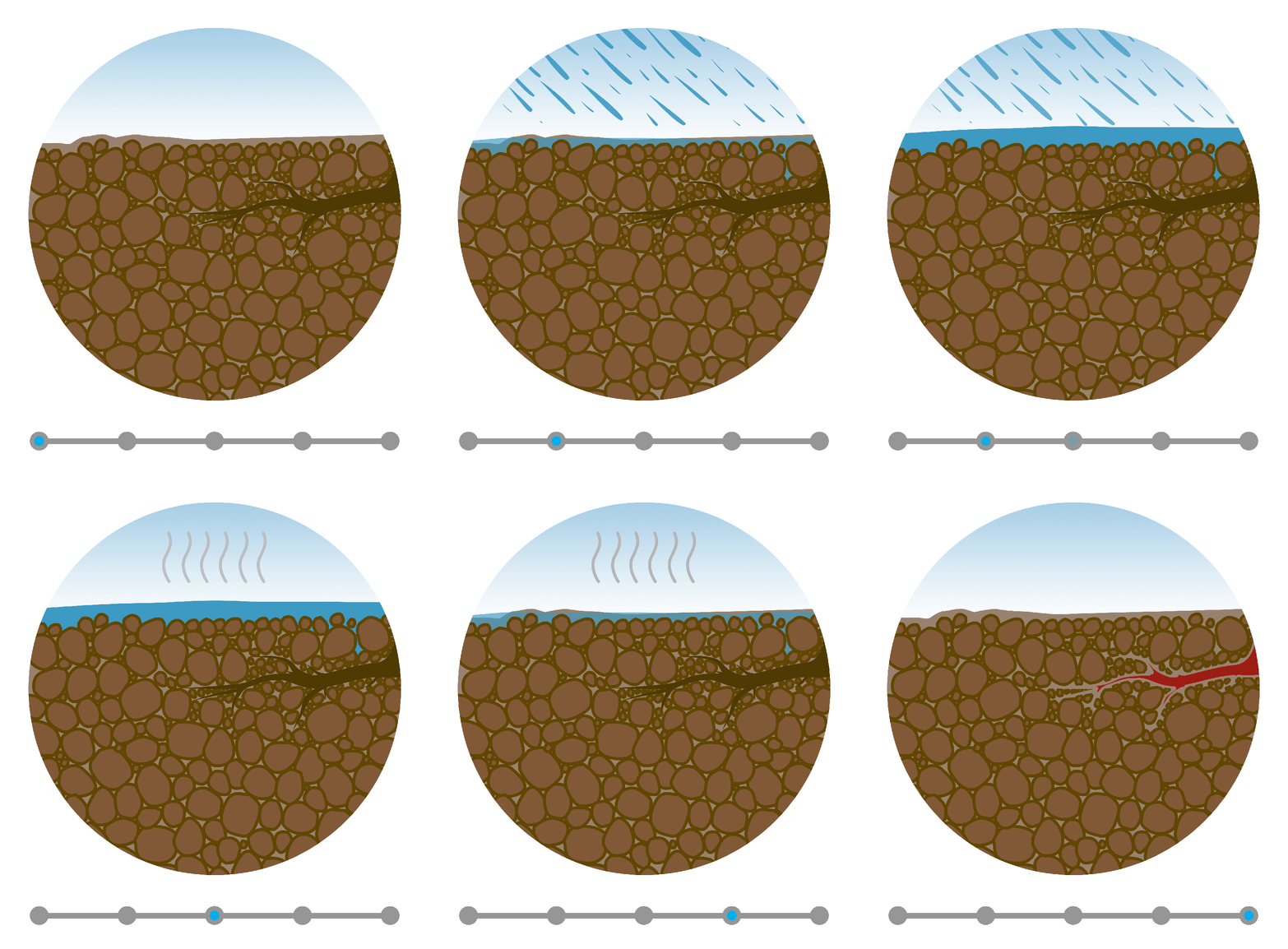
Soil compaction is a big no-no for trees. When soil is compacted (above left graphic), water and oxygen cannot get to the vital root system of the tree. Water will collect on the surface and evaporate since it is unable to penetrate the soil. Seeing as trees need water and oxygen to live, compacted soil can quickly and severely impact the health of a tree.
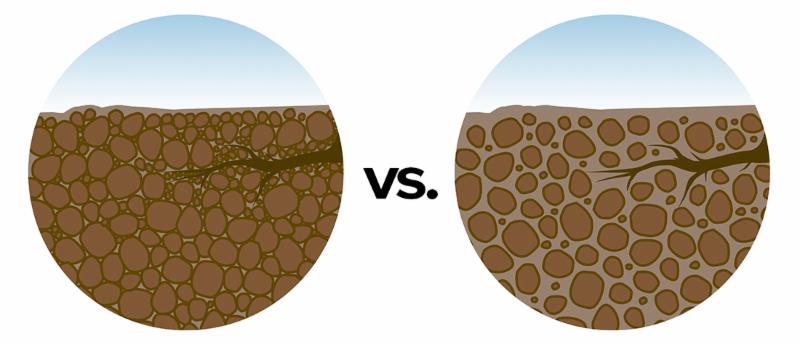
Soil compaction is a big no-no for trees. When soil is compacted (above left graphic), water and oxygen cannot get to the vital root system of the tree. Water will collect on the surface and evaporate since it is unable to penetrate the soil. Seeing as trees need water and oxygen to live, compacted soil can quickly and severely impact the health of a tree.
DID YOU KNOW?
80% of a tree’s absorption roots are in the top 12” of the soil. That is way soil compaction is so detrimental to a tree’s health.
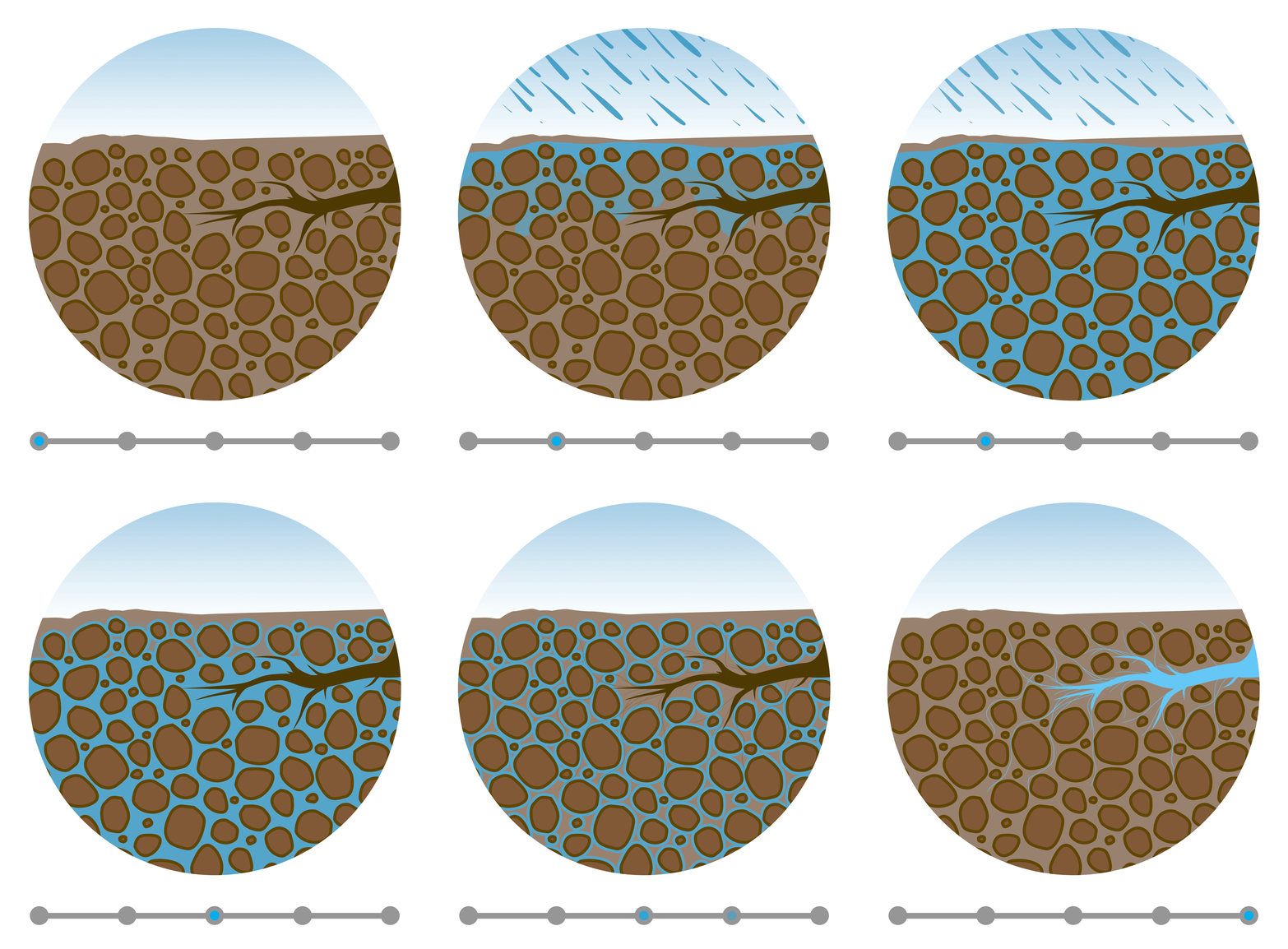
To treat this issue we often recommend a Root Zone Invigoration which is performed by using a supersonic air tilling tool (called an AirSpade) that infuses organic matter into the soil and alleviates compaction around mature trees and shrubs. The result (above right graphic) is a greatly improved environment for your trees to thrive - beautifully tilled soil with all critical fibrous roots still intact.
Check out the below animations which illustrate how water interacts with soil before and after a Root Zone Invigoration:
BEFORE
AFTER

Kenny Greer | Marketing Director, Russell Tree Experts
Kenny graduated from The Ohio State University with a BFA in Photography. He enjoys photography, graphic design, improv comedy, movies (except for the scary ones), and spending time with his wife and 2 kids.
New Research: Boxwood Blight Update
If you read my first installment on this relatively new disease, you will know the major difficulty of this pathogen (Calonectria pseudonaviculata) is that it infects otherwise healthy plants, and once it is at a site, removal and destruction of the infected plants is recommended, with no plant replacement for 3-5 years. This is because the spores remain in and on the soil to infect new plants. Existing asymptomatic plants were to be sprayed with fungicides to help prevent infection.
If you have boxwood plants, please read the following!
Last week I read an article about a new research project that tested the hypothesis that use of mulch may reduce the incidence of boxwood blight at previously infected sites.
If you read my first installment on this relatively new disease, you will know the major difficulty of this pathogen (Calonectria pseudonaviculata) is that it infects otherwise healthy plants, and once it is at a site, removal and destruction of the infected plants is recommended, with no plant replacement for 3-5 years. This is because the spores remain in and on the soil to infect new plants. Existing asymptomatic plants were to be sprayed with fungicides to help prevent infection.
In this new study, two sites (field planting site and existing residential landscape site) were used to test the mulching hypothesis. The results at the residential site were particularly encouraging. At this site, infected plants were cut down, leaving stumps at around 15 cm in height (5.9 inches), similar to a rejuvenation or coppicing pruning. The pruned material was destroyed, but the stumps were freshly mulched to a depth of 8-10 cm (3-4 inches) in an area 2 x 2 m around the stump. Result? Complete protection (no infection) was observed the first season, and “excellent” protection the following season (low infection rate).
The authors of the study stated that the pathogen “primarily attacks leaves and stems”, and “there is no evidence to date of natural infection of boxwood roots” by this pathogen in the soil. Based on this information, recommendations for managing this disease will be summarized by the following steps, representing an integrated approach:
Above all else, do not allow new boxwood plants onto your property that are not guaranteed to be free of this pathogen by the supplier.
Any person/company working on your boxwoods must be able to guarantee that all equipment being used on the property has been cleaned and disinfected prior to entering your property to do work. Under no circumstances should debris from other properties be allowed to enter your property.
If a plant is deemed to have boxwood blight, remove the plant (bagged and dumped in trash or burned), clean away surface mulch and leaf litter, and add new mulch around the stump, periodically checking to maintain at about 3” in depth.
Remaining healthy plants should be put onto a fungicide spray program to provide topical protection for the next several seasons. Hopefully the coppiced plants will sprout vigorously and remain uninfected.
Surface irrigation (sprinklers) should be avoided near boxwood, since water splashing is one of the primary ways the spores are spread. Also, there is a positive correlation between inoculation rates and length of time foliage remains wet.
Exclusion of the pathogen will be the most important step in this program, and the more people become aware of this, the less the disease will be able to spread. Exclusion is maintained by the first two steps shown above. The mulching depth is rather more than normally recommended for plant health, but in this case the idea is to keep fungal spores from landing on stems and leaves.
Please pass this information along to anyone you know that has boxwood plants. The more people we have following exclusion principles, the less this disease will be able to spread.
Reference: Likins, T. M., Kong, P., Avenot, H. F., Marine, S. C., Baudoin, A., and Hong, C. X. 2018. Preventing soil inoculum of Calonectria pseudonaviculata from splashing onto healthy boxwood foliage by mulching. Plant Dis. 103: 357-363.
Your friendly neighborhood arborist,

José Fernández | Regional Manager, Russell Tree Experts
José became an ISA Certified Arborist® in 2004, and a Board-Certified Master Arborist® in 2015. Currently he is enrolled at The Ohio State University pursuing a Master’s Degree in Plant Health Management. José likes working around trees because he is still filled with wonder every time he walks in the woods. José has worked at Russell Tree Experts since 2012.
That "Stuff" Growing on Bark
As Central Ohio moves further into winter, and the majority of deciduous trees have dropped their leaves, bark becomes increasingly visible. Bark is an interesting and important characteristic for trees and tree identification. It doesn’t take long for a novice naturalist to distinguish certain tree species based almost entirely on the bark of a specimen (Beech, Hackberry, River Birch, etc.). Upon further inspection of a tree’s bark an observer might notice organisms growing on the trees bark. A large variety of fungi can be seen on the bark of deadwood in trees and is usually associated with poor health of that particular branch or the entire tree. However, fungi are not the only organism to inhabit the bark of trees.

That “stuff” growing on bark
by ISA Certified Arborist® Chris Gill
As Central Ohio moves further into winter, and the majority of deciduous trees have dropped their leaves, bark becomes increasingly visible. Bark is an interesting and important characteristic for trees and tree identification. It doesn’t take long for a novice naturalist to distinguish certain tree species based almost entirely on the bark of a specimen (Beech, Hackberry, River Birch, etc.). Upon further inspection of a tree’s bark an observer might notice organisms growing on the trees bark. A large variety of fungi can be seen on the bark of deadwood in trees and is usually associated with poor health of that particular branch or the entire tree. However, fungi are not the only organisms to inhabit the bark of trees.
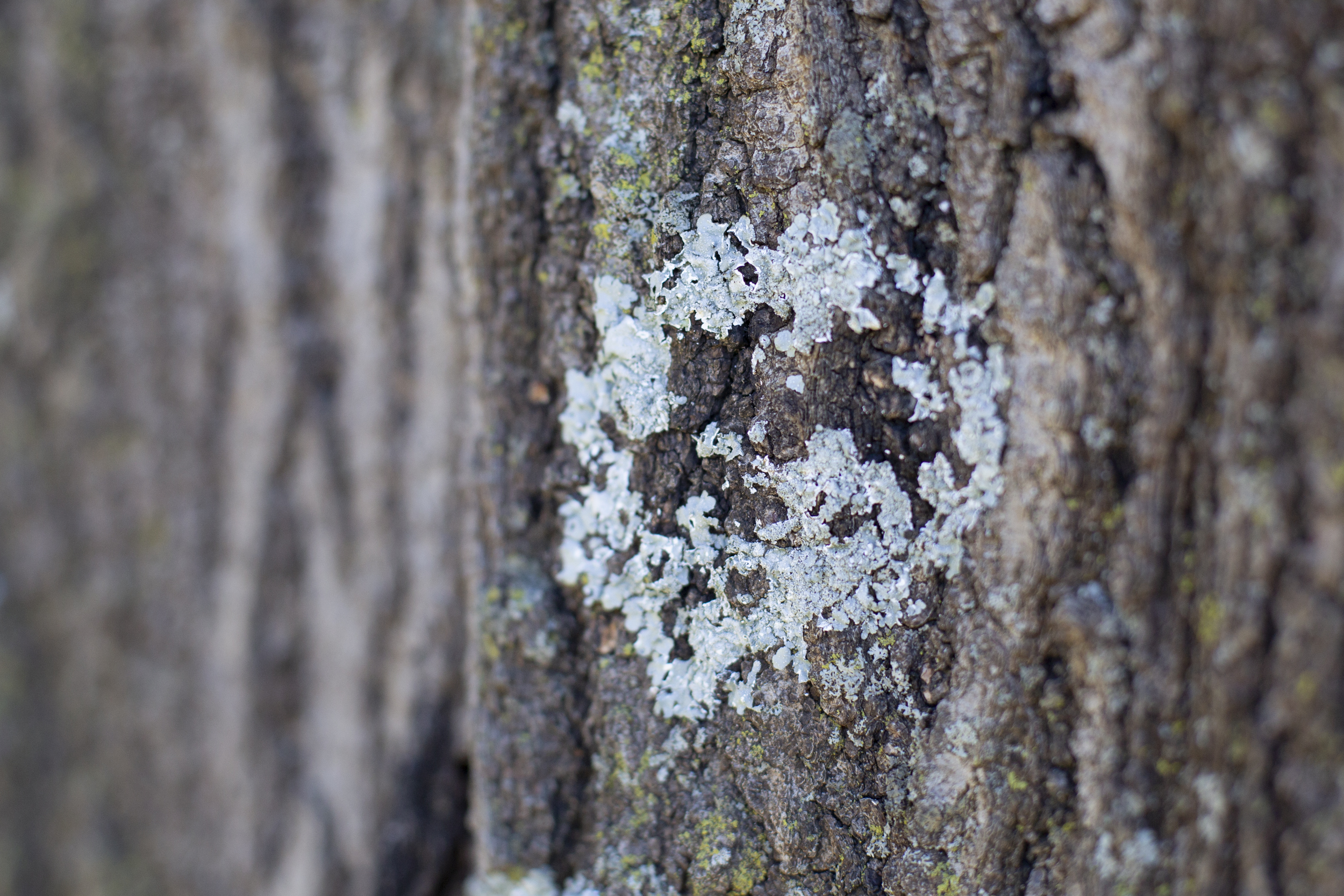
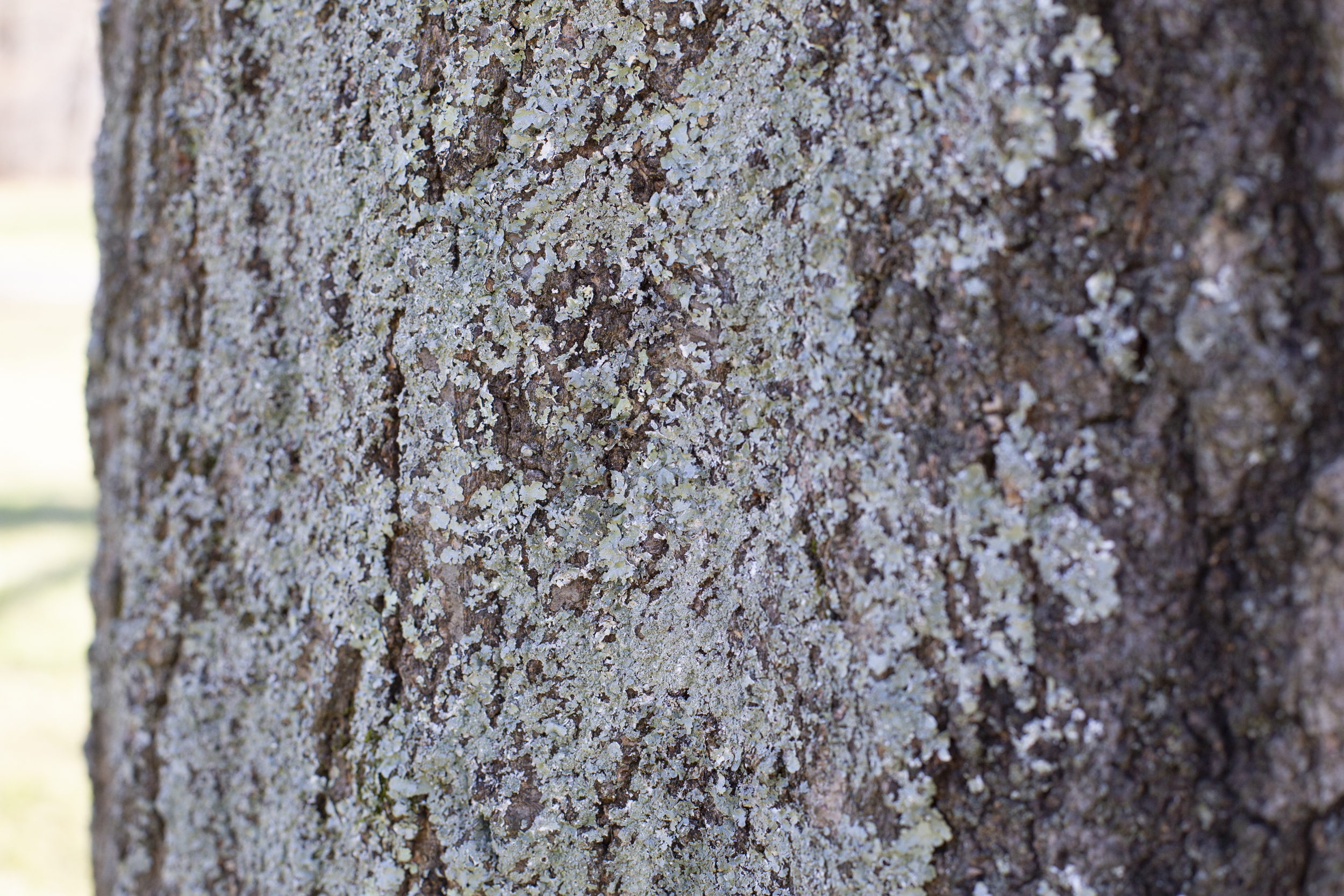
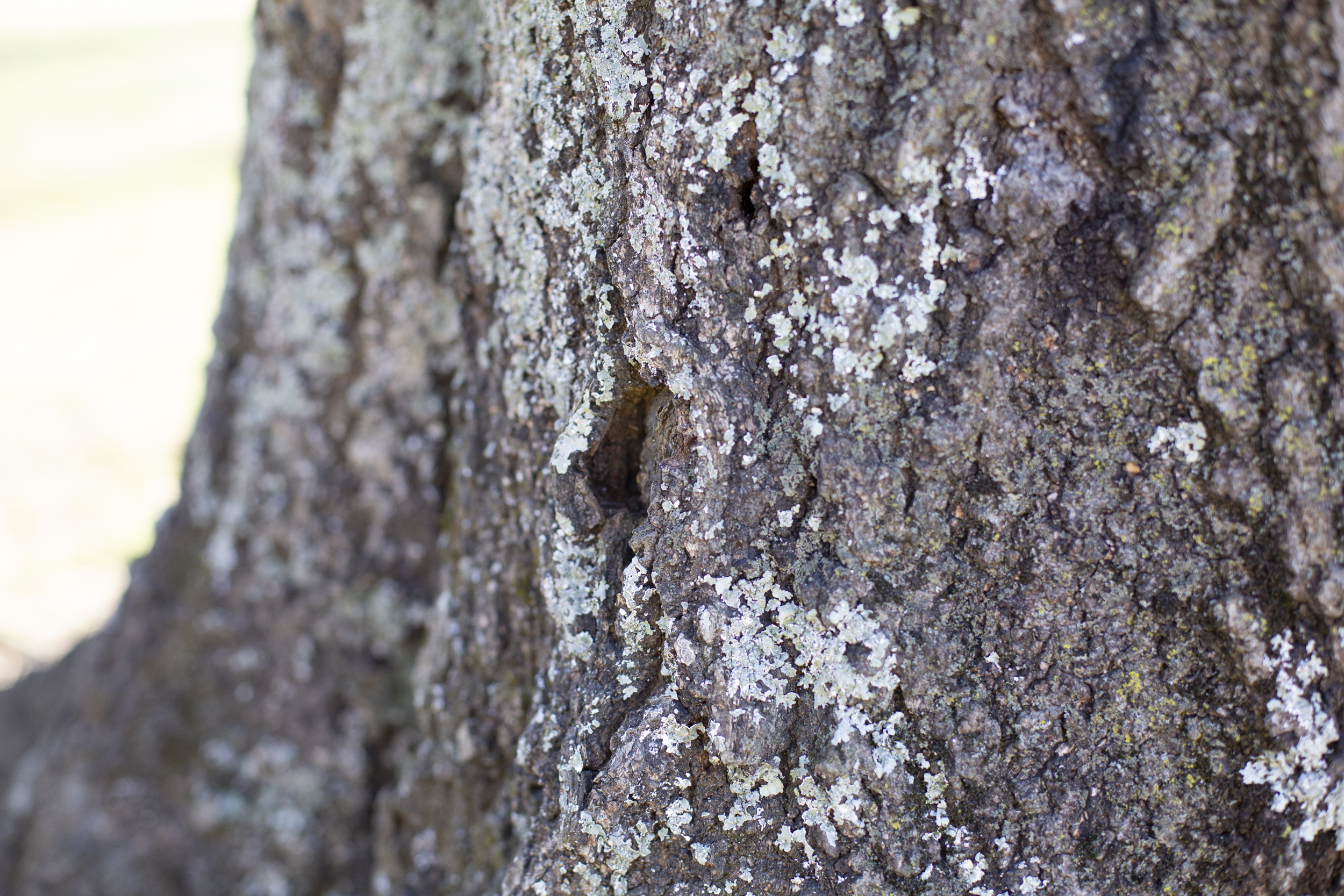
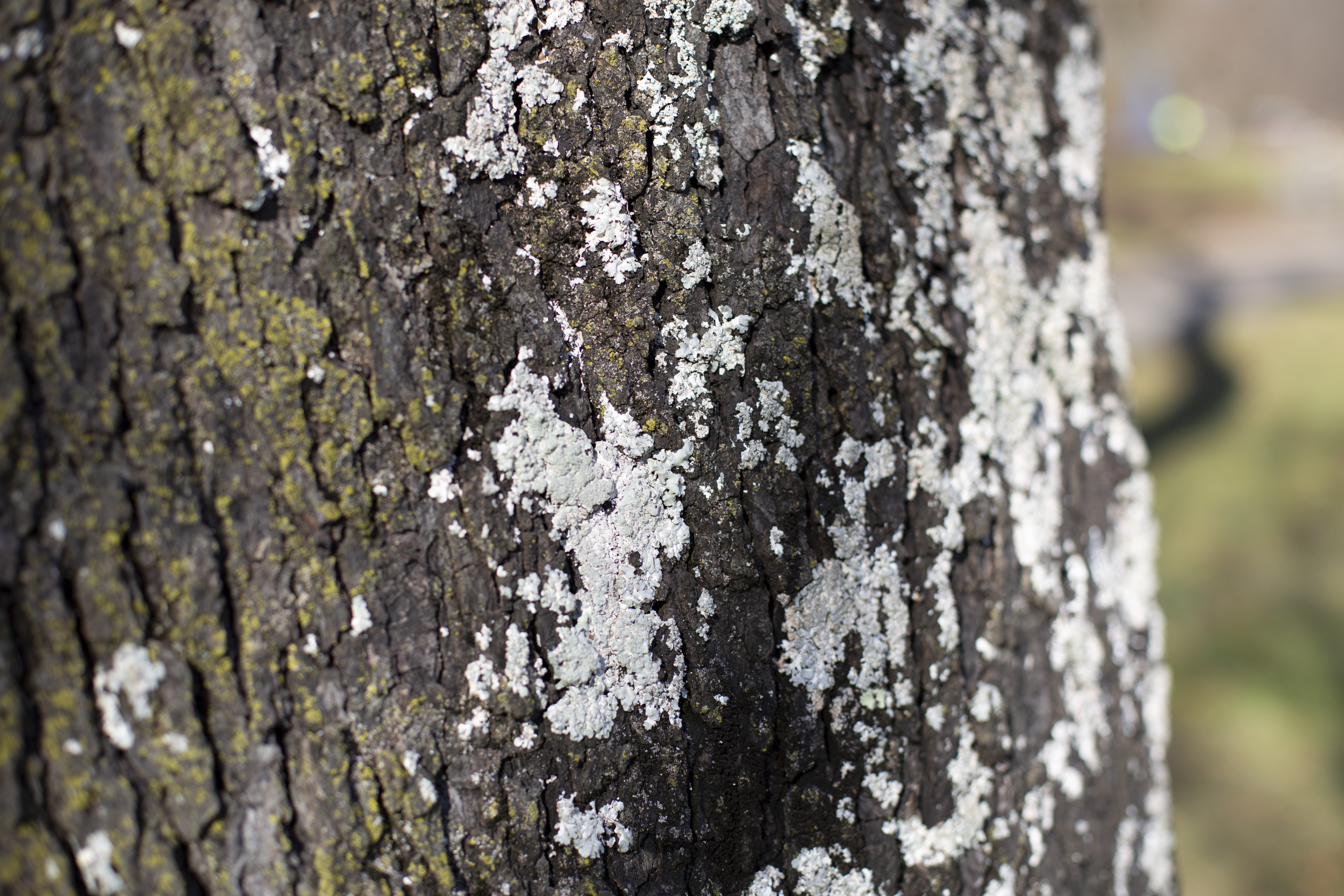
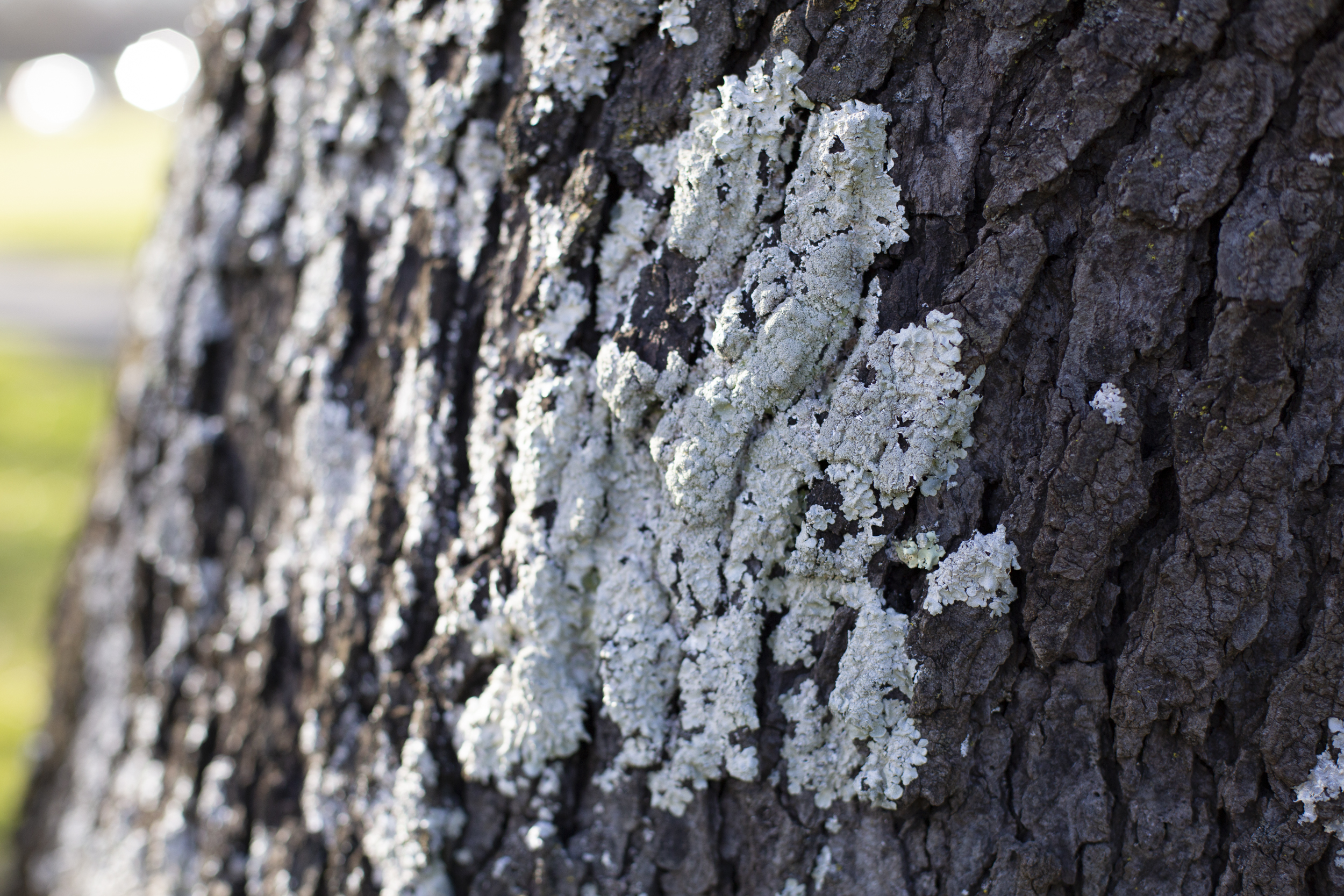
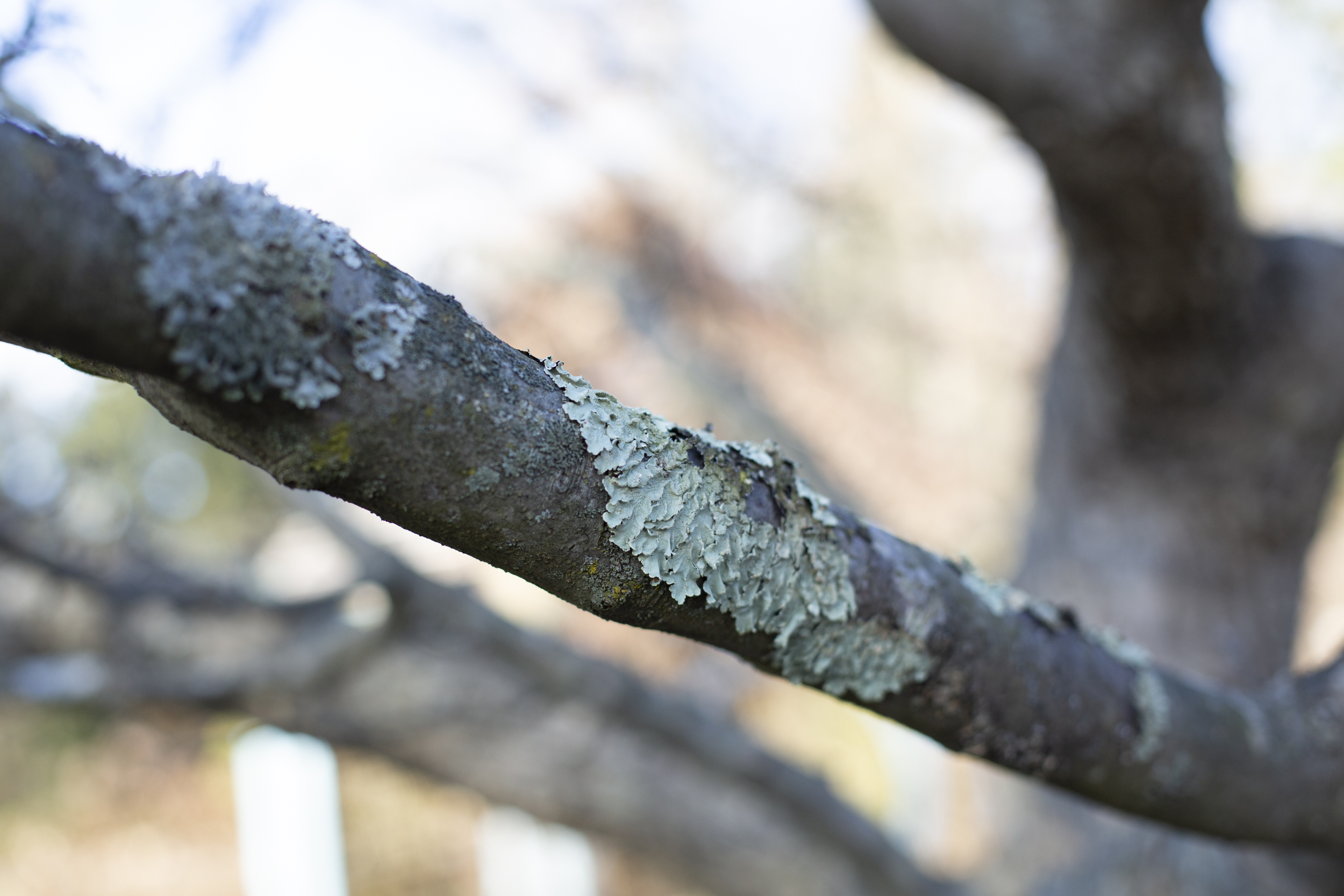
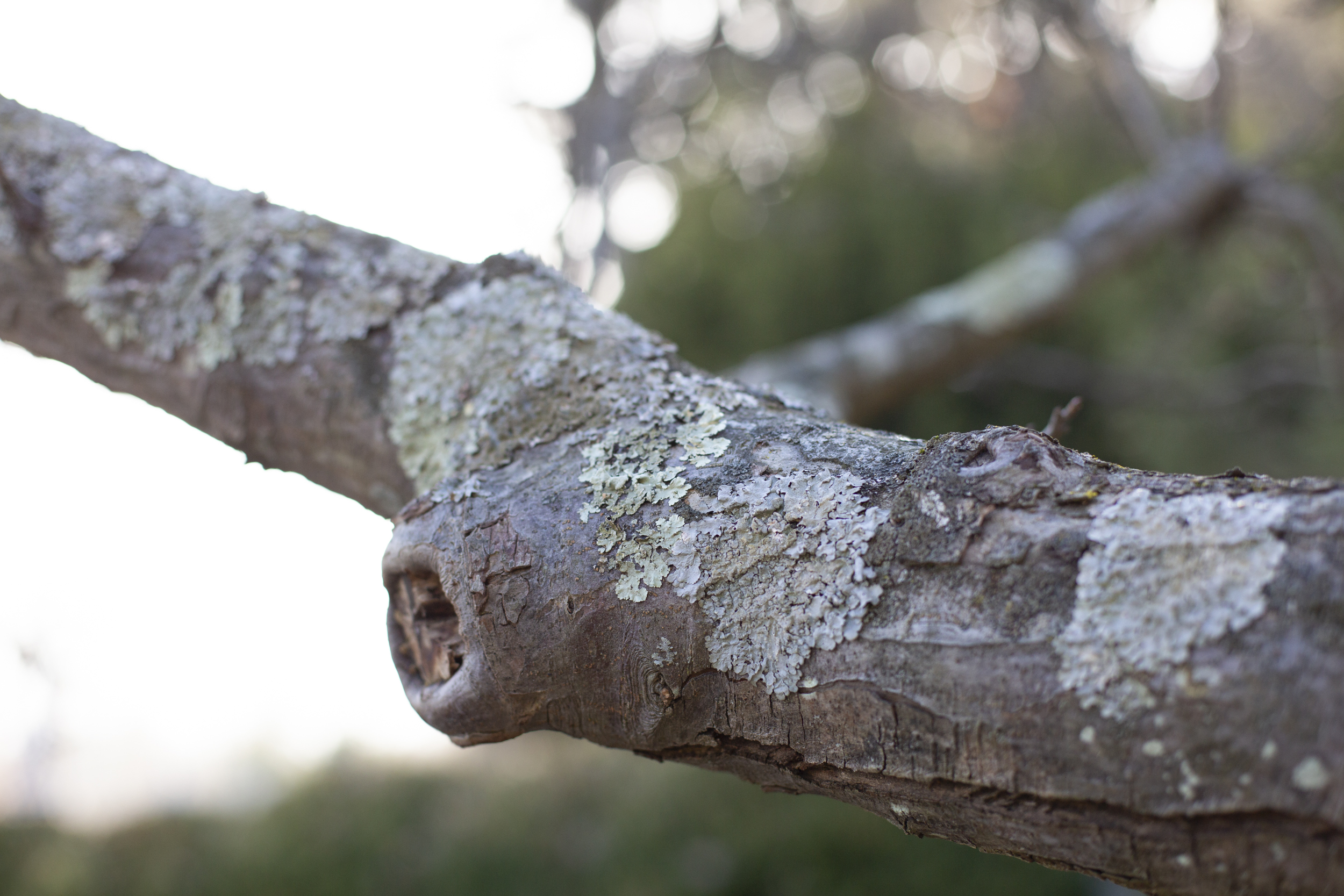
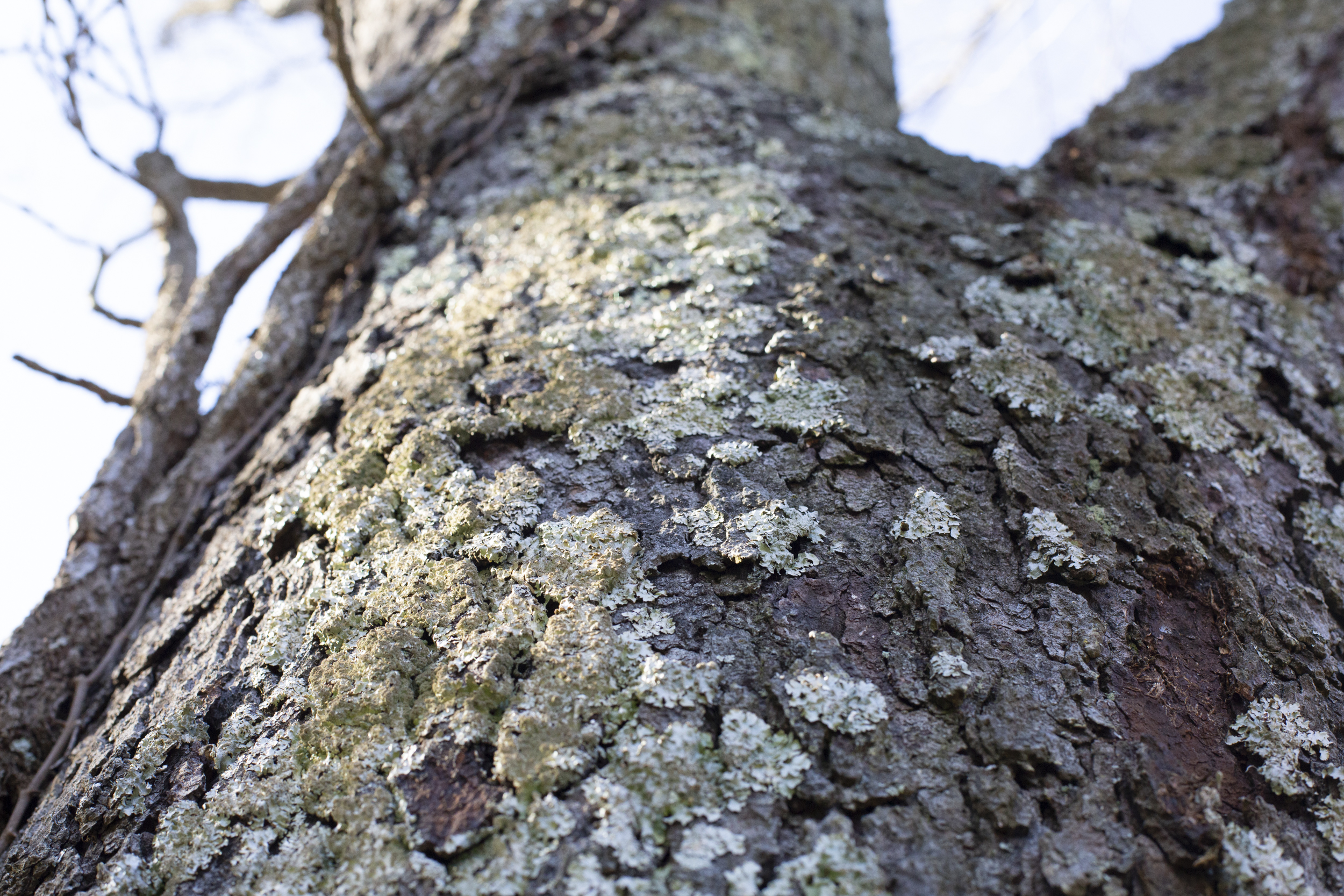
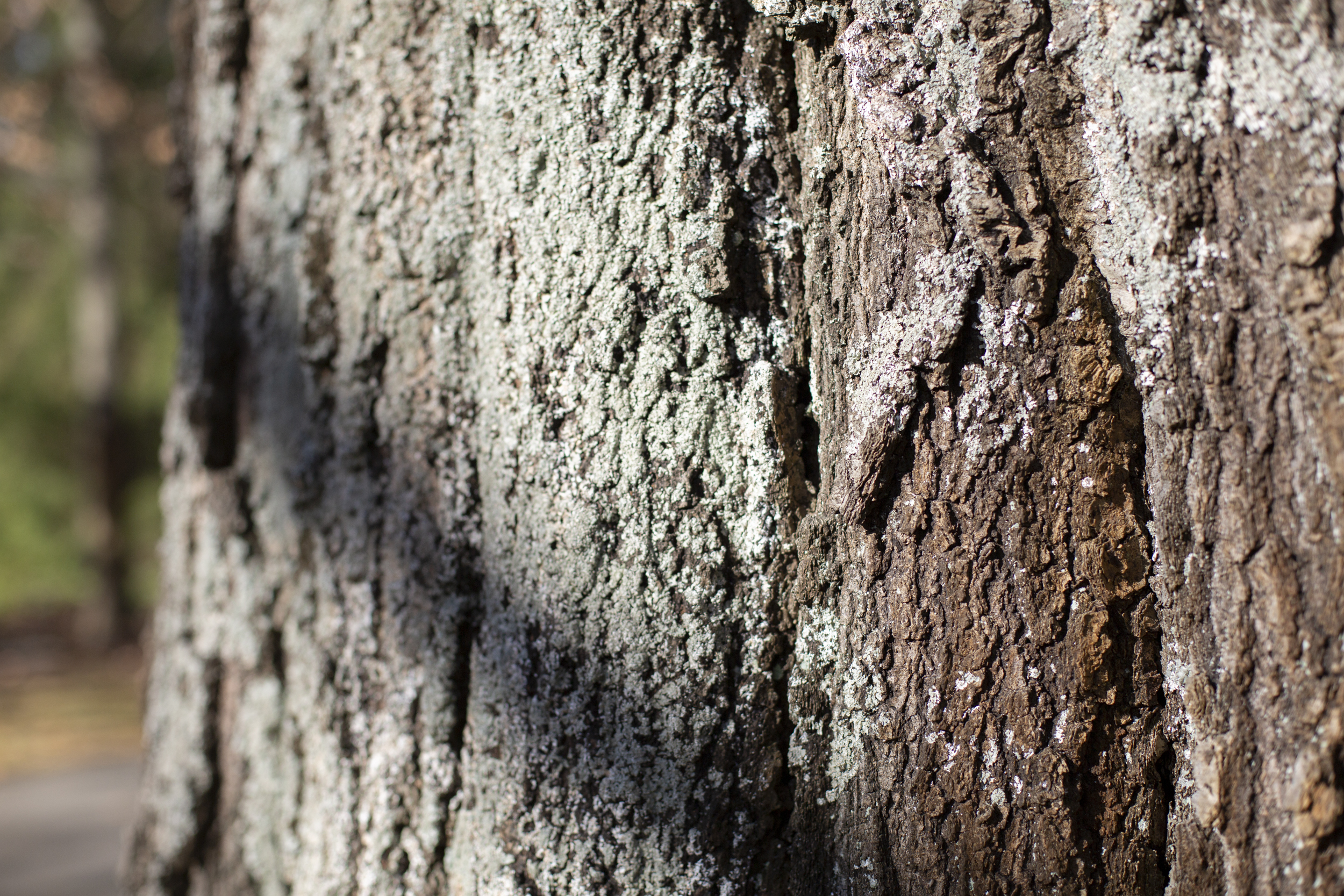
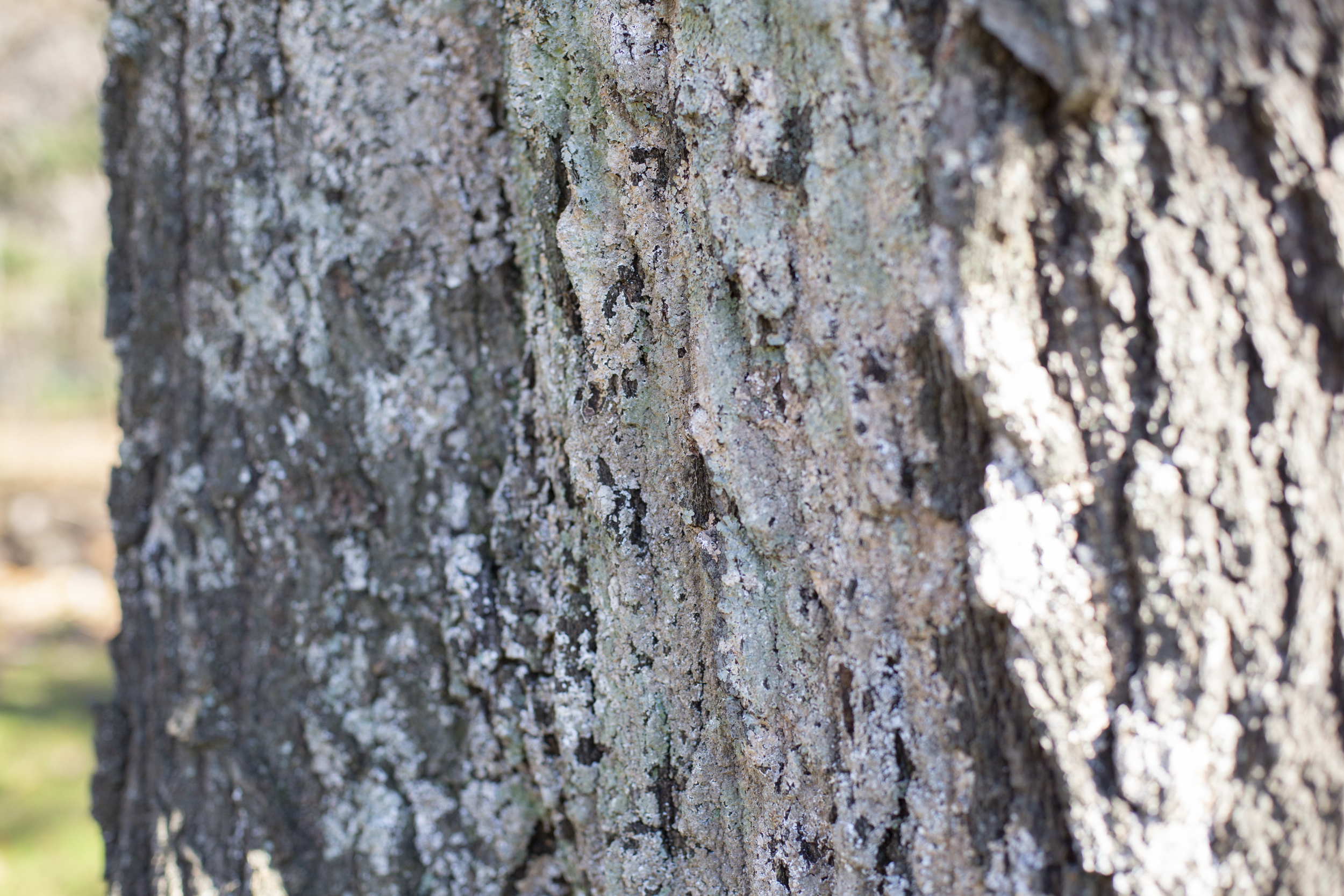
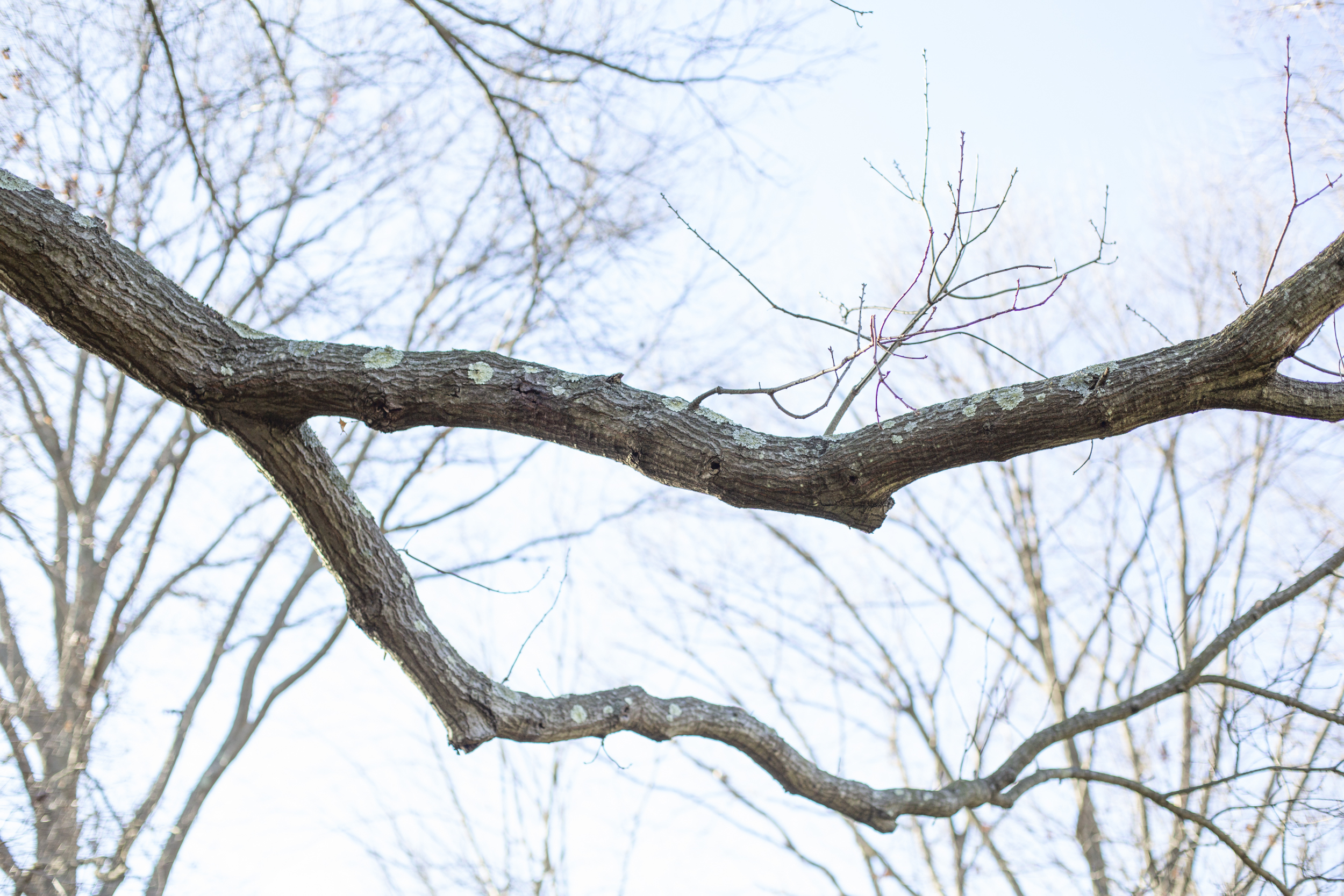
Lichen (pronounced “Like-N”) is frequently seen on trees in Central Ohio and is often mistaken as a sign of a tree’s poor health. Lichen is the result of at least two different organisms living in a symbiotic relationship on the exterior of a tree’s bark. This symbiotic relationship usually consists of a fungus and green alga and/or a cyanobacterium with the filaments of the fungus making up the majority of the lichen. Lichen do not have the typical plant parts (roots, stems, leaves, cuticle, etc..) but instead attach themselves to the outer layer of a trees bark with rhizines. The rhizines are tiny hair like structures that do not penetrate into the inner bark and are harmless to the tree. The Lichen is able to photosynthesize its own food and gather moisture from the air, fog, dew drip or rain. In the vast majority of cases the lichen and tree relationship is viewed as being one of “commensalism,” where the Lichen benefit from the tree with the tree neither benefiting nor being adversely impacted by the Lichen. Lichen benefit from attaching itself to the bark of trees due to the increased availability of sunlight and it is this need for sunlight that makes Lichen really thrive on dead trees (no leaves, more light). The casual observer might infer that the cause of death was due to the Lichen; however, it’s just lichen taking advantage of the sunlight provided by the dead tree.
Lichen are an interesting organism and can grow even in the most extreme conditions. Next time you find yourself looking at a tree, keep your eye out for lichen!

Chris Gill | Regional Manager, Russell Tree Experts
ISA Certified Arborist® OH-6416A // Tree Risk Assessment Qualified (TRAQ) // ODA COMM. PESTICIDE LIC. #104040 // Russell Tree Experts Arborist Since 2015
A Boxwood Bummer
I wanted to dedicate this installment to Boxwood Blight, since this is a disease which has the potential to disrupt formal landscapes all across the state. The disease is fungal, and affects boxwood, especially the cultivated varieties ‘American’ and ‘Suffruticosa’. It is relatively recent in the United States, and was found in Ohio nurseries in 2011.

I wanted to dedicate this installment to Boxwood Blight, since this is a disease which has the potential to disrupt formal landscapes all across the state. The disease is fungal, and affects boxwood, especially the cultivated varieties ‘American’ and ‘Suffruticosa’. It is relatively recent in the United States, and was found in Ohio nurseries in 2011. The Ohio State University has been expecting this disease to crop up in residential landscapes, and now is beginning to see this happen. The disease is a new one for me, and I have not personally found it in any of my landscape inspections. To date, Russell Tree Experts has not applied any fungicide preventively for this issue, but we will have a plan in place for the 2019 season. My main goal in writing this article is to begin to raise awareness about this serious disease, and that it is out there.
Boxwood is a plant that many would consider to be overused in landscape design, but perhaps this is because few plants offer the characteristics that Boxwood does. It is evergreen, takes shearing well, and comes in many sizes and forms. Therefore this plant is an exceptional choice for hedges, both formal and informal, for screening or for outlining borders in a garden or landscape. The difficulty with hedges, or with mass plantings of any size, is that the loss of one plant is much more significant than in an informal grouping of trees or plants of varying species where the loss of 1-2 single plants goes unnoticed.
Years ago I helped take care of the landscape at a large private residence that had many formal plantings incorporated into its design, along with less formal groupings of trees. My stress levels were much higher when one of the formal tree arrangements was threatened by the loss of a single tree. Imagine a formal circle of mature shade trees missing one of its members due to disease or storm damage. The effect is similar to missing one tooth out of an otherwise healthy smile. Somehow the overall result of a missing tooth is not helped by the fact that there are 31 other teeth still remaining. And replacing a mature tree to fill in the gap is arguably much more difficult than replacing a missing tooth.
This is the effect Boxwood Blight could have on many, many landscapes we serve. I imagine that 8 out of 10 readers have at least one row of boxwoods somewhere in their landscape. Some of you have massive formal plantings of hundreds of boxwoods. What makes this disease different than others that have been affecting boxwood for years?
In September of this year I attended the 2018 Urban Landscape Pest Management Workshop at The Ohio State University. There, Dr. Francesca Peduto Hand introduced me to this disease with several main points that raised concern:
The disease can infect otherwise healthy plants.
When climate conditions are favorable, the disease can progress very quickly.
Infected plants must be removed and destroyed, and it is not recommended that boxwood be replanted for 3-5 years from the time the last infected plant was removed.
This is like saying you have to pull the infected tooth, and you can’t get a new tooth implanted for 3-5 years. The best defense is knowing what the symptoms are:
First there are dark spots on leaf surface and white sporulation (fungal spores) on the underside of the leaf.
These spots spread on the leaf, eventually causing defoliation.
Black, elongated cankers are evident on defoliated stems.
Unfortunately, once symptoms are found, the plant must be destroyed. The best preventive measure is to make sure any new plants coming into the landscape from the nursery are carefully inspected and approved as symptom free.
Another preventive defense is a regimen of fungicide applications. These can be costly depending on the size of the hedge and the frequency of applications. Also consider that since the applications are preventive, they need to be repeated on a seasonal basis and would have to become part of a permanent landscape budget.
A pdf with good photos and symptom descriptions authored by the Connecticut Agricultural Experiment Station can be found here:
I leave you, dear reader, with the heartfelt wish that your landscape may remain disease free! May you draw nothing but pleasure and peace from the plants which surround you. Be wary of what may be hitching a ride into your landscape on new plants.
Your friendly neighborhood arborist,

José Fernández | Regional Manager, Russell Tree Experts
José became an ISA Certified Arborist® in 2004, and a Board-Certified Master Arborist® in 2015. Currently he is enrolled at The Ohio State University pursuing a Master’s Degree in Plant Health Management. José likes working around trees because he is still filled with wonder every time he walks in the woods. José has worked at Russell Tree Experts since 2012.
Don’t Get Fooled by the Fall Color of Conifers!
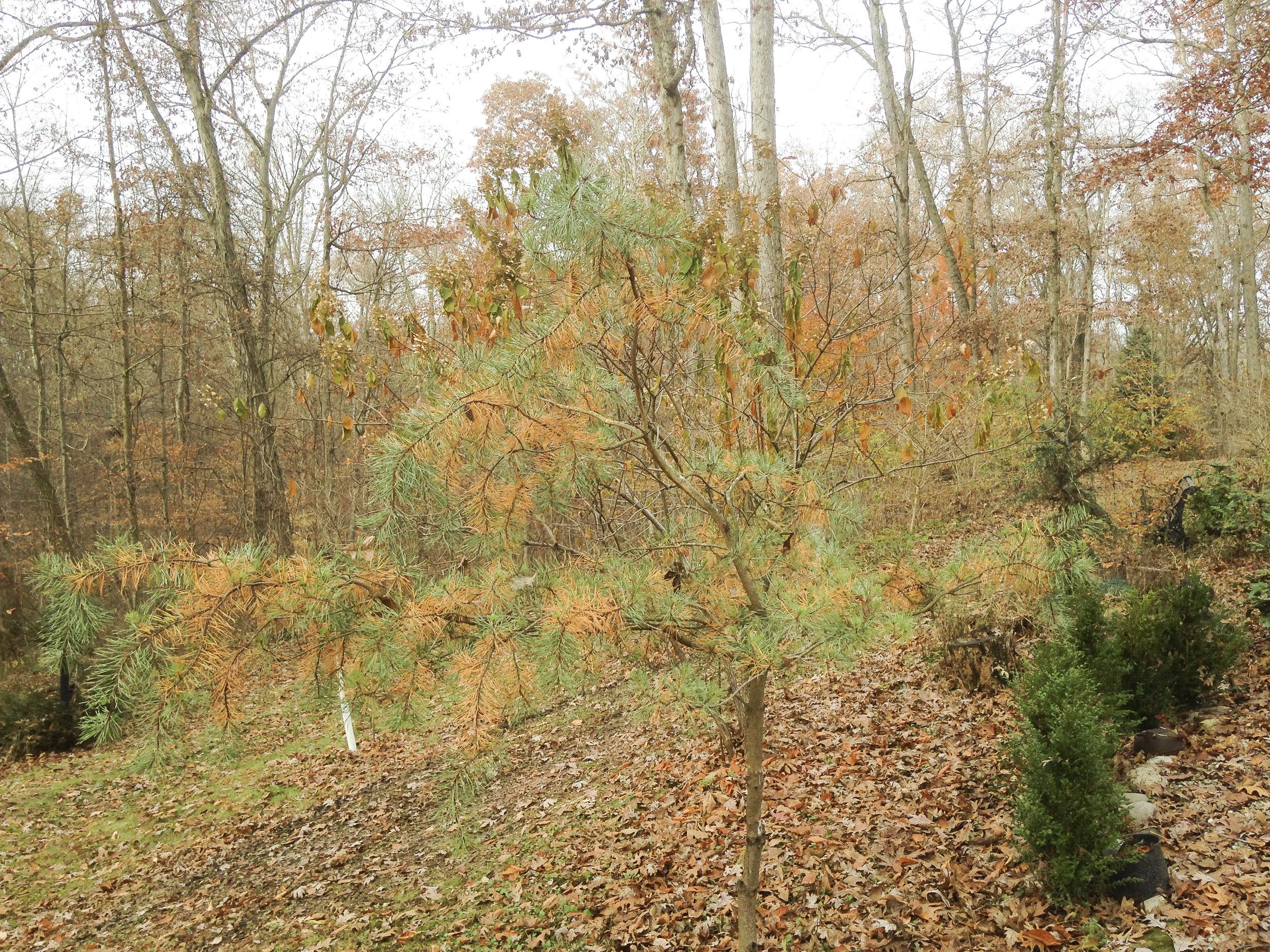
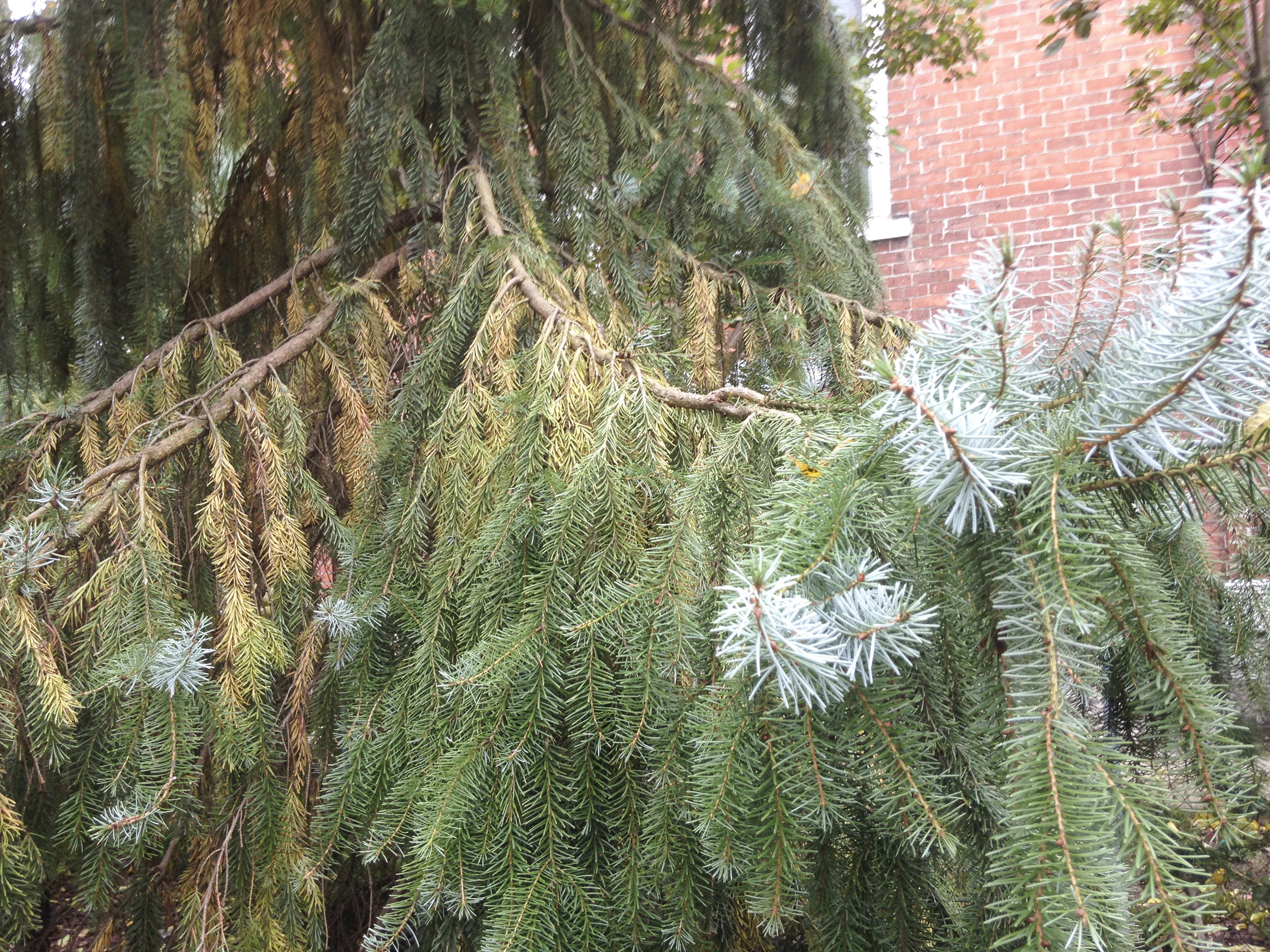
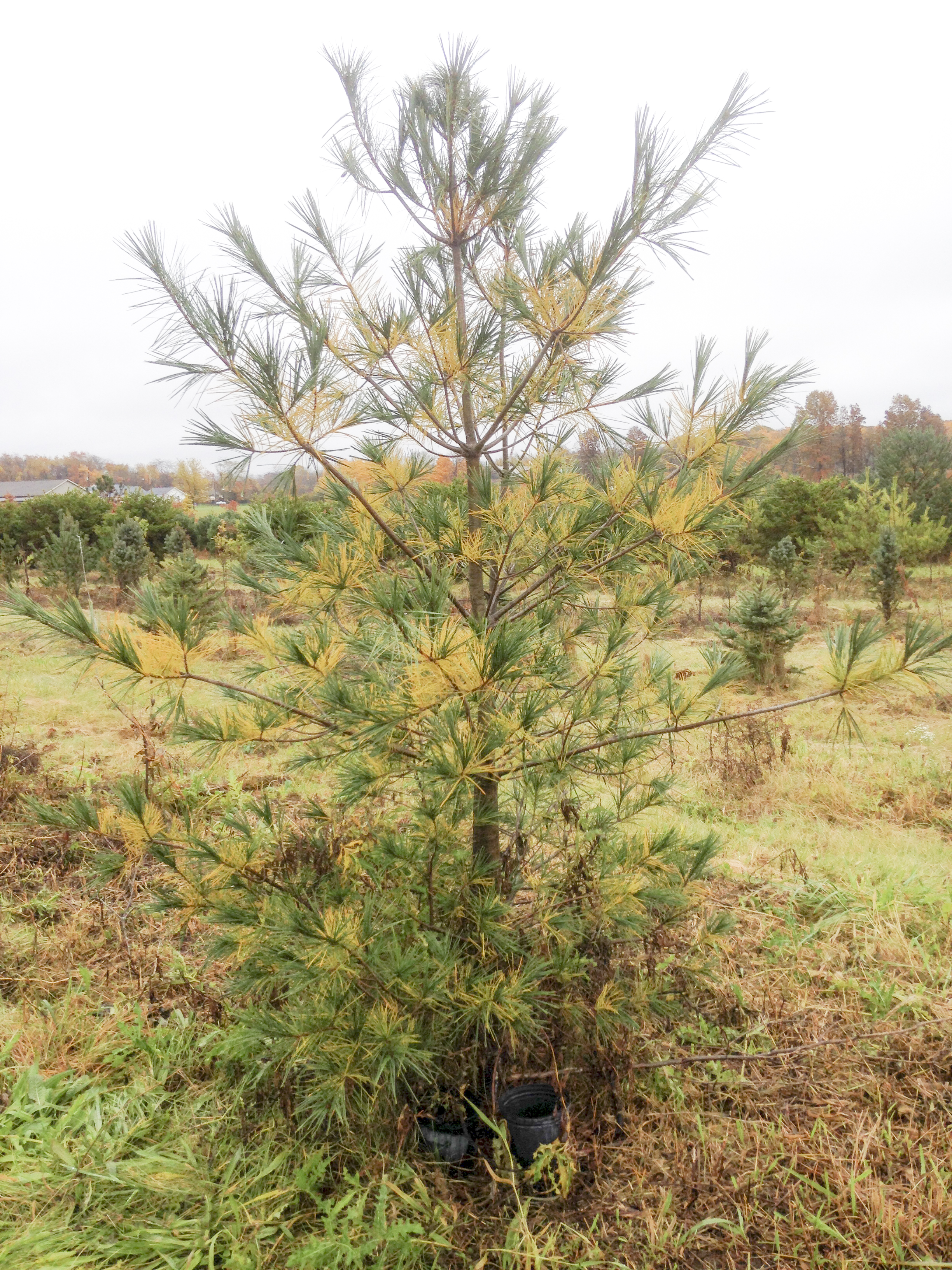
Every fall I get calls from folks concerned about yellow needles on their evergreen trees. Often times I’m told that the trees are sick or that they appear to be dying from the inside out. There are some disease and insect problems that can cause yellowing and premature loss of needles in conifers but most often what people are reporting is just normal fall color.

By TJ Nagel
ISA Board Certified Master Arborist® OH-6298B
November 13, 2025
Every fall I get calls from folks concerned about yellow needles on their evergreen trees. Often times I’m told that the trees are sick or that they appear to be dying from the inside out. There are some disease and insect problems that can cause yellowing and premature loss of needles in conifers but most often what people are reporting is just normal fall color.
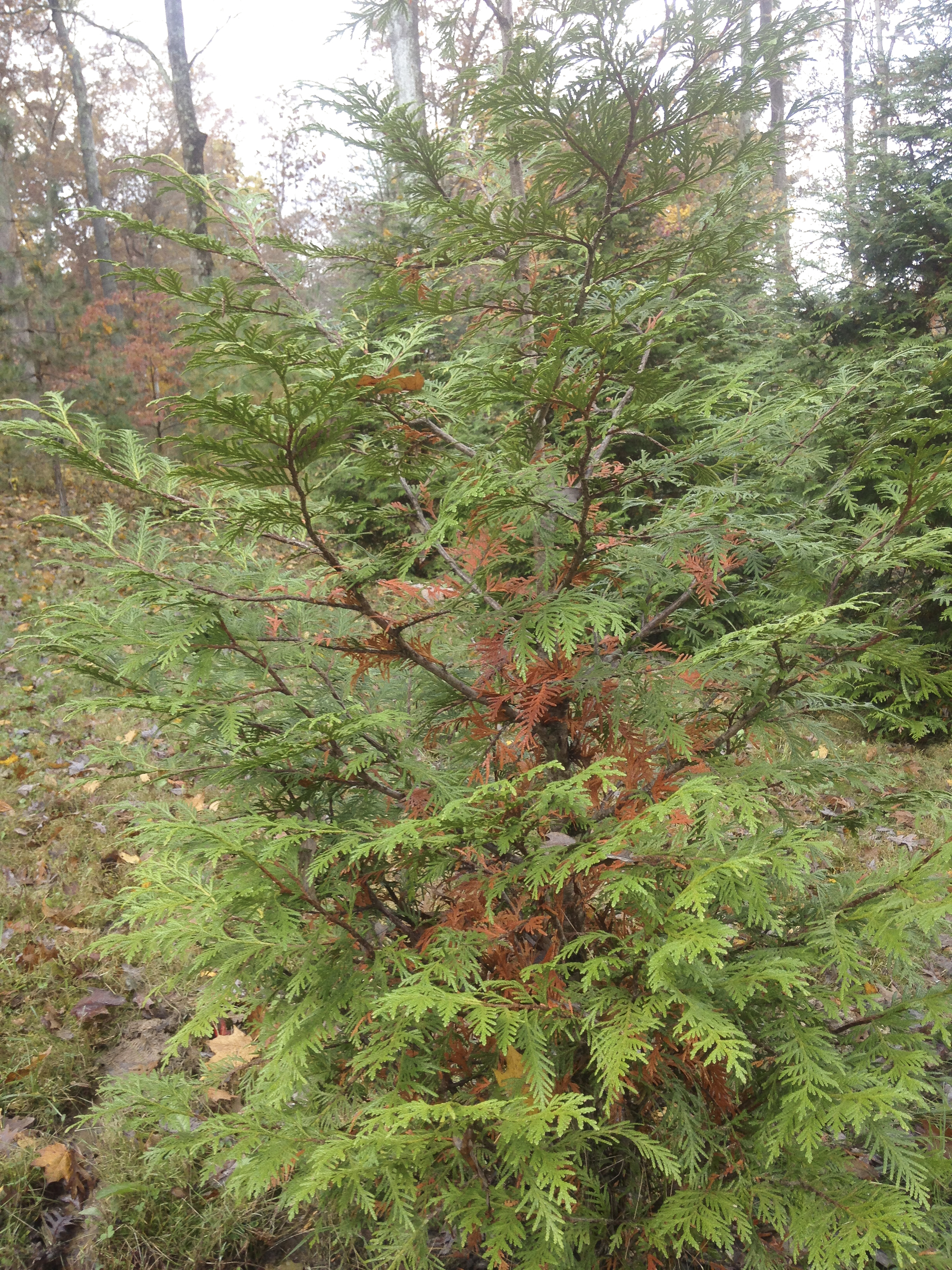
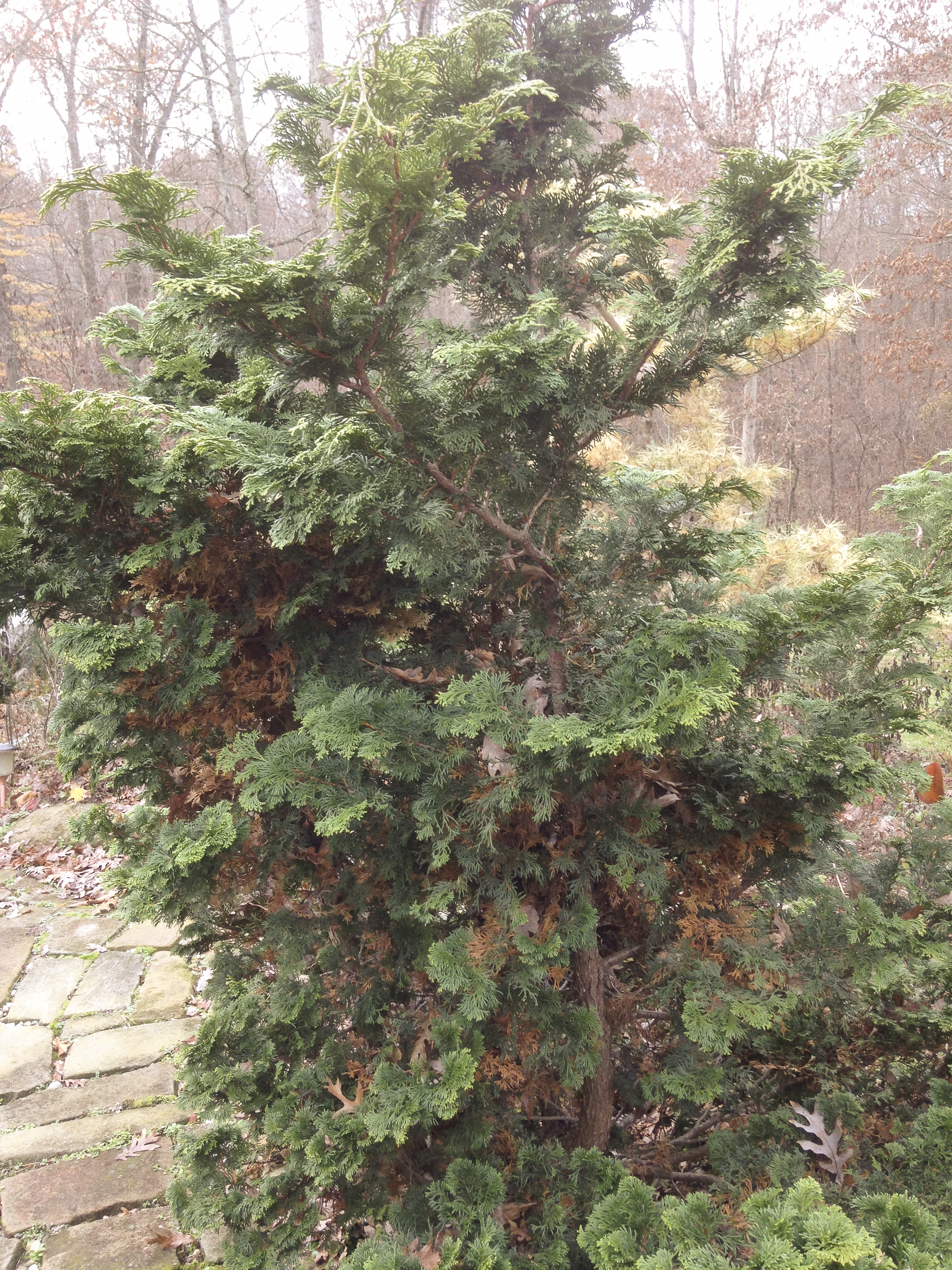
Yellowing and the loss of old needles in the fall is normal for pine, spruce, arborvitae, hemlock and most evergreen conifers in the midwest. Most conifers shed their needles each year starting in late August and continue through November. Older interior needles will turn yellow while needles further out in the canopy and at the tips of branches will stay green. The yellow needles eventually drop off starting at the top of the tree and working their way to the bottom in a uniform fashion. Taxus (also called Yew) is the exception showing it’s “fall color” in mid to late spring.
Most folks understand and look forward to the fall color change in our maples, oaks, hickories and other hardwood trees — fall needle drop in conifers is as normal as leaf drop in deciduous trees.
The change in color and eventual drop of foliage is simply a physiological response to the shorter days and cooler temperatures as trees (both evergreen and deciduous) prepare themselves for the winter.
Pictured below are some of my favorite conifers showing fall color:
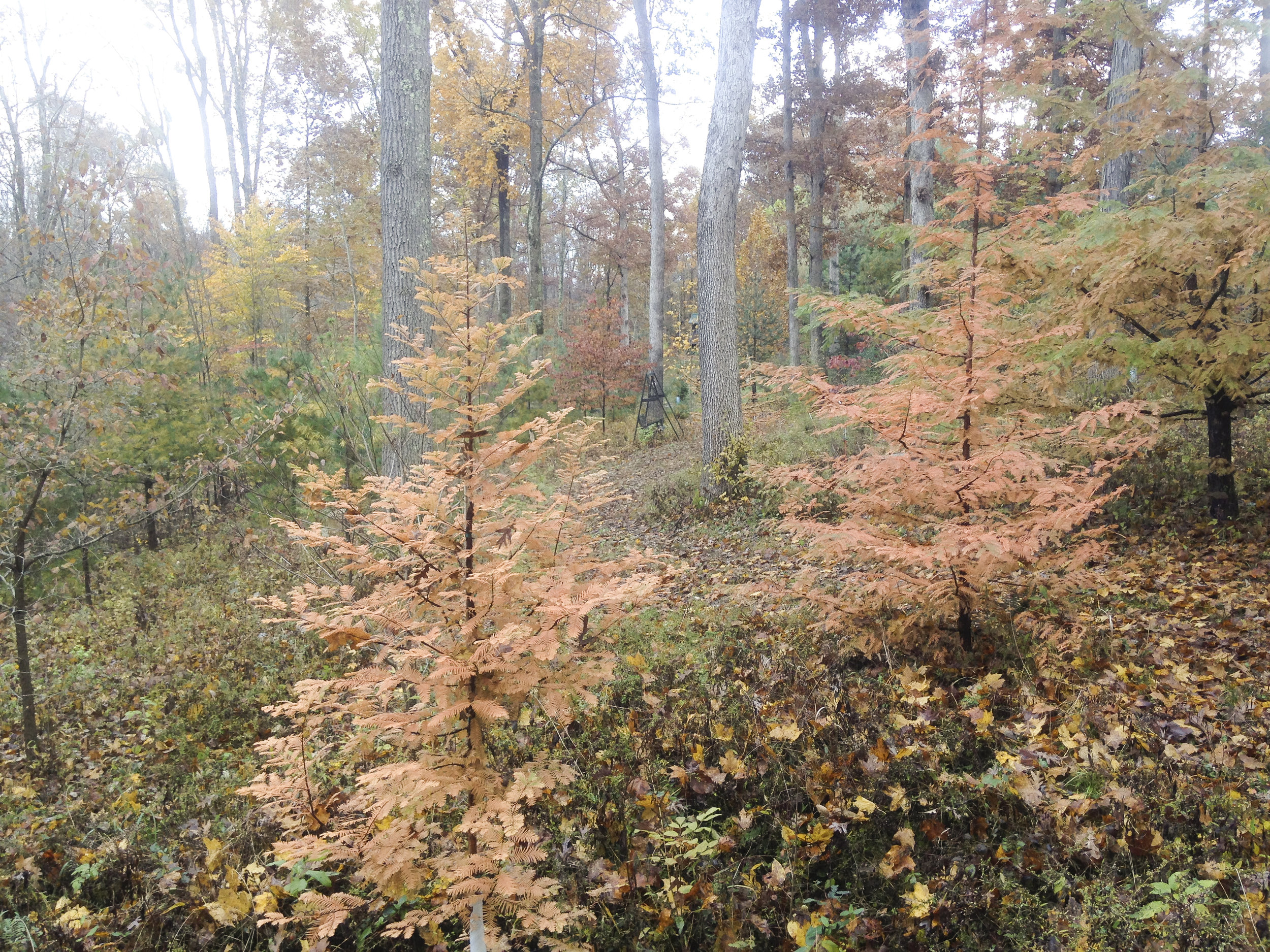
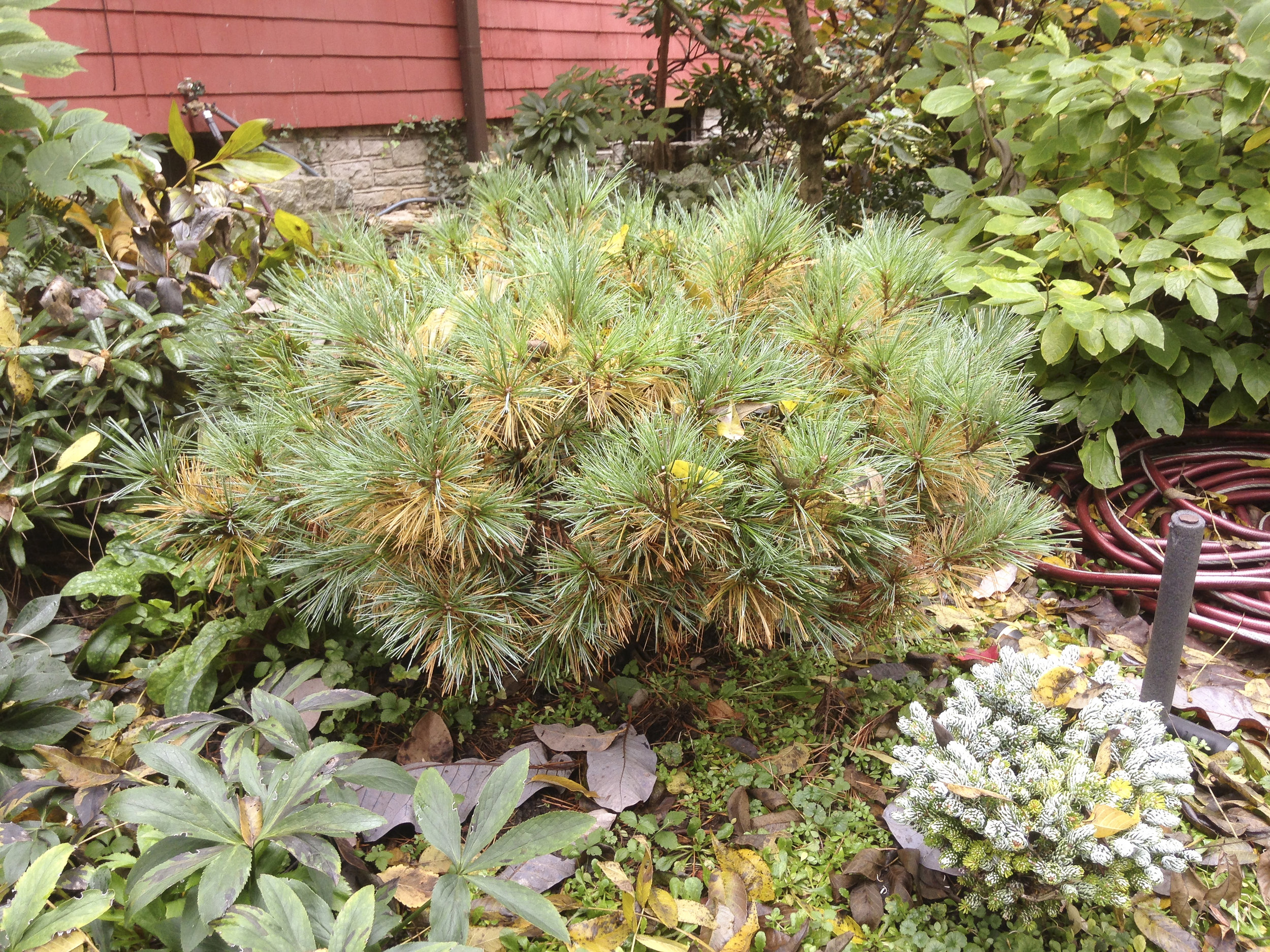
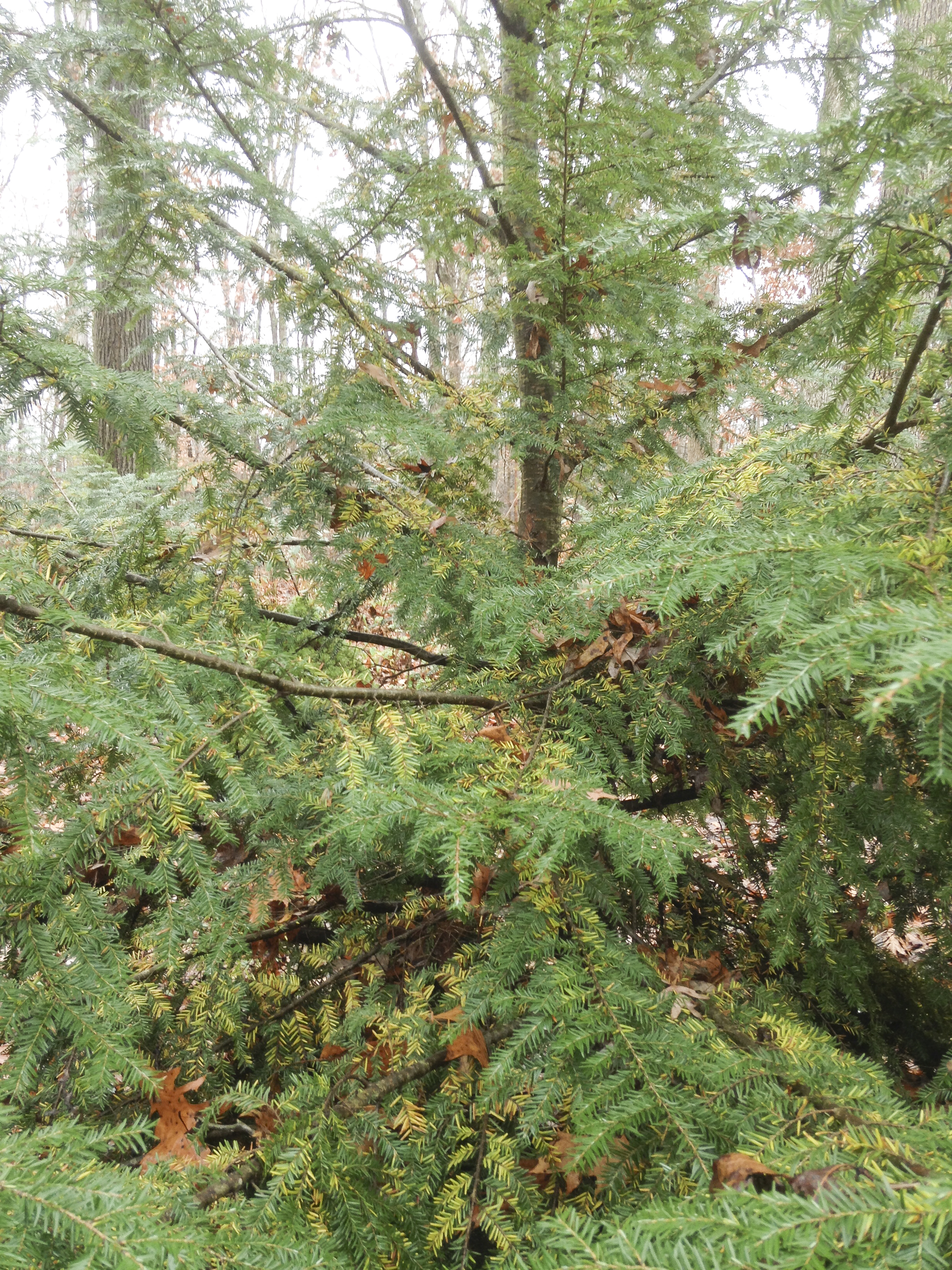
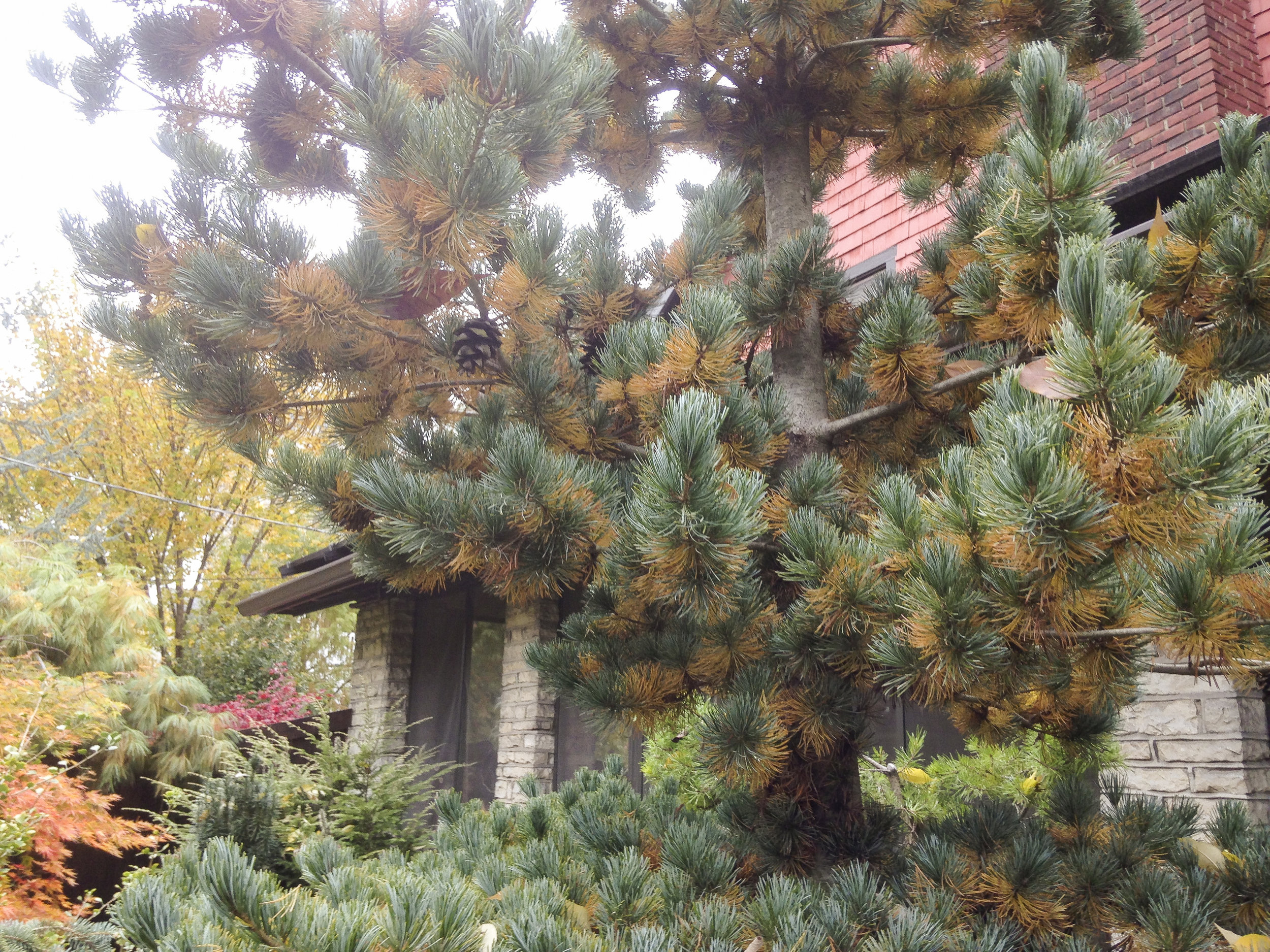
Please note: This article was revised on 11/12/25 and originally published on 11/28/18.
ADDITIONAL ARBOR ED™ ARTICLES!



TJ Nagel I Scheduling Production Manager, Russell Tree Experts
TJ joined Russell Tree Experts in 2012 and loves trees. He is an avid gardener and plant collector. TJ graduated from The Ohio State University with a B.S. in Agriculture with a major in Landscape Horticulture and minor in Entomology. TJ is an ISA Board Certified Master Arborist® and well versed in plant pathology and tree ID.
Test Before Treatment: Soil & Tissue Testing
I find it interesting that test procedures recommended in the medical field for human health have become part of the expected methodology, but not so much in arboriculture, for tree health. As arborists, we are trained that a soil test should be done prior to recommending fertilization, for example, but I don’t know of many outfits that make soil sampling a part of their modus operandi.

©Russell Tree Experts
Test Before Treatment
I find it interesting that test procedures recommended in the medical field for human health have become part of the expected methodology, but not so much in arboriculture, for tree health. As arborists, we are trained that a soil test should be done prior to recommending fertilization, for example, but I don’t know of many outfits that make soil sampling a part of their modus operandi. On the other side of the equation, many clients will choose not to do a soil or tissue sample when presented with the option, perhaps because of budgetary reasons. I think it is time this started to change, because knowledge of a problem is the first step toward the solution. Given an unhealthy tree, I might suspect what the problem is, but unless it is one that is readily identifiable in the field, I would rather start with the sampling than attempt a treatment.
Click here to see the 9-step soil testing process!
Fertilization is one instance where a soil sample, at minimum, should be taken. For fertilization, a tissue sample would also be good, for reasons I will get into shortly. Another instance when plant samples are usually taken is when a problem is not readily identifiable in the field, and the problem is not so developed that treatment is still a viable option. A third instance where sampling is necessary is to rule out the possibility of a disease which could spread to neighboring healthy trees. In this case even dead plants may be sampled to detect the presence of one of these pathogens if possible, and to know how to dispose of the dead plants properly.
Fertilization
In general, “tame” trees and shrubs in finished landscapes benefit from fertilization because they are growing in conditions that do not resemble where they would be growing if they were “wild”. I may not need to sample the soil in an urban landscape to know that usually the addition of organic matter is going to benefit the trees, along with the nitrogen that composted organic matter provides for growth. Also, I know that most of the soil we find in the Columbus area is a limestone based, heavy clay soil. This particular bit of knowledge has led to some confusion in particular tree treatments I am about to discuss. (If you have Pin Oak, River Birch, Maple, Sweetgum, or Sweetbay Magnolia on your property, read this section if nothing else!!) Arborists have traditionally been taught that chlorosis (yellowing foliage) in these trees is due to either a deficiency of iron or manganese in our heavy clay soils. If the tree is a Pin, Red, Shingle, or Sawtooth Oak, you treat it with iron. If the tree is a Maple or a Sweetgum, treat it with manganese. At this point in my life I don’t recall what the recommendation was for the other trees. Why not?
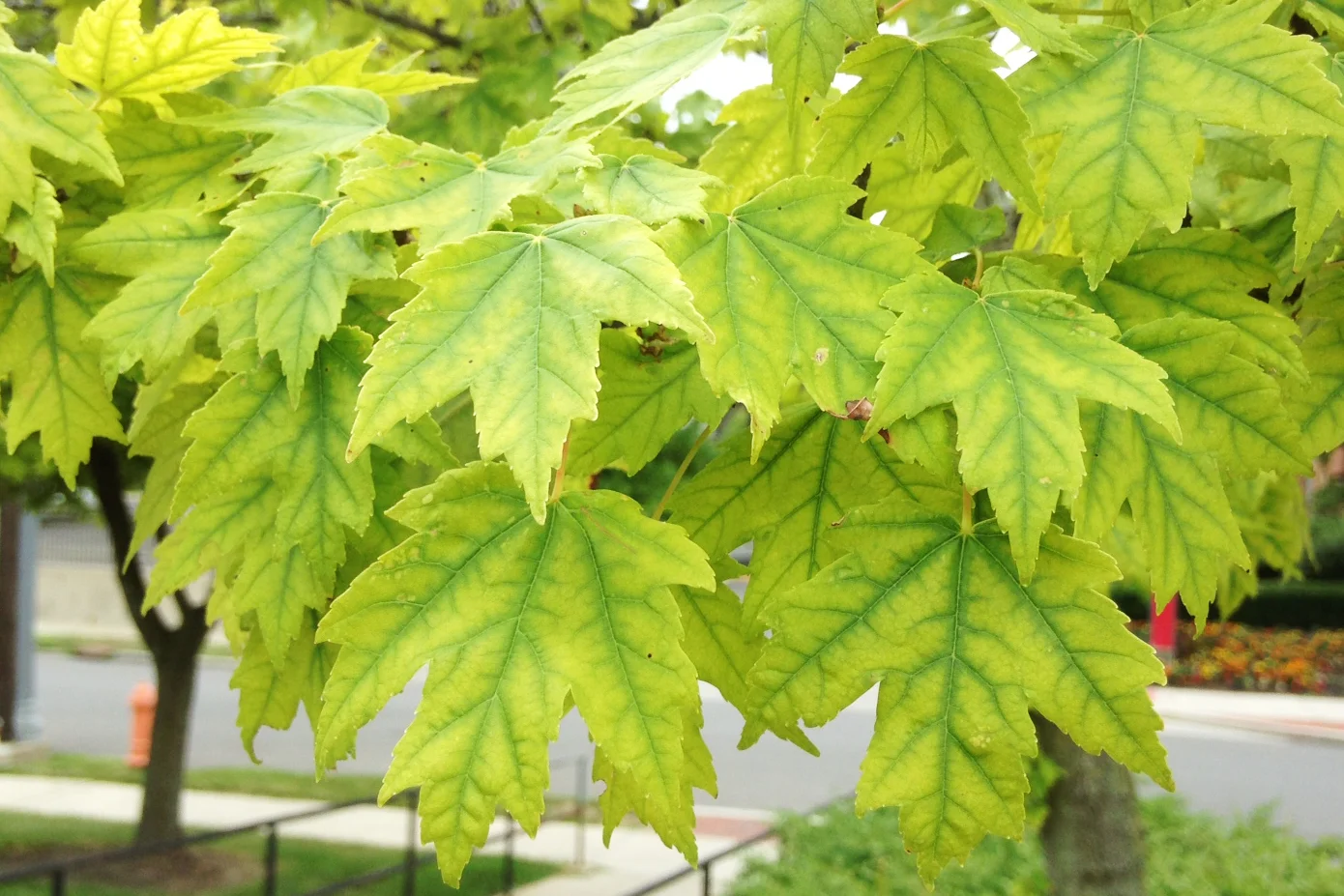
Chlorosis in a Red Maple
©Russell Tree Experts

Chlorosis in a River Birch
©Russell Tree Experts
After years of treating trees this way with very mixed results, I had the good fortune of meeting Dr. Darrah at CLC LABS. His findings over the years for our Columbus soils, related to chlorosis in these trees, have been that the problem is nearly always a manganese deficiency. To make matters even worse, giving iron to a tree that has a manganese deficiency appears to make the manganese deficiency even more pronounced. To this day I continue to be filled with satisfaction when I drive past a tree that was not responding to year after year of iron treatments, in the soil and with trunk injections and implants, to no avail, by someone else. Then, after sending soil and tissue samples to the lab, we found a surplus of iron and a dearth of manganese. The remedy? Treat aggressively with manganese. Sometimes the result is immediate, most times we see a turnaround after 2-3 seasons of treating appropriately. But what a satisfying feeling to know that we have figured out what the problem was, and now the symptoms are being reversed! To be clear, the satisfaction does not come from knowing we were right and someone else was wrong! It comes from seeing a tree that was in decline start to come back to life.
Click here to see Dr. Darrah at CLC LABS perform soil testing!
When I encounter chlorotic foliage in trees now, my top suspect for nutrient deficiency is manganese. If a tree is only beginning to show symptoms, I may recommend manganese to see if it turns around. If it does not turn around, we can sample to see what the issue is. Why take this backward approach? Maybe because I have a subconscious fear that a client may feel that I am just trying to sell additional services that are not needed. Especially if the other two arborists (from other companies) she spoke to “never recommended sampling”. And in her mind she may be thinking “Why does this arborist need to take samples? Can’t he tell what the problem is? And anyway, the other arborists said the issue was iron, not manganese.” So, since I know there is a very high chance the problem is manganese, that’s what I will recommend.
BUT, there have been a very small number of samples that came back showing some other micronutrient deficiency (or surplus), that was critical for knowing what the best treatment approach was. And this is why sampling should always take place first. I pledge to offer that as the first step in a treatment plan to each client with a sickly tree. At least then I will have done my due diligence.
As a final note for fertilization, if the time of year is right, a tissue sample is great for getting a more complete picture of what is happening in the tree. By comparing soil to tissue, we can see what is available to the tree and what is actually inside the tree. This helps with diagnosing the cause for symptoms.
Sampling for disease diagnosis, live or dying trees
There are many diseases arborists can positively identify in the field if properly trained, and they should be able and willing to show the client what they are seeing, and why it needs to be treated (or not). I still find insects that pop up sporadically that I have never seen before. Usually I can pull out the reference books back at the office and find the pest or pathogen, but if I fail at that, it is time to take a sample to the clinic. Even if an arborist had exhaustive knowledge for field identification of diseases (which is a tall order), there are certain diseases that require a specialized lab for a positive identification. In the case of live trees, one may decide that sampling is not needed due to how advanced the symptoms are. If the tree is not salvageable, perhaps sampling is not the best use of funds. But if the symptoms are those that could be of an infectious nature, threatening other live trees, sampling is paramount, and should be done promptly. Let’s look at Oak Wilt, for example.
Several years ago, Russell Tree Experts submitted the first positively identifiable sample of this disease taken from a tree in Franklin County. The year prior, a consulting arborist had turned in a positive sample from a tree in Delaware County. Oak Wilt is a disease that was known in the northeastern counties, and we were sad to see it moving into our neighborhood. However, had we not taken the samples, we would not have known the steps to take to properly dispose of the dead trees, inoculate the surrounding live trees at high risk of infection, and try to get the word out to the local arborist community. That was several years ago. Since then, more and more arborists have had positive samples, but to my chagrin, I still run into trees that I am fairly certain died of Oak Wilt but were removed willy nilly by “arborists” who maybe never even thought why the Red Oak went from live to dead in a matter of days. It takes time for word to get around, and it takes tree owners who are concerned about their trees.
I am happy to say there are several reputable, trustworthy tree care companies in the Columbus area whom I am proud to count as colleagues (and I hope they feel the same way about us!). This provides discerning clientele with plenty of good options to choose from. I am also very happy that more and more people are realizing how important the care of trees and plants is – not just for the love of their own back yard, but for the good of their neighbors. How do I know you are out there? Because you take the time to read these thoughts that flow out of my fingers into the keyboard. As I write this, early evening is coming on. I am looking out my window across a field divided by a small stream. Green grass in the foreground flows to the border of the stream, outlined in buckthorn turning yellowish green, brilliant yellow Maple on the left, defoliated Cottonwoods against the sky. Anchoring the scene on the right is a large Pin Oak turning an orange bronze. When the sun shines it lights up like fire. Across the stream a recently harvested soybean field, the color of straw. In the background, all across the window frame, stretches a native woods made up of what appears to be mostly Oak and Hickory: rusty, ruddy, yellow, gold. Above the green grass, tan straw, and tree line made of fire a sheet of sky in light gray is spread, with a hint of pink peeking through here and there.
Stop for a moment. Look around. Let peace find you, and give thanks for it. The more we notice it, the less we can take it for granted.
Your friendly neighborhood arborist,
José Fernández

José Fernández | Regional Manager, Russell Tree Experts
José became an ISA Certified Arborist® in 2004, and a Board-Certified Master Arborist® in 2015. Currently he is enrolled at The Ohio State University pursuing a Master’s Degree in Plant Health Management. José likes working around trees because he is still filled with wonder every time he walks in the woods.
Fear no Weevil (With Fall Systemic Insecticide)
As we prepare for another season of Fall Tree Wellness, another important insect pest to take note of is the White Pine Weevil. White Pine Weevil is a damaging pest to a broad range of conifers, including White, Scotch, Red and Austrian pine as well as Colorado blue, Norway, and Serbian spruce. Douglas-fir can also be attacked.

As we prepare for another season of Fall Tree Wellness, another important insect to take note of is White Pine Weevil. White Pine Weevil is a damaging pest to a broad range of conifers, including White, Scotch, Red and Austrian pine as well as Colorado blue, Norway, and Serbian spruce. Douglas-fir can also be attacked. White pine Weevil does the bulk of its damage to trees in the later part of the Spring, but I mention it now because we get the most successful management of this pest with a Fall application of systemic insecticide. If you have had damage from White pine weevil in the past - now is the time to take corrective action.
Adult white pine weevil spends the winter underneath dropped needles and debris, generally very close to previously infested trees. On warm days in early Spring, the adults travel to the terminal leaders of host trees and begin feeding on terminal branches. Later in Spring the adult females will mate and deposit eggs into feeding wounds. Dozens to hundreds of eggs can be deposited into one terminal leader. Eggs hatch one to two weeks later with larvae feeding downward on the inner bark of the terminal stems. Feeding continues through mid-July at which point larvae pupate in hollowed out chambers inside the stem. New adults emerge in late July - August and feed intermittently on small twigs throughout the canopy of the tree until they move to the base of the tree for overwintering shelter.
The most destructive stage of white pine weevil is the larval feeding stage which produces a conspicuous injury to the host tree by causing the new growth of the tree to wilt and die back. The affected terminal shoots wilt into a “shepherd’s crook” (see below photo) and the needles turn lighter in color before turning brown and eventually falling off. In most cases host trees are not killed. However, feeding injury stunts the growth of the tree and can also cause trees to develop poor structure with multiple new leaders forming beneath damaged areas.
Injury to white pine is generally confined to the previous season’s growth. Damage on Scotch pine and spruce will often extend downward through two or three year’s growth.
Managing The White Pine Weevil
Host plants are most attractive to White pine weevil between 3’ and 20’ in height. In June - July, look for curled or dead terminal leaders that have the appearance of a “shepherd’s crook.” These infested leaders should be pruned out of the tree and destroyed or removed from the site to attempt to eradicate the pest from the host plant.
If you have had infestations of white pine weevil in the past or have host plants in the preferred size range, a well-timed soil drench with an appropriately labeled systemic insecticide works really well at controlling this pest. This application is recommended in the Fall to allow sufficient time for uptake of the insecticide to the terminal shoots of the tree by Spring when larval feeding resumes.

TJ Nagel | Regional Manager, Russell Tree Experts
ISA Certified Arborist® OH-6298A // Graduated from The Ohio State University in 2012, Earned B.S. in Agriculture with a major in Landscape Horticulture and minor in Entomology // Tree Risk Assessment Qualified (TRAQ) // Russell Tree Experts Arborist Since 2010
The Late Season Blues (or Yellows or Browns)
Springtime is long gone, even though it only seems like a couple of months ago that we were coming out of winter. Suddenly, here we are, getting ready to enter the fall season, and true to form, during the past several weeks I have been seeing trees go into what we call “late season blues”.
I’m trying, and finding myself unable to, recall something I read from H.D. Thoreau once regarding trees when they first leafed out in the spring. In his usual poetic style, Thoreau was commenting on how clean, fresh, new, and unspoiled each leaf was when it emerged, and how so very soon, it seemed like each tree had its own unique insect that began to feed on it, marring its beauty. I wish I recall the exact wording. If anyone out there is a reader of Thoreau, please refresh my memory and comment below! :)
Springtime is long gone, even though it only seems like a couple of months ago that we were coming out of winter. Suddenly, here we are, getting ready to enter the fall season, and true to form, during the past several weeks I have been seeing trees go into what TJ (Certified Arborist here at RTE) calls “late season blues”. During this time we start to see an accumulation of issues on tree leaves that make them look less than pristine, sometimes even tattered and tired. It is almost as if the plants are tired of fending off all the plagues that they must coexist with each season, and allow their defenses to drop before they go dormant.
Early Signs of “Late Season Blues”
I knew we were into the late season blues when I started to see certain types of flowering cherry exhibiting quite spectacular outbreaks of leaf spot, and clients began to call very concerned about the discolored leaves falling off their trees rather suddenly. This was around mid-August, and I continued to see it several weeks after.
During the heat of late summer I commonly see the lacy, cutleaf varieties of various species begin to scorch around the leaf margins. Same for some variegated species like tricolor beech, when planted in full sun.
River Birch and Cottonwood, among others, can go through a period of early defoliation during dry summer heat, causing clients to think that their trees are dying. Multiple late season foliar issues, which I typically lump under “late season foliar diseases” start cropping up.
No Big Deal?
Why do I sound so nonchalant about these things? Well, in a nutshell, it has to do with the time of year. If these symptoms only become evident in late summer/early fall, there is usually nothing to worry about concerning long term tree health. Biologically, by late summer/early fall trees have largely made and stored enough sugars and starches to supply their needs for growth and reproduction the following season. Aesthetically, we are beginning to enter the time of year when some trees are thinking about fall color, and soon all of them will be switching to the seasonal color scheme. The loss of some green here and there is not as tragic as it would be earlier in the season when we need our trees to show up in their best threads.
In my part of town (Northwest Columbus), late season blues this year have shown up as a higher incidence of foliar fungal diseases, such as late season anthracnose (something I usually see in early spring). Why? Fungi that infect tree leaves prefer cool, moist weather, and this season we have certainly had a lot of that! Everywhere I go, clients tell me the same thing: “I have barely had to water my lawn this summer!” For the same reason, I have noticed many more mushrooms than usual this year, and of several types I have not seen before.
The Moral of the Story
During late summer/early fall, issues affecting the leaves/canopy of trees are generally not as bad as they look, and chances are very good the tree will leaf out normally next spring. For this reason I may ask a client to send some photos of what they are seeing. This helps me return a quicker answer during this busy time of year. In the meantime, if your tree looks like it has some sort of fungal issue in the leaves, a good fall raking will help remove the source of inoculant for the following season.
Following are some photos I took yesterday. I am sharing these because as bad as these leaves look, I was not concerned for the health of these trees at this time. Enjoy the photos. Better yet, get out on one of our plant walks, or on your own plant walk, and enjoy this season! I am looking forward to a colorful fall this year, especially if moisture levels continue the way they have been.
Thank you for reading, thank you for your interest, thank you for your love of trees.
Your friendly neighborhood arborist,
José Fernández
ISA BCMA® OH-5129B
614-586-5777
Magnolia Scale: Take a Look!
“Take a look”, I said to my concerned client, as we stood in the shade of her Magnolia tree. I had just handed her my hand lens, and I showed her how to get it close to her eye as she peered through it. I wanted her to see what was in my hand – a dead adult Magnolia scale insect.

"Take a Look!"
“Take a look”, I said to my concerned client, as we stood in the shade of her Magnolia tree. I had just handed her my hand lens, and I showed her how to get it close to her eye as she peered through it. I wanted her to see what was in my hand – a dead adult Magnolia scale insect. Recently dead, which meant that the crawlers should already have emerged.
When I first looked at this tree, I expected to find crawlers on the stems but was surprised that there weren’t any. "This time of year - they should already be out", I said to myself as I let my client examine what I had just picked off her tree. My thoughts were interrupted by a low cry of consternation: “José, they’re crawling all over your hand! You have to wash your hands right away!”

Ugh. She was right. They were way too small to feel, but I could certainly see small black specs on my fingers, and they were covering ground pretty quickly. As we moved toward the garden hose, I was thinking: Those eggs had to have hatched out days or weeks ago, but they are only now emerging from under the adult? Why have they waited this long? Scale insects are the worst and they often throw us these curve balls…
Magnolia Scale: A Summary
Most people don’t realize they are even looking at an insect when they see a scale on a plant. It is an insect that forms a sort of shell, some hard, some soft, over itself. Immobile, it sucks the sap out of a plant, lays eggs, and dies, mostly unnoticed. That is until their numbers grow so large that the plant may decline or parts of the plant may die, sooty mold grows on the honeydew excreted by the scale insect, and flies start buzzing around the honeydew as well. Then folks start wondering what in the world is going on with this plant?
Magnolia scale is very host specific, meaning that it affects Magnolia species almost exclusively. It is the largest scale insect in our area, sometimes as large as a dime. The adult in its prime is very white, and soft when pressed. It can be very messy if squished. Be warned. Mechanical pressure is one way to kill this pest, but that pressure usually requires hands and fingers. Not an effort for the faint of heart.
There is one generation per year, which usually indicates the pest can be controlled more easily. As with all scale insects, experience proves control to be a process of perseverance over time. The most vulnerable stage is the newly hatched nymph stage, the mobile stage we call a “crawler”. At this point, the insect has still not formed its waxy covering and will be killed if contacted with the appropriate insecticide.

Nymphs emerging from a recently plucked adult Magnolia Scale
As I write this, eggs have hatched, nymphs have emerged, and some are still emerging. Ken has captured some great footage of this very process, something I have never seen recorded before. Thanks for sharing Ken!
(Technical notes gathered from experience, general knowledge, and from Insects that Feed on Trees and Shrubs, second edition, Johnson and Lyon.)
Your friendly neighborhood arborist,
José Fernández
ISA BCMA® OH-5129B
614-586-5777
Fall Webworm In Full Effect
We’ve received a high volume of calls over the last couple of weeks about “bagworms” in client’s trees. In central Ohio, true bagworm feeds predominantly on evergreens - arborvitae, spruce, and junipers although some deciduous trees can be hosts as well. Generally, this

Fall Webworm vs. Bagworm
We’ve received a high volume of calls over the last couple of weeks about “bagworms” in client’s trees. In central Ohio, true bagworm feeds predominantly on evergreens - arborvitae, spruce, and junipers although some deciduous trees can be hosts as well. Generally, this feeding occurs late Spring through mid-Summer and by mid-August they have stopped feeding to go pupate and become a moth. So I initially was confused about this late population of “bagworm” that had taken central Ohio by surprise and was making my appointment schedule grow faster than kudzu.
After visiting with a few customers, I realized the real culprit of concern was actually, Fall Webworm - not Bagworm. It’s easy to understand why a lot of folks call this pest (which resembles a bunch of worms in a bag) bagworm. This article should clear this up. (For information on true bagworm see the postscript at the end of this post). For those of you reading this article, I hope you can help me to rise up and start a movement to correct this awful error in nomenclature. 😉
The Facts about Fall Webworm

Fall webworm on Bald cypress
Fall webworm is a native pest of shade trees and ornamentals and can appear early summer through early fall. It feeds on over 100 different species of trees commonly attacking hickory, walnut, elm, birch, cherry, and willow. In urban landscapes, I’ve observed it daily on oak, sweetgum, redbud, linden, mulberry, and crabapple.
Fall webworm gets most folks attention by the large unattractive webbed nests it makes at the ends of branches. In most cases, Fall webworm is most damaging to plants aesthetically, diminishing the beauty of its host plant. A large nest can contain dozens to hundreds of caterpillars and can measure up to 3 feet across. Even after caterpillars have left to pupate, empty webbed nests can persist for months containing dried up leaf fragments and lots of caterpillar feces.
A fall webworm feed generally lasts for 5 - 6 weeks before the caterpillar leaves its host plant to pupate in the soil. Fall webworm generally has 2 generations per year.
Fall Webworm Management
Because Fall webworm generally causes little to no harm to the overall health of established healthy trees, I generally do not recommend management for this pest. Ohio has dozens of natural predators that make a living on Fall webworm including several species of birds, parasitic wasps, and other beneficial insects and they can generally keep populations of Fall webworm in check without the help of human intervention.
Newly planted trees could be at risk of significant defoliation and heavy feeding could impact fruit or nut yield for crop trees. If management of Fall webworm does become necessary, nests can be pruned out and destroyed or insecticides can be sprayed to kill the caterpillars while they are feeding. The beneficial bacteria "Bt" (Bacillus thurngiensis) can also be used on young caterpillars. This is available at most high-end garden centers labeled as Dipel or Thuricide.
If spraying is your control method of choice, please note that product only needs to be applied directly to the nests (rather than the entire tree) to avoid damage to beneficial insects and other non-target organisms.
If you need assistance managing Fall webworm - we’re here to help.
And Now, Bagworms

Bagworm is a small caterpillar that uses silk and bits of foliage and bark from its host plant to make a small bag around its body to protect itself. Each bagworm has its own individual bag (which often resembles a small pine cone), rather than large webbed nests that protect entire communities of caterpillars like in the case of Fall webworm. Bagworms feed aggressively from late May through July and can quickly defoliate entire portions of trees and shrubs if left unchecked.
Bagworms can be removed from plants by hand and disposed of easily on small trees and shrubs. On larger plants, insecticide applications can be made effectively through June before bagworms have covered their bodies with their bag.
Thanks for reading!
TJ Nagel
ISA CERTFIED ARBORIST® OH-6298A
Verticillium Wilt
It’s hard to miss this disease once we enter the hot dry months of summer. Without fail, each July/August I start to see trees turning brown and wilting suddenly, usually in patches within the canopy that can be traced back to entire individual limbs that have died. More dramatically, an entire tree…

It’s hard to miss this disease once we enter the hot dry months of summer. Without fail, each July/August I start to see trees turning brown and wilting suddenly, usually in patches within the canopy that can be traced back to entire individual limbs that have died. More dramatically, an entire tree will just turn brown and wilt. The pattern of wilting is very regular, and the symptoms can carry over into winter because the wilted leaves sometimes stay on the tree well after normal leaf drop in the fall.
Verticillium Wilt (VW) is easily recognizable once you know what to look for, but not easily treated. To make matters worse, it affects a large number of trees and plants, with varying expression of symptoms from tree to tree. During my years as an arborist, I have found Norway Maple, Japanese Maple, Yellowwood, Smoke tree, Redbud and Magnolia to be very common hosts of this disease. And this is a short, short list of the plants that can be affected.
Dead Sugar Maple, suspect VW due to suddenness of wilting
The disease is caused by a fungus present within the soil, and there are so many ways it can get into the soil that my approach is usually “if there is soil present, there is probably VW present”. What do we do? It sounds like a copout, but the best answer for dealing with this issue is the best answer for dealing with most plant pests and diseases: Choose the right plant for the site conditions. This is the best way to cultivate healthy plants that can naturally cope with the more problematic neighbors within an ecosystem. But this doesn’t really help the tree that has already been planted and is making do with what it has.
If the tree has already been planted, the next best option is to do everything possible to manipulate conditions at the planting site to minimize stress factors to the tree. Ensuring proper moisture, adding organic mulch matter, amending soil both chemically (fertilization if needed) and physically (soil aeration/relief of compaction) are all good measures that can be taken. There are systemic fungicides that can be applied to suppress the development of the disease within the vascular system of the plant as well, but these applications should be secondary to the site work.
Dead vascular tissue in Sweetbay Magnolia characteristic of VW
The fungus can enter the tree by wounds in roots but can enter roots even when no wounds are present. Once in the tree, the disease tends to progress upward and outward, causing foliar wilting and dieback to varying extent. I have seen trees coexist with the disease for years and years, seemingly keeping up with the disease, losing a branch here and there, but generally coping with it. On the other hand, I have seen trees decline quickly. I recall one Sugar Maple which barely had any symptoms until it wilted from head to toe and died over the weekend.
In closing, I feel that VW is an example of how trees really die. There are questions that need to be asked, such as “Was it just a super-virulent strain that entered the tree?” or “Was it a weaker strain, but the tree was just weakened by multiple other factors?”. Sure, there may be cases where everything is perfect for the tree, but the disease was like The Terminator - unstoppable. In my experience though, most trees die because something else has made them vulnerable and weak enough that a relatively low-grade disease is what finishes them off. In that case, treating the disease is a last-ditch effort that can only really work if the treatment keeps the tree alive long enough to benefit from the effects of cultural changes that should be implemented if possible.
I think there is a life lesson that can be applied here, but I will let the reader sort that out. Have fun out there! For every wilted leaf, there are 100 other green ones.
Your friendly neighborhood arborist,
José Fernández
ISA BCMA® OH-5129B
The Importance of Green Leaves
I have been noticing what I consider to be an unacceptable amount of chlorosis in urban trees around Columbus. In general, chlorosis is the yellowing of plant foliage caused by a lack of chlorophyll. This is a problem because plants depend on chlorophyll to absorb energy from sunlight and to survive. Several…

Chlorosis in a River Birch causing a die-back in the canopy. ©Russell Tree Experts
I have been noticing what I consider to be an unacceptable amount of chlorosis in urban trees around Columbus. In general, chlorosis is the yellowing of plant foliage caused by a lack of chlorophyll. This is a problem because plants depend on chlorophyll to absorb energy from sunlight and to survive.
Several factors can contribute to the development of chlorosis in trees such as nutrient deficiency, drought, poorly drained and compacted soils, girdling roots, graft union incompatibility and mechanical damage to the tree trunk. For the purpose of this article, I’m going to focus on chlorosis caused by nutrient deficiency because I believe it’s the most prevalent and most often mismanaged. Although any nutrient deficiency could lead to chlorosis in trees, manganese and iron deficiency is what we see most.

Chlorosis in a Red Maple. ©Russell Tree Experts

Chlorosis in a Pin Oak. ©Russell Tree Experts
It is important to understand that the availability of nutrients from the soil can vary with soil pH. For example, even though there may be an adequate amount of manganese for a certain tree in the soil, the soil pH can cause the manganese to be inaccessible by the tree. Most urban soils in central Ohio are alkaline. (A quick review for those of you who fell asleep in biology, the soil’s pH is an indicator of soil acidity or alkalinity. On a scale of 1-14, 7.0 is neutral, below 7.0 the pH is acidic, above 7.0 the pH is alkaline. Nutrients are most available to trees when the soil pH is between 5.0 and 6.5. Because most of our urban soils have a pH of around 7, we find ourselves dealing with chlorosis.
Initially, chlorosis expresses itself in the canopy of trees by the yellowing of foliage with a network of green veins. As the chlorosis progresses, leaves become a paler yellow and develop brown necrotic lesions. Leaf margins will eventually brown completely and leaves will dry up and fall off. Over time this results in poor vigor, reduced twig extension, poor density of canopy, dieback and eventual tree death.
The easiest way to manage chlorosis is to prevent it by planting urban tolerant trees that are tolerant of high pH soils. Although most trees species have the potential to develop chlorosis, the most common trees affected by high pH soils in central Ohio are Pin oak, Red maple, River birch, Shingle Oak, Red Oak, Sweetgum, White pine, and Canadian Hemlock. If you notice yellow leaves on your trees (and it is not time for Fall color) it is important to take action for long-term preservation.

Russell Tree Experts Tree Wellness Technician Collecting a Soil Sample. ©Russell Tree Experts
The first step is to have a soil and plant tissue test performed. This is the only way to know which nutrients are lacking in your trees and soil. Any attempt at correcting chlorosis without the information from these tests is guesswork and treatment without proper diagnosis is malpractice. We can have these tests performed for you, interpret the results, and determine the best management for your tree(s).
Just another way Russell Tree Experts is keeping Ohio green!
TJ Nagel
ISA CERTFIED ARBORIST® OH-6298A
Black Knot Disease In Plum & Cherry Trees
Black Knot is a relatively common disease that mainly effects Plum and Cherry trees, but can impact other trees in the prunus species as well. These types of trees can frequently be seen growing in and around Columbus area neighborhoods. Black knot is actually a type of…

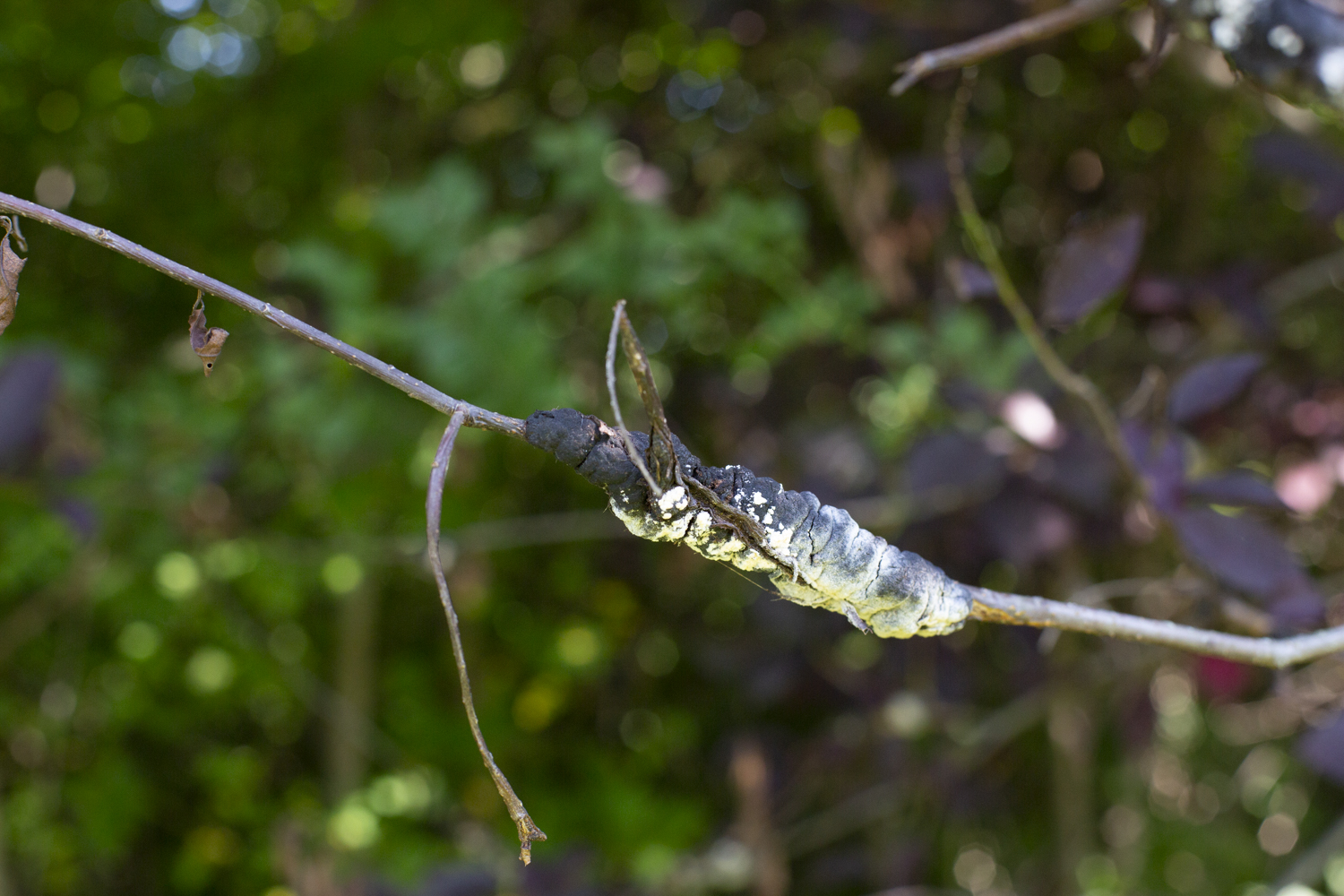
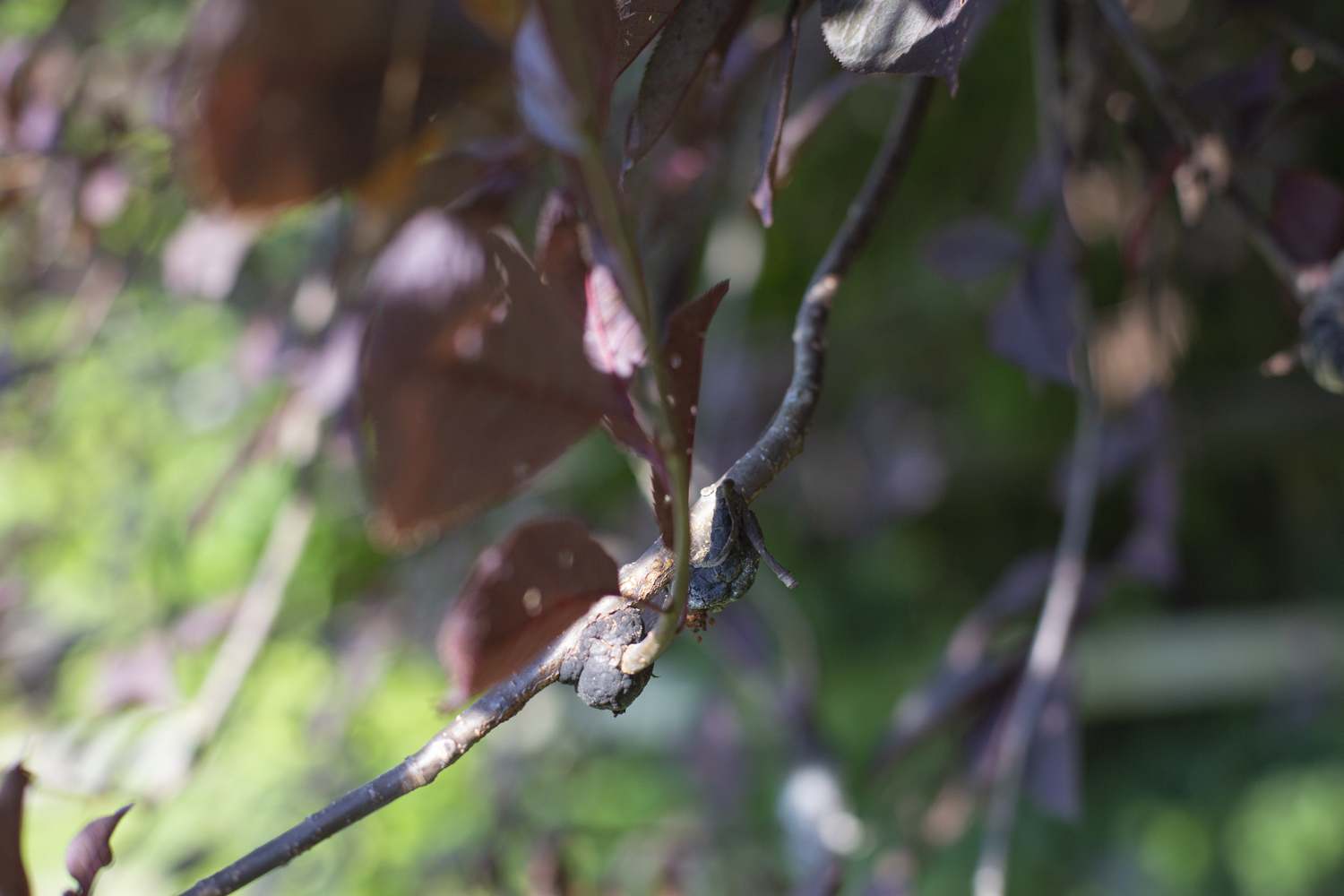
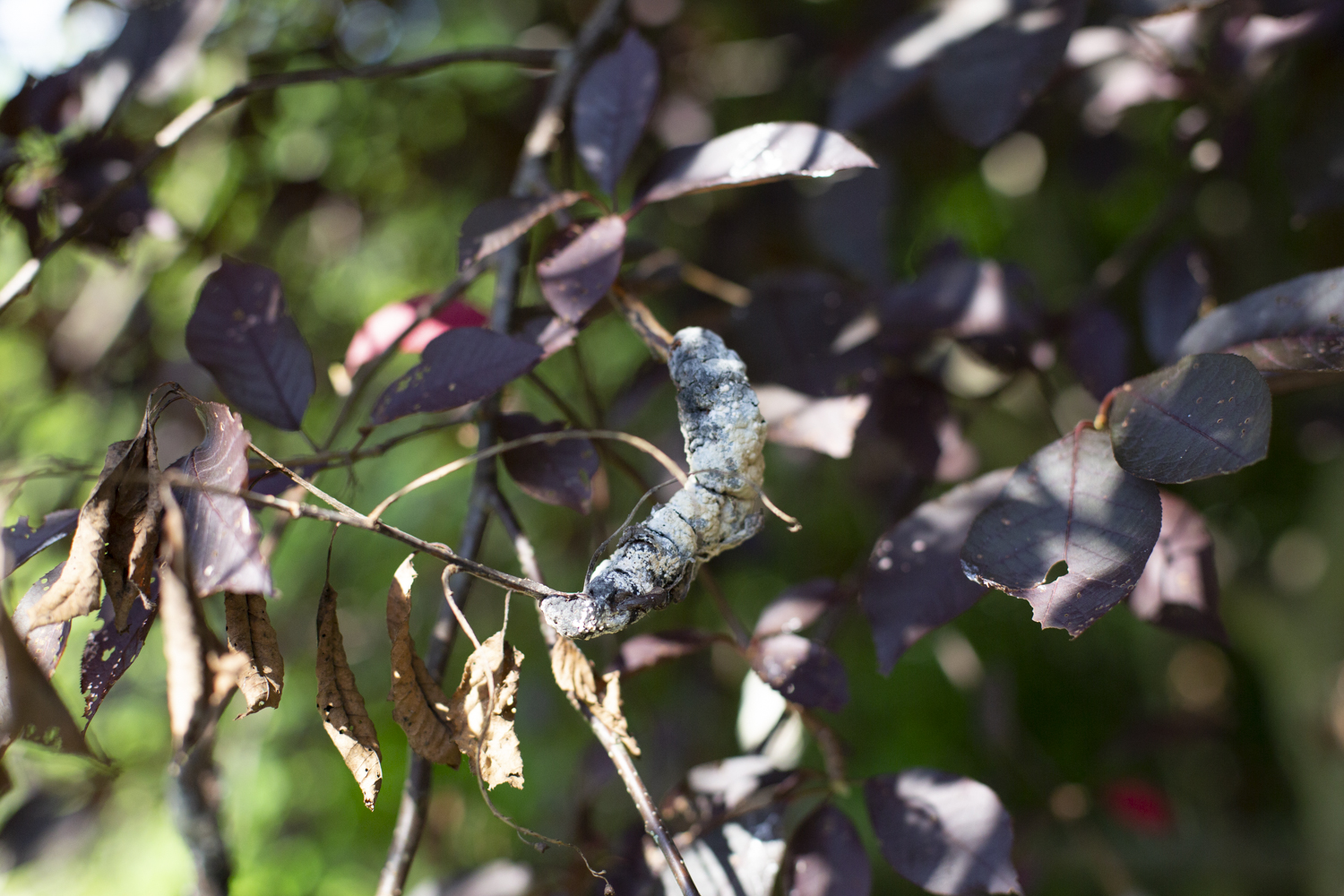

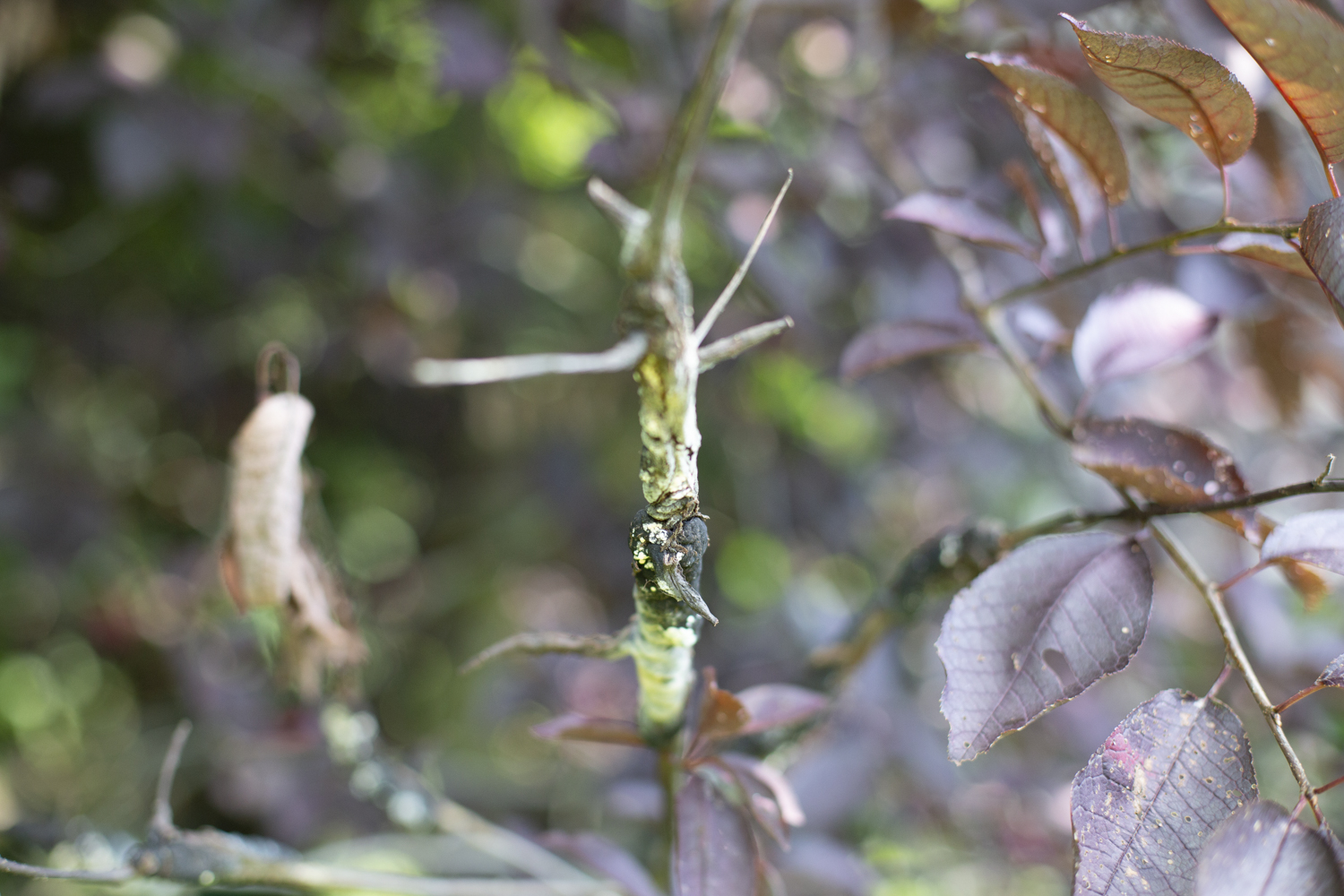
Black Knot is a relatively common disease that mainly effects Plum and Cherry trees, but can impact other trees in the prunus species as well. These types of trees can frequently be seen growing in and around Columbus area neighborhoods. Black knot is actually a type of fungus (Apiosporina morbosa). Its characteristic look consists of irregularly shaped black outgrowths arising from tree branches. It often spreads in the springtime but is not noticed by homeowners until winter after the tree leaves have fallen. If left untreated, the black knot growths eventually expand and encase the limbs and twigs of trees and can lead to dead branches, even death of the tree itself. Unfortunately, by the time many homeowners identify this as an issue, the fungus has already critically damaged the tree.
Early Stages of Black Knot in a Purple Plum Tree in Blacklick, Ohio. ©Russell Tree Experts
It’s best to catch this disease early as this is when it is most easily treated. An early warning sign that black knot may be affecting your tree is the presence of small green swellings/growths on a tree's branches. The first step in treatment is the identification of the presence of the disease. Once identified, selective sanitary pruning of the tree in combination with a fungicide can be instituted. Unfortunately, if the tree is in the advanced stages of the disease, these treatments may not be enough and the tree may need to be removed. In summary, Black Knot is an important disease that is relatively common, especially in trees types found throughout the Columbus area and is best treated when caught early.
Chris Gill
ISA CERTIFIED ARBORIST® OH-6416A
- - - -
If you suspect that your tree(s) may be infected with Black Knot, feel free to give us a call 614-895-7000 or request a free quote!
Witch-Hazel Cone Gall
I find insects that cause galls to be really interesting. There are many different types, usually host-specific, with various shapes and sizes of galls formed. In most instances, the feeding of the insect causes an abnormal growth reaction in the plant that forms this gall where either the adult or the immature insect lives inside.
The photo below is of Witch-hazel cone gall, caused by an aphid bearing the same name. I find insects that cause galls to be really interesting. There are many different types, usually host-specific, with various shapes and sizes of galls formed. In most instances, the feeding of the insect causes an abnormal growth reaction in the plant that forms this gall where either the adult or the immature insect lives inside. In this case, a single aphid will feed on the leaf in spring, causing the gall to form. While inside the gall, the female aphid will produce young that eventually emerge in two forms, with two destinies: A wingless form stays on the host plant; the winged form goes to live on Birch trees. In autumn a second winged generation develops and flies back to the witch-hazel where eggs are laid on the twigs to start the process again the following spring.
When we see galls on leaves and twigs, do we stop to think about the lives of these insects, and the plants that support them? This world we share is much larger than we realize – it gets bigger the more we look up, or down, and we’re all in this together.
Your friendly neighborhood arborist,
José Fernández
ISA BCMA® OH-5129B
Insect notes summarized from Insects That Feed on Trees and Shrubs, by Warren T. Johnson and Howard H. Lyon, second edition.
Fire Blight is No Delight
This year has been a particularly bad one for fire blight on Pear and Apple trees. Fire blight is a bacterial disease that affects plants in the Rosaceae family, causing a characteristic blackened wilting of leaves and twigs. This family of plants is also popular for its landscape value, both for flowers and fruit production. Pear, Cherry, Rose, Apple, Serviceberry, Cotoneaster, Hawthorn are just a few trees and shrubs that are very familiar to us. Have you noticed a profusion of dead, blackened leaves in your neighborhood? In your trees?
As an arborist, I can spot spring coming in February when a faint reddish tinge starts to color the woods. This tells me trees are starting to stir, and warmth will soon be on its way. Despite the early clues that I am looking for, I am always amazed by the vibrancy of life once trees have fully emerged. Yes, I love the stage when trees are flowering, but somehow once trees are fully leafed out they look so alive, so perfect, so unblemished. No bugs, no drought stress, no fungal diseases – just full, green leaves.
And then… pests and pathogens let us know that they have been waiting for spring as well. What can we say? Life the way we know it is varied and expressed by many different forms, each trying to survive in its own way.
This year has been a particularly bad one for fire blight on Pear and Apple trees. Fire blight is a bacterial disease that affects plants in the Rosaceae family, causing a characteristic blackened wilting of leaves and twigs. This family of plants is also popular for its landscape value, both for flowers and fruit production. Pear, Cherry, Rose, Apple, Serviceberry, Cotoneaster, Hawthorn are just a few trees and shrubs that are very familiar to us. Have you noticed a profusion of dead, blackened leaves in your neighborhood? In your trees?
There are ways to stave off the progression of the disease, even now. Ideally, the trees would be treated earlier in the season for better control, but a combination of steps are recommended for trees that are highly susceptible to the disease. Treatment steps vary depending on how affected your tree is.
Thanks for being our client, and for loving your trees! I’ll see you out there.
Your friendly neighborhood arborist,
José Fernández
ISA BCMA® OH-5129B
3 Tips to Check for Fire Blight
Check if your tree's leaves are browning only at the tips of the limbs
Check if limbs have the "Shepherd's Crook" (FYI - The Shepherd's Crooks doesn't always occur in trees infected with fire blight but it an obvious sign of the Fire Blight inspection.)
If you suspect your tree has fire blight, please click here or call 614-895-7000 and we'll send a Certified Arborist to review the tree and give you a quote to treat the issue
Watch out Crabapples! Apple Scab is a Major Threat!
Plant diseases love Spring! As temperatures warm and tender new growth emerges, conditions are ideal for pathogens to settle in and take up residence in our favorite trees. It is now when many plants are susceptible and treatable for diseases, such as Dothistroma needle cast of Austrian Pine, Rhizosphaera needle cast of Blue Spruce, rust diseases on hawthorn and pear, and for the purpose of this article: the aesthetically devastating apple scab on flowering crabapple.
Plant diseases love Spring! As temperatures warm and tender new growth emerges, conditions are ideal for pathogens to settle in and take up residence in our favorite trees. It is now when many plants are susceptible and treatable for diseases, such as Dothistroma needle cast of Austrian Pine, Rhizosphaera needle cast of Blue Spruce, rust diseases on hawthorn and pear, and for the purpose of this article: the aesthetically devastating apple scab on flowering crabapple.
What is apple scab and what does it do?
Apple scab is caused by the pathogen Venturia inaequalis. It is a common disease targeting the rose family of plants which includes crabapple, apple, pear, hawthorn, mountain ash, cotoneaster and pyracantha.
Apple scab produces lesions on leaves, flowers, fruit and on young succulent shoots. When infected areas are numerous, leaves can become curled and distorted and severe infections can lead to complete defoliation of trees and shrubs.
Several years of early leaf loss generally results in poor growth, reduced bloom and increased susceptibility to winter injury and insect predation.
How does the disease work?
Apple scab overwinters in fallen diseased leaves and in the soil. Disease development is favored by wet weather and cool temperatures that generally occur in central Ohio in the Spring and early Summer. Fungal spores are moved from the ground and carried to trees by raindrop splash and wind where they make their way to leaves, flowers, and fruit.
During wet periods, newly emerging crabapple leaves are extremely susceptible to infection. The longer the leaves remain wet, the more significant the infection can be. 10 - 20 days after initial infection, new spores are released which infect new leaves. Repeated infections can continue through the summer until environmental conditions become too hot and dry for the pathogen.
What can be done to protect my crabapples?
For most cultivated varieties of crabapple, fungicides must be applied preventatively to successfully manage apple scab. Fungicide sprays should begin when the first green leaf tips are emerging with additional sprays being applied in roughly 2-week intervals. The number of fungicide applications needed can vary with weather conditions but generally, we recommend 3 separate applications.
Other cultural practices that can increase the effectiveness of fungicide applications when managing apple scab are:
Raking up and destroying fallen leaves to reduce locations where the apple scab pathogen can overwinter
Space crabapple trees generously to increase air circulation around trees
Prune out crossing limbs, vigorous upright sprouts and suckers to increase airflow and sunlight penetration into the canopy (this can help foliage dry faster after rain or dew)
Avoid overhead irrigation, if plants need water, apply water directly to the root zone.
Additionally, much breeding and selection work has been performed to introduce scab resistant crabapples into the landscape. A short list of some of the most resistant cultivars includes:
Coralburst
Donald Wyman
Prairiefire
Purple Prince
Red Jewel
Royal Raindrops
Sugar Tyme
Other common fungal diseases of plants that can be managed through the use of our fungicides include: Oak Wilt, Dutch Elm Disease, Powdery Mildew, Anthracnose and Verticillium wilt.
Neonicotinoid Use in Ornamental Landscape and Effects on Honeybees
Neonicotinoids are chemical products that are effective in systemic control of insect pests in plants. Systemic application of insecticide has multiple advantages over other methods, such as topical applications. When applied systemically, neonicotinoids are absorbed by the plant, and persist for a longer period of time, so that insect pests subsequently feeding on plant parts ingest the chemical and die.
Because of this mode of action, there has been concern about neonicotinoids persisting long enough to be found in plant products such as nectar or pollen, where they could be ingested by foraging bees.
Neonicotinoids are chemical products that are effective in systemic control of insect pests in plants. Systemic application of insecticide has multiple advantages over other methods, such as topical applications. When applied systemically, neonicotinoids are absorbed by the plant, and persist for a longer period of time, so that insect pests subsequently feeding on plant parts ingest the chemical and die.
Because of this mode of action, there has been concern about neonicotinoids persisting long enough to be found in plant products such as nectar or pollen, where they could be ingested by foraging bees.
--
I have been following this topic for several years, collecting various articles that have been trickling in. As licensed commercial applicators, we are trained that “the label is the law”, so pesticide applications to plants are always made according to label instructions. However, there have been claims made about neonicotinoids causing problems for Honeybee populations.
I have personally attended seminars here in Ohio where scientists leading research on neonicotinoid use for controlling invasive insect pests have stated that despite some claims to the opposite, there have been “no documented studies” proving a relationship between neonicotinoid use and Honeybee decline. Since then I have read some articles referring to studies that seem to show a correlation, but no conclusive proof. As an applicator who cares about the welfare of beneficial insects, the lack of conclusive studies is a source of frustration. In fact, the approach I was leaning toward was “if there is a high level of uncertainty, perhaps it is best to seek alternatives for treatment, or to not treat at all”. There is a lot to consider when deciding whether or not to treat a plant chemically, but that topic is beyond the scope of this article.
What is the issue with neonicotinoid use and bees? The reason neonicotinoids are great options for pest control are ease of application, larger windows of application timing, and more targeted applications. Using topical sprays to control pests requires very specific timing (pest usually needs to be present at the time of spray), and there is a risk that other non-target plants may get sprayed (wind drift). Also, non-targeted insects present at the time of application can come into contact with the chemical.
A systemic application is much simpler: no spraying may be required (usually applied as liquid drenches into the soil around the root zone of the target plant, or injected directly into the tree), only insects feeding on plant tissue are targeted, and timing is much less critical since the chemical resides within the tree, eventually breaking down so reapplication is necessary for continued control. And this is the question raised by many concerned people: If the plant tissue has enough chemical to kill insects feeding on the plant, isn’t it possible that the nectar produced by the plant’s flowers will be laced with the chemical as well? So how does this affect bees? These are very reasonable questions, and I agree that they merit consideration.
I was intrigued to see Bernadette Mach (Department of Entomology, University of Kentucky) on the speaker schedule at the Ohio Chapter ISA Tree Care Conference in Columbus, Ohio, this year. Intrigued, because she was speaking on the topic of neonicotinoid levels that persist within a plant after treatment, specifically in nectar. Her talk was in two parts, both of which applied to our concerns as commercial applicators. The first half dealt with her studies on which flowering plants were attractive to bees. The second half was measuring residual levels of systemic chemicals in nectar following application at label rates during different times of the year. Details of her study informing the second half of her talk can be found online (Uptake and Dissipation of Neonicotinoid Residues in Nectar and Foliage of Systemically Treated Woody Landscape Plants).
In short, there were several important details that I came away with:
- Of two chemicals commonly used, one has a lower residual in nectar than the other.
- The timing of the application matters. Applications made post-bloom had a low residual in nectar the following year.
- For some plants, the issue does not matter. For example, Boxwood, in particular, has caused me difficulty. Leafminer is a very common insect pest that can destroy Boxwoods, but it can be readily treated with a systemic application. Last season I began communicating with clients my concern over treating Boxwoods and potential harm to bees. After communicating with Bernadette specifically on this topic, I feel more comfortable continuing with Boxwood treatments as usual. The reason is that Boxwoods are not a plant that attracts bees, so there is a greatly reduced risk that they would feed on the nectar.
As a Certified Arborist and licensed commercial applicator making recommendations to clients, I need to consider each plant prior to treatment. Yes, the client wants to control Magnolia Scale, but should we attempt to do so systemically? Is this plant attractive to bees? If so, should we time the application post bloom? Will this concur with the insect life stage being targeted? What about other options? Can we apply a targeted topical spray that will be effective?
In some cases, nothing more will be possible than to explain to the client the implications of treatment. For example, if the client has a Hawthorn that consistently looks ugly each season when the leaves turn brown and blotchy due to Hawthorn leafminer, I can explain that the best way to control this pest is with a systemic application in the fall (which is essentially pre-bloom) to protect the tree from the pest in spring. This means that there will be higher levels of neonicotinoid in the nectar the following spring, and since bees are attracted to Hawthorn blooms there is a chance they may be affected by the chemical. Leafminer in Hawthorn causes damage that is mostly aesthetic. Once the client considers all this, she may simply choose to leave the tree untreated and deal with some less than perfect leaves.
Ultimately Certified Arborists that are licensed commercial applicators will be making applications based on label recommendations provided by the specific chemical manufacturer. However, we need to follow the thought process outlined above to make responsible decisions, understanding that our choice of which chemical to use when to apply it, and how to apply it may have effects that reach further than simply trying to save one plant, or make it look better.
José Fernández
ISA BOARD CERTIFIED MASTER ARBORIST® OH-5129B
ODA COMM. PESTICIDE LIC. #105859 (Categories 2B, 4A, 6A, Core)
TREE RISK ASSESSMENT QUALIFICATION (TRAQ)