
STOP! DON'T TOP!
As an arborist I have frequently been asked to “top” people’s trees. People want their trees topped for several reasons: safety concerns, vista pruning, aesthetics or height reduction. This request prompts a conversation about the practice of tree topping and the hazards associated with it.

As an arborist I have frequently been asked to “top” people’s trees. People want their trees topped for several reasons: safety concerns, vista pruning, aesthetics or height reduction. This request prompts a conversation about the practice of tree topping and the hazards associated with it.
Topping a tree is the practice of removing tree tops or pieces of the canopy while leaving stubs or branches that are too small to assume the role of a terminal leader. Probably the most common place to observe a topped tree would be underneath a utility wire. These trees are topped in order to prevent them from interfering with the electric grid and not necessarily pruned with the overall tree’s health as the primary focus.
Topping, “hat racking” or “rounding-over” a tree can put a tremendous amount of stress on a tree. The practice can result in the removal of 50-100% of the tree’s leaves. This extreme reduction in a tree’s leaf bearing canopy places tremendous stress on the tree. If the tree doesn’t die it will use a large portion of it’s starch reserves (stored in the roots) to replace the removed canopy. The replacement shoots will grow quickly from buds located in the outer tissue around the removed branches, but will not be anchored the same as a “normal” branch. This poor attachment point and fast growth often results in these “shoots” failing.
Residential tree improperly trimmed called “topping” (click to enlarge)
The large wounds left after a tree has been topped expose the tree to more hazards than just fast growing, poorly attached shoots. The wounds are slow to heal (if they heal at all) and the exposed cambium layer is vulnerable to insects, disease, and decay. The remaining portion of the tree can also experience sunburn or “scalding” due to the lack of leaves and sun exposure.
After explaining this to a potential client I am often asked “then what should I do?” Depending on the species, location, health and client desires there are several options. Proper reduction pruning is one solution and involves reducing limbs according to industry standards (Click here to see our pruning guide). If the tree is in poor health or an unfortunate location, removal is also an option. Often times it is better to remove a poor specimen and replace it with a species that is better suited to that particular site.
As we learn more about the value of trees in our urban forest we have a responsibility to be good stewards of our trees. Witnessing the proverbial “light bulb” turn on after discussing the practice of topping trees is one of the many rewards of being an arborist.
Sincerely,

Chris Gill
Regional Manager, Russell Tree Experts
ISA Certified Arborist® OH-6416A
The Late Season Blues (or Yellows or Browns)
Springtime is long gone, even though it only seems like a couple of months ago that we were coming out of winter. Suddenly, here we are, getting ready to enter the fall season, and true to form, during the past several weeks I have been seeing trees go into what we call “late season blues”.

Trees get late season blues… or yellows… or browns
I’m trying, and finding myself unable to, recall something I read from H.D. Thoreau once regarding trees when they first leafed out in the spring. In his usual poetic style, Thoreau was commenting on how clean, fresh, new, and unspoiled each leaf was when it emerged, and how so very soon, it seemed like each tree had its own unique insect that began to feed on it, marring its beauty. I wish I recall the exact wording. If anyone out there is a reader of Thoreau, please refresh my memory and comment below! :)
Springtime is long gone, even though it only seems like a couple of months ago that we were coming out of winter. Suddenly, here we are, getting ready to enter the fall season, and true to form, during the past several weeks I have been seeing trees go into what TJ (Certified Arborist here at RTE) calls “late season blues”. During this time we start to see an accumulation of issues on tree leaves that make them look less than pristine, sometimes even tattered and tired. It is almost as if the plants are tired of fending off all the plagues that they must coexist with each season, and allow their defenses to drop before they go dormant.
Early Signs of “Late Season Blues”
I knew we were into the late season blues when I started to see certain types of flowering cherry exhibiting quite spectacular outbreaks of leaf spot, and clients began to call very concerned about the discolored leaves falling off their trees rather suddenly. This was around mid-August, and I continued to see it several weeks after.
During the heat of late summer I commonly see the lacy, cutleaf varieties of various species begin to scorch around the leaf margins. Same for some variegated species like tricolor beech, when planted in full sun.
River Birch and Cottonwood, among others, can go through a period of early defoliation during dry summer heat, causing clients to think that their trees are dying. Multiple late season foliar issues, which I typically lump under “late season foliar diseases” start cropping up.
No Big Deal?
Why do I sound so nonchalant about these things? Well, in a nutshell, it has to do with the time of year. If these symptoms only become evident in late summer/early fall, there is usually nothing to worry about concerning long term tree health. Biologically, by late summer/early fall trees have largely made and stored enough sugars and starches to supply their needs for growth and reproduction the following season. Aesthetically, we are beginning to enter the time of year when some trees are thinking about fall color, and soon all of them will be switching to the seasonal color scheme. The loss of some green here and there is not as tragic as it would be earlier in the season when we need our trees to show up in their best threads.
In my part of town (Northwest Columbus), late season blues this year have shown up as a higher incidence of foliar fungal diseases, such as late season anthracnose (something I usually see in early spring). Why? Fungi that infect tree leaves prefer cool, moist weather, and this season we have certainly had a lot of that! Everywhere I go, clients tell me the same thing: “I have barely had to water my lawn this summer!” For the same reason, I have noticed many more mushrooms than usual this year, and of several types I have not seen before.
The Moral of the Story
During late summer/early fall, issues affecting the leaves/canopy of trees are generally not as bad as they look, and chances are very good the tree will leaf out normally next spring. For this reason I may ask a client to send some photos of what they are seeing. This helps me return a quicker answer during this busy time of year. In the meantime, if your tree looks like it has some sort of fungal issue in the leaves, a good fall raking will help remove the source of inoculant for the following season.
Following are some photos I took yesterday. I am sharing these because as bad as these leaves look, I was not concerned for the health of these trees at this time. Enjoy the photos. Better yet, get out on one of our plant walks, or on your own plant walk, and enjoy this season! I am looking forward to a colorful fall this year, especially if moisture levels continue the way they have been.
Thank you for reading, thank you for your interest, thank you for your love of trees.

London Planetree showing it’s “late season blues”

Hackberry. Foliar fungus (possibly) with some insect feeding damage.
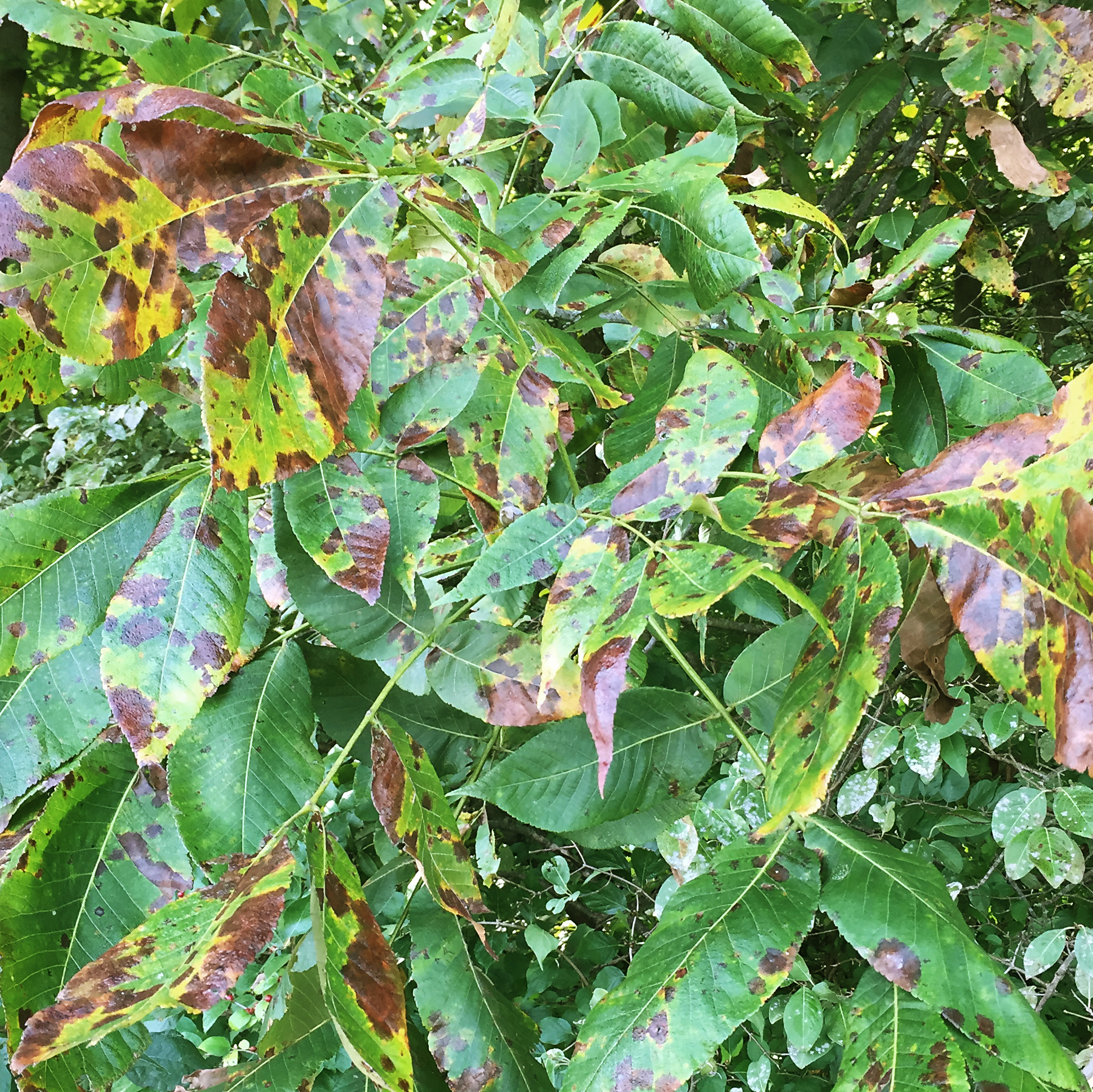
Shellbark Hickory having symptomatic “late season blues” in small portions of the outer canopy

American Linden showing late season foliar issues and some Japanese Beetle feeding damage on the left
Your friendly neighborhood arborist,
José Fernández
ISA BCMA® OH-5129B
614-586-5777
Leaf Senescence: The Magic of Fall Color
During the growing season trees are making food through a process called photosynthesis. Isn’t that incredible - trees make their own food! (Magic.) The magic is due in part to the chlorophyll stored in each leaf, which absorbs energy from the sun to transform carbon dioxide and water into plant food (glucose) and oxygen.

Please note: This article was originally published on 9/24/2018 and was republished on 10/28/2021.
Autumn is quickly approaching and with it brings a wondrous display of ephemeral beauty. It shows up almost overnight and never overstays its welcome. Fall color, of course, is the long anticipated signal that the dog days of summer have finally ended. Warm sweaters, hot cider, bonfires and football games (GO BUCKS) - we made it.
Around this time each year I get a little giddy. I know it’s coming and I seriously cannot wait. All those reds, purples, oranges and yellows, dancing on the breeze as I drive down the street. It’s spectacular. Recently I was trying to explain the phenomenon of the fall to my children while on the way home from piano practice. My arborist self started using words like: chlorophyll and photosynthesis. “Photosynthe-what?” my youngest repeated. Exactly. I resorted to the simplest explanation: Trees have magic powers. That made total sense to them, of course they do. But seriously, have you ever stopped and wondered why trees change color?
Here’s the simplest arborist’s answer:

During the growing season trees are making food through a process called photosynthesis. Isn’t that incredible - trees make their own food! (Magic.) The magic is due in part to the chlorophyll stored in each leaf, which absorbs energy from the sun to transform carbon dioxide and water into plant food (glucose) and oxygen. During the process of “photosynthe-what”, chlorophyll absorbs red and blue wavelengths of light from the visible light spectrum and reflects green wavelengths of light, which is why leaves are green during the growing season.
Around this time of year the days grow shorter and less sunlight is available to make plant food. Coupled with decreases in daily temperature, chlorophyll begins to break down in each leaf. As the chlorophyll absorbs less light, the green color fades away leaving behind the pigments hiding beneath: those incredible reds, purples, oranges and yellows. Totally magical.
How fortunate to live in a section of the world that offers such spectacular displays of fall color. Living amongst an abundance of deciduous trees we experience the beauty of this chemical reaction whether we know why it happens or not. From all of us at Russell Tree Experts, we wish you a very Happy Fall and remember if anyone ever asks you why trees change color, it’s accurate to answer: Trees have magic powers.
Sincerely,
Shari Russell
Co-Owner, Russell Tree Experts
The Value of Trees in the Urban Landscape
Trees in our landscapes are not only beautiful but they provide countless benefits that can enrich our lives. These benefits extend well beyond backyard aesthetics and go on to include health implications, improved energy efficiency, and community-wide effects.

Trees in our landscapes are not only beautiful but they provide countless benefits that can enrich our lives. These benefits extend well beyond backyard aesthetics and go on to include health implications, improved energy efficiency, and community-wide effects.
Increased Energy Efficiency
The canopy of properly placed trees surrounding your home can provide much needed shade to ensure the house stays cooler on hot summer days. Additionally, trees around the home can provide an often underestimated windscreen which can help diminish harsh winter winds and keep your home warmer in the winter months. The end result is the same - increased energy efficiency and cost savings on heating and cooling bills.
Environmental/Community Benefits
There are innumerable environmental and community benefits of trees, however there are two that we chose to focus on at this time.
Through the years, the community and public have been increasingly aware of the concern for increased CO2 emissions in our atmosphere. Trees are a beautiful way to help combat this as they naturally provide a reduction in carbon dioxide through photosynthesis. In the process of consuming carbon dioxide, trees release more oxygen into the atmosphere as a byproduct. Depending on the age of the tree, they are estimated to absorb anywhere from 12-48lbs of carbon dioxide per year. Amazingly, trees also have the ability to absorb other harmful environmental gases as well, including sulfur dioxide, ozone, and nitrogen oxides, effectively serving as a filter to clean the air we breathe every day.
Another important quality of trees is their ability to reduce storm water runoff and erosion. Trees are able to do this in three main ways. Firstly, a trees broad leaves and branching limbs help deflect heavy rains over a larger area. Secondly, a tree’s wide reaching roots act as an anchor to support not only the tree itself but the surrounding soil, which helps prevent erosion. Lastly, trees act as a sponge to absorb surrounding ground water in the environment (a single mature tree can uptake thousands of gallons of water per year!). The end result is reduced storm water runoff and reduced soil erosion.
Personal Health and Wellness
Trees also provide the intangible benefit as a place of social gathering for local community members, and can provide a calming environment that reduces stress levels and improve overall health and wellbeing.
Property Value
There are an abundance of studies showing the benefit of great landscaping on property value. Trees are essential to a well-maintained landscaped property. With proper planning, well placed trees on your property can greatly enhance your property value.
In Summary
Trees provide countless benefits to individuals and communities as a whole. Trees not only provide improved energy efficiency in the home, they also improve property value, have long lasting environmental effects, and can improve one’s quality of life. After reading this, I hope you can truly appreciate the power of trees to change our lives both for today and for the future to come.
Chris Gill
ISA Certified Arborist® OH-6416A
Magnolia Scale: Take a Look!
“Take a look”, I said to my concerned client, as we stood in the shade of her Magnolia tree. I had just handed her my hand lens, and I showed her how to get it close to her eye as she peered through it. I wanted her to see what was in my hand – a dead adult Magnolia scale insect.

"Take a Look!"
“Take a look”, I said to my concerned client, as we stood in the shade of her Magnolia tree. I had just handed her my hand lens, and I showed her how to get it close to her eye as she peered through it. I wanted her to see what was in my hand – a dead adult Magnolia scale insect. Recently dead, which meant that the crawlers should already have emerged.
When I first looked at this tree, I expected to find crawlers on the stems but was surprised that there weren’t any. "This time of year - they should already be out", I said to myself as I let my client examine what I had just picked off her tree. My thoughts were interrupted by a low cry of consternation: “José, they’re crawling all over your hand! You have to wash your hands right away!”

Ugh. She was right. They were way too small to feel, but I could certainly see small black specs on my fingers, and they were covering ground pretty quickly. As we moved toward the garden hose, I was thinking: Those eggs had to have hatched out days or weeks ago, but they are only now emerging from under the adult? Why have they waited this long? Scale insects are the worst and they often throw us these curve balls…
Magnolia Scale: A Summary
Most people don’t realize they are even looking at an insect when they see a scale on a plant. It is an insect that forms a sort of shell, some hard, some soft, over itself. Immobile, it sucks the sap out of a plant, lays eggs, and dies, mostly unnoticed. That is until their numbers grow so large that the plant may decline or parts of the plant may die, sooty mold grows on the honeydew excreted by the scale insect, and flies start buzzing around the honeydew as well. Then folks start wondering what in the world is going on with this plant?
Magnolia scale is very host specific, meaning that it affects Magnolia species almost exclusively. It is the largest scale insect in our area, sometimes as large as a dime. The adult in its prime is very white, and soft when pressed. It can be very messy if squished. Be warned. Mechanical pressure is one way to kill this pest, but that pressure usually requires hands and fingers. Not an effort for the faint of heart.
There is one generation per year, which usually indicates the pest can be controlled more easily. As with all scale insects, experience proves control to be a process of perseverance over time. The most vulnerable stage is the newly hatched nymph stage, the mobile stage we call a “crawler”. At this point, the insect has still not formed its waxy covering and will be killed if contacted with the appropriate insecticide.

Nymphs emerging from a recently plucked adult Magnolia Scale
As I write this, eggs have hatched, nymphs have emerged, and some are still emerging. Ken has captured some great footage of this very process, something I have never seen recorded before. Thanks for sharing Ken!
(Technical notes gathered from experience, general knowledge, and from Insects that Feed on Trees and Shrubs, second edition, Johnson and Lyon.)
Your friendly neighborhood arborist,
José Fernández
ISA BCMA® OH-5129B
614-586-5777
Fall Webworm In Full Effect
We’ve received a high volume of calls over the last couple of weeks about “bagworms” in client’s trees. In central Ohio, true bagworm feeds predominantly on evergreens - arborvitae, spruce, and junipers although some deciduous trees can be hosts as well. Generally, this

Fall Webworm vs. Bagworm
We’ve received a high volume of calls over the last couple of weeks about “bagworms” in client’s trees. In central Ohio, true bagworm feeds predominantly on evergreens - arborvitae, spruce, and junipers although some deciduous trees can be hosts as well. Generally, this feeding occurs late Spring through mid-Summer and by mid-August they have stopped feeding to go pupate and become a moth. So I initially was confused about this late population of “bagworm” that had taken central Ohio by surprise and was making my appointment schedule grow faster than kudzu.
After visiting with a few customers, I realized the real culprit of concern was actually, Fall Webworm - not Bagworm. It’s easy to understand why a lot of folks call this pest (which resembles a bunch of worms in a bag) bagworm. This article should clear this up. (For information on true bagworm see the postscript at the end of this post). For those of you reading this article, I hope you can help me to rise up and start a movement to correct this awful error in nomenclature. 😉
The Facts about Fall Webworm

Fall webworm on Bald cypress
Fall webworm is a native pest of shade trees and ornamentals and can appear early summer through early fall. It feeds on over 100 different species of trees commonly attacking hickory, walnut, elm, birch, cherry, and willow. In urban landscapes, I’ve observed it daily on oak, sweetgum, redbud, linden, mulberry, and crabapple.
Fall webworm gets most folks attention by the large unattractive webbed nests it makes at the ends of branches. In most cases, Fall webworm is most damaging to plants aesthetically, diminishing the beauty of its host plant. A large nest can contain dozens to hundreds of caterpillars and can measure up to 3 feet across. Even after caterpillars have left to pupate, empty webbed nests can persist for months containing dried up leaf fragments and lots of caterpillar feces.
A fall webworm feed generally lasts for 5 - 6 weeks before the caterpillar leaves its host plant to pupate in the soil. Fall webworm generally has 2 generations per year.
Fall Webworm Management
Because Fall webworm generally causes little to no harm to the overall health of established healthy trees, I generally do not recommend management for this pest. Ohio has dozens of natural predators that make a living on Fall webworm including several species of birds, parasitic wasps, and other beneficial insects and they can generally keep populations of Fall webworm in check without the help of human intervention.
Newly planted trees could be at risk of significant defoliation and heavy feeding could impact fruit or nut yield for crop trees. If management of Fall webworm does become necessary, nests can be pruned out and destroyed or insecticides can be sprayed to kill the caterpillars while they are feeding. The beneficial bacteria "Bt" (Bacillus thurngiensis) can also be used on young caterpillars. This is available at most high-end garden centers labeled as Dipel or Thuricide.
If spraying is your control method of choice, please note that product only needs to be applied directly to the nests (rather than the entire tree) to avoid damage to beneficial insects and other non-target organisms.
If you need assistance managing Fall webworm - we’re here to help.
And Now, Bagworms

Bagworm is a small caterpillar that uses silk and bits of foliage and bark from its host plant to make a small bag around its body to protect itself. Each bagworm has its own individual bag (which often resembles a small pine cone), rather than large webbed nests that protect entire communities of caterpillars like in the case of Fall webworm. Bagworms feed aggressively from late May through July and can quickly defoliate entire portions of trees and shrubs if left unchecked.
Bagworms can be removed from plants by hand and disposed of easily on small trees and shrubs. On larger plants, insecticide applications can be made effectively through June before bagworms have covered their bodies with their bag.
Thanks for reading!
TJ Nagel
ISA CERTFIED ARBORIST® OH-6298A
Preventing Tree & Property Storm Damage
Summer months include long hot sunny days that we can enjoy by the pool or lake, but can also bring thunderstorms and high winds. While trees provide shade in these very hot months, they can also be a source of property damage during these summer storms.

Summer months include long hot sunny days that we can enjoy by the pool or lake, but can also bring thunderstorms and high winds. While trees provide shade in these very hot months, they can also be a source of property damage during these summer storms.
What is "Storm Damage"?
Storm damage occurs when a tree or limbs from the tree fall and damage valued property. This can range from a tree limb falling on your gutter to a large tree falling onto your home. Storm damage results in millions of dollars in property loss every year.

A Silver Maple fell onto a house following a wind storm. The tight "V" crotch near the base of the tree made this tree a likely victim of the wind storm.
Is it Possible to Prevent Storm Damage?
Of course! While it’s difficult to always predict nature, storm damage can often be prevented and sometimes eliminated by mindful homeowners.
3 Tips: How to Identify Storm Damage Risks
(See Photos Below)
The key to reducing potential storm damage is identifying the hazards. The following are a few simple ways to try and identify potential hazards.
Identify hazardous dead limbs close to your house or other valued property
- Identify declining trees on your property - Look for these:
- A large number of dead limbs in the canopy of the tree
- The existence of fruiting bodies on the trunk of the tree
- Overall the tree doesn’t look healthy (missing leaves, loose bark, etc.)
- Identify Co-dominant stems
- Tight “V” type crotches
- Multiple stems originating from one point in the trunk.
How to Mitigate The Hazards
At Russell Tree Experts we can help to identify the hazards. Once the hazards are identified a full mitigation plan will be put together. The plan may include but not limited to pruning, removal, and cabling to make your property a safer place.
In Summary
A well-maintained tree with regular pruning and care has been shown to result in a stronger more storm-resistant tree. Identifying hazards and putting together a mitigation plan can save you thousands of dollars as well as save you lots of headaches when storms hit!
Sincerely,
Chris Gill, Russell Tree Experts
ISA Certified Arborist® OH-6416A
Verticillium Wilt
It’s hard to miss this disease once we enter the hot dry months of summer. Without fail, each July/August I start to see trees turning brown and wilting suddenly, usually in patches within the canopy that can be traced back to entire individual limbs that have died. More dramatically, an entire tree…

It’s hard to miss this disease once we enter the hot dry months of summer. Without fail, each July/August I start to see trees turning brown and wilting suddenly, usually in patches within the canopy that can be traced back to entire individual limbs that have died. More dramatically, an entire tree will just turn brown and wilt. The pattern of wilting is very regular, and the symptoms can carry over into winter because the wilted leaves sometimes stay on the tree well after normal leaf drop in the fall.
Verticillium Wilt (VW) is easily recognizable once you know what to look for, but not easily treated. To make matters worse, it affects a large number of trees and plants, with varying expression of symptoms from tree to tree. During my years as an arborist, I have found Norway Maple, Japanese Maple, Yellowwood, Smoke tree, Redbud and Magnolia to be very common hosts of this disease. And this is a short, short list of the plants that can be affected.
Dead Sugar Maple, suspect VW due to suddenness of wilting
The disease is caused by a fungus present within the soil, and there are so many ways it can get into the soil that my approach is usually “if there is soil present, there is probably VW present”. What do we do? It sounds like a copout, but the best answer for dealing with this issue is the best answer for dealing with most plant pests and diseases: Choose the right plant for the site conditions. This is the best way to cultivate healthy plants that can naturally cope with the more problematic neighbors within an ecosystem. But this doesn’t really help the tree that has already been planted and is making do with what it has.
If the tree has already been planted, the next best option is to do everything possible to manipulate conditions at the planting site to minimize stress factors to the tree. Ensuring proper moisture, adding organic mulch matter, amending soil both chemically (fertilization if needed) and physically (soil aeration/relief of compaction) are all good measures that can be taken. There are systemic fungicides that can be applied to suppress the development of the disease within the vascular system of the plant as well, but these applications should be secondary to the site work.
Dead vascular tissue in Sweetbay Magnolia characteristic of VW
The fungus can enter the tree by wounds in roots but can enter roots even when no wounds are present. Once in the tree, the disease tends to progress upward and outward, causing foliar wilting and dieback to varying extent. I have seen trees coexist with the disease for years and years, seemingly keeping up with the disease, losing a branch here and there, but generally coping with it. On the other hand, I have seen trees decline quickly. I recall one Sugar Maple which barely had any symptoms until it wilted from head to toe and died over the weekend.
In closing, I feel that VW is an example of how trees really die. There are questions that need to be asked, such as “Was it just a super-virulent strain that entered the tree?” or “Was it a weaker strain, but the tree was just weakened by multiple other factors?”. Sure, there may be cases where everything is perfect for the tree, but the disease was like The Terminator - unstoppable. In my experience though, most trees die because something else has made them vulnerable and weak enough that a relatively low-grade disease is what finishes them off. In that case, treating the disease is a last-ditch effort that can only really work if the treatment keeps the tree alive long enough to benefit from the effects of cultural changes that should be implemented if possible.
I think there is a life lesson that can be applied here, but I will let the reader sort that out. Have fun out there! For every wilted leaf, there are 100 other green ones.
Your friendly neighborhood arborist,
José Fernández
ISA BCMA® OH-5129B
Our Safe & Drug-Free Workplace
From day one, Russell Tree Experts has always held safety to the highest regard. Each week we dedicate time to train, educate and discuss the most efficient production techniques focused first on safety. Managing a business in an industry recognized by the Bureau of Workers Compensation (BWC) as…

From day one, Russell Tree Experts has always held safety to the highest regard. Each week we dedicate time to train, educate and discuss the most efficient production techniques focused first on safety. Managing a business in an industry recognized by the Bureau of Workers Compensation (BWC) as one of the most dangerous occupations in Ohio, our approach is serious. Not only do we focus on hazards relating to occupational safety, we take it one step further by providing training and awareness regarding issues hard to recognize and not always apparent, but certainly gaining much attention in our society.

Dyann McDowell of Training Marbles
Once a year all 31 Russell Tree Experts crew members gather together to focus specifically on drug and alcohol safety. Last week, before the regular day began, we invited an expert in substance abuse to educate all employees and provide supervisor training pertaining to drug prevention and problems associated with use and misuse of drugs and alcohol in the workplace. Dyann McDowell of Training Marbles (associated with the Ohio BWC Drug-Free Safety Program) led us through real-life scenarios of how to recognize addiction and how to act swiftly to maintain an environment safe for ourselves and the public. She provided in-depth descriptions of common drugs and those just gaining momentum. She explained historical trends in drug use and current data on where specific drugs are prevalent. She went on to explain how an overdose physically occurs in the body and why it is so hard to reverse. She offered many resources dedicated to rehabilitation for those suffering from drug or alcohol addiction. Supervisors broke out into a small group after the main presentation to further discuss the importance of being aware of the warning signs of substance abuse, how to handle rumors of abuse and when and how to take action.
By participating in the Drug-Free Safety Program, facilitated through the BWC, I am confident our company is smarter, stronger and safer because of the deliberate time we choose to make ourselves aware of the dangers associated with drug and alcohol abuse. I am proud that as a team we are watching out for the wellbeing of our fellow coworkers, to stay safe and make certain everyone returns home healthy and well each and every day.
At the end of the program, all 31 of us participated in drug and alcohol testing administered by a third party organization. I am happy to report we all passed and Russell Tree Experts is 100% Drug and Alcohol FREE!!
Shari Russell
Member, Co-Owner
Russell Tree Experts
The Importance of Green Leaves
I have been noticing what I consider to be an unacceptable amount of chlorosis in urban trees around Columbus. In general, chlorosis is the yellowing of plant foliage caused by a lack of chlorophyll. This is a problem because plants depend on chlorophyll to absorb energy from sunlight and to survive. Several…

Chlorosis in a River Birch causing a die-back in the canopy
I have been noticing what I consider to be an unacceptable amount of chlorosis in urban trees around Columbus. In general, chlorosis is the yellowing of plant foliage caused by a lack of chlorophyll. This is a problem because plants depend on chlorophyll to absorb energy from sunlight and to survive.
Several factors can contribute to the development of chlorosis in trees such as nutrient deficiency, drought, poorly drained and compacted soils, girdling roots, graft union incompatibility and mechanical damage to the tree trunk. For the purpose of this article, I’m going to focus on chlorosis caused by nutrient deficiency because I believe it’s the most prevalent and most often mismanaged. Although any nutrient deficiency could lead to chlorosis in trees, manganese and iron deficiency is what we see most.

Chlorosis in a Red Maple

Chlorosis in a Pin Oak
It is important to understand that the availability of nutrients from the soil can vary with soil pH. For example, even though there may be an adequate amount of manganese for a certain tree in the soil, the soil pH can cause the manganese to be inaccessible by the tree. Most urban soils in central Ohio are alkaline. (A quick review for those of you who fell asleep in biology, the soil’s pH is an indicator of soil acidity or alkalinity. On a scale of 1-14, 7.0 is neutral, below 7.0 the pH is acidic, above 7.0 the pH is alkaline. Nutrients are most available to trees when the soil pH is between 5.0 and 6.5. Because most of our urban soils have a pH of around 7, we find ourselves dealing with chlorosis.
Initially, chlorosis expresses itself in the canopy of trees by the yellowing of foliage with a network of green veins. As the chlorosis progresses, leaves become a paler yellow and develop brown necrotic lesions. Leaf margins will eventually brown completely and leaves will dry up and fall off. Over time this results in poor vigor, reduced twig extension, poor density of canopy, dieback and eventual tree death.
The easiest way to manage chlorosis is to prevent it by planting urban tolerant trees that are tolerant of high pH soils. Although most trees species have the potential to develop chlorosis, the most common trees affected by high pH soils in central Ohio are Pin oak, Red maple, River birch, Shingle Oak, Red Oak, Sweetgum, White pine, and Canadian Hemlock. If you notice yellow leaves on your trees (and it is not time for Fall color) it is important to take action for long-term preservation.

Russell Tree Experts Tree Wellness Technician Collecting a Soil Sample
The first step is to have a soil and plant tissue test performed. This is the only way to know which nutrients are lacking in your trees and soil. Any attempt at correcting chlorosis without the information from these tests is guesswork and treatment without proper diagnosis is malpractice. We can have these tests performed for you, interpret the results, and determine the best management for your tree(s).
Just another way Russell Tree Experts is keeping Ohio green!
TJ Nagel
ISA CERTFIED ARBORIST® OH-6298A
Black Knot Disease In Plum & Cherry Trees
Black Knot is a relatively common disease that mainly effects Plum and Cherry trees, but can impact other trees in the prunus species as well. These types of trees can frequently be seen growing in and around Columbus area neighborhoods. Black knot is actually a type of…

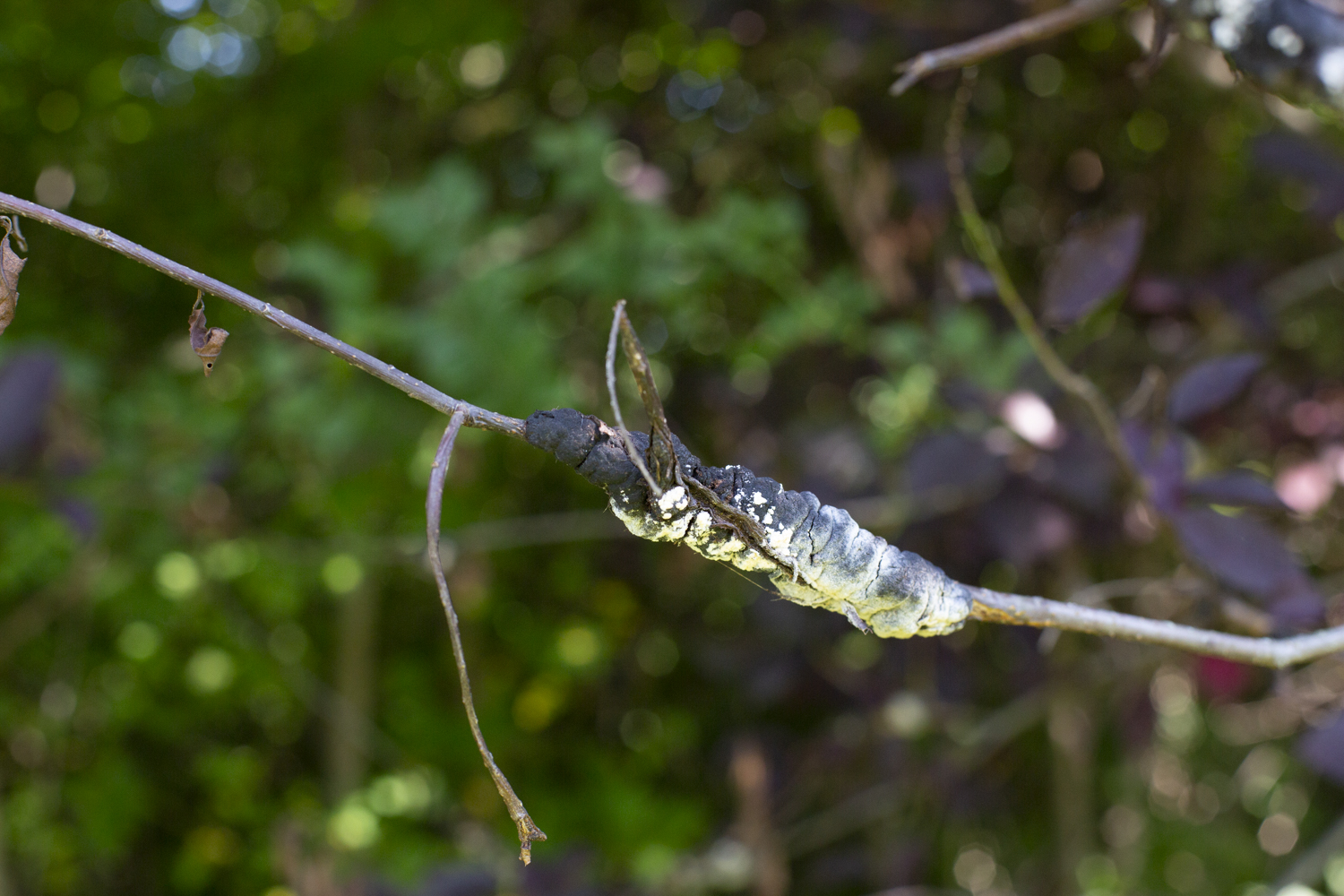
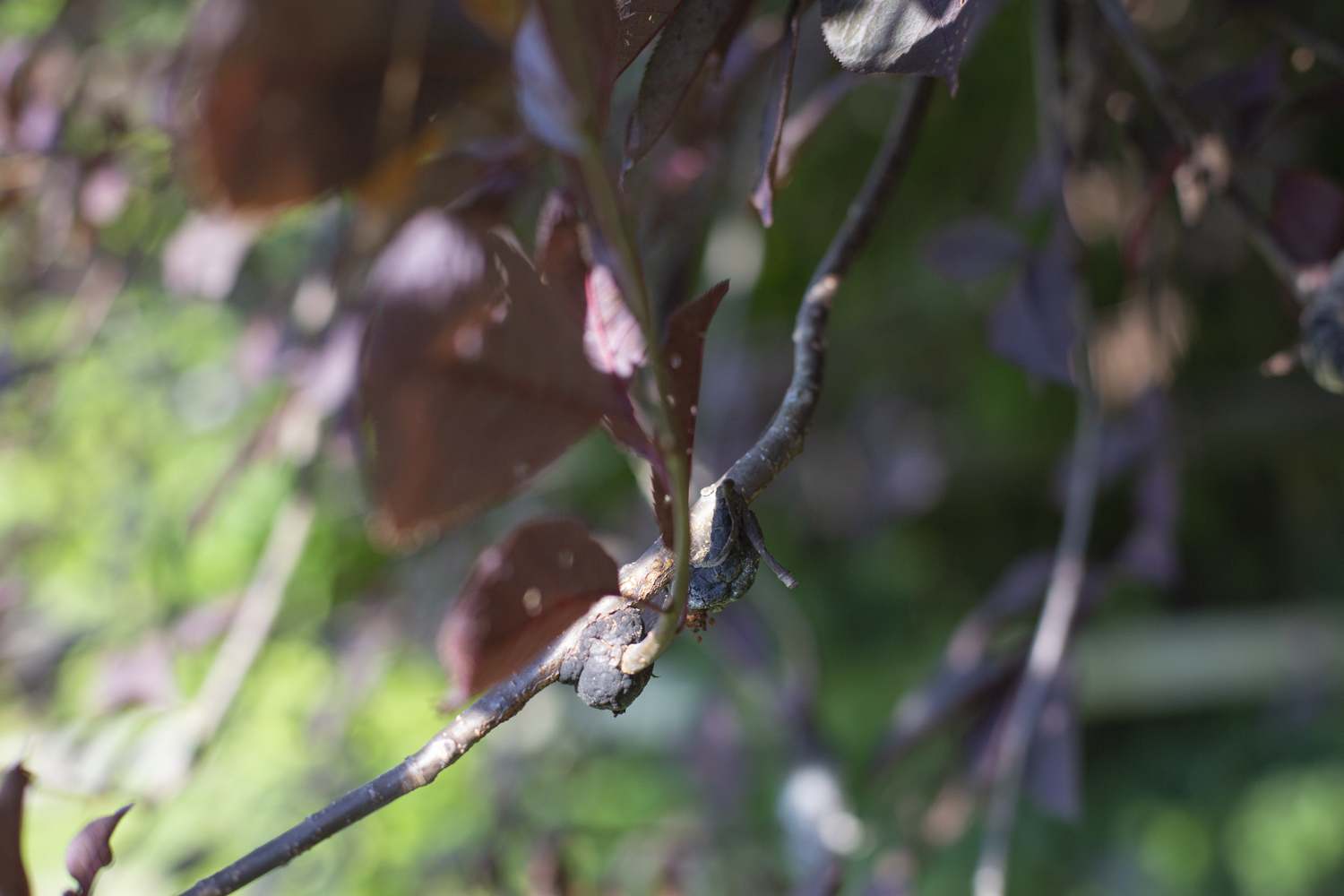
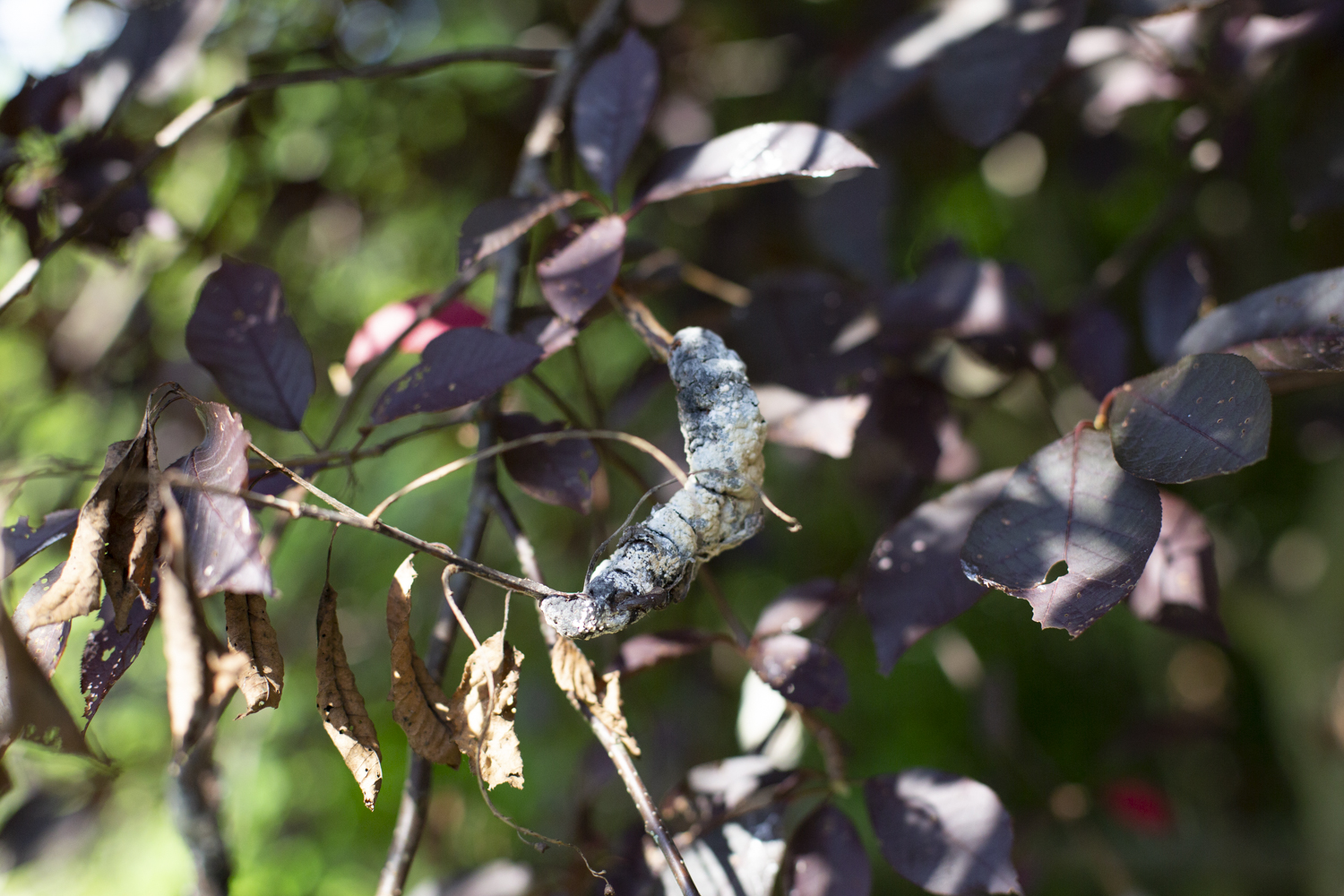

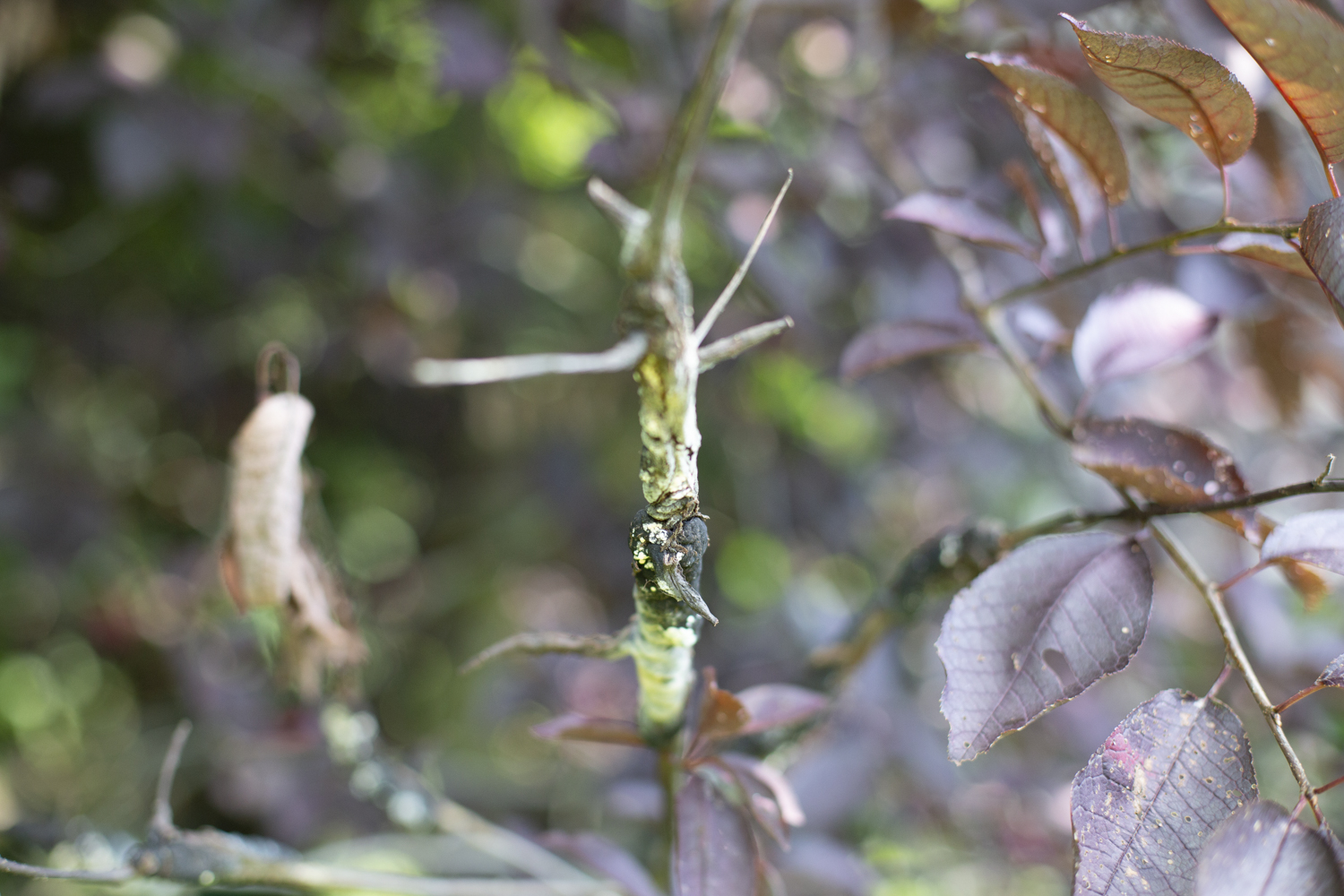
Black Knot is a relatively common disease that mainly effects Plum and Cherry trees, but can impact other trees in the prunus species as well. These types of trees can frequently be seen growing in and around Columbus area neighborhoods. Black knot is actually a type of fungus (Apiosporina morbosa). Its characteristic look consists of irregularly shaped black outgrowths arising from tree branches. It often spreads in the springtime but is not noticed by homeowners until winter after the tree leaves have fallen. If left untreated, the black knot growths eventually expand and encase the limbs and twigs of trees and can lead to dead branches, even death of the tree itself. Unfortunately, by the time many homeowners identify this as an issue, the fungus has already critically damaged the tree.
Early Stages of Black Knot in a Purple Plum Tree in Blacklick, Ohio
It’s best to catch this disease early as this is when it is most easily treated. An early warning sign that black knot may be affecting your tree is the presence of small green swellings/growths on a tree's branches. The first step in treatment is the identification of the presence of the disease. Once identified, selective sanitary pruning of the tree in combination with a fungicide can be instituted. Unfortunately, if the tree is in the advanced stages of the disease, these treatments may not be enough and the tree may need to be removed. In summary, Black Knot is an important disease that is relatively common, especially in trees types found throughout the Columbus area and is best treated when caught early.
Chris Gill
ISA CERTIFIED ARBORIST® OH-6416A
- - - -
If you suspect that your tree(s) may be infected with Black Knot, feel free to give us a call 614-895-7000 or request a free quote!
Witch-Hazel Cone Gall
I find insects that cause galls to be really interesting. There are many different types, usually host-specific, with various shapes and sizes of galls formed. In most instances, the feeding of the insect causes an abnormal growth reaction in the plant that forms this gall where either the adult or the immature insect lives inside.
The photo below is of Witch-hazel cone gall, caused by an aphid bearing the same name. I find insects that cause galls to be really interesting. There are many different types, usually host-specific, with various shapes and sizes of galls formed. In most instances, the feeding of the insect causes an abnormal growth reaction in the plant that forms this gall where either the adult or the immature insect lives inside. In this case, a single aphid will feed on the leaf in spring, causing the gall to form. While inside the gall, the female aphid will produce young that eventually emerge in two forms, with two destinies: A wingless form stays on the host plant; the winged form goes to live on Birch trees. In autumn a second winged generation develops and flies back to the witch-hazel where eggs are laid on the twigs to start the process again the following spring.
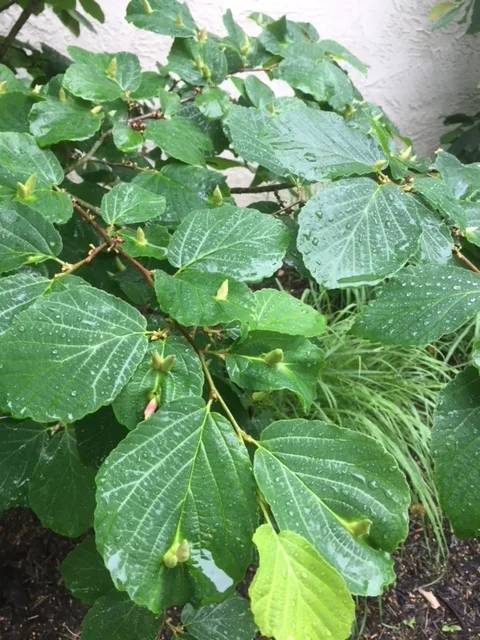
Cone Gulls in a Witch-Hazel Tree
When we see galls on leaves and twigs, do we stop to think about the lives of these insects, and the plants that support them? This world we share is much larger than we realize – it gets bigger the more we look up, or down, and we’re all in this together.
Your friendly neighborhood arborist,
José Fernández
ISA BCMA® OH-5129B
Insect notes summarized from Insects That Feed on Trees and Shrubs, by Warren T. Johnson and Howard H. Lyon, second edition.
Fire Blight is No Delight
This year has been a particularly bad one for fire blight on Pear and Apple trees. Fire blight is a bacterial disease that affects plants in the Rosaceae family, causing a characteristic blackened wilting of leaves and twigs. This family of plants is also popular for its landscape value, both for flowers and fruit production. Pear, Cherry, Rose, Apple, Serviceberry, Cotoneaster, Hawthorn are just a few trees and shrubs that are very familiar to us. Have you noticed a profusion of dead, blackened leaves in your neighborhood? In your trees?

A Crabapple tree infected with Fire Blight
Fire Blight is No Delight
As an arborist, I can spot spring coming in February when a faint reddish tinge starts to color the woods. This tells me trees are starting to stir, and warmth will soon be on its way. Despite the early clues that I am looking for, I am always amazed by the vibrancy of life once trees have fully emerged. Yes, I love the stage when trees are flowering, but somehow once trees are fully leafed out they look so alive, so perfect, so unblemished. No bugs, no drought stress, no fungal diseases – just full, green leaves.
And then… pests and pathogens let us know that they have been waiting for spring as well. What can we say? Life the way we know it is varied and expressed by many different forms, each trying to survive in its own way.

The "Shepherd's Crook" - a sign of a tree being infected with Fire Blight
This year has been a particularly bad one for fire blight on Pear and Apple trees. Fire blight is a bacterial disease that affects plants in the Rosaceae family, causing a characteristic blackened wilting of leaves and twigs. This family of plants is also popular for its landscape value, both for flowers and fruit production. Pear, Cherry, Rose, Apple, Serviceberry, Cotoneaster, Hawthorn are just a few trees and shrubs that are very familiar to us. Have you noticed a profusion of dead, blackened leaves in your neighborhood? In your trees?
There are ways to stave off the progression of the disease, even now. Ideally, the trees would be treated earlier in the season for better control, but a combination of steps are recommended for trees that are highly susceptible to the disease. Treatment steps vary depending on how affected your tree is.
Thanks for being our client, and for loving your trees! I’ll see you out there.
Your friendly neighborhood arborist,
José Fernández
ISA BCMA® OH-5129B
3 Tips to Check for Fire Blight
- Check if your tree's leaves are browning only at the tips of the limbs
- Check if limbs have the "Shepherd's Crook" (FYI - The Shepherd's Crooks doesn't always occur in trees infected with fire blight but it an obvious sign of the Fire Blight inspection.)
- If you suspect your tree has fire blight, please click here or call 614-895-7000 and we'll send a Certified Arborist to review the tree and give you a quote to treat the issue
Watch out Crabapples! Apple Scab is a Major Threat!
Plant diseases love Spring! As temperatures warm and tender new growth emerges, conditions are ideal for pathogens to settle in and take up residence in our favorite trees. It is now when many plants are susceptible and treatable for diseases, such as Dothistroma needle cast of Austrian Pine, Rhizosphaera needle cast of Blue Spruce, rust diseases on hawthorn and pear, and for the purpose of this article: the aesthetically devastating apple scab on flowering crabapple.

As seen above, apple scab produces lesions on leaves, flowers, fruit and on young succulent shoots. (photo courtesy of Wikipedia)
Plant diseases love Spring! As temperatures warm and tender new growth emerges, conditions are ideal for pathogens to settle in and take up residence in our favorite trees. It is now when many plants are susceptible and treatable for diseases, such as Dothistroma needle cast of Austrian Pine, Rhizosphaera needle cast of Blue Spruce, rust diseases on hawthorn and pear, and for the purpose of this article: the aesthetically devastating apple scab on flowering crabapple.
What is apple scab and what does it do?
- Apple scab is caused by the pathogen Venturia inaequalis. It is a common disease targeting the rose family of plants which includes crabapple, apple, pear, hawthorn, mountain ash, cotoneaster and pyracantha.
- Apple scab produces lesions on leaves, flowers, fruit and on young succulent shoots. When infected areas are numerous, leaves can become curled and distorted and severe infections can lead to complete defoliation of trees and shrubs.
- Several years of early leaf loss generally results in poor growth, reduced bloom and increased susceptibility to winter injury and insect predation.
How does the disease work?
- Apple scab overwinters in fallen diseased leaves and in the soil. Disease development is favored by wet weather and cool temperatures that generally occur in central Ohio in the Spring and early Summer. Fungal spores are moved from the ground and carried to trees by raindrop splash and wind where they make their way to leaves, flowers, and fruit.
- During wet periods, newly emerging crabapple leaves are extremely susceptible to infection. The longer the leaves remain wet, the more significant the infection can be. 10 - 20 days after initial infection, new spores are released which infect new leaves. Repeated infections can continue through the summer until environmental conditions become too hot and dry for the pathogen.
What can be done to protect my crabapples?
- For most cultivated varieties of crabapple, fungicides must be applied preventatively to successfully manage apple scab. Fungicide sprays should begin when the first green leaf tips are emerging with additional sprays being applied in roughly 2-week intervals. The number of fungicide applications needed can vary with weather conditions but generally, we recommend 3 separate applications.
- Other cultural practices that can increase the effectiveness of fungicide applications when managing apple scab are:
- Raking up and destroying fallen leaves to reduce locations where the apple scab pathogen can overwinter
- Space crabapple trees generously to increase air circulation around trees
- Prune out crossing limbs, vigorous upright sprouts and suckers to increase airflow and sunlight penetration into the canopy (this can help foliage dry faster after rain or dew)
- Avoid overhead irrigation, if plants need water, apply water directly to the root zone.
Additionally, much breeding and selection work has been performed to introduce scab resistant crabapples into the landscape. A short list of some of the most resistant cultivars includes:
- Coralburst
- Donald Wyman
- Prairiefire
- Purple Prince
- Red Jewel
- Royal Raindrops
- Sugar Tyme
Other common fungal diseases of plants that can be managed through the use of our fungicides include: Oak Wilt, Dutch Elm Disease, Powdery Mildew, Anthracnose and Verticillium wilt.
Are Your Trees Being Suffocated By Their Own Roots?
More and more trees are growing up in confined urban environments that force their root systems to wrap around the base of the tree causing girdling roots. Girdling roots will block vital nutrients to flow to the tree's canopy which can eventually cause the tree to die. The good news: girdling roots can be fixed if caught early!
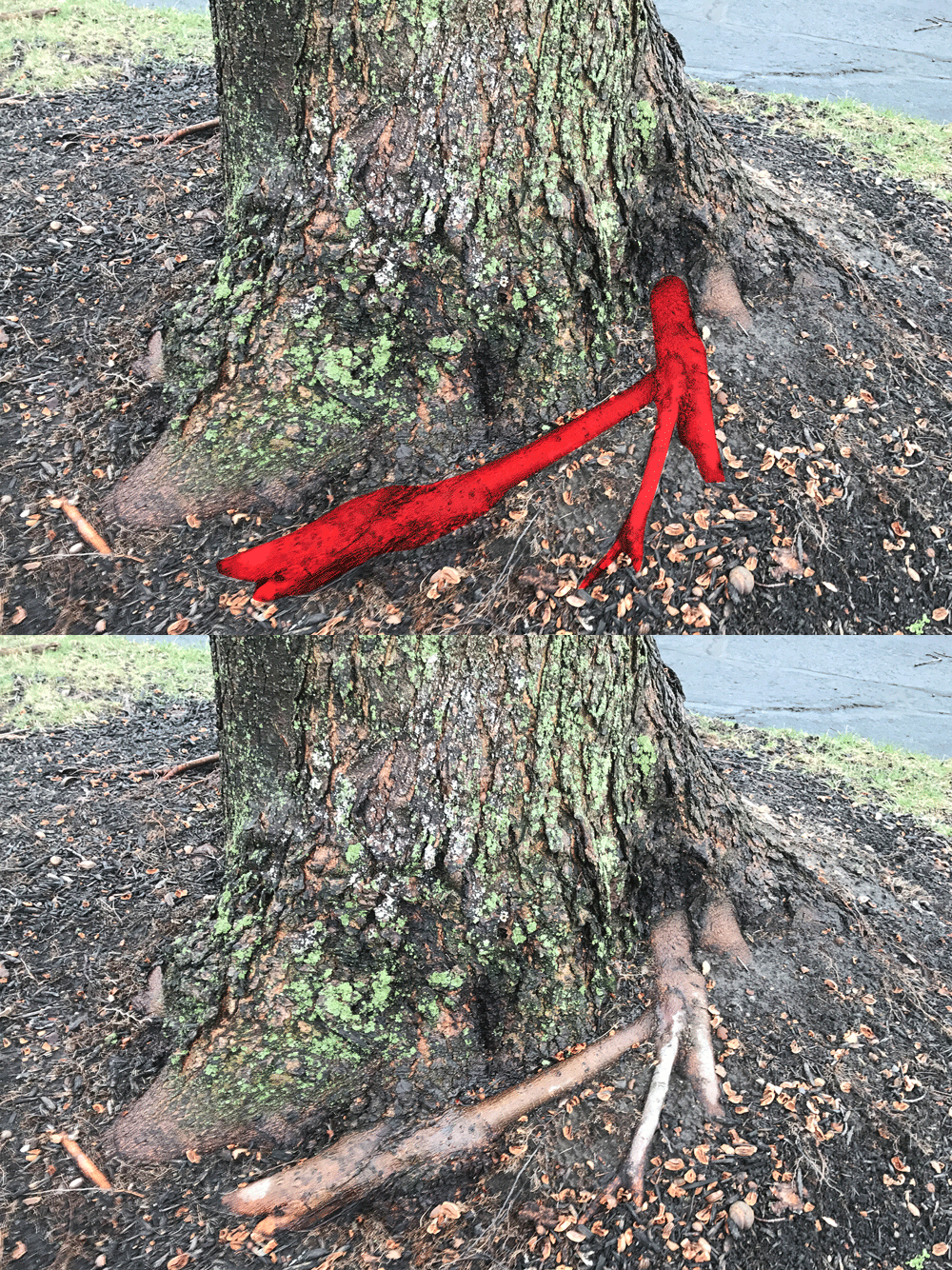
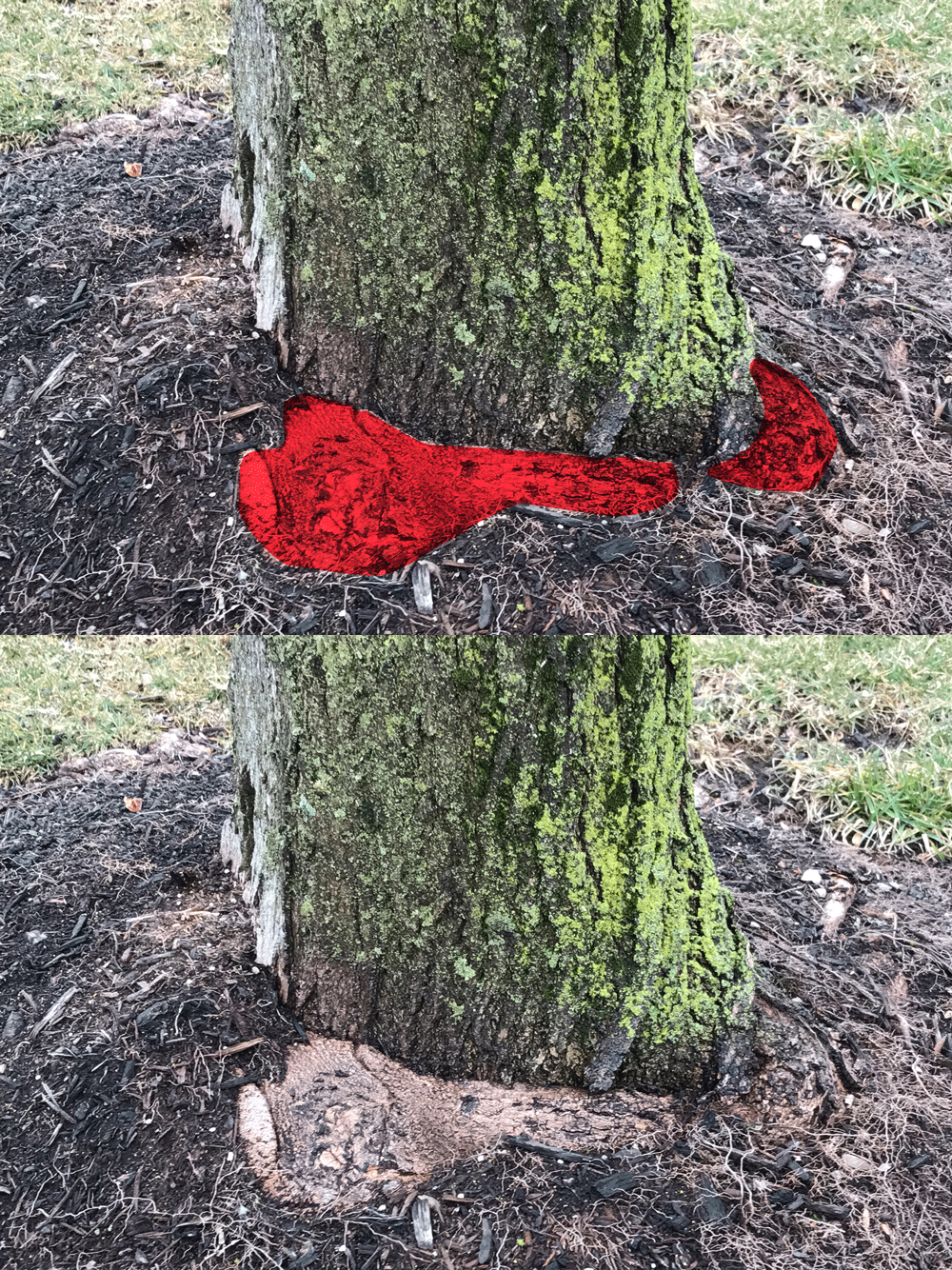
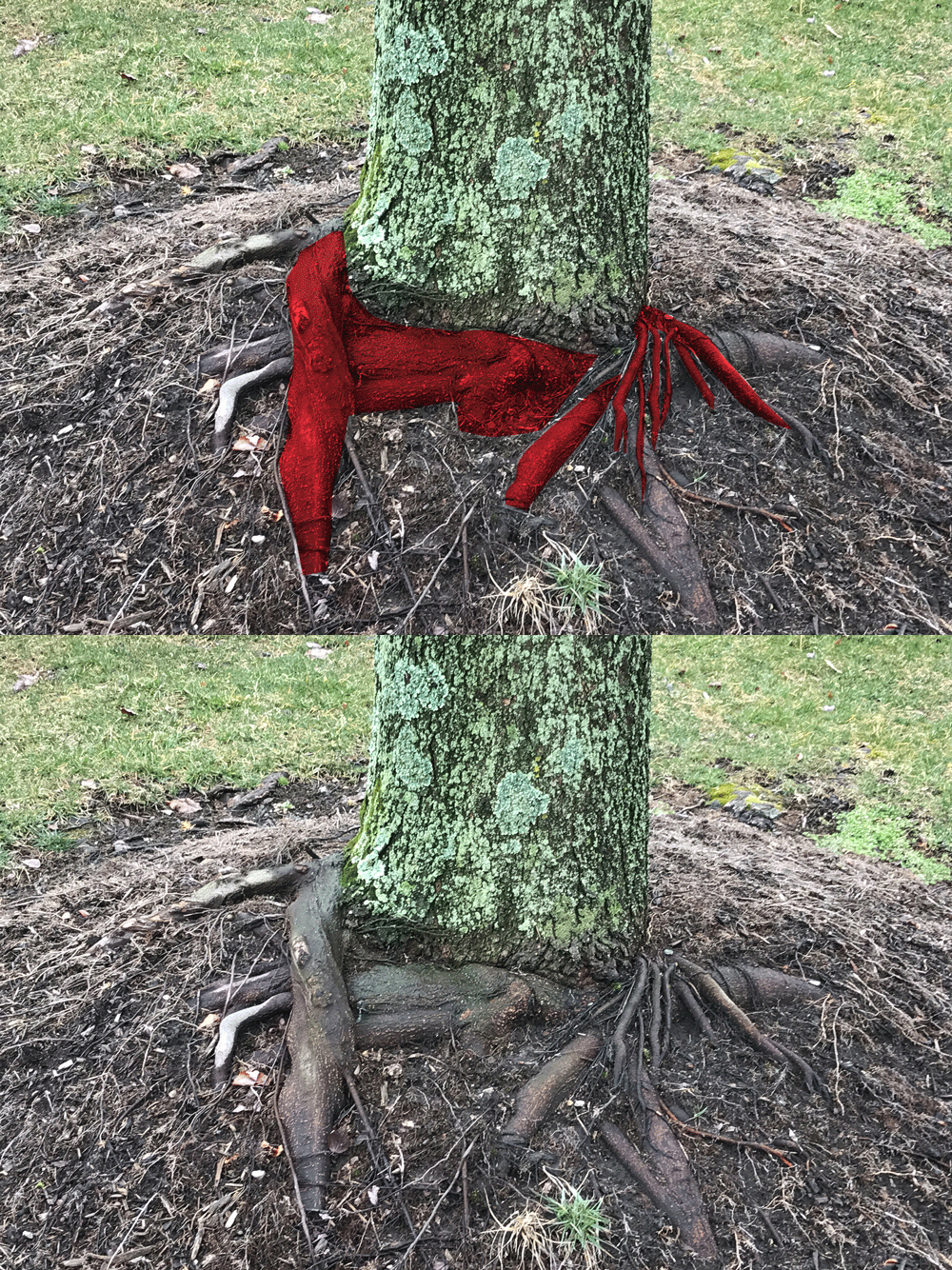
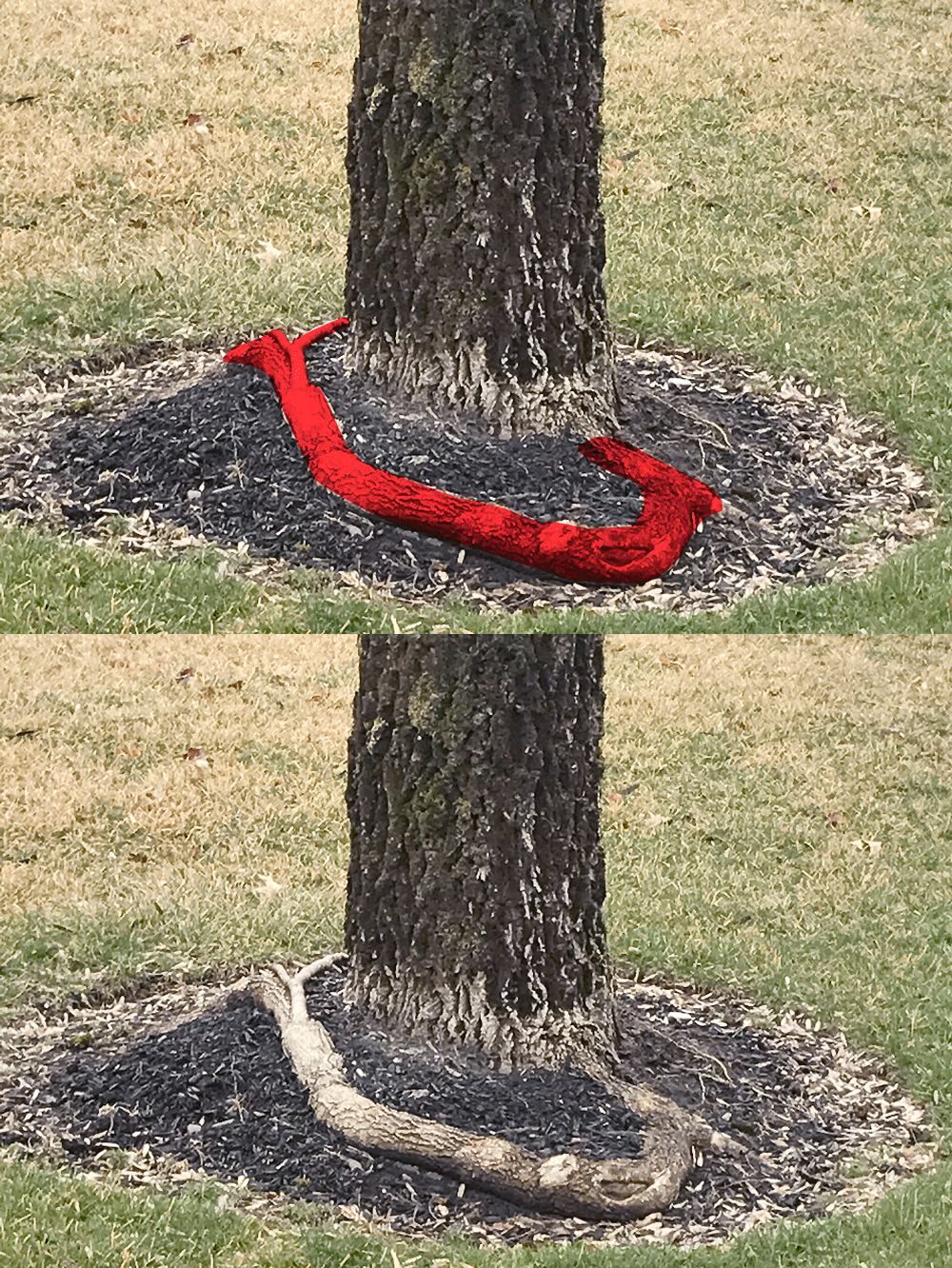
Please note: This article was originally published on 3/28/2018 and was republished on 3/25/2021.
Unfortunately, more and more trees are “growing up” in unnatural environments that force their root systems into confined spaces which leads to the formation of girdling roots. From the start of a tree’s life, girdling roots may be forming. Trees grown in nurseries are forced to grow in small containers. This practice encourages the binding and tangling of roots AKA pot-bound. Poor nursery practices and poor planting practices are the two most common ways girdling roots are introduced into landscapes.
Other “tight spaces” include trees planted near homes, backyard structures, sidewalks, or roads. Even a perfectly placed tree can fall victim to girdling roots by the act of over-mulching its base –a trend that has resulted in the death of many trees by many well-intentioned homeowners
Four Signs of Girdling Root Issues
1. The tree appears to be dying from the top down
2. The tree is late to leaf out in the spring and/or has smaller than normal leaves
3. There are visible roots above the surface circling the trunk:


4. There is no visible root flare:

Good - Root flare is above ground

Bad - Root flare is below the mulch
Why do Girdling Roots Form?
In an attempt to survive, the trees root system branches out in search of nutrients, only to be blocked by nearby structures and are forced to re-direct backward onto themselves, serving as a tourniquet –cutting off the nutrients the tree was so desperately in search of. Root collar excavation serves to identify these “problem roots” before they cause permanent irreversible damage.
How We Fix The Problem
Root collar excavation is a technique used to expose “problem roots” that may be suffocating your tree and cutting off vital nutrient uptake, ultimately leading to the demise of your tree. These “problem roots” are known as girdling roots. Girdling roots are roots that tightly wrap themselves around the base of a tree in an unnatural fashion. A tree root collar (AKA tree root flare) is the area where the first division of roots attaches to the trunk of the tree and is the area where girdling roots form.
Root collar excavation is a process that involves directing high-pressure air at the base of the tree to displace local soil in order to inspect the root system. Once problem roots are identified we begin the process of careful and selective root pruning to remove the unwanted roots while keeping the tree healthy and vigorous.

Step 1
Review the tree to see if any visible roots are wrapped around the base of the tree. Another symptom of girdling roots is die-back starting in the top of the tree.

Step 2
Using an AirSpade, the soil will be blasted to expose the tree’s root system below the surface. Don’t worry, the AirSpade only moves the soil and does not hurt the tree and it’s fibrous roots.

Step 3
The arborist will then identify all the girdling roots and remove them using hand tools and/or a chainsaw.

Step 4
The root zone is then covered with composted mulch and voila! - the tree can “breathe” again!
Contact Russell Tree Experts for Help!
It may be hard to identify girdling roots on your own tree so if you have any questions, our certified arborists at Russell Tree Experts will be happy to inspect your trees. We can perform root collar excavation year-round but we recommend doing this in early spring or late fall as it is healthiest for the tree.
How to Avoiding Girdling Roots
Avoid over-mulching! Avoid those mulch volcanos.
Plan ahead! Pick your planting site wisely, use proper planting practices.
Choose tree species wisely! Some trees are at higher risk of developing girdling roots (ie: Maple, Crabapple, Cherry, and Pear trees).
Neonicotinoid Use in Ornamental Landscape and Effects on Honeybees
Neonicotinoids are chemical products that are effective in systemic control of insect pests in plants. Systemic application of insecticide has multiple advantages over other methods, such as topical applications. When applied systemically, neonicotinoids are absorbed by the plant, and persist for a longer period of time, so that insect pests subsequently feeding on plant parts ingest the chemical and die.
Because of this mode of action, there has been concern about neonicotinoids persisting long enough to be found in plant products such as nectar or pollen, where they could be ingested by foraging bees.
Neonicotinoids are chemical products that are effective in systemic control of insect pests in plants. Systemic application of insecticide has multiple advantages over other methods, such as topical applications. When applied systemically, neonicotinoids are absorbed by the plant, and persist for a longer period of time, so that insect pests subsequently feeding on plant parts ingest the chemical and die.
Because of this mode of action, there has been concern about neonicotinoids persisting long enough to be found in plant products such as nectar or pollen, where they could be ingested by foraging bees.
--
I have been following this topic for several years, collecting various articles that have been trickling in. As licensed commercial applicators, we are trained that “the label is the law”, so pesticide applications to plants are always made according to label instructions. However, there have been claims made about neonicotinoids causing problems for Honeybee populations.
I have personally attended seminars here in Ohio where scientists leading research on neonicotinoid use for controlling invasive insect pests have stated that despite some claims to the opposite, there have been “no documented studies” proving a relationship between neonicotinoid use and Honeybee decline. Since then I have read some articles referring to studies that seem to show a correlation, but no conclusive proof. As an applicator who cares about the welfare of beneficial insects, the lack of conclusive studies is a source of frustration. In fact, the approach I was leaning toward was “if there is a high level of uncertainty, perhaps it is best to seek alternatives for treatment, or to not treat at all”. There is a lot to consider when deciding whether or not to treat a plant chemically, but that topic is beyond the scope of this article.
What is the issue with neonicotinoid use and bees? The reason neonicotinoids are great options for pest control are ease of application, larger windows of application timing, and more targeted applications. Using topical sprays to control pests requires very specific timing (pest usually needs to be present at the time of spray), and there is a risk that other non-target plants may get sprayed (wind drift). Also, non-targeted insects present at the time of application can come into contact with the chemical.
A systemic application is much simpler: no spraying may be required (usually applied as liquid drenches into the soil around the root zone of the target plant, or injected directly into the tree), only insects feeding on plant tissue are targeted, and timing is much less critical since the chemical resides within the tree, eventually breaking down so reapplication is necessary for continued control. And this is the question raised by many concerned people: If the plant tissue has enough chemical to kill insects feeding on the plant, isn’t it possible that the nectar produced by the plant’s flowers will be laced with the chemical as well? So how does this affect bees? These are very reasonable questions, and I agree that they merit consideration.
I was intrigued to see Bernadette Mach (Department of Entomology, University of Kentucky) on the speaker schedule at the Ohio Chapter ISA Tree Care Conference in Columbus, Ohio, this year. Intrigued, because she was speaking on the topic of neonicotinoid levels that persist within a plant after treatment, specifically in nectar. Her talk was in two parts, both of which applied to our concerns as commercial applicators. The first half dealt with her studies on which flowering plants were attractive to bees. The second half was measuring residual levels of systemic chemicals in nectar following application at label rates during different times of the year. Details of her study informing the second half of her talk can be found online (Uptake and Dissipation of Neonicotinoid Residues in Nectar and Foliage of Systemically Treated Woody Landscape Plants).
In short, there were several important details that I came away with:
- Of two chemicals commonly used, one has a lower residual in nectar than the other.
- The timing of the application matters. Applications made post-bloom had a low residual in nectar the following year.
- For some plants, the issue does not matter. For example, Boxwood, in particular, has caused me difficulty. Leafminer is a very common insect pest that can destroy Boxwoods, but it can be readily treated with a systemic application. Last season I began communicating with clients my concern over treating Boxwoods and potential harm to bees. After communicating with Bernadette specifically on this topic, I feel more comfortable continuing with Boxwood treatments as usual. The reason is that Boxwoods are not a plant that attracts bees, so there is a greatly reduced risk that they would feed on the nectar.
As a Certified Arborist and licensed commercial applicator making recommendations to clients, I need to consider each plant prior to treatment. Yes, the client wants to control Magnolia Scale, but should we attempt to do so systemically? Is this plant attractive to bees? If so, should we time the application post bloom? Will this concur with the insect life stage being targeted? What about other options? Can we apply a targeted topical spray that will be effective?
In some cases, nothing more will be possible than to explain to the client the implications of treatment. For example, if the client has a Hawthorn that consistently looks ugly each season when the leaves turn brown and blotchy due to Hawthorn leafminer, I can explain that the best way to control this pest is with a systemic application in the fall (which is essentially pre-bloom) to protect the tree from the pest in spring. This means that there will be higher levels of neonicotinoid in the nectar the following spring, and since bees are attracted to Hawthorn blooms there is a chance they may be affected by the chemical. Leafminer in Hawthorn causes damage that is mostly aesthetic. Once the client considers all this, she may simply choose to leave the tree untreated and deal with some less than perfect leaves.
Ultimately Certified Arborists that are licensed commercial applicators will be making applications based on label recommendations provided by the specific chemical manufacturer. However, we need to follow the thought process outlined above to make responsible decisions, understanding that our choice of which chemical to use when to apply it, and how to apply it may have effects that reach further than simply trying to save one plant, or make it look better.
José Fernández
ISA BOARD CERTIFIED MASTER ARBORIST® OH-5129B
ODA COMM. PESTICIDE LIC. #105859 (Categories 2B, 4A, 6A, Core)
TREE RISK ASSESSMENT QUALIFICATION (TRAQ)
20 NEED-TO-KNOW TREES BY TJ NAGEL
TJ Nagel, ISA Certified Arborist® of Russell Tree Experts, created a list of 20 trees you should know about in Central Ohio. Some are wonderful, must-have trees while others are on the ol' DO NOT PLANT list!

As the weather breaks, this is a time of year that I get a lot of questions from clients about what kind of tree to plant. This is a decision that requires careful thought because there are several factors that can influence the success of a new tree planting.
Selecting the right tree for a particular site the first time is the best strategy for a healthy tree. A healthy tree will avoid costly services down the road like pesticide applications, extra pruning, aggressive fertilizations and potentially removal and starting over.
So this Winter, I spent some time by the fireplace compiling a list of 20 trees that I think central Ohioans should be aware of when buying a tree because it’s an important investment.
Most trees on this list have been selected for urban adaptability and ornamental qualities. Others have been selected because they would make a great street tree. Read through these carefully because not every tree on the list should be considered for your landscape. I have also included a couple of trees that I recommend NOT planting.
Things to consider when selecting the appropriate tree are cold hardiness, provenance, soil quality and nutritional content, sunlight, mature size of the tree and planting site restrictions (structures, utilities, restricted root zones). It is also important to purchase trees from a reputable source.
If you are feeling a bit overwhelmed with the tree selection process, that’s OK – we are here to help.
Hire us for a tree selection consultation and one of our certified arborists can meet with you, inspect the planting site, give you options for the appropriate tree and recommend the appropriate Landscape contractor that plants high quality plant material and plants trees to industry standards.
Remember, choosing the right tree the first time is a lot less expensive than trying to make the wrong tree work. Let us help you do that – you will be rewarded many times over.
CLICK ON A TREE BELOW TO LEARN MORE



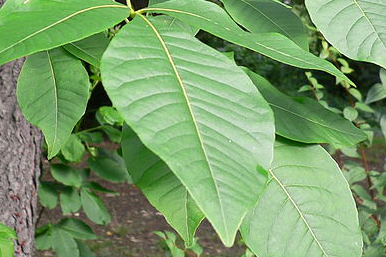


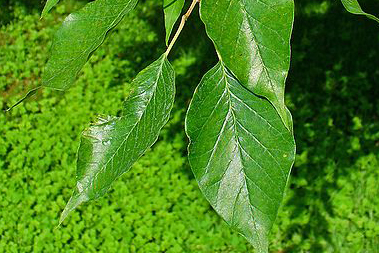
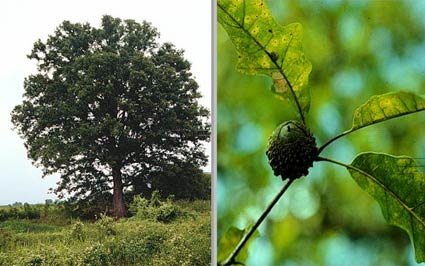

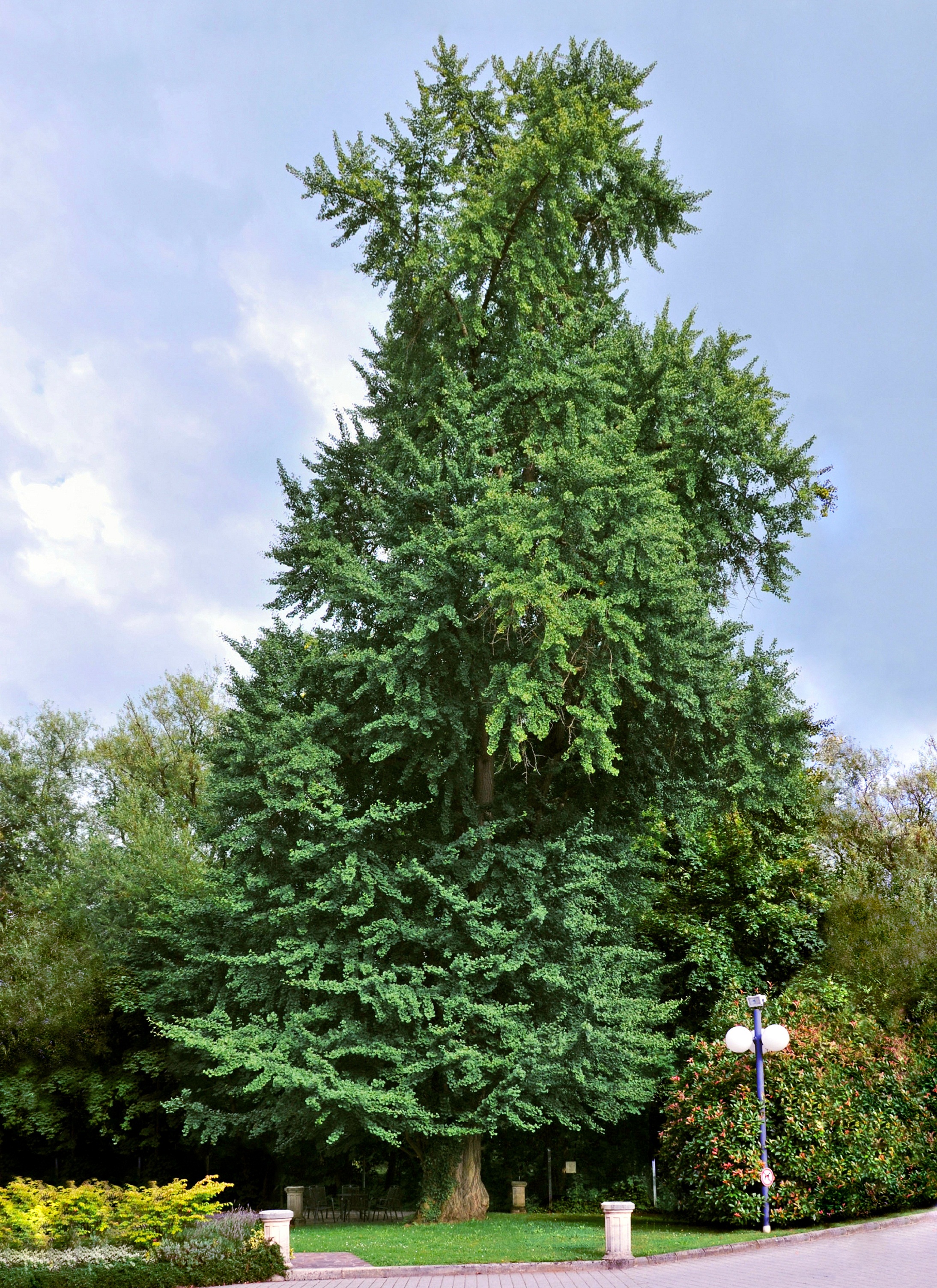


Did You Know Construction Can Kill Trees?
We see it all the time: trees surrounding a newly built home dying as a result of soil compaction and mechanical damage from heavy machinery, as well as change in the native grade affecting soil depth and water flow. A tree preservation plan is needed prior to construction which prioritizes your woody landscape as an important part of your construction project. With a Pre-Construction Tree Preservation Consultation from Arbor Answers, our experts will build a custom plan for your construction site to encourage the trees to thrive following the completion of the project.

We see it all the time: trees surrounding a newly built home dying as a result of soil compaction and mechanical damage from heavy machinery, as well as change in the native grade affecting soil depth and water flow. A tree preservation plan is needed prior to construction which prioritizes your woody landscape as an important part of your construction project. With a Pre-Construction Tree Preservation Consultation from Arbor Answers, our experts will build a custom plan for your construction site to encourage the trees to thrive following the completion of the project.
Options for the Pre-Construction Tree Preservation Consultation:
- On-site meeting to discuss construction plan and desired trees on the property
- Customized plan to help protect your trees during and after construction
- Installation of temporary fencing to give trees proper perimeters (if needed)
- Installation of temporary root zone protection (if needed)
Contact us before you build to maintain the beautiful wooded landscape you desire!
Oak Wilt in Franklin County
Several weeks ago a client called the office about some Red Oaks that were dying, one by one. I arrived at his home in north Columbus and he quickly filled me in on the details: Two years ago one tree died, last year one other tree died (neighbor’s tree nearby) and this year two more trees had died.
Several weeks ago a client called the office about some Red Oaks that were dying, one by one. I arrived at his home in north Columbus and he quickly filled me in on the details: Two years ago one tree died, last year one other tree died (neighbor’s tree nearby) and this year two more trees had died.
After inspecting the site I found the mature Red Oak were within about a 50’ diameter area, and were all defoliated. One tree still had some dead leaves attached to limbs high in the canopy as well as some sprouts in the inner canopy with a few remaining green leaves. The site was a nice stand of native woods surrounding a ravine area that spans across the rear of multiple properties.
I inspected the base of the tree and found some weeping spots at the base of the trunk on two of the trees:
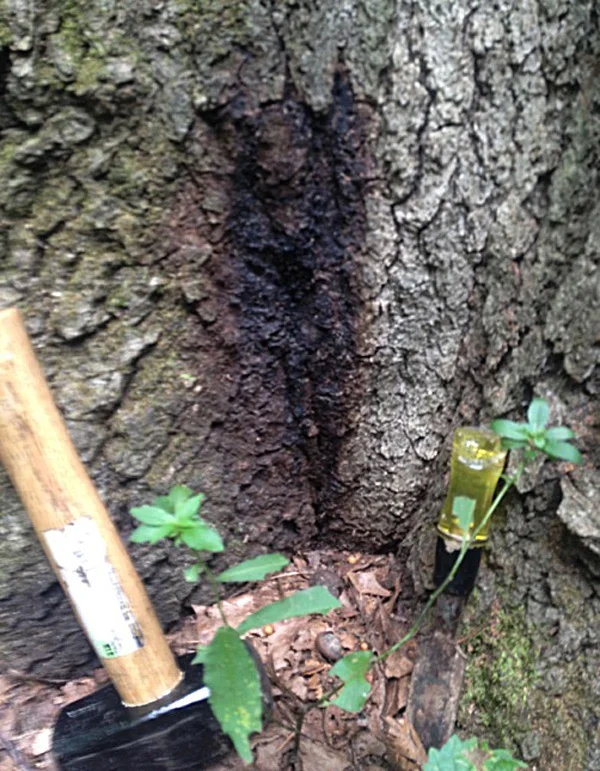
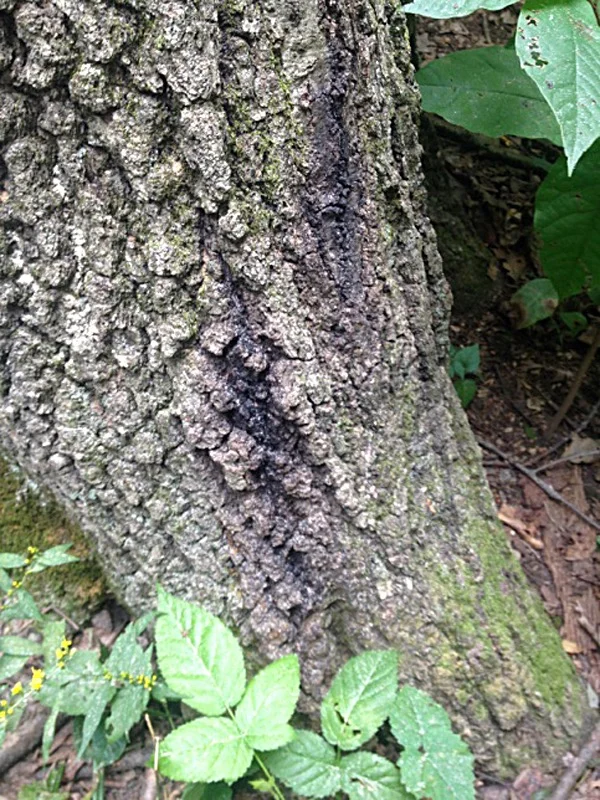
There were a couple of areas with vertical cracks oozing black seepage. These symptoms, coupled with the fact that the trees had died quickly, brought a couple of ideas to mind, but I wanted to sample the trees and send them to the lab for a proper diagnosis as all the things I was thinking of were very serious. The client had done some research on his own and suspected Oak Wilt. I had not heard of this in our area, although I was aware that this is a problem north of the Columbus area.
Samples were retrieved from the middle canopy, selecting two branches that had both dead and live leaves in hopes that a transitional section could be sampled. After several weeks, the C. Wayne Ellett Plant and Pest Diagnostic Clinic (The Ohio State University) was able to identify the fungus Ceratocystis fagacearum which causes Oak Wilt.
Please follow this link for the Ohio State University Extension Fact Sheet on Oak Wilt, where the information summarized below is drawn from.
The implications of this are serious. All oak varieties are susceptible, and Red Oak seem to be particularly vulnerable.
The disease can be spread both by root grafts (roots from neighboring trees growing together) and by sap feeding beetles and possibly oak bark beetles. Because it spreads in two ways, two approaches are needed to stop the spread of the disease.
The beetles that are vectors for the disease area attracted to fresh wounds on Oak trees, so pruning of Oaks during the growing season when the beetles are active is not recommended. A pruning wound will attract these beetles, and if they have been feeding on infected trees, the healthy trees will be subsequently infected.
To prevent infection from tree to tree, trenching between trees is recommended to sever any root grafts. This is not always feasible depending on soil type and tree location, and trees must be accessible with proper equipment.
A fungicidal trunk injection can be applied preventively to healthy trees in order to help protect them from infection. The treatment needs to be reapplied every one to three years in order to maintain its efficacy.
In Closing: I have an Oak tree. What does this mean for me?
- For maximum safety, do not allow your tree to be pruned during the growing season when beetles are active.
- If your tree is a vital part of your landscape, consider a trunk injection to increase the odds it will not be infected.
- If your trees are infected and need to be removed, make sure the Certified Arborist doing or directing the work knows how to dispose of the material to prevent spreading the fungus.