
What's Wrong with my Sycamore & Maple?
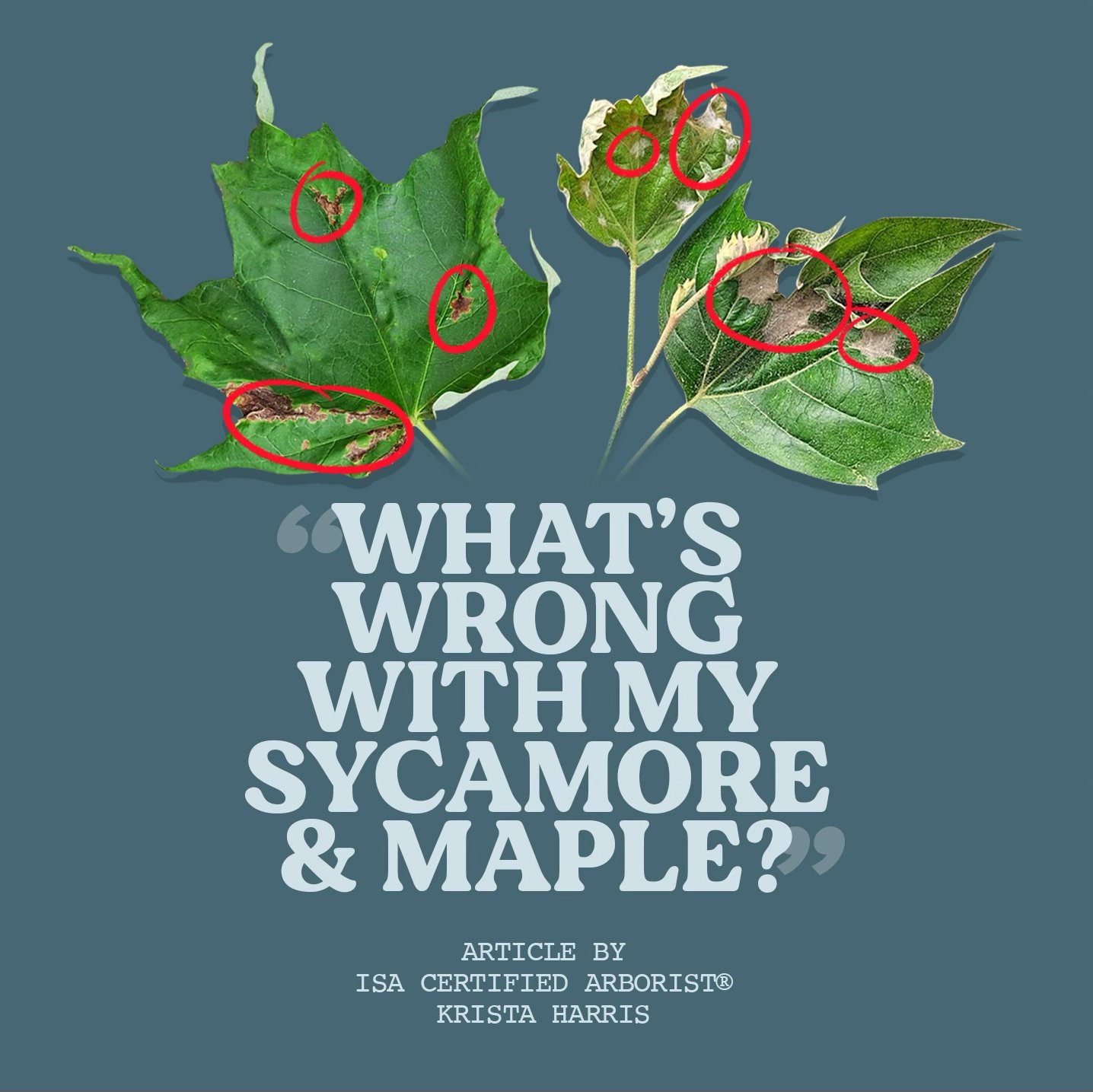
"Why does my beautiful maple have ugly black spots on its leaves?" "Why is my American sycamore bare this year” …To answer these questions, we need to go back to a chilly, wet evening 5 weeks ago. On May 5th, the temperature dropped overnight to 41 degrees just after an early morning shower that day. We continued this cool, wet trend for 10 lousy days, and…
©Russell Tree Experts
"Why does my beautiful maple have ugly black spots on its leaves?""Why is my American sycamore bare this year?"By Krista Harris
ISA Certified Arborist® OH-6699A
May 22, 2025
Anthracnose fungus attacks newly emerging leaves in the spring when the weather is just right for disease development. The symptoms vary from host to host, but typically infected leaves will have irregular dark spots along veins. Eventually, the leaf will curl, die, and fall. In the case of the sycamore, often the leaf buds are killed before they have even had a chance to emerge.
[Sugar Maple leaf before and after anthracnose fungus]
©Russell Tree Experts
Anthracnose fungus affects many deciduous trees and seems to be most noticeable this year on sycamore and maple in our area. I have had at least 10 customers per week concerned that their beloved trees were dying due to this fungus. I have also been driving by my favorite American sycamores around my home, only to find them very sparsely leafed and struggling. This includes Upper Arlington's oldest tree, an amazing 3 stemmed beauty that our team pruned a few months ago.

©Russell Tree Experts
[American Sycamore leaves with anthracnose fungus]Thankfully, I have wonderful news for the stewards of these afflicted trees. Anthracnose is a cosmetic disease for the majority of trees! If the tree is otherwise healthy and well established, it will be just fine. It will replace those lost leaves in July when conditions no longer favor anthracnose development.
How can you help trees with this seasonal infection?
Water your trees during our hot, dry summers! Concentrate the water at the ground level only, do not splash the leaves. All trees will appreciate the extra water, but those that have lost their leaves and are attempting to replace them will relish it! ARTICLE: HOW TO WATER YOUR TREES
Prune your trees for better air circulation and light penetration. This will help the leaves dry faster and it will be harder for the fungus to spread.
Dispose of affected leaves so that the spores are not hanging around next year to re-infect your tree.
Consider fertilizing your trees in the spring so that they have the needed nutrients to stay healthy (and possibly put on 2 sets of leaves if it is another good year for anthracnose infection).
Above all, do not panic! We cannot control the weather or the fungus. Just concentrate on overall tree health and by mid-summer, the trees will have recovered and this disease will be just a bad memory. For a free tree quote by one of our 20+ ISA Certified Arborists®, visit RussellTreeExperts.com/Quote or speaker to our friendly, local office staff at (614) 895-7000!
Please note: This article was originally published on 6/14/2021 and was revised on 5/22/2025.
ADDITIONAL ARBOR ED™ ARTICLES!


Krista Harris | Journeyperson, Russell Tree Experts
Krista grew up in the central Ohio area and became an ISA Certified Arborist® in 2017. She graduated from The Ohio State University with a Bachelor of Science in Crop Science and a minor in Plant Pathology in 2000 and has been in the green industry ever since. Her favorite trees are the American sycamore, American beech, and giant sequoia. [BS in Horticulture Crop Science, The Ohio State University / ISA Certified Arborist® OH-6699A / ODA Comm. Pesticide Lic. #148078]
Pruning Upper Arlington's Oldest Tree
We are honored that The City of Upper Arlington entrusted our arborists to prune their oldest tree - a towering, beautiful American sycamore. This massive tree is around 100 feet tall, 90 feet wide, and likely over
First, check out the above video — then read below! :)
By Enrique Arayata
ISA Certified Arborist® OH-7252A
March 18, 2021
While working on a street tree pruning project with Upper Arlington, Ohio, where we are pruning approximately 2,500 trees, we had the opportunity and pleasure to prune, according to the Upper Arlington, Ohio Tree Commission, the oldest tree in Upper Arlington: an American sycamore tree (Platanus occidentalis) approximately 100 feet tall and approximately 90 feet wide. It is unclear how old this ancient tree is, but when reaching out to my fellow coworker ISA Certified Arborist Walter Reins, he approximated that this tree is likely over a century old. This tree took half a day to prune as ISA Certified Arborist Mac McGuire skillfully pruned this tree using a bucket truck to remove deadwood, diseased limbs, broken branches, and hangers. Elevation pruning was also performed over Cambridge Boulevard to provide proper clearance for vehicles traveling on the road below. Through years of proper care and periodic pruning, this American sycamore has been able to reach its full potential and grow to this enormous size.
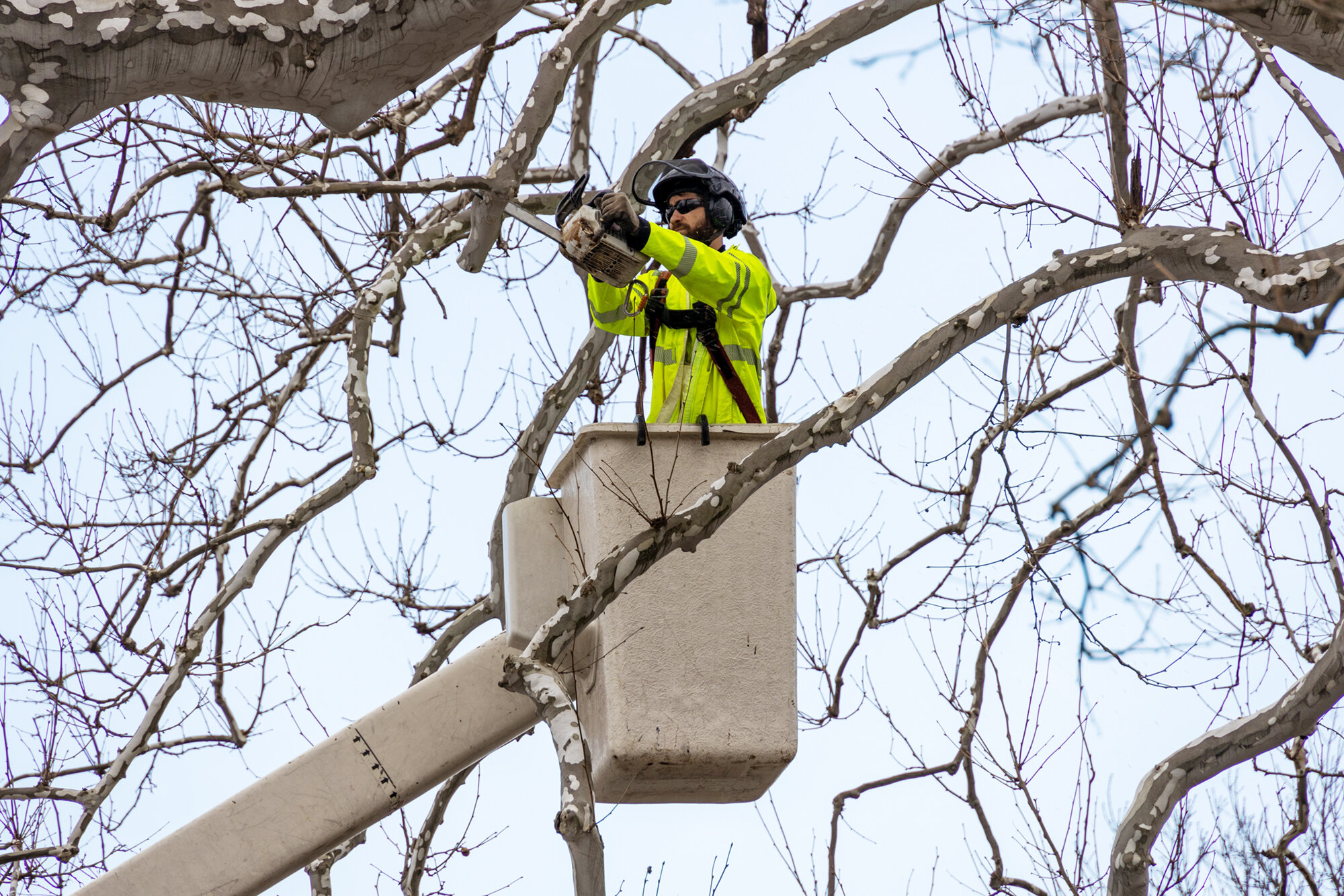
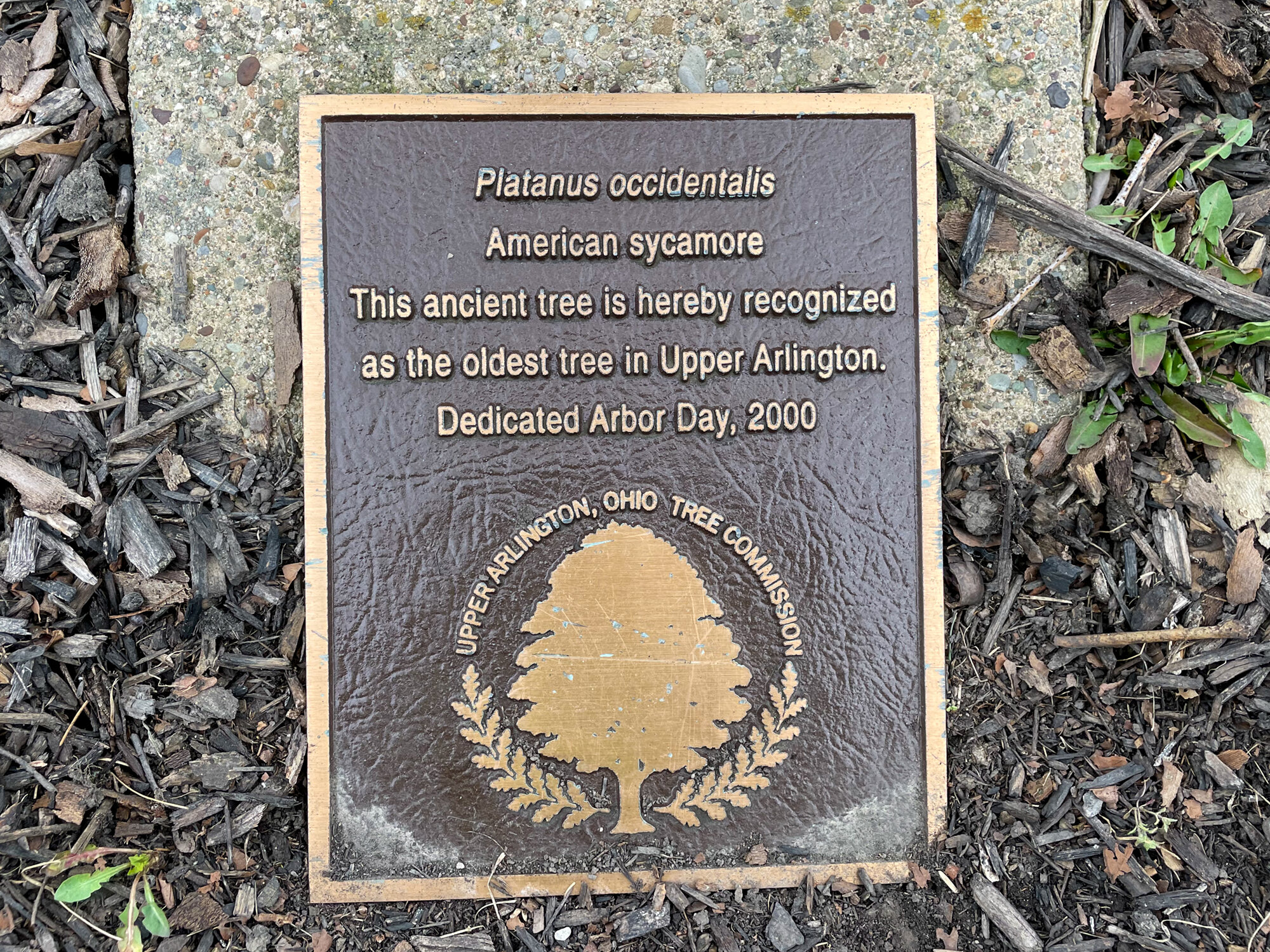
The American sycamore tree (Platanus occidentalis) is native to Ohio and can typically grow to a height and spread of up to 75 to 100 feet. The tree prefers and grows best in partial to full sun and in moderately to well-drained soils. Along with being native to Ohio, the American Sycamore can be natively found anywhere ranging from zones 4 through 9 on the eastern half of the United States (see map below).

Hardiness Zone Map Courtesy of the Arbor Day Foundation
In nature, one can often find this tree along creeks and rivers. They can be identified by their tall height and unique bark, featuring a camouflage-like pattern of green, tan, and white. Its leaves can have truncate or cordate bases with three to five lobes, loosely resembling a maple leaf. Alongside the leaves are round fruit approximately 1.5 inches in diameter that are attractive to birds. Potential issues that arise from the American sycamore are anthracnose, a fungus that can destroy emergent leaves in the spring, hollow trunks that can be prone to storm damage, and overgrowth in tight, urban areas that may call for pruning or removal.
We are honored to help contribute to the long-term health of Upper Arlington Ohio’s oldest tree. We are excited to see what other interesting trees we encounter while continuing on with our street tree pruning project! Check out this amazing tree by visiting the corner of Cambridge Boulevard and Yorkshire Road in Upper Arlington, Ohio!
Sincerely,

Enrique Arayata I Media Production Manager, Russell Tree Experts
Enrique is an ISA Certified Arborist® and FAA Certified Remote Pilot. In his free time, he enjoys working out, hanging out with his family and girlfriend, video production, photography, cars, technology, and cooking. Enrique has a BA in moving image production with a double minor in film studies and studio art specializing in photography from The Ohio State University, and an AA in web graphic design from DeVry University. His favorite tree is the Kwanzan cherry tree.
Trees that Love Wet "Feet"
“Who Will Stop the Rain?” — I think a lot of us have been wondering this lately. After seeing problem after problem at almost every property I have visited recently, I decided to write about trees that like wet feet.
“Who Will Stop the Rain?” — I think a lot of us have been wondering this lately. After seeing problem after problem at almost every property I have visited recently, I decided to write about trees that like wet “feet.”
I myself have a very wet back yard. After visiting Louisiana several years ago I came to know one of my favorite trees for wet locations. We took several boat rides into the swamps and bayous where we were introduced to the Bald cypress (Taxodium distichun). My wife’s uncle Roland had some favorite spots where the knees growing from the root systems were unbelievable, some reaching up to 2’ high.

Bald cypress “knees” growing out of the ground from the root system
© Russell Tree Experts
It is thought that the knees produced by the Bald cypress are actually a function of the root system to acquire oxygen. The tree is often mistaken for an evergreen. It is actually a deciduous evergreen. Each fall when they acquire their amazing fall color, I am often asked if they are dead. They become a beautiful orange to rust color each fall.
Here is another photo that I took on the San Antonio river walk which shows just how adaptable this tree can be. It is growing in a 5’ tree lawn where it grew to be over 4’ in diameter and well over 70’ tall. It does have an unlimited water supply in this situation.

© Russell Tree Experts
My favorite ornamental for wet locations happens to be a Red Buckeye (Aesculus pavia). I have one in my backyard that puts on a tremendous show each spring with its red blooms. The buckeyes that it produces seem to be a lighter shade than traditional buckeyes and actually show a little bit of wood grain in the nut.
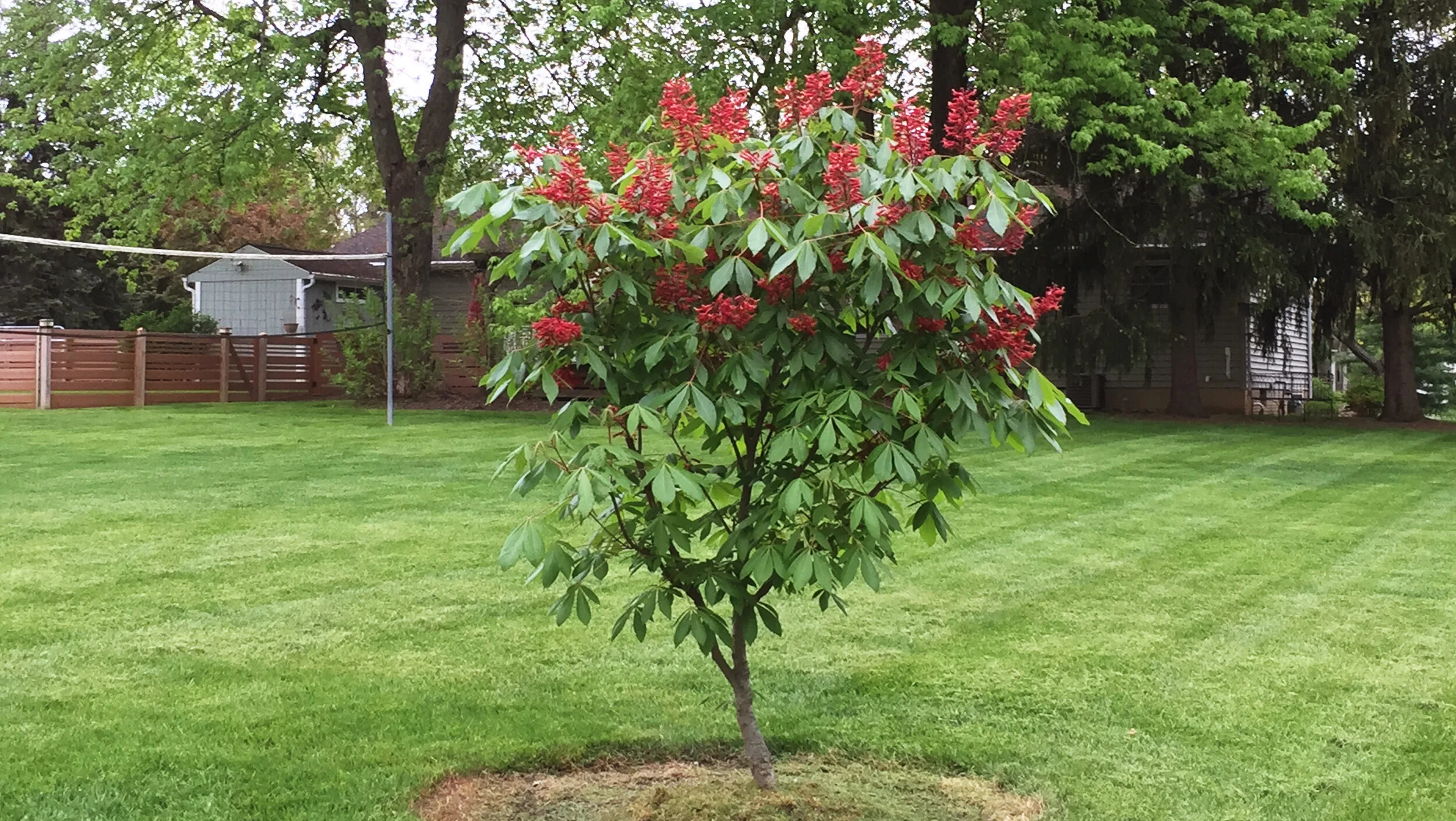
Red Buckeye (Aesculus pavia)
© Russell Tree Experts
A couple of other small ornamentals that can handle wet areas would be the Sweetbay Magnolia (Magnolia virginiana) and the Pawpaw (Asimina triloba). The Sweetbay which blooms later in the spring than other varieties, is not quite as showy, but makes up for it with their scent. The Pawpaw is known for the fruit that it produces. See a previous article written by Jose Fernandez to learn more about the Pawpaw.
A couple of trees that you can find growing naturally along our river banks and streams would be the River birch (Betula nigra) and the American Sycamore (Platanus occidentalis). Both are loved for the year round appeal of their bark. The Sycamore can become quite large and should be properly sited. We often find River birch planted in the wrong location as well. Their root systems can become quite aggressive in search of water.
If you have a pond or small stream and plenty of room there is always the Weeping willow (Salix babylonica). People have always loved its graceful habit, but like other trees on this list it must be properly sited. Another favorite seems to be the Red Maple (Acer rubrum) but as we learned from TJ Nagel in a previous article, you need to be careful where you plant Red Maple due to incompatible soils in much of central Ohio. They do have amazing fall color though and tolerate wet conditions if properly sited.
A couple of native trees that also produce amazing fall color are the Black gum (Nyssa sylvatica) and the Sweet gum (Liquidambar styraciflua).
And last there are a couple of trees in the oak family as well that tolerate wet conditions. There is the Willow Oak (Quercus phellos) and the Swamp White Oak (Quercus bicolor) which are both beautiful and long lived trees if planted in the right location.
Although many of these trees can be considered nuisance trees if not properly sited, they all can be beautiful if planted where they are meant to be.
If you have lost trees recently due to fungal issues or site conditions in the last few years, please take the time to speak with an arborist about the right tree for the right location.
Sincerely,

Mike McKee | Regional Manager, Russell Tree Experts
Mike graduated from Hocking College in 1983 with a degree in Natural Resources specializing in urban tree care. He has been a certified arborist since 1991. Mike started his career in the private industry in 1985 before becoming a municipal arborist in1989. He retired after serving thirty years before joining us at Russell Tree Experts in Sept. of 2018. His love of trees has never waned since trying to climb up the ridges of the massive Cottonwood tree in front of his childhood home.