
Trees that Love Wet "Feet"
“Who Will Stop the Rain?” — I think a lot of us have been wondering this lately. After seeing problem after problem at almost every property I have visited recently, I decided to write about trees that like wet feet.
“Who Will Stop the Rain?” — I think a lot of us have been wondering this lately. After seeing problem after problem at almost every property I have visited recently, I decided to write about trees that like wet “feet.”
I myself have a very wet back yard. After visiting Louisiana several years ago I came to know one of my favorite trees for wet locations. We took several boat rides into the swamps and bayous where we were introduced to the Bald cypress (Taxodium distichun). My wife’s uncle Roland had some favorite spots where the knees growing from the root systems were unbelievable, some reaching up to 2’ high.

Bald cypress “knees” growing out of the ground from the root system
© Russell Tree Experts
It is thought that the knees produced by the Bald cypress are actually a function of the root system to acquire oxygen. The tree is often mistaken for an evergreen. It is actually a deciduous evergreen. Each fall when they acquire their amazing fall color, I am often asked if they are dead. They become a beautiful orange to rust color each fall.
Here is another photo that I took on the San Antonio river walk which shows just how adaptable this tree can be. It is growing in a 5’ tree lawn where it grew to be over 4’ in diameter and well over 70’ tall. It does have an unlimited water supply in this situation.

© Russell Tree Experts
My favorite ornamental for wet locations happens to be a Red Buckeye (Aesculus pavia). I have one in my backyard that puts on a tremendous show each spring with its red blooms. The buckeyes that it produces seem to be a lighter shade than traditional buckeyes and actually show a little bit of wood grain in the nut.
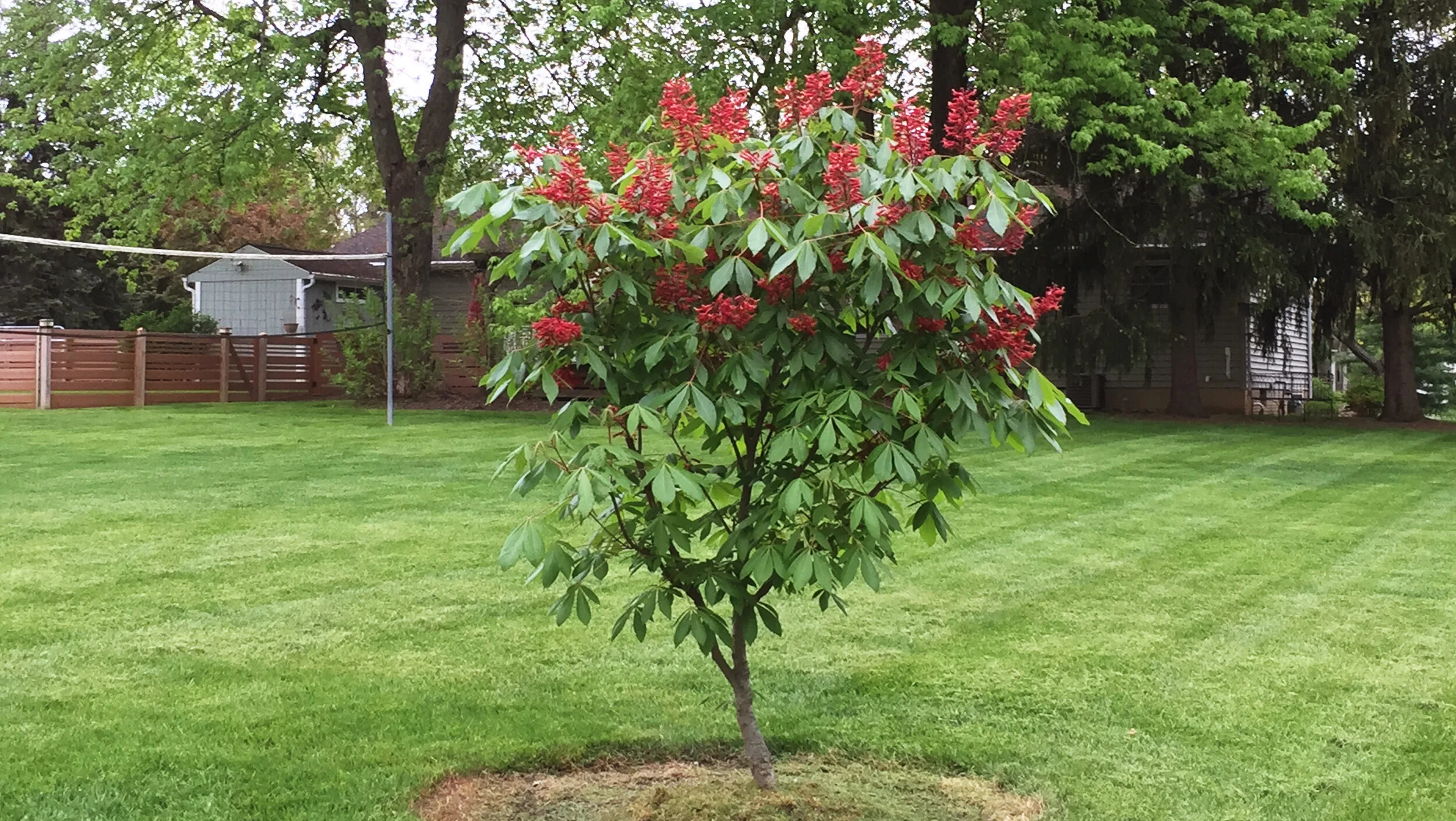
Red Buckeye (Aesculus pavia)
© Russell Tree Experts
A couple of other small ornamentals that can handle wet areas would be the Sweetbay Magnolia (Magnolia virginiana) and the Pawpaw (Asimina triloba). The Sweetbay which blooms later in the spring than other varieties, is not quite as showy, but makes up for it with their scent. The Pawpaw is known for the fruit that it produces. See a previous article written by Jose Fernandez to learn more about the Pawpaw.
A couple of trees that you can find growing naturally along our river banks and streams would be the River birch (Betula nigra) and the American Sycamore (Platanus occidentalis). Both are loved for the year round appeal of their bark. The Sycamore can become quite large and should be properly sited. We often find River birch planted in the wrong location as well. Their root systems can become quite aggressive in search of water.
If you have a pond or small stream and plenty of room there is always the Weeping willow (Salix babylonica). People have always loved its graceful habit, but like other trees on this list it must be properly sited. Another favorite seems to be the Red Maple (Acer rubrum) but as we learned from TJ Nagel in a previous article, you need to be careful where you plant Red Maple due to incompatible soils in much of central Ohio. They do have amazing fall color though and tolerate wet conditions if properly sited.
A couple of native trees that also produce amazing fall color are the Black gum (Nyssa sylvatica) and the Sweet gum (Liquidambar styraciflua).
And last there are a couple of trees in the oak family as well that tolerate wet conditions. There is the Willow Oak (Quercus phellos) and the Swamp White Oak (Quercus bicolor) which are both beautiful and long lived trees if planted in the right location.
Although many of these trees can be considered nuisance trees if not properly sited, they all can be beautiful if planted where they are meant to be.
If you have lost trees recently due to fungal issues or site conditions in the last few years, please take the time to speak with an arborist about the right tree for the right location.
Sincerely,

Mike McKee | Regional Manager, Russell Tree Experts
Mike graduated from Hocking College in 1983 with a degree in Natural Resources specializing in urban tree care. He has been a certified arborist since 1991. Mike started his career in the private industry in 1985 before becoming a municipal arborist in1989. He retired after serving thirty years before joining us at Russell Tree Experts in Sept. of 2018. His love of trees has never waned since trying to climb up the ridges of the massive Cottonwood tree in front of his childhood home.
Test Before Treatment: Soil & Tissue Testing
I find it interesting that test procedures recommended in the medical field for human health have become part of the expected methodology, but not so much in arboriculture, for tree health. As arborists, we are trained that a soil test should be done prior to recommending fertilization, for example, but I don’t know of many outfits that make soil sampling a part of their modus operandi.

©Russell Tree Experts
Test Before Treatment
I find it interesting that test procedures recommended in the medical field for human health have become part of the expected methodology, but not so much in arboriculture, for tree health. As arborists, we are trained that a soil test should be done prior to recommending fertilization, for example, but I don’t know of many outfits that make soil sampling a part of their modus operandi. On the other side of the equation, many clients will choose not to do a soil or tissue sample when presented with the option, perhaps because of budgetary reasons. I think it is time this started to change, because knowledge of a problem is the first step toward the solution. Given an unhealthy tree, I might suspect what the problem is, but unless it is one that is readily identifiable in the field, I would rather start with the sampling than attempt a treatment.
Click here to see the 9-step soil testing process!
Fertilization is one instance where a soil sample, at minimum, should be taken. For fertilization, a tissue sample would also be good, for reasons I will get into shortly. Another instance when plant samples are usually taken is when a problem is not readily identifiable in the field, and the problem is not so developed that treatment is still a viable option. A third instance where sampling is necessary is to rule out the possibility of a disease which could spread to neighboring healthy trees. In this case even dead plants may be sampled to detect the presence of one of these pathogens if possible, and to know how to dispose of the dead plants properly.
Fertilization
In general, “tame” trees and shrubs in finished landscapes benefit from fertilization because they are growing in conditions that do not resemble where they would be growing if they were “wild”. I may not need to sample the soil in an urban landscape to know that usually the addition of organic matter is going to benefit the trees, along with the nitrogen that composted organic matter provides for growth. Also, I know that most of the soil we find in the Columbus area is a limestone based, heavy clay soil. This particular bit of knowledge has led to some confusion in particular tree treatments I am about to discuss. (If you have Pin Oak, River Birch, Maple, Sweetgum, or Sweetbay Magnolia on your property, read this section if nothing else!!) Arborists have traditionally been taught that chlorosis (yellowing foliage) in these trees is due to either a deficiency of iron or manganese in our heavy clay soils. If the tree is a Pin, Red, Shingle, or Sawtooth Oak, you treat it with iron. If the tree is a Maple or a Sweetgum, treat it with manganese. At this point in my life I don’t recall what the recommendation was for the other trees. Why not?
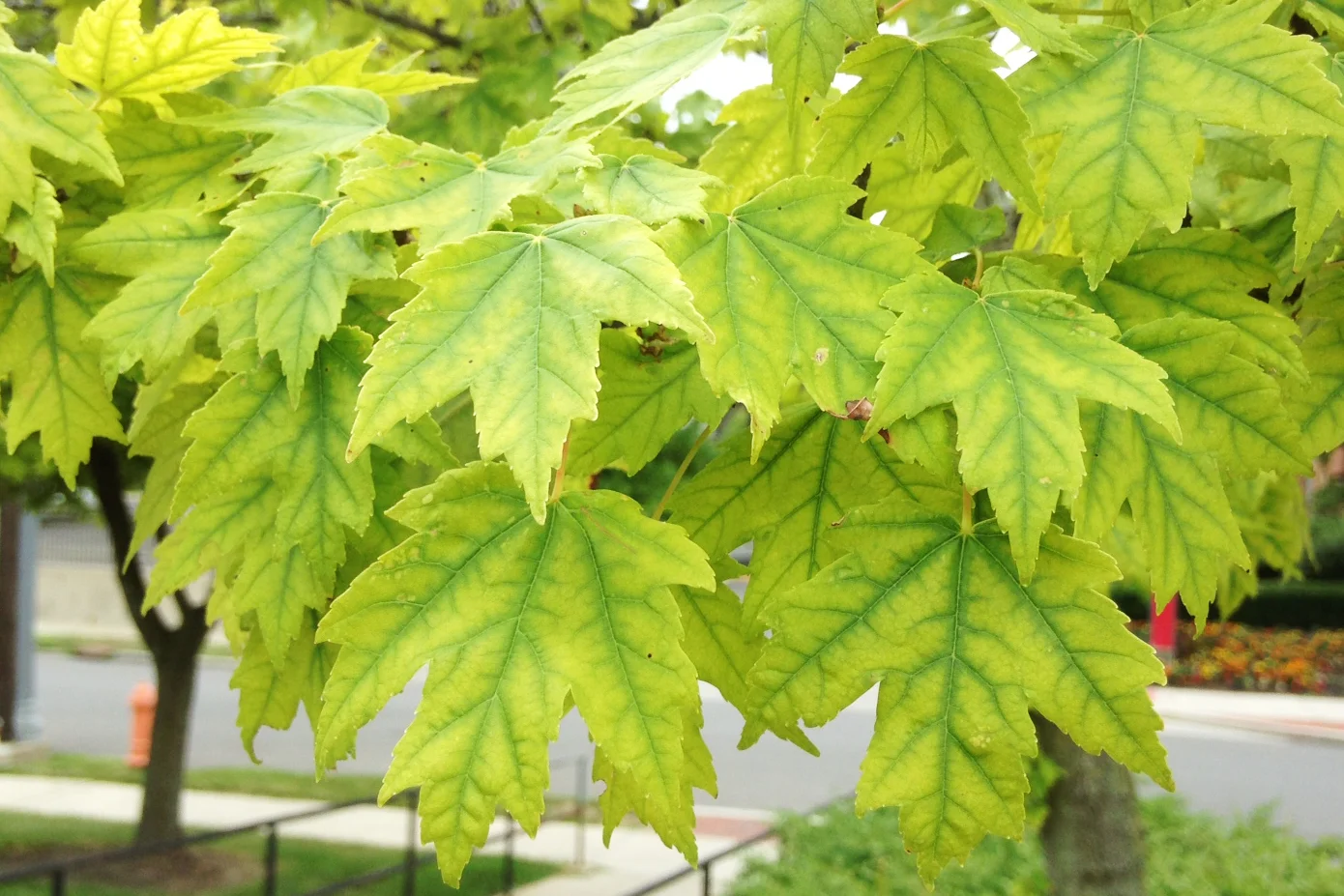
Chlorosis in a Red Maple
©Russell Tree Experts

Chlorosis in a River Birch
©Russell Tree Experts
After years of treating trees this way with very mixed results, I had the good fortune of meeting Dr. Darrah at CLC LABS. His findings over the years for our Columbus soils, related to chlorosis in these trees, have been that the problem is nearly always a manganese deficiency. To make matters even worse, giving iron to a tree that has a manganese deficiency appears to make the manganese deficiency even more pronounced. To this day I continue to be filled with satisfaction when I drive past a tree that was not responding to year after year of iron treatments, in the soil and with trunk injections and implants, to no avail, by someone else. Then, after sending soil and tissue samples to the lab, we found a surplus of iron and a dearth of manganese. The remedy? Treat aggressively with manganese. Sometimes the result is immediate, most times we see a turnaround after 2-3 seasons of treating appropriately. But what a satisfying feeling to know that we have figured out what the problem was, and now the symptoms are being reversed! To be clear, the satisfaction does not come from knowing we were right and someone else was wrong! It comes from seeing a tree that was in decline start to come back to life.
Click here to see Dr. Darrah at CLC LABS perform soil testing!
When I encounter chlorotic foliage in trees now, my top suspect for nutrient deficiency is manganese. If a tree is only beginning to show symptoms, I may recommend manganese to see if it turns around. If it does not turn around, we can sample to see what the issue is. Why take this backward approach? Maybe because I have a subconscious fear that a client may feel that I am just trying to sell additional services that are not needed. Especially if the other two arborists (from other companies) she spoke to “never recommended sampling”. And in her mind she may be thinking “Why does this arborist need to take samples? Can’t he tell what the problem is? And anyway, the other arborists said the issue was iron, not manganese.” So, since I know there is a very high chance the problem is manganese, that’s what I will recommend.
BUT, there have been a very small number of samples that came back showing some other micronutrient deficiency (or surplus), that was critical for knowing what the best treatment approach was. And this is why sampling should always take place first. I pledge to offer that as the first step in a treatment plan to each client with a sickly tree. At least then I will have done my due diligence.
As a final note for fertilization, if the time of year is right, a tissue sample is great for getting a more complete picture of what is happening in the tree. By comparing soil to tissue, we can see what is available to the tree and what is actually inside the tree. This helps with diagnosing the cause for symptoms.
Sampling for disease diagnosis, live or dying trees
There are many diseases arborists can positively identify in the field if properly trained, and they should be able and willing to show the client what they are seeing, and why it needs to be treated (or not). I still find insects that pop up sporadically that I have never seen before. Usually I can pull out the reference books back at the office and find the pest or pathogen, but if I fail at that, it is time to take a sample to the clinic. Even if an arborist had exhaustive knowledge for field identification of diseases (which is a tall order), there are certain diseases that require a specialized lab for a positive identification. In the case of live trees, one may decide that sampling is not needed due to how advanced the symptoms are. If the tree is not salvageable, perhaps sampling is not the best use of funds. But if the symptoms are those that could be of an infectious nature, threatening other live trees, sampling is paramount, and should be done promptly. Let’s look at Oak Wilt, for example.
Several years ago, Russell Tree Experts submitted the first positively identifiable sample of this disease taken from a tree in Franklin County. The year prior, a consulting arborist had turned in a positive sample from a tree in Delaware County. Oak Wilt is a disease that was known in the northeastern counties, and we were sad to see it moving into our neighborhood. However, had we not taken the samples, we would not have known the steps to take to properly dispose of the dead trees, inoculate the surrounding live trees at high risk of infection, and try to get the word out to the local arborist community. That was several years ago. Since then, more and more arborists have had positive samples, but to my chagrin, I still run into trees that I am fairly certain died of Oak Wilt but were removed willy nilly by “arborists” who maybe never even thought why the Red Oak went from live to dead in a matter of days. It takes time for word to get around, and it takes tree owners who are concerned about their trees.
I am happy to say there are several reputable, trustworthy tree care companies in the Columbus area whom I am proud to count as colleagues (and I hope they feel the same way about us!). This provides discerning clientele with plenty of good options to choose from. I am also very happy that more and more people are realizing how important the care of trees and plants is – not just for the love of their own back yard, but for the good of their neighbors. How do I know you are out there? Because you take the time to read these thoughts that flow out of my fingers into the keyboard. As I write this, early evening is coming on. I am looking out my window across a field divided by a small stream. Green grass in the foreground flows to the border of the stream, outlined in buckthorn turning yellowish green, brilliant yellow Maple on the left, defoliated Cottonwoods against the sky. Anchoring the scene on the right is a large Pin Oak turning an orange bronze. When the sun shines it lights up like fire. Across the stream a recently harvested soybean field, the color of straw. In the background, all across the window frame, stretches a native woods made up of what appears to be mostly Oak and Hickory: rusty, ruddy, yellow, gold. Above the green grass, tan straw, and tree line made of fire a sheet of sky in light gray is spread, with a hint of pink peeking through here and there.
Stop for a moment. Look around. Let peace find you, and give thanks for it. The more we notice it, the less we can take it for granted.
Your friendly neighborhood arborist,
José Fernández

José Fernández | Regional Manager, Russell Tree Experts
José became an ISA Certified Arborist® in 2004, and a Board-Certified Master Arborist® in 2015. Currently he is enrolled at The Ohio State University pursuing a Master’s Degree in Plant Health Management. José likes working around trees because he is still filled with wonder every time he walks in the woods.
Fall Webworm In Full Effect
We’ve received a high volume of calls over the last couple of weeks about “bagworms” in client’s trees. In central Ohio, true bagworm feeds predominantly on evergreens - arborvitae, spruce, and junipers although some deciduous trees can be hosts as well. Generally, this

Fall Webworm vs. Bagworm
We’ve received a high volume of calls over the last couple of weeks about “bagworms” in client’s trees. In central Ohio, true bagworm feeds predominantly on evergreens - arborvitae, spruce, and junipers although some deciduous trees can be hosts as well. Generally, this feeding occurs late Spring through mid-Summer and by mid-August they have stopped feeding to go pupate and become a moth. So I initially was confused about this late population of “bagworm” that had taken central Ohio by surprise and was making my appointment schedule grow faster than kudzu.
After visiting with a few customers, I realized the real culprit of concern was actually, Fall Webworm - not Bagworm. It’s easy to understand why a lot of folks call this pest (which resembles a bunch of worms in a bag) bagworm. This article should clear this up. (For information on true bagworm see the postscript at the end of this post). For those of you reading this article, I hope you can help me to rise up and start a movement to correct this awful error in nomenclature. 😉
The Facts about Fall Webworm

Fall webworm on Bald cypress
Fall webworm is a native pest of shade trees and ornamentals and can appear early summer through early fall. It feeds on over 100 different species of trees commonly attacking hickory, walnut, elm, birch, cherry, and willow. In urban landscapes, I’ve observed it daily on oak, sweetgum, redbud, linden, mulberry, and crabapple.
Fall webworm gets most folks attention by the large unattractive webbed nests it makes at the ends of branches. In most cases, Fall webworm is most damaging to plants aesthetically, diminishing the beauty of its host plant. A large nest can contain dozens to hundreds of caterpillars and can measure up to 3 feet across. Even after caterpillars have left to pupate, empty webbed nests can persist for months containing dried up leaf fragments and lots of caterpillar feces.
A fall webworm feed generally lasts for 5 - 6 weeks before the caterpillar leaves its host plant to pupate in the soil. Fall webworm generally has 2 generations per year.
Fall Webworm Management
Because Fall webworm generally causes little to no harm to the overall health of established healthy trees, I generally do not recommend management for this pest. Ohio has dozens of natural predators that make a living on Fall webworm including several species of birds, parasitic wasps, and other beneficial insects and they can generally keep populations of Fall webworm in check without the help of human intervention.
Newly planted trees could be at risk of significant defoliation and heavy feeding could impact fruit or nut yield for crop trees. If management of Fall webworm does become necessary, nests can be pruned out and destroyed or insecticides can be sprayed to kill the caterpillars while they are feeding. The beneficial bacteria "Bt" (Bacillus thurngiensis) can also be used on young caterpillars. This is available at most high-end garden centers labeled as Dipel or Thuricide.
If spraying is your control method of choice, please note that product only needs to be applied directly to the nests (rather than the entire tree) to avoid damage to beneficial insects and other non-target organisms.
If you need assistance managing Fall webworm - we’re here to help.
And Now, Bagworms

Bagworm is a small caterpillar that uses silk and bits of foliage and bark from its host plant to make a small bag around its body to protect itself. Each bagworm has its own individual bag (which often resembles a small pine cone), rather than large webbed nests that protect entire communities of caterpillars like in the case of Fall webworm. Bagworms feed aggressively from late May through July and can quickly defoliate entire portions of trees and shrubs if left unchecked.
Bagworms can be removed from plants by hand and disposed of easily on small trees and shrubs. On larger plants, insecticide applications can be made effectively through June before bagworms have covered their bodies with their bag.
Thanks for reading!
TJ Nagel
ISA CERTFIED ARBORIST® OH-6298A
The Importance of Green Leaves
I have been noticing what I consider to be an unacceptable amount of chlorosis in urban trees around Columbus. In general, chlorosis is the yellowing of plant foliage caused by a lack of chlorophyll. This is a problem because plants depend on chlorophyll to absorb energy from sunlight and to survive. Several…

Chlorosis in a River Birch causing a die-back in the canopy. ©Russell Tree Experts
I have been noticing what I consider to be an unacceptable amount of chlorosis in urban trees around Columbus. In general, chlorosis is the yellowing of plant foliage caused by a lack of chlorophyll. This is a problem because plants depend on chlorophyll to absorb energy from sunlight and to survive.
Several factors can contribute to the development of chlorosis in trees such as nutrient deficiency, drought, poorly drained and compacted soils, girdling roots, graft union incompatibility and mechanical damage to the tree trunk. For the purpose of this article, I’m going to focus on chlorosis caused by nutrient deficiency because I believe it’s the most prevalent and most often mismanaged. Although any nutrient deficiency could lead to chlorosis in trees, manganese and iron deficiency is what we see most.

Chlorosis in a Red Maple. ©Russell Tree Experts

Chlorosis in a Pin Oak. ©Russell Tree Experts
It is important to understand that the availability of nutrients from the soil can vary with soil pH. For example, even though there may be an adequate amount of manganese for a certain tree in the soil, the soil pH can cause the manganese to be inaccessible by the tree. Most urban soils in central Ohio are alkaline. (A quick review for those of you who fell asleep in biology, the soil’s pH is an indicator of soil acidity or alkalinity. On a scale of 1-14, 7.0 is neutral, below 7.0 the pH is acidic, above 7.0 the pH is alkaline. Nutrients are most available to trees when the soil pH is between 5.0 and 6.5. Because most of our urban soils have a pH of around 7, we find ourselves dealing with chlorosis.
Initially, chlorosis expresses itself in the canopy of trees by the yellowing of foliage with a network of green veins. As the chlorosis progresses, leaves become a paler yellow and develop brown necrotic lesions. Leaf margins will eventually brown completely and leaves will dry up and fall off. Over time this results in poor vigor, reduced twig extension, poor density of canopy, dieback and eventual tree death.
The easiest way to manage chlorosis is to prevent it by planting urban tolerant trees that are tolerant of high pH soils. Although most trees species have the potential to develop chlorosis, the most common trees affected by high pH soils in central Ohio are Pin oak, Red maple, River birch, Shingle Oak, Red Oak, Sweetgum, White pine, and Canadian Hemlock. If you notice yellow leaves on your trees (and it is not time for Fall color) it is important to take action for long-term preservation.

Russell Tree Experts Tree Wellness Technician Collecting a Soil Sample. ©Russell Tree Experts
The first step is to have a soil and plant tissue test performed. This is the only way to know which nutrients are lacking in your trees and soil. Any attempt at correcting chlorosis without the information from these tests is guesswork and treatment without proper diagnosis is malpractice. We can have these tests performed for you, interpret the results, and determine the best management for your tree(s).
Just another way Russell Tree Experts is keeping Ohio green!
TJ Nagel
ISA CERTFIED ARBORIST® OH-6298A