
Trees that Love Wet "Feet"
“Who Will Stop the Rain?” — I think a lot of us have been wondering this lately. After seeing problem after problem at almost every property I have visited recently, I decided to write about trees that like wet feet.
“Who Will Stop the Rain?” — I think a lot of us have been wondering this lately. After seeing problem after problem at almost every property I have visited recently, I decided to write about trees that like wet “feet.”
I myself have a very wet back yard. After visiting Louisiana several years ago I came to know one of my favorite trees for wet locations. We took several boat rides into the swamps and bayous where we were introduced to the Bald cypress (Taxodium distichun). My wife’s uncle Roland had some favorite spots where the knees growing from the root systems were unbelievable, some reaching up to 2’ high.

Bald cypress “knees” growing out of the ground from the root system
© Russell Tree Experts
It is thought that the knees produced by the Bald cypress are actually a function of the root system to acquire oxygen. The tree is often mistaken for an evergreen. It is actually a deciduous evergreen. Each fall when they acquire their amazing fall color, I am often asked if they are dead. They become a beautiful orange to rust color each fall.
Here is another photo that I took on the San Antonio river walk which shows just how adaptable this tree can be. It is growing in a 5’ tree lawn where it grew to be over 4’ in diameter and well over 70’ tall. It does have an unlimited water supply in this situation.

© Russell Tree Experts
My favorite ornamental for wet locations happens to be a Red Buckeye (Aesculus pavia). I have one in my backyard that puts on a tremendous show each spring with its red blooms. The buckeyes that it produces seem to be a lighter shade than traditional buckeyes and actually show a little bit of wood grain in the nut.
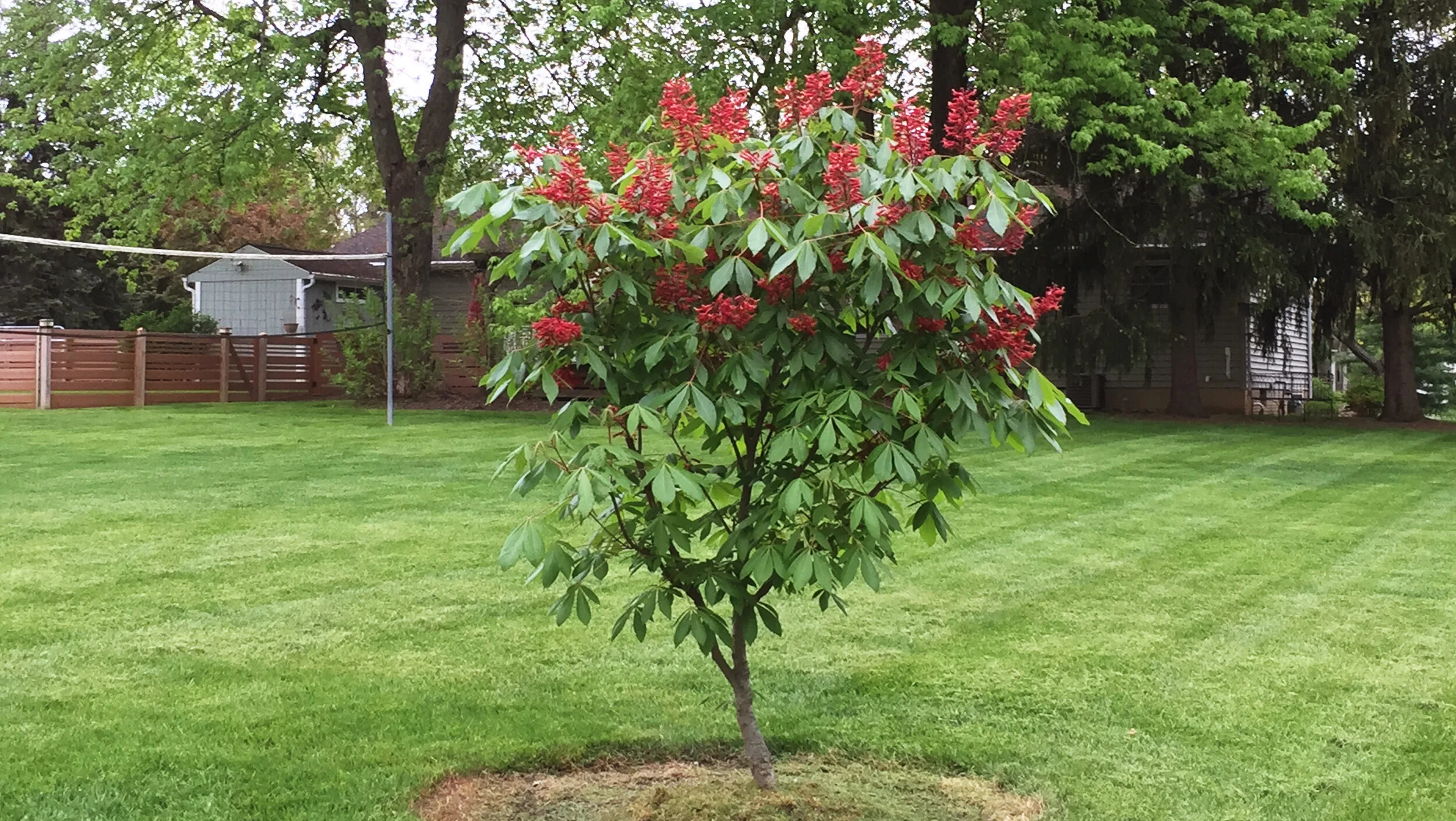
Red Buckeye (Aesculus pavia)
© Russell Tree Experts
A couple of other small ornamentals that can handle wet areas would be the Sweetbay Magnolia (Magnolia virginiana) and the Pawpaw (Asimina triloba). The Sweetbay which blooms later in the spring than other varieties, is not quite as showy, but makes up for it with their scent. The Pawpaw is known for the fruit that it produces. See a previous article written by Jose Fernandez to learn more about the Pawpaw.
A couple of trees that you can find growing naturally along our river banks and streams would be the River birch (Betula nigra) and the American Sycamore (Platanus occidentalis). Both are loved for the year round appeal of their bark. The Sycamore can become quite large and should be properly sited. We often find River birch planted in the wrong location as well. Their root systems can become quite aggressive in search of water.
If you have a pond or small stream and plenty of room there is always the Weeping willow (Salix babylonica). People have always loved its graceful habit, but like other trees on this list it must be properly sited. Another favorite seems to be the Red Maple (Acer rubrum) but as we learned from TJ Nagel in a previous article, you need to be careful where you plant Red Maple due to incompatible soils in much of central Ohio. They do have amazing fall color though and tolerate wet conditions if properly sited.
A couple of native trees that also produce amazing fall color are the Black gum (Nyssa sylvatica) and the Sweet gum (Liquidambar styraciflua).
And last there are a couple of trees in the oak family as well that tolerate wet conditions. There is the Willow Oak (Quercus phellos) and the Swamp White Oak (Quercus bicolor) which are both beautiful and long lived trees if planted in the right location.
Although many of these trees can be considered nuisance trees if not properly sited, they all can be beautiful if planted where they are meant to be.
If you have lost trees recently due to fungal issues or site conditions in the last few years, please take the time to speak with an arborist about the right tree for the right location.
Sincerely,

Mike McKee | Regional Manager, Russell Tree Experts
Mike graduated from Hocking College in 1983 with a degree in Natural Resources specializing in urban tree care. He has been a certified arborist since 1991. Mike started his career in the private industry in 1985 before becoming a municipal arborist in1989. He retired after serving thirty years before joining us at Russell Tree Experts in Sept. of 2018. His love of trees has never waned since trying to climb up the ridges of the massive Cottonwood tree in front of his childhood home.
Test Before Treatment: Soil & Tissue Testing
I find it interesting that test procedures recommended in the medical field for human health have become part of the expected methodology, but not so much in arboriculture, for tree health. As arborists, we are trained that a soil test should be done prior to recommending fertilization, for example, but I don’t know of many outfits that make soil sampling a part of their modus operandi.

©Russell Tree Experts
Test Before Treatment
I find it interesting that test procedures recommended in the medical field for human health have become part of the expected methodology, but not so much in arboriculture, for tree health. As arborists, we are trained that a soil test should be done prior to recommending fertilization, for example, but I don’t know of many outfits that make soil sampling a part of their modus operandi. On the other side of the equation, many clients will choose not to do a soil or tissue sample when presented with the option, perhaps because of budgetary reasons. I think it is time this started to change, because knowledge of a problem is the first step toward the solution. Given an unhealthy tree, I might suspect what the problem is, but unless it is one that is readily identifiable in the field, I would rather start with the sampling than attempt a treatment.
Click here to see the 9-step soil testing process!
Fertilization is one instance where a soil sample, at minimum, should be taken. For fertilization, a tissue sample would also be good, for reasons I will get into shortly. Another instance when plant samples are usually taken is when a problem is not readily identifiable in the field, and the problem is not so developed that treatment is still a viable option. A third instance where sampling is necessary is to rule out the possibility of a disease which could spread to neighboring healthy trees. In this case even dead plants may be sampled to detect the presence of one of these pathogens if possible, and to know how to dispose of the dead plants properly.
Fertilization
In general, “tame” trees and shrubs in finished landscapes benefit from fertilization because they are growing in conditions that do not resemble where they would be growing if they were “wild”. I may not need to sample the soil in an urban landscape to know that usually the addition of organic matter is going to benefit the trees, along with the nitrogen that composted organic matter provides for growth. Also, I know that most of the soil we find in the Columbus area is a limestone based, heavy clay soil. This particular bit of knowledge has led to some confusion in particular tree treatments I am about to discuss. (If you have Pin Oak, River Birch, Maple, Sweetgum, or Sweetbay Magnolia on your property, read this section if nothing else!!) Arborists have traditionally been taught that chlorosis (yellowing foliage) in these trees is due to either a deficiency of iron or manganese in our heavy clay soils. If the tree is a Pin, Red, Shingle, or Sawtooth Oak, you treat it with iron. If the tree is a Maple or a Sweetgum, treat it with manganese. At this point in my life I don’t recall what the recommendation was for the other trees. Why not?
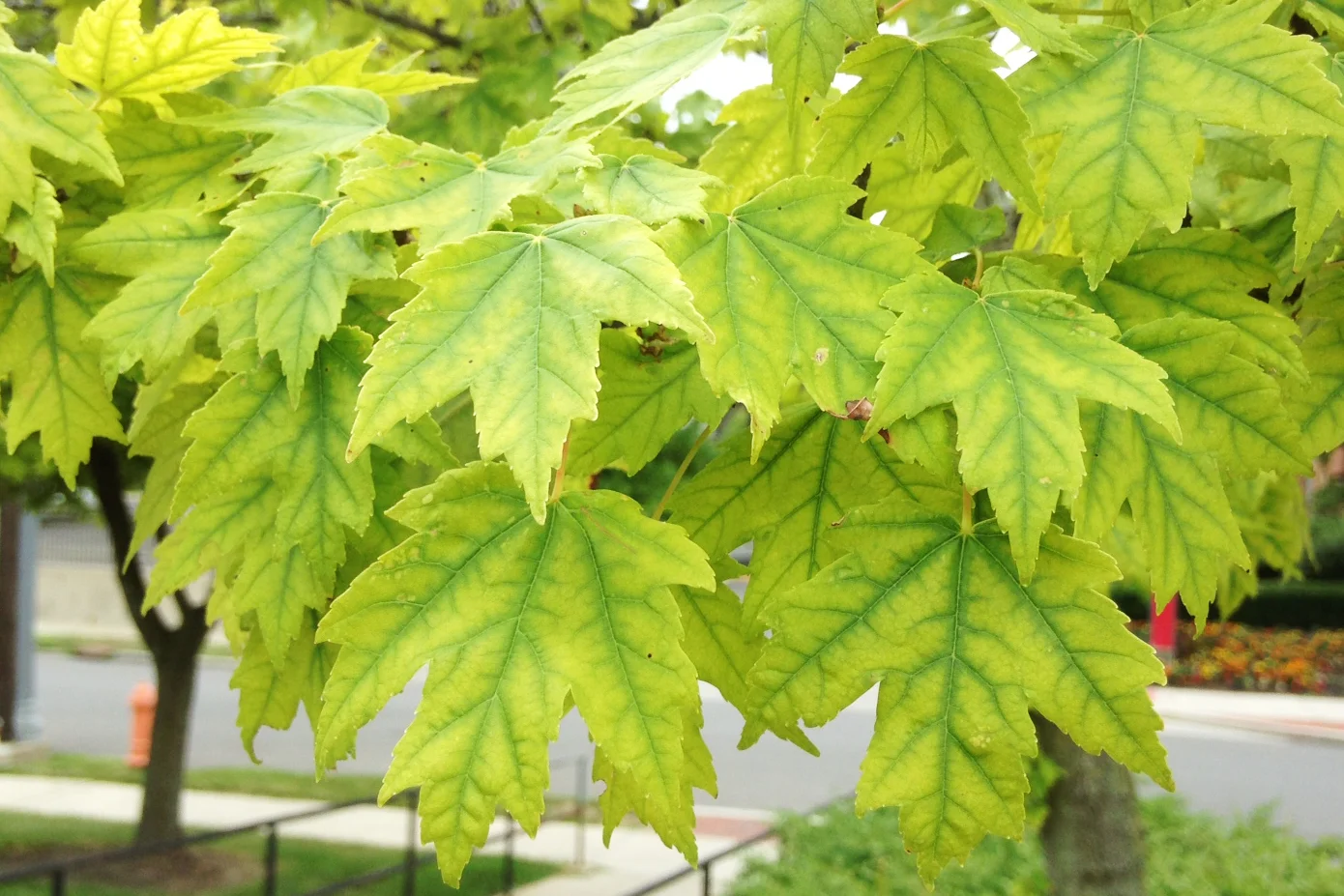
Chlorosis in a Red Maple
©Russell Tree Experts

Chlorosis in a River Birch
©Russell Tree Experts
After years of treating trees this way with very mixed results, I had the good fortune of meeting Dr. Darrah at CLC LABS. His findings over the years for our Columbus soils, related to chlorosis in these trees, have been that the problem is nearly always a manganese deficiency. To make matters even worse, giving iron to a tree that has a manganese deficiency appears to make the manganese deficiency even more pronounced. To this day I continue to be filled with satisfaction when I drive past a tree that was not responding to year after year of iron treatments, in the soil and with trunk injections and implants, to no avail, by someone else. Then, after sending soil and tissue samples to the lab, we found a surplus of iron and a dearth of manganese. The remedy? Treat aggressively with manganese. Sometimes the result is immediate, most times we see a turnaround after 2-3 seasons of treating appropriately. But what a satisfying feeling to know that we have figured out what the problem was, and now the symptoms are being reversed! To be clear, the satisfaction does not come from knowing we were right and someone else was wrong! It comes from seeing a tree that was in decline start to come back to life.
Click here to see Dr. Darrah at CLC LABS perform soil testing!
When I encounter chlorotic foliage in trees now, my top suspect for nutrient deficiency is manganese. If a tree is only beginning to show symptoms, I may recommend manganese to see if it turns around. If it does not turn around, we can sample to see what the issue is. Why take this backward approach? Maybe because I have a subconscious fear that a client may feel that I am just trying to sell additional services that are not needed. Especially if the other two arborists (from other companies) she spoke to “never recommended sampling”. And in her mind she may be thinking “Why does this arborist need to take samples? Can’t he tell what the problem is? And anyway, the other arborists said the issue was iron, not manganese.” So, since I know there is a very high chance the problem is manganese, that’s what I will recommend.
BUT, there have been a very small number of samples that came back showing some other micronutrient deficiency (or surplus), that was critical for knowing what the best treatment approach was. And this is why sampling should always take place first. I pledge to offer that as the first step in a treatment plan to each client with a sickly tree. At least then I will have done my due diligence.
As a final note for fertilization, if the time of year is right, a tissue sample is great for getting a more complete picture of what is happening in the tree. By comparing soil to tissue, we can see what is available to the tree and what is actually inside the tree. This helps with diagnosing the cause for symptoms.
Sampling for disease diagnosis, live or dying trees
There are many diseases arborists can positively identify in the field if properly trained, and they should be able and willing to show the client what they are seeing, and why it needs to be treated (or not). I still find insects that pop up sporadically that I have never seen before. Usually I can pull out the reference books back at the office and find the pest or pathogen, but if I fail at that, it is time to take a sample to the clinic. Even if an arborist had exhaustive knowledge for field identification of diseases (which is a tall order), there are certain diseases that require a specialized lab for a positive identification. In the case of live trees, one may decide that sampling is not needed due to how advanced the symptoms are. If the tree is not salvageable, perhaps sampling is not the best use of funds. But if the symptoms are those that could be of an infectious nature, threatening other live trees, sampling is paramount, and should be done promptly. Let’s look at Oak Wilt, for example.
Several years ago, Russell Tree Experts submitted the first positively identifiable sample of this disease taken from a tree in Franklin County. The year prior, a consulting arborist had turned in a positive sample from a tree in Delaware County. Oak Wilt is a disease that was known in the northeastern counties, and we were sad to see it moving into our neighborhood. However, had we not taken the samples, we would not have known the steps to take to properly dispose of the dead trees, inoculate the surrounding live trees at high risk of infection, and try to get the word out to the local arborist community. That was several years ago. Since then, more and more arborists have had positive samples, but to my chagrin, I still run into trees that I am fairly certain died of Oak Wilt but were removed willy nilly by “arborists” who maybe never even thought why the Red Oak went from live to dead in a matter of days. It takes time for word to get around, and it takes tree owners who are concerned about their trees.
I am happy to say there are several reputable, trustworthy tree care companies in the Columbus area whom I am proud to count as colleagues (and I hope they feel the same way about us!). This provides discerning clientele with plenty of good options to choose from. I am also very happy that more and more people are realizing how important the care of trees and plants is – not just for the love of their own back yard, but for the good of their neighbors. How do I know you are out there? Because you take the time to read these thoughts that flow out of my fingers into the keyboard. As I write this, early evening is coming on. I am looking out my window across a field divided by a small stream. Green grass in the foreground flows to the border of the stream, outlined in buckthorn turning yellowish green, brilliant yellow Maple on the left, defoliated Cottonwoods against the sky. Anchoring the scene on the right is a large Pin Oak turning an orange bronze. When the sun shines it lights up like fire. Across the stream a recently harvested soybean field, the color of straw. In the background, all across the window frame, stretches a native woods made up of what appears to be mostly Oak and Hickory: rusty, ruddy, yellow, gold. Above the green grass, tan straw, and tree line made of fire a sheet of sky in light gray is spread, with a hint of pink peeking through here and there.
Stop for a moment. Look around. Let peace find you, and give thanks for it. The more we notice it, the less we can take it for granted.
Your friendly neighborhood arborist,
José Fernández

José Fernández | Regional Manager, Russell Tree Experts
José became an ISA Certified Arborist® in 2004, and a Board-Certified Master Arborist® in 2015. Currently he is enrolled at The Ohio State University pursuing a Master’s Degree in Plant Health Management. José likes working around trees because he is still filled with wonder every time he walks in the woods.
Magnolia Scale: Take a Look!
“Take a look”, I said to my concerned client, as we stood in the shade of her Magnolia tree. I had just handed her my hand lens, and I showed her how to get it close to her eye as she peered through it. I wanted her to see what was in my hand – a dead adult Magnolia scale insect.

"Take a Look!"
“Take a look”, I said to my concerned client, as we stood in the shade of her Magnolia tree. I had just handed her my hand lens, and I showed her how to get it close to her eye as she peered through it. I wanted her to see what was in my hand – a dead adult Magnolia scale insect. Recently dead, which meant that the crawlers should already have emerged.
When I first looked at this tree, I expected to find crawlers on the stems but was surprised that there weren’t any. "This time of year - they should already be out", I said to myself as I let my client examine what I had just picked off her tree. My thoughts were interrupted by a low cry of consternation: “José, they’re crawling all over your hand! You have to wash your hands right away!”

Ugh. She was right. They were way too small to feel, but I could certainly see small black specs on my fingers, and they were covering ground pretty quickly. As we moved toward the garden hose, I was thinking: Those eggs had to have hatched out days or weeks ago, but they are only now emerging from under the adult? Why have they waited this long? Scale insects are the worst and they often throw us these curve balls…
Magnolia Scale: A Summary
Most people don’t realize they are even looking at an insect when they see a scale on a plant. It is an insect that forms a sort of shell, some hard, some soft, over itself. Immobile, it sucks the sap out of a plant, lays eggs, and dies, mostly unnoticed. That is until their numbers grow so large that the plant may decline or parts of the plant may die, sooty mold grows on the honeydew excreted by the scale insect, and flies start buzzing around the honeydew as well. Then folks start wondering what in the world is going on with this plant?
Magnolia scale is very host specific, meaning that it affects Magnolia species almost exclusively. It is the largest scale insect in our area, sometimes as large as a dime. The adult in its prime is very white, and soft when pressed. It can be very messy if squished. Be warned. Mechanical pressure is one way to kill this pest, but that pressure usually requires hands and fingers. Not an effort for the faint of heart.
There is one generation per year, which usually indicates the pest can be controlled more easily. As with all scale insects, experience proves control to be a process of perseverance over time. The most vulnerable stage is the newly hatched nymph stage, the mobile stage we call a “crawler”. At this point, the insect has still not formed its waxy covering and will be killed if contacted with the appropriate insecticide.

Nymphs emerging from a recently plucked adult Magnolia Scale
As I write this, eggs have hatched, nymphs have emerged, and some are still emerging. Ken has captured some great footage of this very process, something I have never seen recorded before. Thanks for sharing Ken!
(Technical notes gathered from experience, general knowledge, and from Insects that Feed on Trees and Shrubs, second edition, Johnson and Lyon.)
Your friendly neighborhood arborist,
José Fernández
ISA BCMA® OH-5129B
614-586-5777
Verticillium Wilt
It’s hard to miss this disease once we enter the hot dry months of summer. Without fail, each July/August I start to see trees turning brown and wilting suddenly, usually in patches within the canopy that can be traced back to entire individual limbs that have died. More dramatically, an entire tree…

It’s hard to miss this disease once we enter the hot dry months of summer. Without fail, each July/August I start to see trees turning brown and wilting suddenly, usually in patches within the canopy that can be traced back to entire individual limbs that have died. More dramatically, an entire tree will just turn brown and wilt. The pattern of wilting is very regular, and the symptoms can carry over into winter because the wilted leaves sometimes stay on the tree well after normal leaf drop in the fall.
Verticillium Wilt (VW) is easily recognizable once you know what to look for, but not easily treated. To make matters worse, it affects a large number of trees and plants, with varying expression of symptoms from tree to tree. During my years as an arborist, I have found Norway Maple, Japanese Maple, Yellowwood, Smoke tree, Redbud and Magnolia to be very common hosts of this disease. And this is a short, short list of the plants that can be affected.
Dead Sugar Maple, suspect VW due to suddenness of wilting
The disease is caused by a fungus present within the soil, and there are so many ways it can get into the soil that my approach is usually “if there is soil present, there is probably VW present”. What do we do? It sounds like a copout, but the best answer for dealing with this issue is the best answer for dealing with most plant pests and diseases: Choose the right plant for the site conditions. This is the best way to cultivate healthy plants that can naturally cope with the more problematic neighbors within an ecosystem. But this doesn’t really help the tree that has already been planted and is making do with what it has.
If the tree has already been planted, the next best option is to do everything possible to manipulate conditions at the planting site to minimize stress factors to the tree. Ensuring proper moisture, adding organic mulch matter, amending soil both chemically (fertilization if needed) and physically (soil aeration/relief of compaction) are all good measures that can be taken. There are systemic fungicides that can be applied to suppress the development of the disease within the vascular system of the plant as well, but these applications should be secondary to the site work.
Dead vascular tissue in Sweetbay Magnolia characteristic of VW
The fungus can enter the tree by wounds in roots but can enter roots even when no wounds are present. Once in the tree, the disease tends to progress upward and outward, causing foliar wilting and dieback to varying extent. I have seen trees coexist with the disease for years and years, seemingly keeping up with the disease, losing a branch here and there, but generally coping with it. On the other hand, I have seen trees decline quickly. I recall one Sugar Maple which barely had any symptoms until it wilted from head to toe and died over the weekend.
In closing, I feel that VW is an example of how trees really die. There are questions that need to be asked, such as “Was it just a super-virulent strain that entered the tree?” or “Was it a weaker strain, but the tree was just weakened by multiple other factors?”. Sure, there may be cases where everything is perfect for the tree, but the disease was like The Terminator - unstoppable. In my experience though, most trees die because something else has made them vulnerable and weak enough that a relatively low-grade disease is what finishes them off. In that case, treating the disease is a last-ditch effort that can only really work if the treatment keeps the tree alive long enough to benefit from the effects of cultural changes that should be implemented if possible.
I think there is a life lesson that can be applied here, but I will let the reader sort that out. Have fun out there! For every wilted leaf, there are 100 other green ones.
Your friendly neighborhood arborist,
José Fernández
ISA BCMA® OH-5129B