
The Oak Wilt Defense
The fall season is approaching, and cooler weather is hopefully just right around the corner. With changing temperatures, all our trees are going to be going through a change as well. As we enter the dormant season, we will be gifted with…

By Lindsey Rice
ISA Certified Arborist® OH-6739A
November 6, 2025
Fall and cooler weather is here! With changing temperatures, all our trees are going to be going through a change as well. As we enter the dormant season, we will be gifted with vibrant leaf colors on all our deciduous trees. The dormant season doesn’t just refer to leaf senescence and the weather getting colder; disease-carrying insects also enter the stage in their lifecycle where they do not pose as big of a threat to our landscape. In recent studies it has been found that from October 15th to March 31st, the Nitidulid beetles that spread Oak Wilt disease will not be actively feeding in the Midwest, thus reducing the risk of infection with the fungal disease. Nitidulid beetles are insects that feed on the sap of trees. When a beetle feeds on the sap of an infected tree, it can move to a new susceptible oak tree and spread the disease. These beetles are most attracted to fresh open wounds, such as a new pruning cut.
All oak species are susceptible to the disease, but oak wilt is most damaging to the red oak group. The fungal infection causes xylem vessels to clog, leading the host of the disease to wilt and then die as quickly as within one growing season. Thus far, we have been unable to treat any infected oak tree with any success. We have treated some healthy trees in the area with a preventative fungal application, especially those close to a confirmed case of the disease.
Unfortunately, these beetles are not the only way that this disease is spread. It is also spread via root grafts of neighboring infected trees. Root grafts can connect oak trees underground and transmit the disease from more than 50 feet away. When there is a known infected tree in the vicinity of other oak trees, root disruption may be recommended, even after the infected tree and stump have been removed.
What can you do if you have Oak trees on your property? Be sure to have them pruned during the appropriate time of year between October 15th and March 31st. If you must prune an Oak tree outside of this window, ensure the wounds are sealed with latex paint to limit the beetles' ability to transmit the disease. If you suspect any of your trees have this disease, please call us, and we can advise you on the next step to confirm a diagnosis. Note that this is the same pruning window for Elm trees as well, so we may help limit the spread of Dutch Elm Disease.

Recently, we had ISA Board Certified Master Arborist® José Fernández, an oak wilt expert and a former RTE employee, visit our office and give a presentation on oak wilt disease to our arborists. Check it out down below!
Enjoy the colorful autumn season! For a free tree work quote by one of our 25+ ISA Certified Arborists®, visit RussellTreeExperts.com/Quote or call our friendly, local office staff at (614) 895-7000!
Please note: This article was updated on 11/6/2025, but originally published on 9/28/2023.
ADDITIONAL ARBOR ED ARTICLES!


Lindsey Rice | Operations Manager, Russell Tree Experts
Lindsey joined Russell Tree Experts in 2015 with a B.S. in Agribusiness and a minor in Horticulture from The Ohio State University. Growing up in northwest Ohio, she participated in various sports, band, and FFA which ultimately inspired her love for the tree industry. In her free time she loves to spend it outdoors with her husband and daughters.
———
Additional Resources & Sources for this Article:
“New Disease Control Measures for Oak & Elm Trees” Article (2021)
“Oak Wilt in Franklin County” Article (2017)
Lecanium Scale (Part One)
If “Lecanium” is a new word for you, consider yourself lucky, or at worst, blissfully ignorant. If you have experienced species of this genus in your landscape you may know how devastating, unsightly, and generally… uncomfortable this insect can be. If you have ever stood under a tree covered in a scale population which is actively feeding and digesting you will know why the word “uncomfortable” came to mind. In this installment I will briefly describe Lecanium scale and its life cycle. In the next installment, I will share an unusual finding from last season, and stand out on a limb to make a forecast for this season.

A Brief Description of a Common Pest:
If “Lecanium” is a new word for you, consider yourself lucky, or at worst, blissfully ignorant. If you have experienced species of this genus in your landscape you may know how devastating, unsightly, and generally… uncomfortable this insect can be. If you have ever stood under a tree covered in a scale population which is actively feeding and digesting you will know why the word “uncomfortable” came to mind. In this installment I will briefly describe Lecanium scale and its life cycle. In the next installment, I will share an unusual finding from last season, and stand out on a limb to make a forecast for this season.
Lecanium is a genus in the family Coccidae. Within this genus there are many different species of scale insects, but fortunately they are very similar in their appearance, feeding habits, and life cycle. This helps arborists identify the insect when populations reach a threatening level on a plant. Because the life cycle is similar from one species to another (with very few exceptions), treatment intervention is relatively straightforward. For the purpose of this article, and for discussion among arborists, we lump these scale species into a generic type we call lecanium scale.

Lecanium scale starts life as an egg. In central Ohio egg hatch usually takes place in June, when Washington hawthorn is blooming. (This event is a phenological indicator for lecanium scale hatch. For more on that topic, read my article here). The first nymphal form (called an instar) is the most mobile state within the lifecycle of the insect. Because of this we call this form a crawler. Crawlers will move out onto the leaf of a plant or tree and affix themselves adjacent to the veins of the leaf where they will feed through the summer. Sometime in late summer these crawlers turn into the second-instar form, and they move back onto the twigs to overwinter. Here one must pause for a moment of silence and ponder the question: How do these nymphs know that their host’s leaves are going to fall off for the winter? Do they really “know” at all? Why do they do what they do?
Moving on, we find these second-instar nymphs waking up with the rest of the plant and insect world the following spring. They begin to feed on the twigs now, and are no longer mobile. A waxy covering begins to form over their bodies as they grow. Most of the lecanium scales will have a domed appearance, some flatter than others, some with different colors, but easily recognizable as lecanium scales once you know what to look for. When the adult female matures, she lays her clutch of eggs underneath her “shell” and dies soon after. The eggs hatch soon and the cycle continues.
Now some comments to finish up the picture:
Many plant hosts are targeted by this insect, including oak, hickory, honeylocust, crabapple, cherry, pear.
There is only one generation per year, which greatly simplifies the treatment process.
The crawler stage is the most vulnerable to treatment and is the one we try to target for control.
The most damaging stage is the second-instar nymph which feeds voraciously on plant sap in order to grow into an adult and lay eggs.
During this stage, digested sap is excreted as honeydew, a sweet substance that coats leaves, sidewalks, cars, and yes, people if you stand under the tree for too long. This honeydew is fed upon by sooty mold, turning the surfaces black.
Large populations can weaken a plant, causing dieback, stress, and even plant death due to the amount of sap extracted during feeding. Sooty mold interferes with photosynthesis, further stressing plants.
How new scale populations arrive onto formerly uninfested trees seems to be a bit of a mystery.
Lecanium scales are grouped with sucking insects (as opposed to chewing insects). They insert a proboscis into plant tissue to feed on sugars and other nutrients in the sap.
So much for the entomology lesson. Congratulations to you stalwart readers who have made it this far! You now have a good base of knowledge that will help you understand how I came to certain conclusions about the 2020 population of this pest, and what this might mean for 2021. I hope you can meet me here once more next week for the final installment!
>> (2/15/21 Update: Read Part 2!) <<
Your friendly neighborhood arborist,

José Fernández | Regional Manager, Russell Tree Experts
José became an ISA Certified Arborist® in 2004, and a Board-Certified Master Arborist® in 2015. Currently he is enrolled at The Ohio State University pursuing a Master’s Degree in Plant Health Management. José likes working around trees because he is still filled with wonder every time he walks in the woods. José has worked at Russell Tree Experts since 2012.
[Some technical notes retrieved, and some fact-checking facilitated by W. T. Johnson and H. H. Lyon, Insects That Feed On Trees and Shrubs, Second Edition, Cornell University, 1991.]
Putting the Year to Sleep
Today the light begins to increase again; days begin to lengthen. For the last 6 months or so each day has lost a minute or two of daylight, growing shorter as this part of the world approached the darkest day of the year. Earlier this week I was reading the musings of Henry David Thoreau once again, and came across a passage about the wonders of a milkweed seed, how each seed is carefully packed within its “light chest” attached to silk streamers, to be released when the time is right. Thoreau ends the thought with a quiet reflection on the faith of a milkweed plant which “matures its seeds” despite the prophecies of some men that the world would end.
[Written on December 22, 2020 @ 7:29 am]
Today the light begins to increase again; days begin to lengthen. For the last 6 months or so each day has lost a minute or two of daylight, growing shorter as this part of the world approached the darkest day of the year. Earlier this week I was reading the musings of Henry David Thoreau once again, and came across a passage about the wonders of a milkweed seed, how each seed is carefully packed within its “light chest” attached to silk streamers, to be released when the time is right. Thoreau ends the thought with a quiet reflection on the faith of a milkweed plant which “matures its seeds” despite the prophecies of some men that the world would end.
I remember as a child when I would help my father clear a new patch of ground to expand the garden. I was always amazed when, a few weeks later, the soil we had stripped of grass and cultivated began to grow all kinds of weeds that had not been there before. Plants that looked different to me from those we had cleared out to make the garden. “The seeds are all there, waiting to grow at the right time,” my father would tell me. Even then the idea of a seed just waiting there to grow, and then eventually deciding in some way that it was time to sprout, to cast off the protective husk and send out a tiny tendril of life, to risk it all in the hope of becoming something totally new, a plant with leaves that could harvest life from the sun – even as a child I remember thinking there was something mysterious about that. And now as an arborist every now and then I will look at an oak tree standing over 100 feet tall, overshadowing several houses in downtown Columbus, its bulk shouldering up between street and sidewalk, offering food and shelter for possibly hundreds of other plant and animal species. All the while the tree is using sunlight as energy to split a water molecule to use the energy stored in those chemical bonds to gather carbon dioxide from the atmosphere in order to make carbohydrate for food and structure. Every now and then I will stop my feet from crunching the acorns under such a tree and think “this tree came from an acorn just like one of these under my feet.” I pick up the acorn and look at it, itself an amazing little package, perfectly formed with characteristics unique to its species. If it is in the white oak family it might already have a tiny white root peeking out of one end if it is late fall. But I hold the acorn in my hand where I can see it against its parent, step back, look from one to another. The tree came from one of these. At some point an acorn was produced, carried to one spot or another by a squirrel, a blue jay, a person. Perhaps the acorn was planted, perhaps it was forgotten. But it bided its time, listening, feeling, sensing somehow. Am I anthropomorphizing? Perhaps. But sensing is sensing no matter how you look at it, and sensing is inextricably linked to purpose.
In time something within the acorn trembles – whatever it is waiting for seems to be happening. Moisture, temperature, sunlight. All coalesce and movement begins somewhere in the heart of the acorn. Energy stored within the seed is being consumed, and suddenly a root tip emerges. A purpose is being fulfilled. A stem peers out, pale and spindly, stretching upward with a mixture of hesitancy and confidence – faith.
Special proteins within the seedling called photoreceptors begin to absorb light, responding to very specific light frequencies that cause these proteins to stimulate change: “Produce chlorophyll”; “Expand leaves”; “You’ve emerged from the soil, straighten out your head”; “Stop extending so much, make some branches”; “Make some other pigments so you don’t burn up in the sun”. And so a tree begins.
Question: What is the difference between a seed and a tree? Once the tree begins, what becomes of the seed? Many of us shy away from words like faith because we link them to “religion,” perhaps fearing that such words lead us away from “science” or “real life.” But if we dared we would see that every day, each of us makes decisions based on nothing more than faith. We park our car in the lot and walk into a store, never wondering if our car will be waiting for us or not when we return. We believe so strongly that it will be there that we would be extremely surprised and upset if it were not.
Many of us go to work knowing that come Friday, we will be paid. We stop at the store on the way home and get some milk, fully expecting to wake up tomorrow hungry for breakfast. We expect to wake up so strongly that we would be surprised if we did not.
We walk into a dark room and feel on the wall for something that we know if we just move it one way or another, light will fill the room.
Perhaps because my work takes me outside more than inside I tend to follow the passing of days more by length of light than by the numbers on a calendar. So when winter solstice arrives here in the Midwestern United States I feel movement somewhere inside my chest. A trembling, of sorts, perhaps similar to a seed that is beginning to stir. Something, in this case, history, tells me more light is coming, and I have no reason not to believe it. In fact, I would be surprised if by the end of December the sunlight was not sticking around for several minutes longer per day than it was yesterday. Longest night is beginning to move once more to longest day. And here is a gift: where there is faith, there is hope.
Most of what I have heard and read in the latter part of 2020 is how difficult this year has been for people all over our world. No need to revisit why. Rather than making resolutions for a new year, I am instead going to plant this past year into the fading darkness like a seed into dark soil. And I have faith that, like a seed, it will become something new, something I had never expected it to be, something that will then bear fruit of its own to be planted yet again.
Somewhere I heard about a farmer who plants seeds in a field and then simply goes to sleep. Why? Because he lives by faith. He knows the seed will sprout and turn into plants that will bear a harvest for food.
I like this story. Who doesn’t like to take naps? But even a good nap is not possible without faith.
I wish you all the best in this coming year.
Your friendly neighborhood arborist,

José Fernández | Regional Manager, Russell Tree Experts
José became an ISA Certified Arborist® in 2004, and a Board-Certified Master Arborist® in 2015. Currently he is enrolled at The Ohio State University pursuing a Master’s Degree in Plant Health Management. José likes working around trees because he is still filled with wonder every time he walks in the woods. José has worked at Russell Tree Experts since 2012.
Test Before Treatment: Soil & Tissue Testing
I find it interesting that test procedures recommended in the medical field for human health have become part of the expected methodology, but not so much in arboriculture, for tree health. As arborists, we are trained that a soil test should be done prior to recommending fertilization, for example, but I don’t know of many outfits that make soil sampling a part of their modus operandi.

©Russell Tree Experts
Test Before Treatment
I find it interesting that test procedures recommended in the medical field for human health have become part of the expected methodology, but not so much in arboriculture, for tree health. As arborists, we are trained that a soil test should be done prior to recommending fertilization, for example, but I don’t know of many outfits that make soil sampling a part of their modus operandi. On the other side of the equation, many clients will choose not to do a soil or tissue sample when presented with the option, perhaps because of budgetary reasons. I think it is time this started to change, because knowledge of a problem is the first step toward the solution. Given an unhealthy tree, I might suspect what the problem is, but unless it is one that is readily identifiable in the field, I would rather start with the sampling than attempt a treatment.
Click here to see the 9-step soil testing process!
Fertilization is one instance where a soil sample, at minimum, should be taken. For fertilization, a tissue sample would also be good, for reasons I will get into shortly. Another instance when plant samples are usually taken is when a problem is not readily identifiable in the field, and the problem is not so developed that treatment is still a viable option. A third instance where sampling is necessary is to rule out the possibility of a disease which could spread to neighboring healthy trees. In this case even dead plants may be sampled to detect the presence of one of these pathogens if possible, and to know how to dispose of the dead plants properly.
Fertilization
In general, “tame” trees and shrubs in finished landscapes benefit from fertilization because they are growing in conditions that do not resemble where they would be growing if they were “wild”. I may not need to sample the soil in an urban landscape to know that usually the addition of organic matter is going to benefit the trees, along with the nitrogen that composted organic matter provides for growth. Also, I know that most of the soil we find in the Columbus area is a limestone based, heavy clay soil. This particular bit of knowledge has led to some confusion in particular tree treatments I am about to discuss. (If you have Pin Oak, River Birch, Maple, Sweetgum, or Sweetbay Magnolia on your property, read this section if nothing else!!) Arborists have traditionally been taught that chlorosis (yellowing foliage) in these trees is due to either a deficiency of iron or manganese in our heavy clay soils. If the tree is a Pin, Red, Shingle, or Sawtooth Oak, you treat it with iron. If the tree is a Maple or a Sweetgum, treat it with manganese. At this point in my life I don’t recall what the recommendation was for the other trees. Why not?
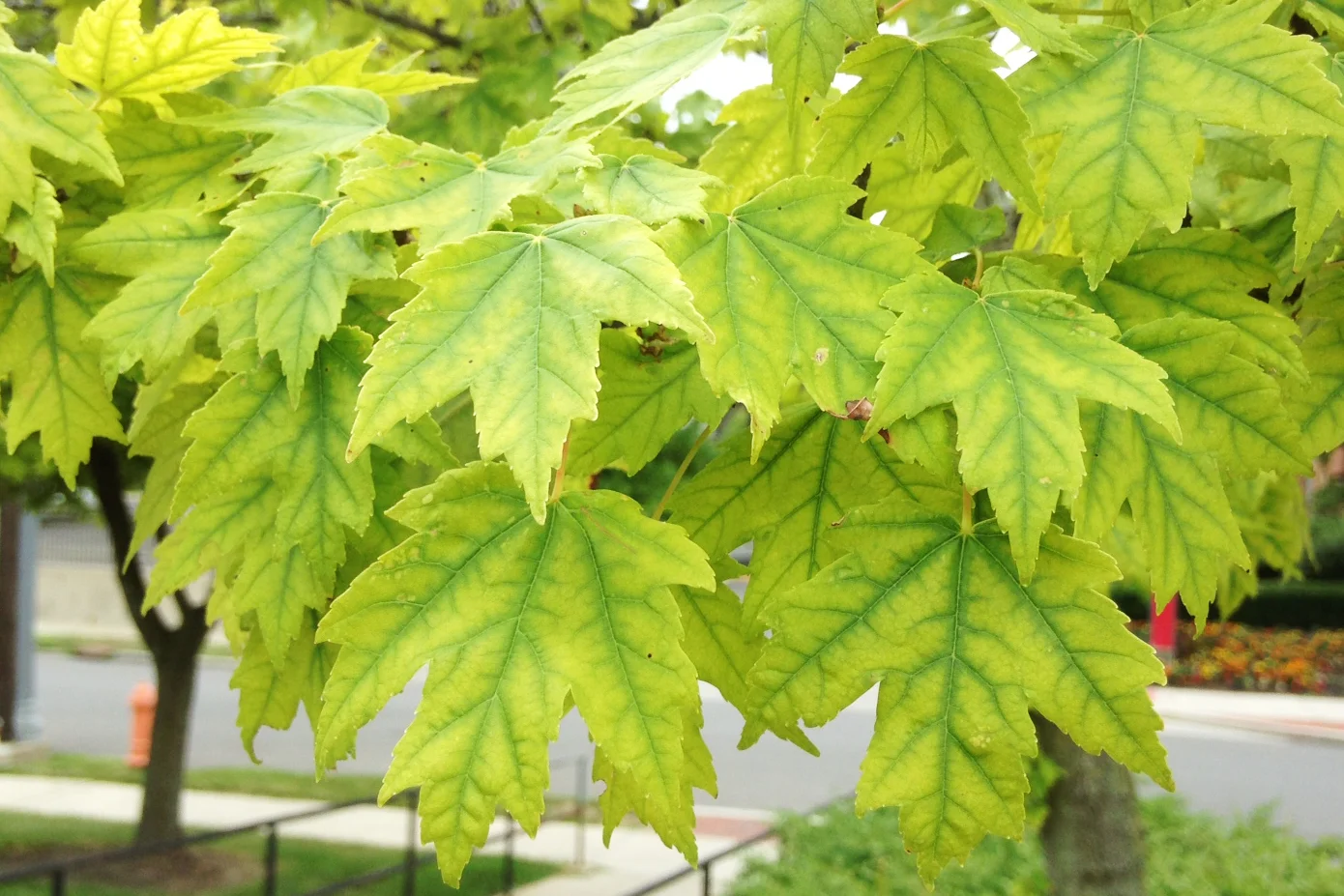
Chlorosis in a Red Maple
©Russell Tree Experts

Chlorosis in a River Birch
©Russell Tree Experts
After years of treating trees this way with very mixed results, I had the good fortune of meeting Dr. Darrah at CLC LABS. His findings over the years for our Columbus soils, related to chlorosis in these trees, have been that the problem is nearly always a manganese deficiency. To make matters even worse, giving iron to a tree that has a manganese deficiency appears to make the manganese deficiency even more pronounced. To this day I continue to be filled with satisfaction when I drive past a tree that was not responding to year after year of iron treatments, in the soil and with trunk injections and implants, to no avail, by someone else. Then, after sending soil and tissue samples to the lab, we found a surplus of iron and a dearth of manganese. The remedy? Treat aggressively with manganese. Sometimes the result is immediate, most times we see a turnaround after 2-3 seasons of treating appropriately. But what a satisfying feeling to know that we have figured out what the problem was, and now the symptoms are being reversed! To be clear, the satisfaction does not come from knowing we were right and someone else was wrong! It comes from seeing a tree that was in decline start to come back to life.
Click here to see Dr. Darrah at CLC LABS perform soil testing!
When I encounter chlorotic foliage in trees now, my top suspect for nutrient deficiency is manganese. If a tree is only beginning to show symptoms, I may recommend manganese to see if it turns around. If it does not turn around, we can sample to see what the issue is. Why take this backward approach? Maybe because I have a subconscious fear that a client may feel that I am just trying to sell additional services that are not needed. Especially if the other two arborists (from other companies) she spoke to “never recommended sampling”. And in her mind she may be thinking “Why does this arborist need to take samples? Can’t he tell what the problem is? And anyway, the other arborists said the issue was iron, not manganese.” So, since I know there is a very high chance the problem is manganese, that’s what I will recommend.
BUT, there have been a very small number of samples that came back showing some other micronutrient deficiency (or surplus), that was critical for knowing what the best treatment approach was. And this is why sampling should always take place first. I pledge to offer that as the first step in a treatment plan to each client with a sickly tree. At least then I will have done my due diligence.
As a final note for fertilization, if the time of year is right, a tissue sample is great for getting a more complete picture of what is happening in the tree. By comparing soil to tissue, we can see what is available to the tree and what is actually inside the tree. This helps with diagnosing the cause for symptoms.
Sampling for disease diagnosis, live or dying trees
There are many diseases arborists can positively identify in the field if properly trained, and they should be able and willing to show the client what they are seeing, and why it needs to be treated (or not). I still find insects that pop up sporadically that I have never seen before. Usually I can pull out the reference books back at the office and find the pest or pathogen, but if I fail at that, it is time to take a sample to the clinic. Even if an arborist had exhaustive knowledge for field identification of diseases (which is a tall order), there are certain diseases that require a specialized lab for a positive identification. In the case of live trees, one may decide that sampling is not needed due to how advanced the symptoms are. If the tree is not salvageable, perhaps sampling is not the best use of funds. But if the symptoms are those that could be of an infectious nature, threatening other live trees, sampling is paramount, and should be done promptly. Let’s look at Oak Wilt, for example.
Several years ago, Russell Tree Experts submitted the first positively identifiable sample of this disease taken from a tree in Franklin County. The year prior, a consulting arborist had turned in a positive sample from a tree in Delaware County. Oak Wilt is a disease that was known in the northeastern counties, and we were sad to see it moving into our neighborhood. However, had we not taken the samples, we would not have known the steps to take to properly dispose of the dead trees, inoculate the surrounding live trees at high risk of infection, and try to get the word out to the local arborist community. That was several years ago. Since then, more and more arborists have had positive samples, but to my chagrin, I still run into trees that I am fairly certain died of Oak Wilt but were removed willy nilly by “arborists” who maybe never even thought why the Red Oak went from live to dead in a matter of days. It takes time for word to get around, and it takes tree owners who are concerned about their trees.
I am happy to say there are several reputable, trustworthy tree care companies in the Columbus area whom I am proud to count as colleagues (and I hope they feel the same way about us!). This provides discerning clientele with plenty of good options to choose from. I am also very happy that more and more people are realizing how important the care of trees and plants is – not just for the love of their own back yard, but for the good of their neighbors. How do I know you are out there? Because you take the time to read these thoughts that flow out of my fingers into the keyboard. As I write this, early evening is coming on. I am looking out my window across a field divided by a small stream. Green grass in the foreground flows to the border of the stream, outlined in buckthorn turning yellowish green, brilliant yellow Maple on the left, defoliated Cottonwoods against the sky. Anchoring the scene on the right is a large Pin Oak turning an orange bronze. When the sun shines it lights up like fire. Across the stream a recently harvested soybean field, the color of straw. In the background, all across the window frame, stretches a native woods made up of what appears to be mostly Oak and Hickory: rusty, ruddy, yellow, gold. Above the green grass, tan straw, and tree line made of fire a sheet of sky in light gray is spread, with a hint of pink peeking through here and there.
Stop for a moment. Look around. Let peace find you, and give thanks for it. The more we notice it, the less we can take it for granted.
Your friendly neighborhood arborist,
José Fernández

José Fernández | Regional Manager, Russell Tree Experts
José became an ISA Certified Arborist® in 2004, and a Board-Certified Master Arborist® in 2015. Currently he is enrolled at The Ohio State University pursuing a Master’s Degree in Plant Health Management. José likes working around trees because he is still filled with wonder every time he walks in the woods.
The Importance of Green Leaves
I have been noticing what I consider to be an unacceptable amount of chlorosis in urban trees around Columbus. In general, chlorosis is the yellowing of plant foliage caused by a lack of chlorophyll. This is a problem because plants depend on chlorophyll to absorb energy from sunlight and to survive. Several…

Chlorosis in a River Birch causing a die-back in the canopy. ©Russell Tree Experts
I have been noticing what I consider to be an unacceptable amount of chlorosis in urban trees around Columbus. In general, chlorosis is the yellowing of plant foliage caused by a lack of chlorophyll. This is a problem because plants depend on chlorophyll to absorb energy from sunlight and to survive.
Several factors can contribute to the development of chlorosis in trees such as nutrient deficiency, drought, poorly drained and compacted soils, girdling roots, graft union incompatibility and mechanical damage to the tree trunk. For the purpose of this article, I’m going to focus on chlorosis caused by nutrient deficiency because I believe it’s the most prevalent and most often mismanaged. Although any nutrient deficiency could lead to chlorosis in trees, manganese and iron deficiency is what we see most.

Chlorosis in a Red Maple. ©Russell Tree Experts

Chlorosis in a Pin Oak. ©Russell Tree Experts
It is important to understand that the availability of nutrients from the soil can vary with soil pH. For example, even though there may be an adequate amount of manganese for a certain tree in the soil, the soil pH can cause the manganese to be inaccessible by the tree. Most urban soils in central Ohio are alkaline. (A quick review for those of you who fell asleep in biology, the soil’s pH is an indicator of soil acidity or alkalinity. On a scale of 1-14, 7.0 is neutral, below 7.0 the pH is acidic, above 7.0 the pH is alkaline. Nutrients are most available to trees when the soil pH is between 5.0 and 6.5. Because most of our urban soils have a pH of around 7, we find ourselves dealing with chlorosis.
Initially, chlorosis expresses itself in the canopy of trees by the yellowing of foliage with a network of green veins. As the chlorosis progresses, leaves become a paler yellow and develop brown necrotic lesions. Leaf margins will eventually brown completely and leaves will dry up and fall off. Over time this results in poor vigor, reduced twig extension, poor density of canopy, dieback and eventual tree death.
The easiest way to manage chlorosis is to prevent it by planting urban tolerant trees that are tolerant of high pH soils. Although most trees species have the potential to develop chlorosis, the most common trees affected by high pH soils in central Ohio are Pin oak, Red maple, River birch, Shingle Oak, Red Oak, Sweetgum, White pine, and Canadian Hemlock. If you notice yellow leaves on your trees (and it is not time for Fall color) it is important to take action for long-term preservation.

Russell Tree Experts Tree Wellness Technician Collecting a Soil Sample. ©Russell Tree Experts
The first step is to have a soil and plant tissue test performed. This is the only way to know which nutrients are lacking in your trees and soil. Any attempt at correcting chlorosis without the information from these tests is guesswork and treatment without proper diagnosis is malpractice. We can have these tests performed for you, interpret the results, and determine the best management for your tree(s).
Just another way Russell Tree Experts is keeping Ohio green!
TJ Nagel
ISA CERTFIED ARBORIST® OH-6298A